Performing the Humanities at 24 fps, Gay Hall in conversation with Stelarc

This is worth a watch:

Performing the Humanities @ 24 fps: Part 1

This is the first part of an interview conducted and filmed by the artist Stelarc for the Alternate Anatomies Lab at Curtin University, Perth, Australia. The second part of the interview is avaiulable here. Other interviews in the series are available on the website of the Alternate Anatomies Lab here.

See also Hall’s piece in Culture Machine [open access] on “Pirate Philosophy“, discussed in the video…

New paper (in English) by Bernard Stiegler on Simondon’s Psychic & Collective Individuation

The current issue of Parrhesia, as well as having an interesting paper by Yuk Hui, has a newly translated piece by Bernard Stiegler:

‘The uncanniness of thought and the metaphysics of penelope‘.

To whet the appetite, here is a rather startling one-liner from the latter part of the article:

The Simondonian theory of psychosocial individuation is to the human sciences and to philosophy what quantum mechanics is to physics (p. 74).

This article originally (in French) appeared in the introduction to Gilbert Simondon’s L’individuation psychique et collective (Paris: Aubier, 2007) [which is the first published part of his doctoral thesis]. Hopefully, the full text of Simondon’s work will follow On the Mode of Existence of Technical Objects into English translation, but I am not overly hopeful this will be any time soon.

Algorithmic catastrophe–the revenge of contingency, new paper by @digital_objects

A new issue of Parrhesia is out and it contains a new paper from Yuk Hui.


All catastrophes are algorithmic, even the natural ones, when we consider the universe to be governed by regular and automated laws of motion and principles of emergence.

It begins with this bold statement qualified through a reading of Aristotle that leads us to:

But these material, technological catastrophes are not examples of what I am proposing here to call algorithmic catastrophes. Algorithmic catastrophe doesn’t refer to material failure, but rather to the failure of reason.

And it is this form of catastrophe to which the discussion tends. Through a reading of the work of Bernard Steigler, in relation to Martha Nussbaum and Plato/Socrates, Hui argues that the history of Occidental philosophy has the techno-logical ‘accident’:

This resonates with the two senses of accident that we have explained above: on one hand, the revelation of substance through accidents, meaning the accidents become necessary; on the other hand, the overcoming of the irrational through reason.

Hui then expertly dissects understandings of accident and contingency in relation to what is thought of as ‘automatic’, which leads to this lovely passage:

As an engineer and designer, one has to be assured that it is normal to have a catastrophe. If catastrophe is thus anticipated and becomes a principle of operation, it no longer plays the role it did with the laws of nature. This use of anticipation to overcome catastrophes can never be completed, however, and indeed accident expresses itself in a second level of contingency generated by the machines’ own operations. Herein also lies the second difference between the algorithmic contingency and the contingency of laws of nature, which we would like to approach in the next section. It doesn’t mean that the algorithm itself is not perfect, but rather that the complexity it produces overwhelms the simplicity and clarity of algorithmic thinking. This necessity of contingency takes a different form from the necessity in tragedy and in nature…

Automisation then becomes the target of deconstruction, with a haunting of Virilio, explicated through the ‘Flash Crash’. Nevertheless, the tendency here is towards automation that exceeds the human capacity to react, as Hui has it:

The automation of machines will be much faster than human intelligence, and hence will lead to a temporal gap in terms of operation. The gap can produce disastrous effects since the human is always too late, and machines won’t stop on their own. In face of our inability to fully understand the causality, Wiener warns us that “if we adhere simply to the creed of the scientist, that an incomplete knowledge of the world and of ourselves is better than no knowledge, we can still by no means always justify the naive assumption that the faster we rush ahead to employ the new powers for action which are opened up to us, the better it will be.”

The paper moves on to consider a speculative aesthetics of the accident, through a reading of Meillassoux’s ‘speculative realism’. Just as Meillassoux attempts to reach back beyond the ‘ancestrally’ of the human, Hui argues that we are challenged by atomisation, in the figure of algorithms:

exteriorized reasons, where we find more and more that human reason is becoming less and less capable of understanding the system that it has succeeded in constructing.

Thus:

In the digital age, accidents in both senses come to the fore and beyond, as indicated by the contingency, the unknown, which also comes to the front.

…

The algorithmic catastrophe also resonates with current research on speculative reason, especially what Meillasoux proposes as the absolutization of contingency, which reinvents the metaphysical concept of contingency as necessity while it renounces the subjectivist approach towards knowledge. The celebration of speculative reason seems to be an appropriation of the catastrophic aesthetics of our time, where the unknown and black box become the sole explanations.

It is certainly an interesting, if dense, article and probably requires some knowledge of

I am left wondering, as a less-sophisticated non-philosopher, how one might square this argument with technics as the ‘horizon of all possibility to come and all possibility of a future’, pace Stiegler in Technics and Time – the computational ‘transindividuations’ (the becomings of trans-individual assemblages) that we initiate and cultivate through digital ‘industry’ may begin to probe their way into possibilities outside of our sensory or conscious capacities but they remain, at present, limited precisely by their foundation in a human phenomenological domain. Nevertheless, as Hui argues in his final paragraph:

it would be ignorant to just dismiss the algorithmic catastrophe as something from science fiction. The words of the physicists [Hawking et al. warning about the risks of AI] also remind us of Book III of Plato’s Republic, where the physicians return as guardians of the polis. Should these guardians be scientifically well-trained philosophers or philosophically trained physicians is not a question without importance, since it means a new pedagogical program and a new conception of responsibility. Beyond the reach of this single article, what Virilio proposes as a rethinking of responsibility remains largely undiscussed.

I probably don’t know enough of the references Hui is drawing upon to be able to offer a cogent response to this, but it is a very interesting article and worth a read [it is open access!].

Power, powerlessness, entropy and dissent. A manifesto by de Lagasnerie and Louis & response by Stiegler

Over on the LA Review of Books site there is a really interesting sort of ‘call and response‘ debate, in which Geoffrey de Lagasanerie (Prof. of Philosophy at ÉNS) and Edouard Louis (author) offer a manifesto for counter-acting a perceived capturing of politics by a kind of right-wing intellectualism (this was originally published in Le Monde, and translated for LARB), to which Bernard Stiegler (philosopher & activist) offers a forthright response (translated for LARB).

de Lagasanerie and Louis observe:

Against this massive political-intellectual dynamic [populism, Islamophobia, misogyny, xenophobia, homophobia, antisemitism], a general mood is established. It would not be an exaggeration to say that there are many today who make their living off of this disarray and sadness. To experience politics, for most of us now, is to experience powerlessness.

and offer a kind of manifesto, or set of principles, in response: to refuse to recognise particular ideologues; to recognise refugees and racists alike as what they are rather than bow to a perceived deception; to ‘redistribute shame’ by making those on the far-right understand that their remarks are worthy of nothing but contempt; and finally: to intervene, wherever possible. They argue that:

…we cannot just lament the situation without questioning the means of creating new structures. In fact, all hope is not lost: the Zemmours and Houellebecqs are bent on denying what they really are, and lying. The left continues to dominate symbolically. In France, “intellectual right” remains an oxymoron, better still: an impossibility. We must at least rejoice in that.

In response, Bernard Stiegler opposes the sweeping generalisation of the identification of any kind of ‘intellectual’ which for him validates a kind of proleterianisation (after Marx) that is (in fact) a loss of knowledge (regardless of class position):

In the first place, for any thinking that claims to think powerlessness (and “to say things other than what is already agreed”), the common noun “intellectual” (“an intellectual,” “intellectuals”) must not only be the subject of critique, but should be scrupulously avoided. […] The figure of “the intellectual” is an unfortunate invention that unquestioningly internalizes the opposition between “manual workers” and “intellectuals,” […] Behind all this lies proletarianization, which today affects all forms of knowledge, and firstly as a destruction of knowledge – of how to live, do, and conceptualize.

Stiegler moves on to discuss how the issue of powerlessness not only stems from the issues that de Lagasnerie & Louis diagnose but are, further, entrenched and tied up with these forms of proletarianisation (losses of knowledge), in which even those apparently radical thinkers on the left are somewhat complicit (with a particular withering for Badiou). It is worth quoting at length here:

Geoffroy de Lagasnerie and Edouard Louis deplore the absence of intellectual debate. For my part I deplore that, like Manuel Valls, they have apparently never heard either of Pharmacologie du Front National or of States of Shock – in which I argue that so-called “post-structuralism” has significantly contributed, in France and elsewhere, to the legitimation first of neoliberal discourse and then libertarian discourse, the libertarians being those who are the practitioners of disruption.

This is occurring not only because “intellectuals” yield to the drive-based ideology of the extreme right as it continues to gain ground. It is because there is no thought of the present age worthy of the name – and here, where I am resolutely “on the left,” I would never say that such a thought “worthy of the name” would necessarily be on the left.

The “intellectuals,” whether of the “left” or the “right,” are stuck in an antiquated opposition between “intellectual” and “manual” that refers in a more profound way to the opposition between logos and tekhne against which Marx fought, and which he posited as the basis of the ideology that was then called “bourgeois.” This has largely been forgotten, in particular by the heirs of Althusser and firstly by Alain Badiou. For the consequence lies in the fact that, contrary to what Badiou’s hero, Plato, wants to prove, knowledge is always constituted by technics, which in so doing always constitutes a social relation.

In this forgetting of the technological composition (in all of the meanings of that word) of society and humanity we fail to recognise the context of what is variously (by politicians and technologists alike) referred to as ‘disruption’. Stiegler argues (somewhat) in passing here, and in greater detail elsewhere, that this is precisely what is stake in coming to know/understand the ‘anthropocene’. He discusses how this relates to contemporary feelings of powerlessness through the trope of entropy/negentropy – which he has been working with across various books (some of which have recently been translated and some which are still to be translated):

Entropy is becoming, devenir. Negentropy is what inscribes within it a future, avenir. Becoming and future have until today been confused. It is this confusion that makes us powerless, and it is what the impasse of the Anthropocene reveals. Such a perspective is also an immense building site for intellectual construction – open to all those who still have the ability to think for themselves, rather than vainly repeat received ideas.

These two articles are well worth a read, they offer an interesting counter-poise to anglophone debates about the multiple ‘crises’ in Europe (of refugees, of the rise of the far-right, of the capitulation of democracy to technocracy etc. etc.). Plus they’re good fun to read 🙂

Manifesto for an Intellectual and Political Counteroffensive by Geoffroy de Lagasnerie & Edouard Louis, translated by Adam Briscoe.

Power, Powerlessness, Thinking, and Future by Bernard Stiegler, translated by Daniel Ross.

Reblog> Submit your papers! Philosophy and the future

This looks really good!

Submit your papers! Philosophy and the future

Chiasma, an open-access philosophy journal, is now accepting submissions for their third issues. The deadline is December 15, 2015.

Read the full CFP below.

Chiasma Issue 3: Philosophy and The Future

Philosophy, being untimely, is inexorably embedded in time, dedicated to the future. For Chiasma‘s third issue, we will look for essays engaging with the future – as an object for philosophy, as a hermeneutic of philosophy, and also in terms of the future of philosophy – from an interdisciplinary background.

As Nietzsche writes in Untimely Meditations, philosophy is always “acting counter to our time, and thereby acting on our time, and, let us hope, to the benefit of a time to come.” Essays should focus on, first and foremost, the “time to come,” but also the various ways in which this “to come” affects the now. The future is not merely an ever-receding horizon, but also an immanent object of thought that is itself conditioned by past and present. We invite submissions that explore these and other modes of thinking the future.

Some possible topics include:

  • Philosophies of becoming and event: Badiou, Deleuze, Malabou, Nietzsche, Whitehead
  • Futures of the human: transhumanism, posthumanism, hyperobjects, extinction
  • Ecology and eco-criticism
  • Rhetorics of the future: futurity in capitalist rhetoric, critique of the future as figure, the cultural role of futurity (Marx, Edelman, Zizek)
  • Messianism and non-messianism: Benjamin, Butler, Derrida, Laruelle
  • Utopianism and utopian studies
  • Speculative fiction, science fiction, Meillassoux’s extro-science fiction, future histories
  • Missed futures and lost causes
  • Contemporary divergent futures: intersectionality in critical theory, ontological difference in ethnography and ethnology
  • Revolution and new forms of social action: Occupy, Zapatista, etc.
  • Future of the university: corporatization of the university, crisis of the humanities (Eileen Joy, Henry A. Giroux), alternative academic programs and modes (European Graduate School, New School, Global Centre)


Essays should be 5,000-7,000 words long and formatted according to the Chicago Manual of Style. Please send papers with abstracts of no more than 150 words tochiasma.asiteforthought@gmail.com by December 15.

Critical reflection on the ‘sharing economy'(?)

“Sharing is caring“, The Circle – David Eggers.

“the question of work time outside employment is posed with renewed vigour, having been totally ignored by the law reducing the working week to thirty-five hours, just as it ignored the exhaustion  of the consumerists industrial model, a model within which production and consumption constitute a functional opposition, but one that has now become obsolete”, For a New Critique of Political Economy – Bernard Stiegler.

I have had a bunch of tabs open in my browser with they intention of writing something about the ‘sharing economy’ and how one might begin to ask questions of the kinds of words we use to variously describe reconfigurations of labour/work in relation to peer-to-peer, precarious work, casualisation and (perhaps) the slow dissolution of labour movements but (as one can easily guess) I just don’t have the time to make something coherent about this… so here’s some notes, off the top of my head, with some pointers to things that may be worth reading…

In the Grauniad (as it struggles to contend with a Labour party that is significantly to the left of it) there was a piece by Alex Hern arguing that the term the ‘sharing economy’ should “die”. His argument is that what the ‘sharing economy’ supposedly denotes is no kind of sharing but rather the continuation of unequal labour relations between those with wealth and those in need of work – an example is TaskRabbit: a system to hire temporary labour, such as caterers, cleaners or someone to stand in the queue for the latest iPhone (probably without needing to ensure competitive remuneration, because people who are willing to stand in a queue for you are probably in a precarious position).

I have some sympathies with the argument  – it’s a reworking of the ‘precariat’ argument, best expressed by Guy Standing, in which the rejigging of the economy has created a new class of worker that is reliant upon ‘precarious’ (temporary, difficult and unpredictable) forms of work. However, reducing it to worrying over terminology seems to miss a broader point: regardless of what you call it, any attempt at novel economic activity will attract those who seek to be exploitative.

Before going on to think about how to address this state of affairs, it is worth noting that some have tried to think about how/why we are in such a situation. Izabella Kominska (on the FT website) offers a good overview of some of the ways in which economists have thought about post-Fordism ~ the kinds of automation that are (and are not) happening in manufacturing, the movements of labour (offshoring etc.) and why we don’t have the amount of leisure time and levels of productivity promised by greater automation.

Indeed, in order to extract more profit in an economy of apparently ever-increasing abundance many argue that it is only through business/industry clawing back a more exploitative relation with the labour force that they can continue to extract the levels of profit to which we have all become accustomed. We can look to the likes of the Italian post-Fordists, such as Berardi, Lazzarato, Terranova and Virno; to net critics such as Morozov; and to Bernard Stiegler for articulations of these latest forms of proletarianisation [you don’t have to agree, I’m just pointing out this is an argument that contextualises the ‘sharing economy’]. It is in this context of a decline in the amount of work – a decline of ‘careers’ and a growth of ‘jobs’, that Melissa Gregg articulates the need to rethink our words for labour and to critically think about what might underlie the push for a ‘sharing’ economy.

It is in this context that one might formulate a critique of the ‘sharing economy’ –– the talismans of this novel form of economic practice, the likes of Uber, TaskRabbit and Airbnb, all extract value out of people either rendering their traditional working capacities more ‘flexible’ (or precarious) or by those people seeking to monetise other parts of their lives, e.g. where they live, the stuff they own, or their ‘leisure time’.

The proponents of these kinds of work argue that this offers ‘flexibility’ – work when you want, how you want etc. but one might counter this with the argument that as flexible labour you have to be opportunistic and so you are precisely not working when you want but rather when there is a demand for your work.

Likewise, many of the kinds of ‘work’ that are offered through the ‘sharing economy’ platforms necessarily constitute unequal power relations. The two principal actors in the contract of ‘sharing’ work are not equal: the ‘sharing’ systems rely on creating competition, and thus a ‘scarcity’ of work such that the ‘customer’ has choice and the ‘worker’ doesn’t. The third actor, the platforms themselves, are also seeking to extract value out of the ‘sharing’ of labour by acting as the mediator, which means the system itself is always geared to the creation of a margin.

Seen as a precarious form of work, the ‘sharing economy’ has been labelled otherwise as the ‘gig economy’ and there’s been some interesting discussions about what such work means to us in terms of our mental and physical health. For example, these two pieces in the FT:

The silent anxiety of the sharing economy
New ‘gig’ economy spells end to lifetime careers

Both of which have lots of links to follow up.

The other aspect of an emerging critique of the ‘sharing economy’ is precisely the ‘platform‘ nature of the kinds of systems that are seeking both to further and to profit from these apparently new forms of work. As sebastian olma suggests in a piece for the Institute of Network Cultures:

These are digital platforms that roughly do two things: either making the old practice of re- and multi-using durable goods more efficient or expanding market exchange into economically uncharted territory of society.

Olma argues (as do other) that what these platforms do is render available to the market things that have not been previously…

They stand for a digitally enabled expansion of the market economy, which…is the opposite of sharing.

This is what Sascha Lobbo (amongst others – Gary Hall is good on this) has argued constitutes not a ‘sharing economy’ but a ‘platform capitalism’. Rather than marketplaces, platforms are a kind of generic connective infrastructure, what Olma calls an ‘ecosystem’, that connects customers and companies to anything, not just specific goods or services. He argues that

While it is absolutely true that internet marketplaces and digital platforms can reduce transaction costs, the claim that they cut out the middleman is pure fantasy.

the old ‘middlemen’ [sic.] are replaced by more powerful gatekeepers: “monopolies with an unprecedented control over the markets they themselves create”, through the quasi-autonomous systems (what get popularly referred to as ‘algorithms’) that facilitate such things as Uber’s “surge pricing“. In this way every transaction becomes an auction, which is tipped in the favour of the platform, and the worker is rendered always to some extent precarious.

Indeed, the reality of working in such systems is not only possibly very stressful, as argued in the FT piece linked a bit earlier, but also doesn’t even necessarily offer the positive outcomes that the proponents claim. As Sarah Kessler, a Fast Company journalist, noted in her extensive report of her attempt to become one of the ‘sharing economy’ workforce:

For one month, I became the “micro-entrepreneur” touted by companies like TaskRabbit, Postmates, and Airbnb. Instead of the labor revolution I had been promised, all I found was hard work, low pay, and a system that puts workers at a disadvantage.

This critique presents some interesting challenges to those who espouse alternative modes of working and performing economic activities, such as the P2PFoundation, and Stiegler’s push for an ‘economy of contribution‘ through Ars Industrialis. However, the ‘platform capitalism’ of Uber et al. is not the only way to run such a system.

Rather than resort to a gatekeeper model we might alternatively look to the (supposedly) radical transparency of the blockchain – in this way I’m left with some (probably quite muddled) questions:

  • What kind of economy/ economics is performed when the transactional infrastructure is decentralised?
    • Can you actually do without an intermediary (‘middleman’ [sic])?
    • Does a blockchain infrastructure facilitate enough of a commons to make a ‘no transaction cost’ economy possible?
  • Can we reduce ‘sharing’ to an issue of the negotiation of trust (not to be exploited), solvable by the blockchain?

There must be more/better questions but my brain is fried… I hope that this is at least useful for me to return to as a set of loose notes and perhaps even useful for others vaguely interested in such things. Likewise, as usual, if you’re better informed and want to pitch in – please do leave comments 🙂

McKenzie Wark’s Critical Media Theory syllabus on Public Seminar

On the Public Seminar website, McKenzie Wark has written about a new Autumn course he’s teaching at the New School in NYC. He matches up each week’s class with a recent blogpost addressing the book they’ll be reading. Looks like a great exploration of what media is and how we can critically interrogate its/their role in what it is to be human…

Critical Media Theory

This semester (fall 15) I’m teaching Critical Media Theory (GLIB 5600) in the Liberal Studies program at the New School for Social Research. Critical Media Theory looks at a series of key texts that define pathways for thinking about media.

They are critical in the sense of aiming to delineate limits to how existing media function, and in pointing towards an expanded potential for what media could be. We start with some acknowledged classics, although hopefully not all of them will be too familiar. The we look at some recent texts that map out a range of approaches in media studies today.

The notes for the lectures will all be available here on Public Seminar. The students in the class can read the lectures before class, so we can get through the lecture part fairly quickly and on to discussion. I will be modifying and adding to the lecture notes as we go.

For anyone else who wants to follow along, here are the topics and links to the lecture notes for each week.

Read the rest of McKenzie Wark’s syllabus on the Public Seminar website…

Reblog> CFP: Deleuzian Geographies

CFP: Deleuzian Geographies

Association of American Geographers (AAG) Annual Meeting,
March 29-April 2, 2016
San Francisco, California

“We do not yet know the thought of Deleuze. Too often, whether hostile or adoring, we act as if his concepts were familiar, as if it were enough that his concepts simply touch us in order for us to understand them without spelling them out, or as if we had already made a survey of their promises” (Zourabichvili, 2012: 139)

This session speaks to the ever-growing engagement with the philosophy of Gilles Deleuze in geography and the social sciences. The session will take stock of how Deleuzian (and Deleuzeo-Guattarian) concepts – such as affect, assemblage, becoming, de/re/territorialisation, difference, event, individuation, the minor, and the molecular – have been taken up in geography, productively amplifying key problematics that stage both new conceptual openings and new points of contestation (Sharpe et al, 2014; Woodward and Jones III, 2005).

In particular, we seek papers that respond to Francois Zourabichili’s (2012) call to (re-)engage Deleuze’s philosophy not as a revolution already-made, but instead as a force of creative encounter. Following Deleuze, what are the evaluative terms and stakes of thinking currently emerging in the contact zones of, for example, politics, aesthetics, science, the economy, ethics, and ecology (Ruddick, 2010; Doel and Clarke, 2007; McCormack, 2007; Hynes, 2015; Bonta and Protevi, 2004). We welcome papers then from across the field of geography that explore how Deleuze’s concepts participate in events of thinking that displace extant fields of intelligibility, generating new terms for modifying the conditions of the problems posed by society today. We offer the following ‘conceptual problematics’ and ‘terrains of contestation’ as possible suggestions of some themes that papers might address:

Conceptual problematics:
– Vital materialism and ecologies of nonorganic life
– Dispositions, tendencies, inclinations
– Ethics and the affective production of bodies
– Deleuze’s transcendental empiricism and alternative theorizations of subjectivity
– Earth-thinking: geophilosophy and chaosmosis
– Space after Deleuze: the ‘fold’ of topological thinking and the critique of interiority
– Art after Deleuze: encounters in cinema, music, literature etc.
– Politics after Deleuze: micropolitics and desire

Milieus of contestation:
– Deleuze’s differential ontology: coherence in becoming as opposed to that in being?
– New materialisms and a philosophy of the event: theorising matter as tendency, disposition, inclination as opposed to object-oriented, phenomenological and networked theories?
– The politics of affect: thinking an affective politics through the evental lens of singularities, thresholds and individuations as opposed to those that think these politics through objects, conditions, and atmospheres?
– Deleuze and research methodologies: what is the efficacy in experimenting beyond representation, beyond recognition?
– Deleuze and philosophy: are there different Deleuzes (Deleuze- Nietzsche, -Spinoza, -Bergson, -Simondon, -Whitehead) and how do they marry each to the other?

Please submit abstracts of 250 words or less to Andrew.Lapworth[at]bristol.ac.uk by Wednesday 21st October, 2015.

For more information and more general expressions of interest, please contact the session organizers:

Andrew Lapworth, School of Geographical Sciences, University of Bristol
Andrew.Lapworth[at]bristol.ac.uk

Scott Sharpe, School of Physical, Environmental & Mathematical Sciences, UNSW@Canberra,
S.Sharpe[at]adfa.edu.au

JD Dewsbury, School of Geographical Sciences, University of Bristol,
Jd.dewsbury[at]bristol.ac.uk

Brilliant new paper: Mortal Questions, by @PepeRomanillos

There some good articles (with some interesting contributions to debates on urban geographies) in the latest issue of Progress in Human Geography, including a brilliant article by my colleague Pepe Romanillos, I heartily recommend reading this:

Mortal questions
Geographies on the other side of life

Drawing upon resources from philosophy, sociology, history, and anthropology, this paper explores the possibilities of attending to geographies on the other side of life. After an introductory review of work on deathscapes and extant geographical reflections on absence and loss, the paper turns to consider three horizons in which geographers might extend their interrogations of different mortal conditions: mourning, the spatial politics of the dead, and corporeality. The paper concludes by reflecting on the disciplinary possibilities of responding to these empirical concerns at a time when we are often asked to cultivate all manner of lively geographies.

Reblog> 12 Critical Theory books that came out this month, September

Lots to explore here!

12 Critical Theory books that came out this month, September

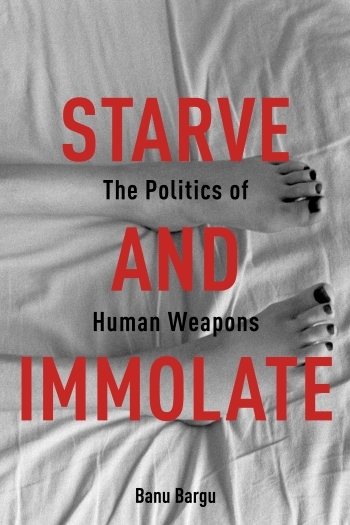
Starve and Immolate

By Banu Bargu

starve and immolate

“Starve and Immolate tells the story of leftist political prisoners in Turkey who waged a deadly struggle against the introduction of high security prisons by forging their lives into weapons. Weaving together contemporary and critical political theory with political ethnography, Banu Bargu analyzes the death fast struggle as an exemplary though not exceptional instance of self-destructive practices that are a consequence of, retort to, and refusal of the increasingly biopolitical forms of sovereign power deployed around the globe.

Bargu chronicles the experiences, rituals, values, beliefs, ideological self-representations, and contentions of the protestors who fought cellular confinement against the background of the history of Turkish democracy and the treatment of dissent in a country where prisons have become sites of political confrontation. A critical response to Michel Foucault’s Discipline and Punish, Starve and Immolate centers on new forms of struggle that arise from the asymmetric antagonism between the state and its contestants in the contemporary prison. Bargu ultimately positions the weaponization of life as a bleak, violent, and ambivalent form of insurgent politics that seeks to wrench the power of life and death away from the modern state on corporeal grounds and in increasingly theologized forms. Drawing attention to the existential commitment, sacrificial morality, and militant martyrdom that transforms these struggles into a complex amalgam of resistance, Bargu explores the global ramifications of human weapons’ practices of resistance, their possibilities and limitations.”

See the other eleven here…