CFP> Mapping (from) the minor of big data?

Here’s an interesting call for papers for the Association of American Geographers conference next year (2016), posted to Crit-Geog by Wen Lin…

Call for Papers:

Mapping (from) the minor of big data?
AAG Annual Meeting, San Francisco
29 March to 2 April 2015

http://www.aag.org/cs/annualmeeting

Organizers:
Wen Lin, Newcastle University
Matthew W. Wilson, University of Kentucky

“The minor is not a theory of the margins, but a different way of working with material. “¦ It is about the conscious use of displacement.” (Katz 1996, 489)

“Clearly, the technology has the potential to disenfranchise the weak and not so powerful through the selective participation of groups and individuals.” (Harris and Weiner 1998, 69)

Recent years have seen the explosive growth of geospatial data produced and shared by vast, diverse users, facilitated by an array of information and communication technologies and mobile devices. There is a burgeoning body of work attempting to theorize and investigate these processes and practices, with notions including neogeography (Turner 2006), volunteered geographic information (VGI) (Goodchild 2007), maps 2.0 (Crampton 2009), vernacular mapping (Gerlach 2014), alt.gis (Schuurman 2015), and a form of geographic big data (Mooney 2015). Significant efforts have been made to examine a range of issues derived from such phenomena regarding ways of mapping, data quality, and associated socio-political implications concerning power, equity and knowledge. Attention has been given to the empowering and emancipatory potential of new ways of mapping and storytelling, while questions have also been raised about possible implications of surveillance, population control, and unevenness of knowledge production.

Yet, there remains much to be known about those mapping efforts that are seemingly on and in the margins of ‘big data’, from those less active contributors, or by actors in relatively marginalized positions. Such efforts may constitute counter-hegemonic knowledge production (Harris and Weiner 1998, see also Elwood 2015) or may be alternatively understood as a kind of minor data (to draw upon ‘minor theory’ in Katz 1996).

This session intends to contribute to these vibrant discussions by engaging with documenting efforts of mappings and data construction that might be of a much smaller quantity in the wake of big data. We welcome papers addressing theoretical, methodological, and empirical investigations of these mapping efforts situated in a variety of contexts. Questions may include, but are not limited to:

  • How might we engage with mapping the minor in the context of big data?
  • In what ways are data generated, represented, or curated by those who might be from a more marginalized position in these mapping efforts?
  • In what ways are geospatial technologies used, reconfigured, or contested in these mapping efforts?
  • In what ways is knowledge (re)produced in these mappings?
  • What are the challenges of tracing and documenting mapping efforts from the margins?
  • What might be the broader implications of these accounts?

If you are interested in participating in this session, please send an abstract of no more than 250 words to Wen Lin (wen.lin[at]ncl.ac.uk) and Matthew W. Wilson (matthew.w.wilson[at]uky.edu) by Friday, 2 October. Please note that we are attempting to bring alternative perspectives and positions to this discussion, in alignment with this recent manifesto on the gender and racial composition of AAG panels (http://www.knowledgepolitics.org/2015/09/07/the-unbearable-white-maleness-of-aag/).

References:

Crampton, J. 2009. Cartography: performative, participatory, political. Progress in Human Geography, 33(6): 840-848.

Elwood, S. 2015. Still Deconstructing the Map: Microfinance Mapping and the Visual Politics of Intimate Abstraction. Cartographica, 50(1): 45-49

Gerlach, J. 2014. Lines, contours, legends: coordinates for vernacular mapping. Progress in Human Geography, 38(1): 22-39.

Goodchild, M. 2007. Citizens as sensors: the world of volunteered geography. GeoJournal, 69: 211-221.

Harris T., Weiner D. 1998. Empowerment, marginalization, and “community-integrated” GIS. Cartography and Geographic Information Systems, 25(2): 67-76.

Katz, C. 1996. Towards minor theory. Environment & Planning D: Society & Space, 14: 487-499.

Mooney, P. 2015. An Outlook for OpenStreetMap.  In J. Jokar Arsanjani, A. Zipf, P. Mooney, M. Helbich (eds.) OpenStreetMap in GIScience: Experiences, Research, and Applications. Cham, Springer, pp. 319-314.

Schuurman, N. 2015. What is alt.gis? Introduction to the Special Issue. The Canadian Geographer, 59(1): 1-2.

Turner. A. 2006. An Introduction to Neogeography. O’Reilly Media, Sebastapol, CA.
Coded language online

By which I mean code as cipher or ‘secret’ (sort of) rather than code as in mark-up…

The UK Child Exploitation and Online Protection centre and ParentZone maintain a website for parents called parentinfo.org that has recently published a guide to “online teen speak“, with the rationale that parents should know what their children are up to.

There are some entertaining examples and it just goes to confirm I am now ‘old’ because I simply don’t recognise some of this stuff…

Now, in a way I have some sympathy with this rationale insofar as anyone (not just people of a given age bracket) can be naive in their behaviour through mediated communications. Whereas the more established risks of rumour and defamation might feel more distant the risks of the permanence of anything one posts online and its potential to spread unimaginably quickly are much more immediate and can be forcefully, sometimes tragically, felt.

Nevertheless, depending on your political persuasion, one might feel that there ought to be some limits to the oligopticon; that perhaps we ought not to be spying on one another all the time. It is thus striking that the rationale for ‘safety’ (in this case the entirely justified concern for the safety of our children) matches very closely to the sort of libertarian ‘nothing to hide’, radical transparency ideology of both the advertising moguls/data sharks at the helm of corporations such as Facebook and the supporters of technologies such as the blockchain. It is interesting (to me anyway) that the bounds of the conversation around privacy have moved so much in only 10 years… When the Labour government talked about introducing a national ID card around 2005ish, campaigns such as No2ID garnered a lot of support based on an appeal to arguments about personal privacy that are already (perhaps) beginning to seem slightly irrelevant, if one has maintained a use of Facebook, Google, Dropbox, PayPal, loyalty cards etc.

There is, of course, a significant difference between the perceived threats to ‘privacy’ by corporations hoovering up our data and the risk to personal safety from those with malign intentions – and I certainly don’t want to overly confuse the two… but the same rationale for an national identity card – to catch those with undesirable intentions – sits behind the perceived need to surveil our children and, indeed, was the rationale for ContactPoint here in the UK. This takes some very careful and nuanced unpacking (although it has attracted press commentary, e.g.) that I don’t think I’m best-placed to do here, but I wanted to record a reflection on this anyway.

The other thing that occurred to me while reading the press coverage of the guide to ‘teen speak’ was that this really isn’t new. As was made very evident by an episode of Fry’s English Delight on BBC Radio 4 the other week – there is a very, very long history of secret languages, and these are often used by groups that feel in a minority, or are a clique… from back slang, or ‘pig latin’ to medical slang (says the person most likely to be TTFO). But the power of these dialects is that they are secret – so what will a handy guide to them being published online do… we shall see… I’ll wait to hear from friends and colleagues with children that fall within the age group…

As an aside, ParentZone are convening an interesting looking conference in October on the Digital Family… worth a look if you’re that way inclined.

Reblog> Days numbered for barcodes (according to Reuters)

A sort of interesting story from Reuters on an apparent growing demand for information by consumers that they suggest may lead to the demise of the low-fi barcode in favour of QR [really?! still trotting out that old nag?] and RFID… so, nothing people like Bruce Sterling haven’t been saying for quite a while but sort of interesting how it’s couched…

Days numbered for barcodes as shoppers demand more data

BERLIN | 

Barcodes are seen on a package in London August 27, 2015. REUTERS/Russell Boyce
Barcodes are seen on a package in London August 27, 2015. REUTERS/RUSSELL BOYCE

Growing demand for more information about the products we buy could mean the end of the simple barcode – the blocks of black and white stripes that adorn most objects for sale and are scanned five billion times a day.

First used on a pack of Wrigley’s Juicy Fruit chewing gum in 1974 in a store in Ohio, barcodes have revolutionized the retail world, allowing cashiers to ring up products much faster and more accurately, while also streamlining logistics.

But shoppers are now demanding far greater transparency about products, and store owners need more information to help with stock taking, product recalls and to fight fakes. The basic barcode is just not up to the job.

That could mean a costly upheaval for retailers and brands to change packaging and invest in new systems and scanners. But it should also bring benefits as more data helps them manage the flow of goods better.

“The barcode did a great job, but it is now time for succession,” said Capgemini consultant Kees Jacobs, who is working with the world’s top retailers and food manufacturers to try to agree new global standards for labels and product data.

“The current barcode is not sufficient to be the carrier of much more granular information that is needed,” Jacobs said.

The most ubiquitous barcodes allow an eight to 14 digit number to be read by a laser scanner. For example, barcode 4-003994-111000 identifies a box as being a 375 gram pack of Kellogg’s Corn Flakes.

However, that number does not directly capture any other information that might interest a shopper – such as ingredients, allergens or country of origin – nor does it provide a retailer with useful details such as the batch number or sell-by date.

That data is usually printed on the pack, but consumers increasingly want to read it online, or with a smartphone app such as one that measures calories. Retailers want data that can be scanned for tasks such as quickly locating faulty goods for recall or about-to-expire products for mark downs.

SUSTAINABLE AND SAFE?

GS1, the non-profit organization that assigns the unique numbers in barcodes, has developed a double-layered barcode it calls the “data bar” which can carry some extra details such as expiry date, quantity, batch or lot number.

That has allowed German retailer Metro (MEOG.DE) to launch PRO Trace, a smartphone app that shows, for example, that a filet of salmon on sale at a store in Berlin on Aug. 25 was caught at the Bremnes Seashore fish farm off the coast of Norway on Aug. 17 and processed in Germany on Aug. 21.

The app also displays a map highlighting the fishing area of the catch and a detailed description of the Atlantic salmon.

Metro says the app helps customers at its cash-and-carry stores such as professional chefs from hotels and restaurants, as they can now embellish their menus with information about the exact origin of pricey delicacies such as wagyu beef.

“We are the only ones in Germany that can do this for fresh fish. It’s about trust. Our customers challenge us to offer sustainable and safe products,” said Lena vom Stein, a corporate responsibility project manager at Metro.

Metro set up the tracking scheme to help it comply with European Union regulations aimed at stemming overfishing and started making the data available to customers in 2012. It now extends to meat, and fresh fruit and vegetables will follow.

Other retailers are also opening up, often supplementing the barcode with a pixilated square known as a quick response (QR) code. It can store dozens more data points and can be scanned by a smartphone camera to lead to a web page, but can still not be read by the majority of store scanners.

Dutch retailer Albert Heijn (AHLN.AS) recently introduced “Check Origin” QR labels on locally-grown radishes and blueberries. Scan the sticker on a mobile phone and it plays a film that rewinds to show the journey from the shelf back to the packing factory, then back to the farmer’s field.

Such tools are likely to fuel demands for more transparency. A GS1 survey found consumers are most interested in nutritional and ingredient information, details on allergens, organic certification, environmental impact and ethical standards.

HARMONIZING DATA

Making such a wealth of data accessible via codes that can be scanned is only part of the problem. A bigger challenge is gathering, storing and standardizing the information in the first place.

Fiona Wheatley, sustainable development manager at British retailer Marks and Spencer (MKS.L), says keeping tabs on all the company’s suppliers can be a daunting task.

“Your ability to give your customers more confidence that they can rely upon is proving to be increasingly challenging,” she said, adding that M&S relies on certification schemes such as Fairtrade to help audit smallholder farmers.

David Linich, supply chain expert at consultants Deloitte, advises retailers to find ways to work together to monitor the thousands of producers they buy from: “If you go it alone it can be really burdensome, really cost prohibitive.”

The Consumer Goods Forum (CGF), a global network of some 400 retailers and manufacturers from 70 countries, is coordinating efforts to harmonize product data and labeling.

Most firms accept that more transparency is needed after scares such as the 2013 scandal about horsemeat being sold as beef in Europe, but it is still proving hard to persuade them to share data that many see as commercially sensitive.

Capgemini’s Jacobs, who is working on the CGF project, hopes pilot schemes to standardize digital information, like one between rival retailers in Belgium including Delhaize (DELB.BR), Carrefour (CARR.PA) and Colruyt (COLR.BR), could be the precursors to new global data standards.

GS1 already holds data from 30,000 companies on some 18 million products that its industry members share with each other behind the scenes to smooth logistics.

It is trying to persuade its members to let consumers access more of this information, while keeping some of it confidential, such as detailed pricing and stock levels.

Malcolm Bowden, president of global solutions at GS1, predicts agreement could come quickest – within a year – on sharing nutrition data as there are already broadly accepted standards, and calorie and allergen apps are proliferating.

“The will is there. It has to happen. Like any major change, big companies have to have time to think through the implications,” he said.

GS1 is also working to create identifier numbers for individual farms and is trying to harmonize standards on sustainability data, such as a measure of water efficiency for detergents and washing powders currently being piloted.

But making such a wealth of data available will sound the death knell for the barcode. Only a QR code can carry that much information without taking up too much space on packaging.

Longer term, more products could carry wireless tags such as the RFID labels that are being widely rolled out across the fashion industry. These tiny tags, which can be embedded in an object and, unlike a barcode or QR code, do not need to be within the line of the sight of a reader, were long too expensive for everyday goods but their price is falling fast.

Bowden predicts different systems will probably have to coexist for the next decade or so as retailers and logistics providers gradually upgrade their scanning systems.

“I am convinced we will have a day where pretty much all information about all products will be available to all consumers,” he said.

(Editing by David Clarke)

Reblog> New paper: Anticipatory Logics of the Global Smart City Imaginary by @jimmerricks

Over on the programmable city website there’s news of a new paper by Jim Merricks White on the anticipatory logics of smart cities… I have previous here so it’ll be an interesting read!

New paper: Anticipatory Logics of the Global Smart City Imaginary

Jim White’s paper, ‘Anticipatory Logics of the Global Smart City Imaginary’, is available for download on the Social Science Research Network as Programmable City Working Paper 8.

Abstract

The smart city encompasses a broad range of technological innovations which might be applied to any city for a broad range of reasons. In this article, I make a distinction between local efforts to effect the urban landscape, and a global smart city imaginary which those efforts draw upon and help sustain. While attention has been given to the malleability of the smart city concept at this global scale, there remains little effort to interrogate the way that the future is used to sanction specific solutions. Through a critical engagement with smart city marketing materials, industry documents and consultancy reports, I explore how the future is recruited, rearranged and represented as a rationalisation for technological intervention in the present. This is done across three recurring crises: massive demographic shifts and subsequent resource pressure; global climate change; and the conflicting demands of fiscal austerity and the desire of many cities to attract foreign direct investment and highly-skilled workers. In revealing how crises are pre-empted, precautioned and prepared for, I argue that the smart city imaginary normalises a style and scale of response deemed appropriate under liberal capitalism.

Keywords: smart cities, the urban age, anticipation, risk

[pdf download]

BBC’s “Future-proofing” radio programme on blockchain – pretty good!

I happened to be driving at around 8ish last night and the car radio was by default on Radio 4 so I caught a bit of the latest programme in the ‘FutureProofing‘ series. Ordinarily such things tend to annoy me, cos I am grumpy, but listening to the programme about block chain last night I confess I was rather impressed. Timandra Harkness and Leo Johnson present an interesting account.

Blockchain is a difficult thing to explain and harder still to attempt to articulate how it might be used, beyond the libertarian goals of particular uses of crypto-currencies. The programme last night excelled in this regard covering lots of interesting angles. They end up having an interesting debate about politics and government.

There’s some interesting interviewees too:

Janina Lowisz (‘blockchain girl’) – ‘ambassador for bitnation‘

Mike Hearn – software developer & bitcoin advocate

Nathaniel Popper –journalist, author of ‘digital gold’

Susanne Tarkowski Tempelhof – CEO of bitnation

Steven Lukes – Prof. of Sociology at NYU

Vinay Gupta – of the Ethereum (blockchain) project

Reblog> A litmus test for the internet of things

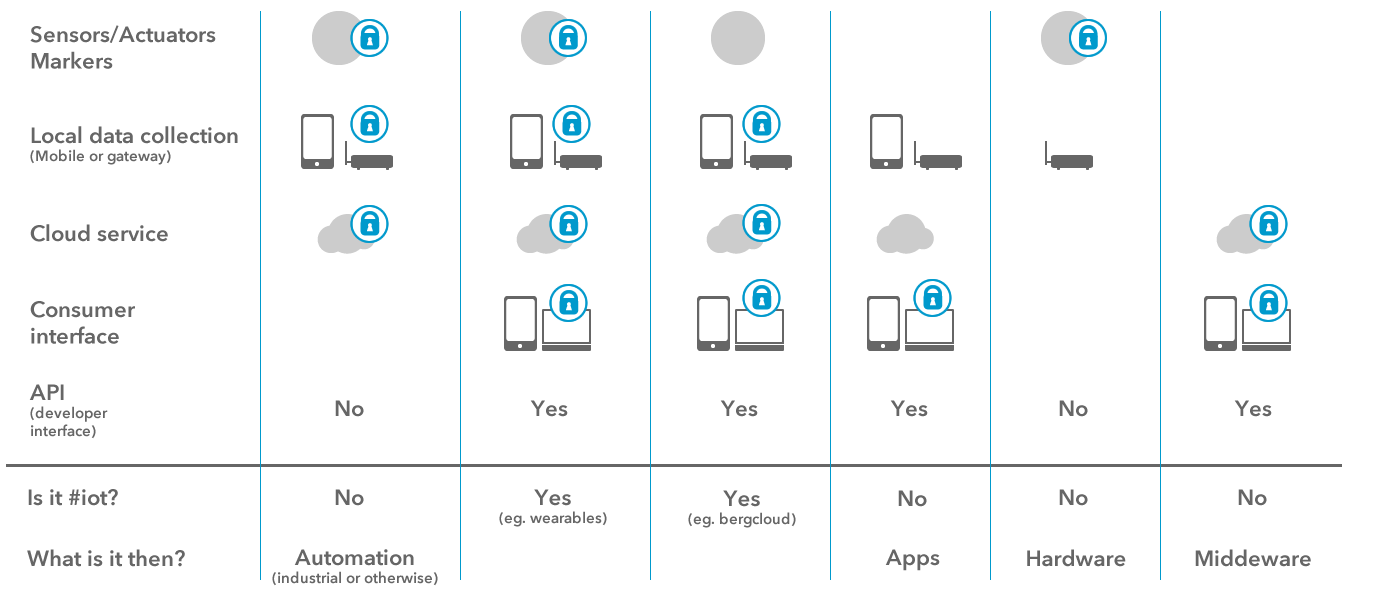
Alexandra Deschamps-Sensino blogged this really interesting ‘test’ to check if something is part of the IoT, or not – and what is it if not..?

I don’t have time to write about this now, but it resonates with the ThingTank project by Chris Speed et al. that I blogged about a little while ago…

A litmus test for the internet of things

It’s taken me about 2 months to work out how to show the differences between products that companies say are iot and those that possibly aren’t. I suspect I actually need to explain it but I’d rather have a good conversation on Twitter about it so I can tweak things accordingly.

For clarity, a lock means it’s proprietary.
No lock means it’s open source.
Absence of means its not provided by the company directly.

designswarm_iotlitmustest2

For these companies you, walking down the street, are a data point

I’ve been collecting the promotional videos of various companies that surveil ‘public’ spaces to garner information that, using the logics applied to web analytics, they see as valuable commercial intelligence.

The rationale that is common throughout is that the aggregate crowd on the street, in a shopping centre, or in any form of apparently ‘public’ space are fair game for surveillance measurement and in turn address (albeit by their commercial partners – retailers etc. etc.). In fact, this is merely a technical or perhaps social problem – not a political one. It’s a technical problem for them because as the chap from Placemeter says “it’s all data” and its ‘waiting’ to be harvested. It’s a social problem for them only insofar as it’s about improving ‘services’ for us as consumers (not as citizens, as families or any other part of our skein of identity). It is NOT a political problem for them – it’s not an issue of who has the right to the city, who has a right to privacy or what might constitute reasonable expectations of any of those things. It certainly is never couched in terms of there needing to be governance of these activities – at least in these kinds of videos.

So, the videos are interesting artefacts of the formulation of what pervasive media/ubiquitous computing and smart cities look like and how they are performed…

A reasonable article about Placemeter is in/on the Guardian Cities section.

Reblog> Data and the City Workshop (31/08-01/09)

The Programmable City project team are running a(nother!) interesting workshop/event at the end of the month, just before the RGS annual conference. See the details below:

Data and the City Workshop

The Programmable City Project is hosting a two day workshop on the relations between data and the city.  The Data and the City Workshop will take place on August 31st and September 1st 2015 and will bring together 20 invited experts in the field and the ProgCity team.  A description of the workshop and the agenda are below with links to some of the papers to be presented that are already available online…

Read more in the original post – including the schedule.

Reblog> New paper: Data-driven, networked urbanism

This looks good –– added to my ‘to read’ pile 🙂

New paper: Data-driven, networked urbanism

A new paper, ‘Data-driven, networked urbanism’, has been published by Rob Kitchin as Programmable City Working Paper 14.  The paper has been prepared for the Data and the City workshop to be held at Maynooth University Aug 31th-Sept 1st.

Abstract
For as long as data have been generated about cities various kinds of data-informed urbanism have been occurring.  In this paper, I argue that a new era is presently unfolding wherein data-informed urbanism is increasingly being complemented and replaced by data-driven, networked urbanism.  Cities are becoming ever more instrumented and networked, their systems interlinked and integrated, and vast troves of big urban data are being generated and used to manage and control urban life in real-time. Data-driven, networked urbanism, I contend, is the key mode of production for what have widely been termed smart cities.  In this paper I provide a critical overview of data-driven, networked urbanism and smart cities focusing in particular on the relationship between data and the city (rather than network infrastructure or computational or urban issues), and critically examine a number of urban data issues including: the politics of urban data; data ownership, data control, data coverage and access; data security and data integrity; data protection and privacy, dataveillance, and data uses such as social sorting and anticipatory governance; and technical data issues such as data quality, veracity of data models and data analytics, and data integration and interoperability.  I conclude that whilst data-driven, networked urbanism purports to produce a commonsensical, pragmatic, neutral, apolitical, evidence-based form of responsive urban governance, it is nonetheless selective, crafted, flawed, normative and politically-inflected.  Consequently, whilst data-driven, networked urbanism provides a set of solutions for urban problems, it does so within limitations and in the service of particular interests.

Key words: big data, data analytics, governance, smart cities, urban data, urban informatics, urban science

Download PDF

What might happen when ‘things’ design themselves?

I’ve been meaning to flag this for a while… Chris Speed at Edinburgh (who gave the ‘dancing with data‘ talk I posted a while ago) is leading a project called ThingTank:

The ThingTank project identifies that ‘things’ may soon know more about lives than we do and may also be able to make suggestions about what is missing. The purpose of this project is to explore the potential for identifying novel patterns of use within the data that is streamed through the interaction between people and things, and things and things. Our project builds on research and innovation that has been established by the three investigators across the fields of Internet of Things, Social Experience Design and Machine Learning. Through a better understanding of how what data can tell us about how we use objects, new models of use will emerge and reinvigorate the role of things and people within design and manufacturing.

The project offers some interesting provocations both as research outcomes and as innovation in methods. It’s worth looking at this write-up by Chris on his website Fields.