Reblog> Disrupting the Humanities: Towards Posthumanities – Special issue of JEP

Via Gary Hall

Disrupting the Humanities: Towards Posthumanities – Special issue of JEP

We are pleased to announce the publication of a special issue of the Journal of Electronic Publishing: ‘Disrupting the Humanities: Towards Posthumanities‘, edited by Janneke Adema and Gary Hall.

‘Disrupting the Humanities: Towards Posthumanities’ consists of a selection of video articles by Johanna Drucker, Mark Amerika, Erin Manning, Monika Bakke, Endre Dányi, Lesley Gourlay, Silvio Lorusso, Niamh Moore, Karen Newman, SØren Pold, Craig Saper, Sarah Kember, and Iris van der Tuin.

It is available for free, open access, CC-BY, here:
http://www.journalofelectronicpublishing.org/

This special issue of the Journal of Electronic Publishing is based on ‘Disrupting the Humanities’. This was a series of seminars exploring research and scholarship in a posthumanities context organised by the Centre for Disruptive Media at Coventry University in the UK. Disrupting the Humanities both critically engaged with the humanist legacy of the humanities, and creatively explored alternate and affirmative possible futures for the humanities. The series was accompanied by a wiki that is still available here: http://disruptivemedia.org.uk/wiki/

‘Posthumanities: The Dark Side of “The Dark Side of the Digital”’

Adema and Hall have written a 10,000 word opening essay, discussing the conceptual premises that underly this special issue. Engaging with various discourses around the digital humanities, the essay outlines the experimental mode in which the videos included in the issue have been edited – as well as pointing to the idea of “posthuman humanities”.
Link: http://dx.doi.org/10.3998/3336451.0019.201

A table of contents for this special issue of the Journal of Electronic Publishing is provided below.

—–

Disrupting the Humanities: Towards PosthumanitiesThe Journal of Electronic Publishing (JEP)

Volume 19, No. 2 winter 2016

Edited by Janneke Adema and Gary Hall


Contents

1  Maria Bonn, A Note From JEP

2 Janneke Adema and Gary Hall, Posthumanities: The Dark Side of “The Dark Side of the Digital”

PART ONE – Creating Posthumanities: Disrupting Humanities Methodologies

Part one of Disrupting the Humanities consists of a radical exploration of new posthumanist methodologies that take into account the agency of technologies and other non-human actants involved in modern forms of knowledge production.

3   Monika Bakke, Deep Time Environments: Art And The Materiality Of Life Beyond The Human

4   Lesley Gourlay, Posthuman Texts: Nonhuman Actors, Mediators and Technologies of Inscription

5   Niamh Moore, “Humanist” Methods in a “More-than-Human” World

6   Iris van der Tuin, Reading Diffractive Reading: Where and When Does Diffraction Happen?

PART TWO – Performing Posthumanities: Disrupting Humanities Aesthetics

Part two looks at the ways in which research is mediated and performed. It focuses on a reconsideration of the aesthetics of scholarship, including the “aesthetics of bookishness.” In doing so it investigates the potential of more post-digital, hybrid and multimodal forms of knowledge creation.

7   Erin Manning, 10 Propositions for Research-Creation

8   SØren Pold, Ink After Print: Literary Interface Criticism

9   Johanna Drucker, Diagrammatic Form and Performative Materiality

10  Silvio Lorusso, The Post-Digital Publishing Archive: An Inventory of Speculative Strategies

PART THREE – Circulating Posthumanities: Disrupting Humanities Institutions

Part three of Disrupting the Humanities provides a critical examination of how research is disseminated and shared, be it by publication to peers or to students in a pedagogical setting, or by adopting practices of radical openness and experimentation to challenge the normative and often print-based (neo)liberal humanist assumptions of how scholars in the humanities communicate.

11   Sarah Kember, At Risk? The Humanities and the Future of Academic Publishing

12   Endre Dányi, Samizdat Lessons: Three Dimensions of the Politics of Self-Publishing

13    Craig Saper, Disrupting Scholarship

14    Mark Amerika, Glitch Ontology (A Video Performance)

15    Karen Newman, The West Midlands as an ‘Electronic Super Highway’: BOM and the Emergence of New Art Infrastructures

Investigating Google’s revolving door with governments – Tactical Tech Collective

Some really interesting work from the Tactical Team looking at the ways in which different people and their skills and knowledges move in and out of government and the ‘Alphabet empire’. Worth a full read, but here’s a snippet to whet the appetite…

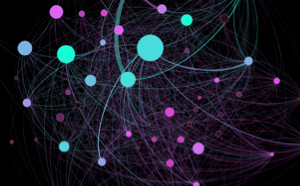
The Alphabet Empire by Tactical Tech and La Loma as shown in The Glass Room in New York. Based on openly available information, this 3-D infographic combines a quote from its chairman, Eric Schmidt, with a mapping of its acquisitions and investments.
By Google’s own admission, the company, like many others, cultivates close relationships with governmental bodies and public officials. Google disclosed that in 2015 it spent over €4 million on lobbying the European Union – considerably more than the €1 million on lobbying spent just three years previously in 2012.

But some of Google’s relationships with public bodies and officials come with a smaller price tag: Over the past ten years at least 80 people have been identified to have moved jobs between Google and European governments.

It’s this “revolving door” that formed the basis of our investigation. We started out with a number of questions: who were these people who had moved from Google to government or vice versa? Where exactly did they move from and to, and when? And most importantly how many of these questions could we find answers to using open, publicly-available information?

Here’s what we learned, and how we did it.

Affect & Social Media 3.0 CFP

Via Tony Sampson…

Affect and Social Media#3 2nd CFP

main2Call for presentations and artworks

Affect and Social Media#3

experience

engagement 

entanglement                                

Including the Sensorium Art Show (the sequel)

Event Date: Thurs 25th May, 2017

Venue: University of East London, Docklands Campus

Confirmed keynote: Prof Jessica Ringrose (UCL) 

https://iris.ucl.ac.uk/iris/browse/profile?upi=JLRIN58

Call for 15min presentations and artworks

The organizers of A&SM#3 welcome proposals for 15min presentations and artworks that interpret and explore the affective, feely and emotional encounters with social media grasped through the following themes:

  1. Experience
  2. Engagement
  3. Entanglement 

Presentations and artworks can widely interpret each theme, but preference will be given to proposals that respond in two ways.

Firstly, the organizers are particularly interested in creative responses (academic and artistic) to recent social media events – the US election, for example. So proposals might address how the Trump win allows us to develop a fresh understanding of shared experiences, emotional engagements or new entanglements with social media.

Secondly, we ask presenters and artists to consider how their approach to affect and social media can be put to work in an education context. For example, how can the potential of affect theory reach out across teaching practices and develop novel understandings of the political nature and transformative possibilities of teaching.

The academic part of this call is open to experienced scholars, new researchers and postgrad students from across the disciplinary boundaries of affect studies and related areas of study interested in theorizing and working with emotion and feelings in a social media context. We welcome a good mixture of innovative conceptual and methodological approaches.

The Sensorium Art Exhibit will interweave the conference proceedings and bring it to a close with a special show, alongside free drinks and nibbles.

15min presentations and artwork proposals to: t.d.sampson@uel.ac.uk

Please include 200 word max description and short bio including academic affiliation and relevant links to previous work and/or website profile.

DEADLINE: Tues 28th Feb 2017.

Full registration details will be made available from 27th Jan via UEL event page.

https://www.uel.ac.uk/Events/2017/05/Affect-and-Social-Media-3

CFP> Creative propositions and provocations on the heritages of data-trade-place-value

Paula Crutchlow, with Ian Cook and I, invite submissions for the following session for this year’s RGS-IBG conference. Please do share this with anyone (doesn’t have to be geographers) who may be interested. As we say below, we welcome any kind of creative response to the theme. The session builds on Paula’s PhD project The Museum of Contemporary Commodities, which will be active before and throughout the conference in the RGS-IBG building.

Museum of Contemporary Commodities: creative propositions and provocations on the heritages of data-trade-place-value

How do we open out the messy digital geographies of trade, place and value to the world? How can we work with the digital beyond beyond archives, spectacle and techno-dystopian imaginations? How do we do so in a ways that are performative, collaborative and provocative of the digital?

This session builds on the planned hosting of the Museum of Contemporary Commodities (MoCC) in the RGS(IBG)’s Pavilion in the days leading up to the annual conference (and its partial installation in the RGS(IBG) building during the conference) where it will join the V&A, Science and Natural History Museums on London’s Exhibition Road. Developed as acts of valuing the things we buy today as the heritage of tomorrow, MoCC’s artworks take the form of dynamic, collaborative hacks and prototypes; socio-material processes, objects and events that aim to enrol publics in trade justice debates in light footed, life-affirming, surprising and contagious ways as part of their daily routines.

We invite prospective participants to offer propositions and provocations that stitch into or unpick the complex and sometime knotty patchwork quilt of data-trade-place-value. This is an invitation to contribute to and convene conversations that enliven geographical understandings of the governance, performance, placings and values/valuing of contemporary (digitally) mediated material culture. The resulting session is not conceived as a ‘conventional’ paper session. We invite submissions of ten-minute contributions that might take various forms, which might include essay, performance, video and many other creative responses to the theme.

This invitation should be understood in its broadest sense. We are interested in the commingling and mash-up of the theme(s) data-trade-place-value. We very much encourage submissions that push back against the normative authorities or discourses surrounding ‘the digital’ (however that might be conceived). So, we hope that all involved in the session will thereby be challenged and inspired by creative propositions and provocations that begin to get to the heart of how we open out the messy digital geographies of trade, place and value to the world.
Themes could include:

  • lively methods that work with and through participatory media
  • intimacy, humour, trust and the internet of things
  • mashups, subversions and hacks of big data from the bottom up
  • discourses and practises of future orientation and the spatial imaginations of ‘the digital’
  • an intersectional internet and the rise of ‘platforms’
  • alternative trade models, value systems and networked culture
  • DIWO (Do It With Others), scholar-activism & public pedagogy
  • the economic geographies of the battle for ‘open’
  • Please submit 250 word abstracts to us by email by 7 February and we will get back to you by 13 February.

Spacing social media – seminar at Swansea (18th Jan)

I am participating in the geography seminar series at Swansea next week. I’ll be talking about some of the ideas that came out of the work we did with social media for the Contagion project.

Mostly the talk is about how ideas about space and spatial experience are important to understanding social media. This, very broadly, appears in two ways: (1) like any technology, how we use social media performs, reflects and reveals forms of spatial understanding and experience; and (2) both the methods and the subsequent analysis we do of social media, as geographers (but also that done in other disciplinary contexts), carry assumptions about space that perhaps need to be made more explicit (especially when methodological techniques carry contradictory assumptions about space to the ideas we then employ in our analysis). This comes from a far-too-long reflection on a manuscript written for publication that had some issues and in reflecting on those issues I realised that there were some interesting geographical issues to make more explicit.

Anyway, the seminar is at 2pm on the 18th of January in Glyndwr E (see 11.1 on this campus map). Hope to see a few people there…

Here’s the abstract:

Spacing Social Media

This talk will interrogate the promise as well as the critical implications of the emerging geographies of social media. In particular, the spacing of social media will be addressed in terms of the ways we might understand and theorise space and spatiality. There will be three parts to the discussion: First, the promise of social media research is addressed through an initial exploration of how those media are ineluctably entangled in changes within social, economic and political fields. Second, the translations of data in social media research are addressed through the applications and techniques involved. Third, this provides a basis for subsequent discussion of the theoretical implications of digital data methods and their spacings. I will argue that the techniques and discourses of social media methods both imply and challenge forms of spatial understanding that present challenges for geographical research.

CFP> Putting philosophies of geography into practice (RGS-IBG 2017)

Putting philosophies of geography into practice

RGS-IBG Annual Conference 2017

Convenor: Dr Sam Kinsley (Exeter)

This session is conceived as means to discuss the relations between the everyday practises of doing geography and the, sometimes-maligned, theoretical-methodological techniques we variously employ in geographical research and teaching. If we are ‘thinking always as geographers’, how do we represent that thought and the ways it becomes located in practice? Marking fifteen years since a session of the same title was convened at the annual conference in Belfast, the aim of this session, following Lorimer and Spedding (2002: 277), is to ‘explore new [established and forgotten] ways of thinking about the history and philosophy of geography’. How then do we re-‘present the stories that geography tells (of) itself’? (ibid.) How can and do we cut into the ‘dogmatic image of what counts as [geographical] thought[?]’ (Thrift, 2004: 81) and seek to contrast the practising of geography with ‘hegemonic geographic knowledge’ (Rose, 1994: 4)?. The invitation of this session is to discuss and reflect upon contemporary knowledge practices in geography (taken at its broadest definition), such as (but in no way limited to):

  • Cultures, traditions, politics and practices of teaching/learning the history and philosophy of geography;
  • The dis-/en-abling role of learned/professional institutions in the production and sharing of geographical knowledge;
  • Spaces of disagreement and debate (in-person, in-text, in-between);
  • The ‘field’ of theory and theory in ‘the field’;
  • Links and divisions between (sub)disciplinary discourses, the practices of departments and institutions and popular geographical knowledge;
  • The formal and informal communication of geographical knowledge and theory (peer-reviewed publications, blogs, social media);
  • Uses of space and time within/outside formal geography departments (labs, lecture theatres, cafes);
  • The ‘geographical canon’, authority, disciplinarity and space for others;
  • The role of activities such as the (UK) REF or QAA benchmarking on what ‘counts’ as geographical knowledge and theory.

Please email prospective contributions or any queries to me, Sam Kinsley, by the close of play on Friday the 10th February.

In the best possible taste? or the intimate geographies of training the mouth as a technology

Someone clutching their neck because of the bad taste of a cup of coffee

I’m undertaking some new research, for which I have received a small pot of funding from the University of Exeter. So, exciting stuff! This combines my theoretical work on understandings of technology and mediation and my near-obsession with ‘speciality’ coffee. I hope that I will be able to say something interesting about the kinds of intimate geography of taste (of aesthetics, of gustatory experience) that are performed through ‘speciality coffee’. Please find below a brief outline. Of course – I’d very much welcome any comments, suggestions or opportunities to chat about the themes here and things you think I’m missing or getting wrong, so please do get in touch!

In the best possible taste?, or the intimate geographies of training the mouth as a technology

Taste is something we pay for. We can pay more for food and drink we think are ‘delicious’. In turn, this creates ways food and drink we find pleasurable comes to market. This project will explore the growth in ‘speciality coffee’ and its contingency on particular kinds of taste, which I posit have a range of subsequent economic and cultural consequences. I will explore the central role of techniques of tasting, known in the coffee trade as “cupping”, in the commodity chains of ‘speciality’ coffee. Claims have been made within the coffee trade and in the popular press (in particular by Jay Rayner in The Observer, 8th June 2014) that a shift in tasting practices and thus how coffee gets roasted and prepared has created a very specific taste experience. The hypothesis of this project is that an increasingly technical and quantitative approach to measuring what we call taste is affecting the gustatory experience of coffee.

The aim of this project is to investigate how this particular taste experience has been constituted: to ask how do professional coffee tasters reflect upon the training of their sense of taste? And: do specific technical gustatory practices of tasting create orthodoxies in judgments about taste? – if so, how?

The methods for this pilot project involve undertaking two empirical activities: (1) undergoing tasting training with the London School of Coffee and documenting this ethnographically; and, (2) interviewing and tasting coffee with key speciality coffee roasters to examine how tasting techniques are used in practice.

When design fiction becomes the advert(?) Amazon Go and the refiguring of trust

I think I’ve been late to this. I saw the story about Barclaycard wanting to do “cardless” credit cards but, of course, Amazon want to vertically integrate. See the first video below. Interesting that this is incredibly similar to previous ‘envisionings’ of “the future” of retail/shopping. The first thing I thought was: ‘hang on, this is  Microsoft circa 2004’, see the second video below… and I’m sure there’s been others, not least from the likes of HP Labs… I wonder where patents lie on this stuff, cos that will be a big bargaining chip.

This is interesting though insofar as, when I was writing about the Microsoft Office Labs videos in 2008/9, the ‘future’ they figured was always positioned at some distance, it was certainly not explicitly stated that this is something you should definitely expect to happen, more a kind of ‘mood music’ to capture some sensibilities of a possible future, by representing it and hooking ideas into our general  imagination of technology and society. It certainly plays on the trope of the normalisation of heavy surveillance… what else can such a system be?

The Amazon Go video is an interesting confluence of lots of contemporary trends in attempts to refigure how we imagine digital technology. Implicit in the video is a normalisation of yet-more automation (of payment, of trust). Explicit here, as already mentioned, is that these kinds of places are not ‘private’ in any way – the system “knows” you, will know your habits, manages your money and that’s ok, in fact – it’s apparently preferable (trust, again).

Amazon seem to be fairly aggressively pushing this, taking the smooth apparently effortless aesthetics of many tech design fiction videos and using this as a means to capture the idea that such technology = Amazon. Apparently there is a “beta” shop in Seattle (where else?). No doubt someone will already be writing a journal article about this as code/space and, of course it is (and just as Kitchin & Dodge suggest about airports – I wouldn’t want to be in this shop when the servers go down), but I think the thing I find more interesting is that it seems to me that this is perhaps an overtly political manoeuvre to capture the public story about what ‘currency’ is and how payment works when we take for granted higher levels of automation, through what kinds of institution and who we can trust. This is quite a different story to the blockchain, Amazon seem to be saying “let us handle the trust issue” – a pitch usually made by a bank, or PayPal…  That might be interesting to think about (I’m sure people, like Rachel O’Dwyer, already are), not least in relation to other ways ‘trust’ is being addressed (and attempts are being made to refigure it) by other companies, institutions and groups.

All this means I’ll definitely be re-writing my lecture about money for the next iteration of my “Geographies of Technology” module next term…