Some interesting papers: mothering with social media, archaeologies of e-waste, and performing tasks with wifi

Just wanted to flag some more interesting papers that have recently come out.

First, Robyn Longhurst‘s fantastic work on mothering with Skype and other social media has been really productive of some great papers and the latest in Social & Cultural Geographies is no exception. There’s some really lovely empirical work here and some interesting discussion of method too. I will be giving this paper to some of my students precisely because of this methods discussion. Good stuff!

Mothering, digital media and emotional geographies in Hamilton, Aotearoa New Zealand

This article traces a line between two literatures that can usefully be drawn into deeper conversation: geographies of digital media, and geographies of emotion. Its broad theoretical aim is to ascertain what insights might be gleaned by increasingly bringing together these two literatures. The more specific and primary aim, however, is an empirical one and that is to offer a materially grounded example of 35 mothers who live in Hamilton, Aotearoa New Zealand who use digital media to communicate with their children. Particular attention is paid to the capacities of different digital media, both individually and combined, to help facilitate, but certainly not guarantee, different emotions. The research is informed by a feminist geographical reading of theories of digital media and emotion. Findings illustrate that increasingly mothers are making use of digital media, both singularly and collectively, to increase the chances of a particular desired emotional outcome with their child or children. This article concludes that bodies, devices, screens, sounds and images comingle to mediate emotions over time and space.

Second, Sy Taffel has written another interesting article (following on from the paper he contributed to our theme issue of Culture Machine in 2012) concerning the desirable and undesirable materialities of electronic devices, not least when they are discarded and thrown away. This paper is part of an interesting forum convened by Angela Piccini. (You’ll find Sy’s piece between pp. 78-85):

Archaeologies of Electronic Waste

The toxicity and volume of electrical waste (commonly referred to as e-waste) forms one material legacy of contemporary digital culture which emphasizes the importance of paying attention to the deleterious material impacts of technological assemblages upon human and ecological systems, and asks serious questions about the sustainability and ethical orientation of current technocultural systems. Globally, around 50 million tonnes of e-waste are generated each year, and this waste is considered to be toxic due to the presence of a “witch’s brew” of substances which are highly hazardous to humans and other biotic systems. Whilst there exist inter-, supra-, and national laws and conventions mandating that most OECD nations (the US being a notable exemption) cannot legally export hazardous wastes to non-OECD nations, there exists a vibrant illegal market in exporting e-waste which is systematically mislabelled as working second-hand electronics goods for sale in emerging markets, with an estimated 50–100 shipping containers of illegally exported e-waste arriving daily in Hong Kong. This short essay seeks to sketch several ways that media archaeology and archaeologies of media provide productive apertures through which to consider issues surrounding e-waste, whilst contextualizing how media archaeology fits within the broader field of materialist media studies.

Thirdly, and by no means least, Sung-Yueh Perng has written a really thoughtful and interesting article on how the apparently ‘immaterial’ infrastructure of wi-fi is enrolled in ‘human-signal assemblages’ through which are performed the intricacies of everyday life. Again, some really lovely empirical work here and a nuanced synthesis of empirics and theory – with an interesting reading together of Adrian Mackenzie’s work on wireless communications, Ingold’s refrain of the ‘taskscape’ and the technocultural spatial imaginaries that have emerged in Taipei around these technologies.

Performing Tasks With Wi-Fi Signals in Taipei

This article examines the process of constructing, repairing, and improvising “human–signal assemblages” by drawing on in-depth interviews and virtual ethnography regarding the engineering of Wi-Fi connectivity in Taipei, Taiwan. It is demonstrated that spatial, temporal, infrastructural, and embodied orchestrations of Wi-Fi signals both reinforce and challenge prescribed ways of conducting daily tasks. Continuity and change, enacted by attempts to incorporate Wi-Fi signals into daily urban life, are explored by discussing a wide range of practices performed by government entities, local companies and initiatives, and users themselves. Particular attention is paid to the ways in which machines, the city landscape, discourses, maps, and signs grow and multiply, as well as intersect and intervene with each other at various levels, locales, and stages of establishing Wi-Fi connections. The article thus argues for the importance of “machine juggling” as a skillful performance that mends, maintains, and improvises Wi-Fi-enabled urban everyday rhythms.

Reblog> The pseudo-digital natives argument

Great, and incisive, post by Martin about the slips we all make in lapsing into easy-but-flawed theories… I’d say this argument also applies to how people talk about a spatial distinction between ‘offline’ and ‘online’, or mediated and face-to-face, communications as a ‘virtual’ / ‘real’ dichotomy. It’s nonsense but still has some residual appeal because we like to put space in a box (a la Descartes).

The pseudo digital-natives argument

When I did my degree in Psychology I remember a lecturer dismissing lots of theories of cognition as a ‘pseudo-homunculus” explanation. The homunculus explanations of psychology posited a little person sitting inside, driving your actions (think Inside Out). Of course, this was debunked hundreds of years ago, but a pseudo-homunculus explanation was one that went so far and then almost implied a little person. For example, theories of perception that posited a projection of the external world as if it was a cinema screen inside the head. It didn’t explain how that then led to action.

I was thinking about this with ed tech presentations. The digital natives myth has long been debunked, like the homunculus, but what we have are often pseudo-digital native explanations. I joked on twitter that we should ban presenters from talking about their children’s use of technology. I don’t really want to ban it (before people start telling me why a ban would be a bad idea), and I think sometimes it is used to effectively make a point. But often the deployment of these anecdotes (or videos even) is to sneak some pseudo-digital native juice in, without being derided for such. “Look, my daughter uses the ipad in a totally different way to me, we need to be ready for these kids in university” is often the implicit or explicit message. I blogged a while ago that there is something appealing about the digital natives idea, people want it to be true, and so it finds new ways to reassert itself. So when you hear a “my kids” anecdote in a presentation, I just ask you to do a pseudo digital natives check. Stay vigilant people.

Margaret Hamilton, Nasa software engineer & her ‘code’ printed out

I’ve put this picture on my office door:

Margaret Hamilton is an inspirational figure and we really should know more about her and her work!

Hamilton is now 78 and runs Hamilton Technologies, the Cambridge, Massachusetts-based company she founded in 1986. She’s lived to see “software engineering” – a term she coined – grow from a relative backwater in computing into a prestigious profession.

In the early days, women were often assigned software tasks because software just wasn’t viewed as very important. “It’s not that managers of yore respected women more than they do now,” Rose Eveleth writes in a great piece on early women programmers for Smithsonian magazine. “They simply saw computer programming as an easy job. It was like typing or filing to them and the development of software was less important than the development of hardware. So women wrote software, programmed and even told their male colleagues how to make the hardware better.”

“I began to use the term ‘software engineering’ to distinguish it from hardware and other kinds of engineering,” Hamilton told Verne’s Jaime Rubio Hancock in an interview. “When I first started using this phrase, it was considered to be quite amusing. It was an ongoing joke for a long time. They liked to kid me about my radical ideas. Software eventually and necessarily gained the same respect as any other discipline.”

Right on, Margaret.

The above quote is from this piece on vox.com by Dylan Matthews is worth reading – it contains lots of interesting bits and pieces, not least the fact that Apollo code was literally ‘hard wired’: it was woven in wire… astonishing to anyone who simply fires up a text editor and then uploads via ftp etc. etc. now…

The process of actually coding in the programs was laborious, as well. The guidance computer used something known as “core rope memory”: wires were roped through metal cores in a particular way to store code in binary. “If the wire goes through the core, it represents a one,” Hamilton explained in the documentary Moon Machines. “And around the core it represents a zero.” The programs were woven together by hand in factories. And because the factory workers were mostly women, core rope memory became known by engineers as “LOL memory,” LOL standing for “little old lady.”

Reblog> CFP: Towards a geographical software studies

Nick Lally has posted this interesting call for papers for the AAG next year in San Francisco, an apposite location for such a discussion 🙂 I am sure that there are plenty of geographers who can and will offer some fascinating reflections on this. I hope you consider contributing…

Toward a geographical software studies

A series of sessions for the Annual Meeting of the Association of American Geographers in San Francisco, March 29-April 2, 2016

Ryan Burns (Temple University)
Nick Lally (University of Wisconsin–Madison)

A growing body of recent geographic scholarship has focused its attention on software and algorithms. Some of these studies analyze geographic technologies –GIS and the geoweb, for example– as such, while others investigate a myriad of digital technologies that have become ubiquitous within the spaces of everyday life. These software/code objects interact with and modulate the world in complex ways, enact processes that connect humans and nonhumans, and become entangled with social, cultural, political, and economic systems. Moreover, software created to visualize data is used to produce knowledge about urban environments and everyday life, but obscure the processes and contexts which underlie its development. Engaging these topics, geographers have developed concepts like the “automatic production of space” (Thrift and French 2002), “software-sorted geographies” (Graham 2005), and “code/space” (Kitchin and Dodge 2011) to describe how software and space are co-constituted in the contemporary world. Productive research is building on these topics to explore new ways geographies are produced (Rose, Degen, and Melhuish 2014), governed (Amoore 2011), materialized, represented (Woodward et al. 2015), and lived through software (Kinsley 2014).

This session seeks to bring together a range of spatial thinkers who are producing new studies, theories, and methods for understanding and producing software. We welcome submissions that address all facets of software: the context of its production, its internal operational logics, the material work it does in the world, and its spatial distribution of social and political effects. Suggested themes could include:

“¢ Radical, feminist, or postcolonial political theories of software, software production, and/or hacking. What are the liberatory potentials/limits of coding or software and its critiques?
“¢ The political economy of software, code, attentional economies, and the audience as commodity.
“¢ Methodological contributions for the study of software (deconstruction, ethnography, reading code, reverse-engineering, archival research, hacking, writing software, visual studies, understanding processes, online research, etc)
“¢ Software and visual and affective epistemology.
“¢ The materiality of software and the work it does in the world (the production of space, embodiment, urbanization, social sorting, securitization, infrastructure, etc).

Amoore, L. 2011. Data Derivatives: On the Emergence of a Security Risk Calculus for Our Times. Theory, Culture & Society 28 (6):24–43.

Graham, S. D. 2005. Software-sorted geographies. Progress in Human Geography 29 (5):562–580.

Kitchin, R., and M. Dodge. 2011. Code/space: software and everyday life. Cambridge, Mass: MIT Press.

Kinsley, S. 2014. The Matter of “Virtual” Geographies. Progress in Human Geography 38(3): 364-384.

Rose, G., M. Degen, and C. Melhuish. 2014. Networks, interfaces, and computer-generated images: learning from digital visualisations of urban redevelopment projects. Environment and Planning D: Society and Space 32 (3):386–403.

Thrift, N., and S. French. 2002. The automatic production of space. Transactions of the Institute of British Geographers 27 (3):309–335.

Woodward, K., J. P. Jones, L. Vigdor, S. A. Marston, H. Hawkins, and D. P. Dixon. 2015. One Sinister Hurricane: Simondon and Collaborative Visualization. Annals of the Association of American Geographers :1–16.

Please submit a 250 word abstract to Nick (nlally [AT] wisc [DOT] edu) and Ryan (ryan.burns [AT] temple [DOT] edu) by October 9th, 2015.

Reblog> A litmus test for the internet of things

Alexandra Deschamps-Sensino blogged this really interesting ‘test’ to check if something is part of the IoT, or not – and what is it if not..?

I don’t have time to write about this now, but it resonates with the ThingTank project by Chris Speed et al. that I blogged about a little while ago…

A litmus test for the internet of things

It’s taken me about 2 months to work out how to show the differences between products that companies say are iot and those that possibly aren’t. I suspect I actually need to explain it but I’d rather have a good conversation on Twitter about it so I can tweak things accordingly.

For clarity, a lock means it’s proprietary.
No lock means it’s open source.
Absence of means its not provided by the company directly.

designswarm_iotlitmustest2

Reblog> CounterText: call for papers

Interesting CFP via Edinburgh Press blog...

CounterText
Call for Papers
Special Issue: Explorations in Electronic Literature
Edited by Mario Aquilina and Ivan Callus

An entire epoch of so-called literature, if not all of it cannot survive a certain technological regime of telecommunications.
– Jacques Derrida, The Post Card

Is literature surviving? Is it not still electrifying? Might electronic literature be one form of its survival? Does electronic literature mark another stage in the evolution of literature or does it open a new, unprecedented paradigm for the concept of the ‘literary’? This special issue investigates electronic literature’s challenges to established conceptions of literature and literariness. The following will be irrepressible questions. How should authorship, creation and originality be rethought? Can we still speak of ‘literature’ when the letter becomes only one element in works which are characterised by kinetic, visual, ludic, and sensory dynamics? Can we think of the electronic (post-)literary also as an electronic post-letter? And how might this be countertextual?

The apocalyptic threat to literature implied in Derrida’s comment on ‘a certain technological regime of telecommunications’ has not come to pass, nor might we be expecting it to. There can be no doubt, however, that computing technologies and code (the digital affordances enabling electronic literature) can prompt fevered speculation on literature’s evolving futures and platforms. As a result literary criticism, too, changes. Long traditions of aesthetic, thematic and formal discussions of literature are brought into question by electronic literature, as is the meaning of reading more generally (never mind close reading).

However, discussions of electronic literature countenancing technological determinism risk ignoring genealogies of electronic literature founded in long traditions of combinatorics and generative (not quite algorithmic) rules. Is electronic literature, then, a manifestation of a potential always already within the literary rather than simply a technology-determined transformation in the literary? And if it is so, how do we conceive the temporal relation and notional continuities between electronic literature and print literature, for example? Do we speak of supplementation, supplantation, renovation, complementarity, convergence? All these terms seem unsatisfying – but why?

The editors of this special issue of CounterText welcome articles with a focus related to these and related points that explore the connections between electronic literature and the concepts of ‘literature’ and ‘literariness’. The following list indicates some other possible points of discussion:

  • E-lit and new understandings of literary ‘value’.
  • The humanist affinities of e-lit.
  • E-lit and communal understanding of the literary.
  • E-Lit and the expectation of originality.
  • E-lit as a literature of the fragment.
  • E-lit and the problem of the total work.
  • Precursors of the electronic post-literary.
  • The space of e-lit: where does e-lit happen?
  • E-lit and literary criticism and theory.
  • E-lit as literary criticism and theory.
  • The role of the letter in e-lit.
  • Code and literariness.
  • Literariness and digital affordances.
  • E-lit as a space where literature meets other art forms.

Potential contributors to the special issue may email the Guest editor, Mario Aquilina (mario.aquilina@um.edu.mt), or Ivan Callus (ivan.callus@um.edu.mt) for further information. They may also wish to refer to the journal’s site for information about CounterText‘s style sheet (http://www.euppublishing.com/journal/count).

Submissions are to be sent as an email attachment to countertext@um.edu.mt by 14thDecember 2015. Notice of acceptance/refusal will be given by February 2016. Final manuscripts incorporating editorial suggestions and changes will then have to be submitted by 28th March 2016.

Some thoughts about how ‘algorithms’ are talked about & what it might mean to study them

A while ago, in a grump, I tweeted something along the lines of “I’m fairly convinced that most social scientists who write about algorithms do not understand what that term means”… Provocative I know, but I was, like I said, in a grump. Rob Kitchin tweeted me back saying that he looked forward to the blogpost – well here it is – finally.

I’m afraid its not going to be a well-structured and in-depth analysis of what one may or may not mean by the word algorithm because, well, other people have already done that. What I want to offer here is an expression of the anxiety that lay behind my grumpy tweet and means of mitigating that. So, this is a post that uses other people’s work to address:

  • what is an algorithm?
  • how/should we analyse/study them?

To be totally open from the start, my principle sources here are:

So, what do we mean when we use the word ‘algorithm’?

To begin with a straight-forward answer from Paul Ford:

“Algorithm” is a word writers invoke to sound smart about technology. Journalists tend to talk about “Facebook’s algorithm” or a “Google algorithm,” which is usually inaccurate. They mean “software.”

Algorithms don’t require computers any more than geometry does. An algorithm solves a problem, and a great algorithm gets a name. Dijkstra’s algorithm, after the famed computer scientist Edsger Dijkstra, finds the shortest path in a graph. By the way, “graph” here doesn’t mean  but rather 

Or, as Rob Kitchin notes in his working paper it is (following Kowalski) “logic+control“, such that (citing Miyazaki) the term denotes a form of:

specific step-by-step method of performing written elementary arithmetic… [and] came to describe any method of systematic or automatic calculation.

This answers a simple definitional question: “what is an algorithm?” but doesn’t quite answer the question I’ve posed: “what do we mean when we use the word algorithm?”, which Ford gestures towards when suggesting journos (and one might include a lot of academics here) use the word ‘algorithm’ when they mean ‘software’. As Gillespie notes

there is a sense that the technical communities, the social scientists, and the broader public are using the word in different ways

There isn’t a single/singular meaning of the word then (of course!) and after decades of post-structuralism that really shouldn’t be a surprise… nevertheless there is a kind of discursive politics being performed when we (geographers, social scientists etc etc) invoke the term and idea of an ‘algorithm’, and we perhaps need to reflect upon that a little more than we do. I may be wrong, perhaps we just need to let the signifier/signified relation flex and evolve – my main motivation for addressing this question is that I think we do already have useful words that address what is being suggested in the use of the word ‘algorithm’ – amongst these words are: code, function (as in software function), policy, programme, protocol (e.g. Ã  la Alexander Galloway), rule and software.

What is salient about the technical definition of an algorithm to how we might use the word more broadly is the sense of a (logical) model of inferred relations between things formally defined in code that is developed through iteration towards a particular end. As Gillespie notes:

Engineers choose between them based on values such as how quickly they return the result, the load they impose on the system’s available memory, perhaps their computational elegance. The embedded values that make a sociological difference are probably more about the problem being solved, the way it has been modeled, the goal chosen, and the way that goal has been operationalised.

What quickly takes us away from simply thinking about a function defined in code is that the programmes or scripts upon which the algorithms are founded need to be validated in some way – to test their effectiveness, and this involves using test data (another word that has become fashionable). The selection of the data also necessarily has embedded assumptions, values and workarounds which, as Gillespie goes on to suggest: “may also be of much more importance to our sociological concerns than the algorithm learning from it.” The code that represents the algorithm is instantiated either within a software programme – a collection of instructions, operations, functions etc. etc. – that is bundled together as what we used to call an ‘application’ or it might exist in a ‘script’ of code that gets pulled into use as and when – for example: in the context of a website. As Gillespie argues:

these exhaustively trained and finely tuned algorithms are instantiated inside of what we might call an application, which actually performs the functions we’re concerned with. For algorithm designers, the algorithm is the conceptual sequence of steps, which should be expressible in any computer language, or in human or logical language. They are instantiated in code, running on servers somewhere, attended to by other helper applications (Geiger 2014), triggered when a query comes in or an image is scanned. I find it easiest the think about the difference between the “book” in your hand and the “story” within it. These applications embody values as well, outside of their reliance on a particular algorithm.

This is often missed when algorithms are invoked, all-too-quickly, in the discussion of contemporary phenomena that involve the use of computing in some way. Like Kitchin says in his working paper:

As a consequence, how algorithms are most often understood is very narrowly framed and lacking in critical reflection.

Indeed, I’d go further, there’s a weird sense in which some discussions of ‘algorithms’ connote the dystopian sci-fi of The Matrix, or The Terminator. Ian Bogost has gone so far as to suggest that this is a form of ‘worship’ of the idea of an ‘algorithm’, suggesting

algorithms hold a special station in the new technological temple because computers have become our favorite idols.


And as Gillespie noted in an earlier piece:

there is an important tension emerging between what we expect these algorithms to be, and what they in fact are

Yet, as with production of religious texts, there are people making decisions every step of the way in the production of software. On top of that, there were decisions made by people in all of the steps of the development and production of the other technologies and infrastructures upon which that software rely.

What we mean when we use the word ‘algorithm’ is, as Gillespie argues (much better than I), a synecdoche: “when we settle uncritically on this shiny, alluring term, we risk reifying the processes that constitute it. All the classic problems we face when trying to unpack a technology, the term packs for us”.

Calling the complex sociotechnical assemblage an “algorithm” avoids the need for the kind of expertise that could parse and understand the different elements; a reporter may not need to know the relationship between model, training data, thresholds, and application in order to call into question the impact of that “algorithm” in a specific instance. It also acknowledges that, when designed well, an algorithm is meant to function seamlessly as a tool; perhaps it can, in practice, be understood as a singular entity. Even algorithm designers, in their own discourse, shift between the more precise meaning, and using the term more broadly in this way.

How should we study algorithms?

Here, I’m not totally sure I can add much to what Kitchin has written in his working paper. This has been adroitly summarised by John Danaher on his blog, and he produced this brilliant graphic:
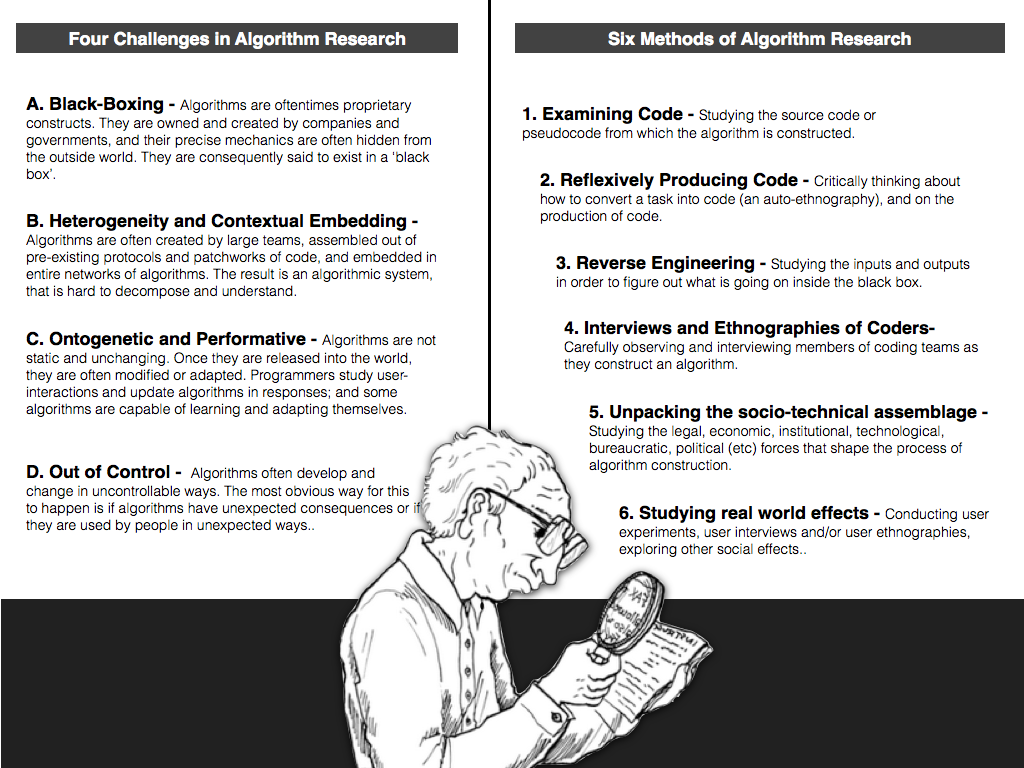
The challenges and methods for studying algorithms


We need to be alive to the challenge that most software we may be interested in is proprietary, although not always and we can look to repositories like GitHub for plenty of open source code, and so it may actually prove impossible to gain access to the code itself –– and here we’d really want the code of the whole programme, and perhaps the training data too. Likewise, software like any complex endeavour may well be the result of collective authorship and maintained by lots of different people. So there are complex sets of relations between people, laws, protocols, standards and many other considerations to negotiate – they are contextually embedded. Furthermore, the programmes we’re calling algorithms here actually have a hand in producing the world within which they exist –– they may bring new kinds of entities and relationships into existence, they may formulate new and different forms of spatial relation and understanding. In this sense they are ontogenetic and performative. Added to this, once ‘in the wild’ this performativity can render the kinds of outcomes of a programme unexpected and peculiar, especially once it is fed all sorts of data, adapted and adopted in unexpected ways.

How can we go about studying these kinds of socio-technical systems then? Well, rather than treat as discrete the six techniques offered by Kitchin (summarised above) – I’d argue we need to combine most of these. Even so, it may prove extremely difficult to actually gain access to code. Further, even if one might reflexively produce code and/or attempt to reverse engineer software –– some systems are the product of companies with such extensive resources that it may well prove near-impossible to do so. Where social scientists might find more traction and actually be able to make a more valuable contribution is, as Kitchin suggests, looking t the full sociotechnical assemblage. We can look at the wider institutional, legal and political apparatuses (the dispositifs) and we can certainly look at the various kinds of relation the assemblages make and how they are enrolled in performing the world they inhabit.

Make no mistake – this kinds of research is necessarily hard. I’m not sure I can imagine papers in geography journals that tie the a/b testing logs of experiments in how a given system works and commit logs to version control systems (even if you could access them!) to particular forms of experience and/or their political consequences… but it might be worth a go. Perhaps this difficulty is why we see (and I am as guilty as any of this) papers written in abstract terms, focusing on the (social) theoretical ways we can talk about these sociotechnical systems in broad terms.

Like Bogost, I can see a kind of pseudo-theological romancing of the ‘algorithm’ and the agency of software in much of what is written about it, and its sort of easy to see why – it is so abundant and yet relatively hidden. We see effects but do not see the systems that produce them:

Algorithms aren’t gods. We need not believe that they rule the world in order to admit that they influence it, sometimes profoundly. Let’s bring algorithms down to earth again.

The algorithm as synecdoche is a kind of ‘talisman’, as Gillespie argues, that reveals something of what Stiegler calls our ‘originary technicity’ – the sense in which we (humans) have always already been bound up in technology and its the forgetting and then remembering of this that forges our ongoing reconstitution (transindividuation) of ourselves.

So, I’d like to end with Kitchin’s argument:

it is clear that much more critical thinking and empirical research needs to be conducted with respect to algorithms [and the software and sociotechnical systems in which they are necessarily embedded] and their work.

Addendum:

It is worth noting that both Gillespie and Kitchin draw on another paper that is very much worth reading by Nick Seaver, who reminded me of this on Twitter, take a look:

“Knowing Algorithms“, presented at Media in Transition 8, Cambridge, MA, April 2013 [revised 2014].

Reblog> Negotiating Affect in Media/Cultural Studies

Jussi Parikka blogs about an interesting review of Dean’s Blog Theory, Shaviro’s Post-Cinematic Affect and his own Insect Media, by Greg Goldberg.

Negotiating Affect in Media/Cultural Studies

I came across this earlier review essay “ Negotiating Affect in Media/Cultural Studies“ (PDF)  of Jodi Dean’s, Steven Shaviro’s and my own book (Insect Media) which might interest some people out there.

It was published in WSQ: Women Studies Quarterly 40 (1&2, Spring/Summer 2012).

Reblog> Klimahaus ~ the world interior of climate (by Martin Mahoney)

Martin Mahoney has written a nice piece reading his visit to the ‘climate museum’ Klimahaus in Bremerhaven through Sloterdijk’s World Interior of Capital.

Here’s some excerpts and then a link to the full post below, it’s worth a read:

The two main strands of Sloterdijk’s argument in the World Interior neatly map onto the two main sections of the Klimahaus. In the first, we follow an ‘explorer’ boldly setting out to discover spaces which do not belong to his own lifeworld. Suitcase in hand, he embodies contemporary residues of the ‘Geography Militant‘ culture which Felix Driver argues can be detected in diverse discourses and media, a long time hence from its Victorian apogee. The presentation of other cultures as situated timelessly within particular spaces and climates, displaying ahistorical ‘customs and traditions’, recalls much earlier modes of knowing and representing the anthropological Other.

…

The ‘Climate Protection’ section offers climate not as an exterior space to be explored, but as part of a modern interior which must be carefully calculated and managed. The symbolic media of this calculation are many and varied: the ice core, the computer model, the ‘personal climate account’. But amid these calculative rationalities uncertainties proliferate, which are domesticated through personal stories from the future offered by characters we met on our first voyage

Klimahaus Bremerhaven: in the world interior of climate

I recently visited the Klimahaus in Bremerhaven, northern Germany along with cultural anthropologist Werner Krauss. Klimahaus is a unique museum dedicated to humanity’s relationship to climate. The main body of the museum leads visitors on a journey along the line of 8-degrees Longitude, following a modern-day explorer as he heads south from Bremerhaven to Switzerland, through Italy and the Sahara, into Cameroon, across the south Atlantic and over Antarctica. From there visitors head across the Pacific, calling in on Samoa and Alaska, before looping back to northern Germany at Hallig Langeness. At each stop, visitors enter an exhibition dedicated to the climate of the location, exploring its role in shaping human life and culture. In a rather old-fashioned anthropological tradition, we are introduced to the ‘customs and traditions’ of the locals, while immersed in the heat or cold, humidity or aridity of their climate.

Read the full blogpost on Topograh blog.