The Office of Archaeologies of Media & Technology… (I think my former colleague Seth Giddings is a member… which is a big positive in my book )
“Fleetlights” – Direct Line ‘prototype’ UAV lighting as a service
Via Anna Jackman.
Plenty to be said about this and not enough time right now, but..:
Ambient literature – new research project
Former colleagues at UWE in the Digital Cultures Research Centre are formally launching their project on what they call ‘ambient literature’ this Friday.
There’s some info on the project copied below, it follows on from a trajectory you can trace through the ‘pervasive media’ canon (with the lovely people from Calvium [many formerly of HP Labs Bristol] instrumental in how this has been technically achieved), from the Mobile Bristol RIOT! 1831 project, Duncan Speakman’s subtle mobs, the fabulous Fortnight project from Proto-type, Curzon Memories, REACT projects like These Pages Fall Like Ash and (my colleague Nicola Thomas’) Dollar Princess – a rich and varied history of work…
Ambient Literature is a two-year collaboration between the University of West England, Bath Spa University, the University of Birmingham, and development partners Calvium, Ltd. established to investigate the locational and technological future of the book. Funded through a grant from the Arts and Humanities Research Council, the project is focused on the study of emergent forms of literature that make use of novel technologies and social practices in order to create robust and evocative experiences for readers.Launched in London, Bristol and online in June 2016, the project draws on the REACT Hub’s experience working with creative industries in order to produce three experimental projects from three different authors. Forming the heart of the project, these commissioned pieces allow researchers to study the processes of innovation and negotiation that become visible as established authors work in the new forms opened up by the idea of Ambient Literature. Combining practice-based, empirical and theoretical research, the project seeks to test out new literary forms and develop a grammar for writing Ambient Literature.
This is an interdisciplinary project focused on understanding how the situation of reading is changing through pervasive and ubiquitous computing. Drawing on literary studies, creative writing, design, human-computer interaction, performance and new media studies, the research being developed looks to engage with the history of the book and see what that history is able to tell us about its future.
“At play on the field of ghosts” – James Bridle on code/spaces of competitive sport
Reflecting upon the increasing instrumentation of the sporting field off play, for spectating, e.g. the ‘Hanwha chickens‘, and for the judgement of rules, e.g. ‘HawkEye’, James Bridle has written a nice piece on Medium about how the idea/ideal of ‘sport’ may be getting translated into something else…
This distinction between the actuality of the event and the fidelity of its recreation is narrow and could easily be dismissed as just another conjuration of spectacular TV coverage, were its remit limited to mere representation. But in the hyper-competitive domain of sports, lubricated with broadcasting and gambling dollars, recreation turns into prediction, and representation into judgement. The distinction between what is seen and what occurs becomes crucial.
More and more, the practice of human adjudication in sports is being crowded out by the supposed superiority of machine perception; a perception which is based on the recreation and prediction of real events, rather than their explicit witnessing. Since 2001, the Hawk-Eye computer system has become increasingly ubiquitous in major sporting competitions, combining machine vision with motion analysis to not only declare where precisely a ball touched or crossed a line, but where the ball would have gone if it were not rudely interrupted.
Behaviourism, productivity & the ‘quantified self’

Steven Poole, in the New Statesman, on “How the craze for Apple Watches, Fitbits and other wearable tech devices revives the old and discredited science of behaviourism“:
Arguably, this authoritarian strand of behaviourist thinking is what morphed into the subtly reinforcing “choice architecture” of nudge politics, which seeks gently to compel citizens to do the right thing (eat healthy foods, sign up for pension plans) by altering the ways in which such alternatives are presented.
By contrast, the Apple Watch, the Pavlok and their ilk revive a behaviourism evacuated of all social concern and designed solely to optimise the individual customer. By using such devices, we voluntarily offer ourselves up to a denial of our voluntary selves, becoming atomised lab rats, to be manipulated electronically through the corporate cloud. It is perhaps no surprise that when the founder of American behaviourism, John B Watson, left academia in 1920, he went into a field that would come to profit very handsomely indeed from his skills of manipulation – advertising. Today’s neo-behaviourist technologies promise to usher in a world that is one giant Skinner Box in its own right: a world where thinking just gets in the way, and we all mechanically press levers for food pellets.
Echoes a common trope of theorising “subjectiv(is)ation” as a process (often labelled “neoliberal”, for good value) that gets done to a being/person… which gets entangled in an all-encompassing ‘labour theory of value’ but that’s a longer discussion…
Contested Cities conference ~ July 2016, Madrid
Saw this via Gillian Rose on Twitter, looks interesting!
As part of our upcoming Conference in Madrid (July 4-7, 2016), the Contested Cities network and its partners invites contributions for a radical mixed- and multi-media exploration of contestation and cities. Our goal is simple – to challenge people everywhere to see cities and the struggle for their past, present and future in a new light, and to do so by gathering an international set of creative projects in one place. We think we can do that in part by using all of the new audio and visual tools at our disposal. We have some ideas ourselves, but are looking globally for those who want to join in.
We encourage and actively seek contributions from amateurs and professionals alike – expert videographers who may be amateur urbanists, expert urbanists who are amateur photographers, people who wear multiple hats comfortably, data visualization nerds, map geeks, audioheads, visual artists and everyone in between. If you are someone new to both thinking about cities and visualizing them, and simply had a moment of inspiration and now have a provocative project they want to show someone, send us your project!
Accepted projects will be shown via slideshow at the Congress, and we hope to invite some of the best submissions for an international book project. We may also build a web version, but will ask permission before posting your work.
All “authors” will be invited to attend, but alas we cannot cover registration fees. There is no fee for submission.
Reblog> Bite Size Theory [on the presence/absence of mobile phones]
via Pop Theory:
“The presence/absence of mobile phones in one’s fictional worlds is going to be, I suspect, no trivial matter. Because so much of the mechanics of novel writing, past and present, is taken up with making information available to characters or keeping it from them, with getting people together in the same room or holding them apart. If, all of a sudden, everyone has access to more or less everyone else – electronic access, that is – what becomes of all that plotting?”John Coetzee, in Paul Auster and J.M. Coetzee, 2013, Here and Now: Letters 2008-2011.
Checkout @TOPOSExeter for some great art & events

This is post is really an invite, from the cultural geographers at Exeter, to an exhibition & associated events that are taking please this week at TOPOS on St. Sidwell’s street – with input and support from Prof John Wylie (Head of Geography at Exeter), and from Ian Cook et al. and Paula Cutchlow’s magnificent Museum of Contemporary Commodities.
TOPOS is a distinctive space for artistic installation/ exhibition/ discussion in Exeter, hosted and run by Volkhardt Mueller and is well worth a visit. So, please do!
This week’s new exhibition, Art-Articles, by Berlin artist Konstantin Bayer, offers a set of installations and objects which comment upon, and invite direct exploration of, contemporary encounters with commodification, originality, materiality and nature. See the link below for details of Bayer’s distinctive approach and products:
There will be a private viewing at TOPOS on Wed May 11th 17.30 – 18.30, and the exhibition will have regular opening hours in the days following (details here). There will also be a conversation/discussion event at TOPOS, on the themes of Landscape, Art & Commodity, Friday May 13th, 18.00 – 21.00
Please visit the TOPOS website for details of how to find it. And consider following them on Twitter for more information.
And here is a link to book a place at the discussion event on Friday: https://www.eventbrite.co.uk/e/topos-conversation-art-landscape-commodity-tickets-25235555225
The Museum of Contemporary Commodities in EXETER

Just a quick note to let you know that the brilliant Paula Crutchlow has brought “The Museum of Contemporary Commodities” (MoCC) to Exeter for the majority of May.
There’s lots going on, much of it creative and interesting – so if you’re in Exeter or nearby: come and visit!
Two immediate things this week:
RIGHT NOW!: help re-create the internet in paper with Artist Louise Ashcroft from 11 -2 in the Exeter University Forum.
TOMORROW: sign up to do a data walkshop with Alison Powell from the LSE on Saturday from 10-1. Places have to be booked, and the Eventbrite page is here https://www.eventbrite.com/e/mocc-data-walkshop-tickets-24464719635
Please do visit the MoCC website for lots more events and activities taking place this month and visit the shop:
87 Fore St,
Exeter
EX46RT
Open 10:00-18:00pm Weds-Sat, 4th-21st May.
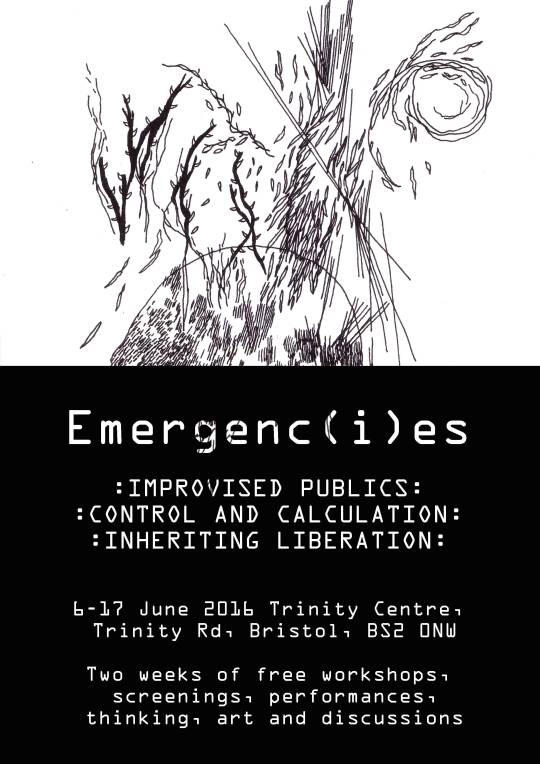
Reblog> Improvised Publics :: Control and Calculation :: Inheriting Liberation :: 6-17 June 2016
This event looks really interesting, check out the website for more information…
Emergenc(i)es is an invitation to consider the emergency of the current historical moment.
The exhibition will dwell in the question of emergence within emergency.
Performance, education activities, visual art, screenings, installations, workshops and a library-cum-pharmacy will create time and space to diagnose, explore and understand the world we live in.
Enter – Relate – Improvise – Diagnose – Inherit – Public – Liberate – Gather
All activities are free to attend, thanks to generous funding from Awards for All.