Reblog> Ordinary digital humanities – event with @rodgers_scott

Another interesting event, this time with Scott Rodgers at Birkbeck.

Ordinary digital humanities: Free event at Birkbeck, 15 May 2017
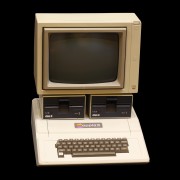
Apple_II_IMG_4212In a couple of weeks’ time I am happy to be hosting an event as part of Birkbeck Arts Week on the subject of ‘Ordinary Digital Humanities’, featuring a talk from Lesley Gourlay (UCL Institute of Education). The publicity blurb below has more than enough information, I suspect, for you to get the idea. The event comes in significant part out of discussions we’ve been having through Satellite, an experimental subcommittee in the School of Arts at Birkbeck focused on exchanging information and perspectives on the critical, creative, academic and pedagogical dimensions of learning technologies.

Ordinary Digital Humanities
The everyday life of digital technologies in pedagogy

15 May 2017, 6pm, Keynes Library, 43 Gordon Square, WC1H 0PD (part of Birkbeck Arts Week)

Book your free place at: https://www.eventbrite.co.uk/e/ordinary-digital-humanities-the-everyday-life-of-digital-technologies-tickets-33211361075

When one hears the term ‘digital humanities’ what likely comes to mind are innovative applications of computational techniques and technologies to humanities research as well as pedagogy. Or, conversely, the application of concepts and philosophies rooted in the humanities toward the study of emergent digital objects.

There are reasons however to think about the digital humanities in a more ordinary sense, beyond ‘cutting edge’ research or pedagogy. In the introduction to her book How We Think, N. Katherine Hayles suggests that in order to understand the implications of digital technologies for the humanities, we must first consider the ‘low level’ implications of digital technologies for academic life. For instance, the widespread normalisation of email, department websites, software applications, web searches, social media, and much more. For Hayles, a ‘digital humanities’ is more than just innovative new approaches to research and pedagogy. It is also inherently about transformations to the cognitive and embodied environments of academic life at the level of the habitual or everyday.

This forum considers the banal dimensions of the digital humanities, focusing specifically (though not exclusively) on pedagogical practice. It begins with an opening lecture from Dr Lesley Gourlay (abstract below), followed by responses from Dr Grace Halden and Dr Tim Markham from Birkbeck, University of London. We will not only survey the everyday ways digital technologies are being used, and are asserting themselves, in academic life; but also, how humanities and other scholars might respond to the apparent opportunities and intrusions wrought by digitisation.

The event will be followed by a wine reception.

Flickering texts and the writing body: posthuman perspectives on the digital university

Dr Lesley Gourlay, Reader in Education and Technology, UCL Institute of Education

As digital technologies become increasingly central in our day-to-day lives, we see profound changes in how we search for information, communicate with others, and express ourselves. The university is also changing, as digital media becomes more central via online resources for distance learning, but also throughout the traditional campus, through the mainstream use of digital media for teaching, library provision and academic reading and writing. This has not only changed approaches to academic teaching, it has also fundamentally altered how we seek resources and how we read and generate new knowledge through writing and interaction. Drawing Hayle’s notion of ’embodied virtuality’, this talk will explore this theme, analysing data from a research project which looked in detail at how a small group of students approached their studies over a six-month period, using drawings, photography and interviews to form an in-depth understanding of their day-to-day lives as students, and how they navigate the complex digital and material landscape of the contemporary university. It looks at how texts change when they move between paper-based and the digital, how students navigate the complexities of multiple devices and formats, how they make spaces for writing and knowledge while on the move, and how they form part of ‘posthuman’ networks of digital devices and material objects in order to engage in their studies. Taking a historical perspective, the talk concludes that textual practices have always been central to how higher education is organised and how we understand ‘knowledge’, and considers how digital media might continue to change what we call ‘the university’.
Elemental machines – the becoming environmental of tech

Via dmf.

With: Andreas Broeckmann, Esther Leslie, Sascha Pohflepp
Moderated by Yvonne Volkart

“The concept of machines generally describes an assemblage of parts assigned to an overall function, designed by a human. Yet, the entwined histories of science, technology, and art are filled with ideas about nature functioning like machines, and of visions where machines become “natural” and organic. These two paths seem to merge as machines increasingly communicate autonomously and operate in fields beyond human perception and influence. Can we devise new perspectives for understanding the elemental machines that now seem to operate contingently within hybrid techno-ecologies like the forces of nature? What are the new aesthetic and political affordances or subjectivities involved in the process of technology becoming environmental?”

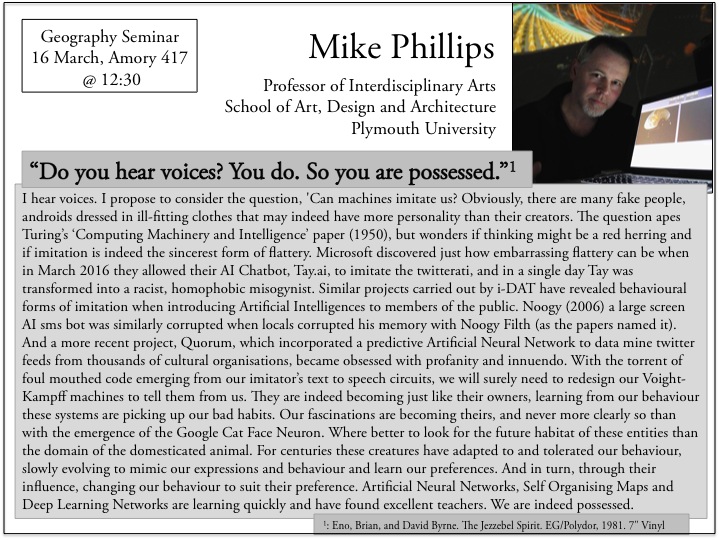
“Do you hear voices? You do. So you are possessed” – @mikedotphillips talk @exetergeography

I’m really pleased to share that Prof. Mike Phillips (i-DAT, Plymouth) will be speaking  next week as part of the Exeter Geography seminar series. Mike is a founder of the Institute of Digital Art and Technology and one of the founders of the undergraduate programme I studied MediaLab Arts, which is now called  Digital Media Design.

Details: Thursday 16th March, 12:30: Amory 417. All welcome!

Reblog> Disrupting the Humanities: Towards Posthumanities – Special issue of JEP

Via Gary Hall

Disrupting the Humanities: Towards Posthumanities – Special issue of JEP

We are pleased to announce the publication of a special issue of the Journal of Electronic Publishing: ‘Disrupting the Humanities: Towards Posthumanities‘, edited by Janneke Adema and Gary Hall.

‘Disrupting the Humanities: Towards Posthumanities’ consists of a selection of video articles by Johanna Drucker, Mark Amerika, Erin Manning, Monika Bakke, Endre Dányi, Lesley Gourlay, Silvio Lorusso, Niamh Moore, Karen Newman, SØren Pold, Craig Saper, Sarah Kember, and Iris van der Tuin.

It is available for free, open access, CC-BY, here:
http://www.journalofelectronicpublishing.org/

This special issue of the Journal of Electronic Publishing is based on ‘Disrupting the Humanities’. This was a series of seminars exploring research and scholarship in a posthumanities context organised by the Centre for Disruptive Media at Coventry University in the UK. Disrupting the Humanities both critically engaged with the humanist legacy of the humanities, and creatively explored alternate and affirmative possible futures for the humanities. The series was accompanied by a wiki that is still available here: http://disruptivemedia.org.uk/wiki/

‘Posthumanities: The Dark Side of “The Dark Side of the Digital”’

Adema and Hall have written a 10,000 word opening essay, discussing the conceptual premises that underly this special issue. Engaging with various discourses around the digital humanities, the essay outlines the experimental mode in which the videos included in the issue have been edited – as well as pointing to the idea of “posthuman humanities”.
Link: http://dx.doi.org/10.3998/3336451.0019.201

A table of contents for this special issue of the Journal of Electronic Publishing is provided below.

—–

Disrupting the Humanities: Towards PosthumanitiesThe Journal of Electronic Publishing (JEP)

Volume 19, No. 2 winter 2016

Edited by Janneke Adema and Gary Hall


Contents

1  Maria Bonn, A Note From JEP

2 Janneke Adema and Gary Hall, Posthumanities: The Dark Side of “The Dark Side of the Digital”

PART ONE – Creating Posthumanities: Disrupting Humanities Methodologies

Part one of Disrupting the Humanities consists of a radical exploration of new posthumanist methodologies that take into account the agency of technologies and other non-human actants involved in modern forms of knowledge production.

3   Monika Bakke, Deep Time Environments: Art And The Materiality Of Life Beyond The Human

4   Lesley Gourlay, Posthuman Texts: Nonhuman Actors, Mediators and Technologies of Inscription

5   Niamh Moore, “Humanist” Methods in a “More-than-Human” World

6   Iris van der Tuin, Reading Diffractive Reading: Where and When Does Diffraction Happen?

PART TWO – Performing Posthumanities: Disrupting Humanities Aesthetics

Part two looks at the ways in which research is mediated and performed. It focuses on a reconsideration of the aesthetics of scholarship, including the “aesthetics of bookishness.” In doing so it investigates the potential of more post-digital, hybrid and multimodal forms of knowledge creation.

7   Erin Manning, 10 Propositions for Research-Creation

8   SØren Pold, Ink After Print: Literary Interface Criticism

9   Johanna Drucker, Diagrammatic Form and Performative Materiality

10  Silvio Lorusso, The Post-Digital Publishing Archive: An Inventory of Speculative Strategies

PART THREE – Circulating Posthumanities: Disrupting Humanities Institutions

Part three of Disrupting the Humanities provides a critical examination of how research is disseminated and shared, be it by publication to peers or to students in a pedagogical setting, or by adopting practices of radical openness and experimentation to challenge the normative and often print-based (neo)liberal humanist assumptions of how scholars in the humanities communicate.

11   Sarah Kember, At Risk? The Humanities and the Future of Academic Publishing

12   Endre Dányi, Samizdat Lessons: Three Dimensions of the Politics of Self-Publishing

13    Craig Saper, Disrupting Scholarship

14    Mark Amerika, Glitch Ontology (A Video Performance)

15    Karen Newman, The West Midlands as an ‘Electronic Super Highway’: BOM and the Emergence of New Art Infrastructures