I wrote some time ago about our issues with keeping Clive Barnett’s website PopTheory alive after his very sad and untimely death, I am now able to offer some good news:
and we have a plan for the long-term sustainable upkeep of the site.
I hope the site’s overdue return is good news for those in GeographyLand, and those beyond, please do make use of the site.
There’s all sorts of things that could be said about situations like this (Clive was, incidentally, really good at unpicking understandings of ‘situation’) – as Jacques Derrida (one of several touchstone philosophers/theorists for Clive) variously addressed, legacy, remembering and mourning are complicated and often difficult. Maintaining a legacy such as a website, a library or other traces (again, in the language of Derrida) exceeds capacities in different ways.
So much to say, and I don’t have the heart for it today. So much to say about what has happened to us
Derrida, J. 1998 “I’m going to have to wander all alone” (trans. L. Lawler), Philosophy Today 42 (1): p. 3 (a tribute to Gilles Deleuze)
As we come to the end of an academic year, emerge from underneath the ever growing heap of administration that tumbles on top of many university staff at this time of year, we can be, understandably, reflective. I have a few things ending, or that have ended, this academic year. A couple of milestones too.
My first time being a Principle Investigator came to an end at the beginning of the academic year – a role I had not expected to take on, yet, which was rewarding but hard. I became ‘PI’ because my colleague, and friend, Clive Barnett suddenly and unexpectedly died at the end of 2021. Through the Algorithmic Politics after Brexit project I learned about digital government in the UK, about many things I didn’t know about Brexit, and I learned how (not) to manage. One of my proudest moments associated with the project (though not really anything I did) was my friend and colleague Kuba Jablonowski’s appointment to a permanent Lectureship at Bristol – a really wonderful (‘unofficial’) outcome for the project and one I am certain Clive would have celebrated too.
My first peer reviewed article came out, at least as ‘Early Online’ anyway, since 2018. The paper is part of a theme issue in Environment and Planning D: Society & Space that originated in an event in Singapore convened by Weiqiang Lin, Peter Adey, Tina Harris and Dylan Brady about automation in the time of COVID-19. Somewhat ironically, I gave that original paper online, rather than in-person, because I actually had coronavirus (I’d love to finally go to Singapore one day). I took a long time getting that article over the finish line, with wonderful support from Weiqiang and Dylan in Singapore, as well as Federico Caprotti and Sean Carter at Exeter, because of the mental health issues that had influenced the preceding gap in publications.
This is absolutely not intended as a ‘poor me’ post. I am very sorry if I have got the tone wrong such that it comes across that way. Rather, I wanted to reflect on the things that happen in life that dictate or influence the pattern of a career, which are (for all sorts of reasons) not visible on a CV, or LinkedIn, or ORCID, or the other quasi- ‘official’ ways we present ourselves professionally. Sometimes it can feel like real ‘feelings’, not the humble bragging of social media, are forbidden. Sometimes a peculiar form of nihilism is mistaken for stoicism. We can seem to only see the prosaic sharing of ‘delighted’ announcements and not the fuller story.
Without wishing to over-share, I have a story that sits behind the lack of writing. I lost my father in 2018 after a long battle with non-alcohol-related liver disease. He had survived various treatments, a liver transplant and many setbacks. With two children born during the time of his illness, my wife and I both found it immensely challenging. Very soon after his death we contended with another family illness and bereavement in my wife’s family. The pandemic happened and all of us clapped, stayed indoors, eat out, went back indoors, knocked elbows, met on Teams and Zoom. Clive passed away. My former head of department and commuting companion (on trains to/from Bristol) Henry Buller also, very sadly, passed away due to cancer. Life happens. I didn’t write. I felt I couldn’t.
Colleagues can be very kind. Even those you don’t know well. I had a bad habit, in the days of Twitter (as was), of expressing my feelings in an un-guarded way and on more than one occasion – perhaps unprofessionally – I said I felt I wasn’t coping or that I was watching my career fizzle out. I received responses from colleagues offering support. I received some informal mentoring from one of them. Academic community matters. While there are, undoubtedly, more helpful and more professional ways of seeking help, I definitely recommend doing so.
I applied for a job, at a different university, a couple of years ago. In my CV and covering letter I made some reference to the gaps in my publication record and tried to offer a positive and ambitious plan for the future, rather than dwell on the past. I was not shortlisted. I requested feedback and was told that I needed to be explicit in providing reasons for the gaps, to explain why I had become PI after the project had already started. more recently, I applied for promotion and tried to learn from the feedback – to explain, in a professional manner, the gaps and to demonstrate my ambition. I received constructive feedback that I hope will help me work towards career advancement in the future.
There has been plenty of commentary about the perceived artificialness of self-promotion on social media and on professional profiles. There are LinkedIn jargon generators, a simple search brings up a lot of them, there are satirical commentaries and videos about self-promotion. My own bot, GeoCritBot (formerly of Twitter, now on BlueSky) was an attempt to satirise both the forms of self-promotion and also the kinds of academic jargon that we tend to use. It is, perhaps, all-too-easy to be cynical and even snide about such things – but I think I/we need to try to resist that temptation.
All of us, of course, have stories broader than the one told on a CV, or on LinkedIn. Some people succeed in academia even in profoundly difficult circumstances. Some people leave, sometimes without choosing to do so. Some of us are not, and don’t necessarily want to be, the stellar Professor. Most of us contend with ‘rejection’ regularly – for publication, for grants and, perhaps, for jobs. Some of us don’t embody the ‘vocation’ of academia, perhaps see it as ‘work’. Life events happen, we all have to deal with them. There can be, perhaps has to be, ways of telling some parts of these wider stories as work lives are complicated by the rest-of-life happening. I am not advocating for over-sharing, I am far too British(!), nor for radical transparency, although I do believe in ‘open’ research. I am not really able to offer any neat solution. I want to reflect on reflecting – to think about how not to feel negative about perceived fallings-short. Comparison can be the thief of fulfilment. ‘We’/’I’ can’t be ‘them’, but we can try to find ways to be a good ‘us’/’me’.
Celebrate your successes. Find ways to tell the story of adversity professionally and without underselling yourself. Celebrate other people’s successes too, however you feel comfortable about doing so (in a kind and professional manner). We can’t know some of the challenges people go through, often – we shouldn’t. However, even in a system that rewards individualism, that still reveres the ‘big name’, we can and should look for ways to advocate for and support one another, to work together, where we can. Solidarity is important.
Lastly, even when everything is hard, hold on to the little wins.
As professionals we claim only that we are privileged to devote ourselves to the field of geography. Neither we nor our academic predecessors discovered the field, nor have we been the only ones who have tilled it … We have never been more than a few of those who contributed to the growth of geographic knowledge. The interest is immemorial and universal; should we disappear, the field will remain.
Carl Ortwin Sauer, The Education of a Geographer (1956)
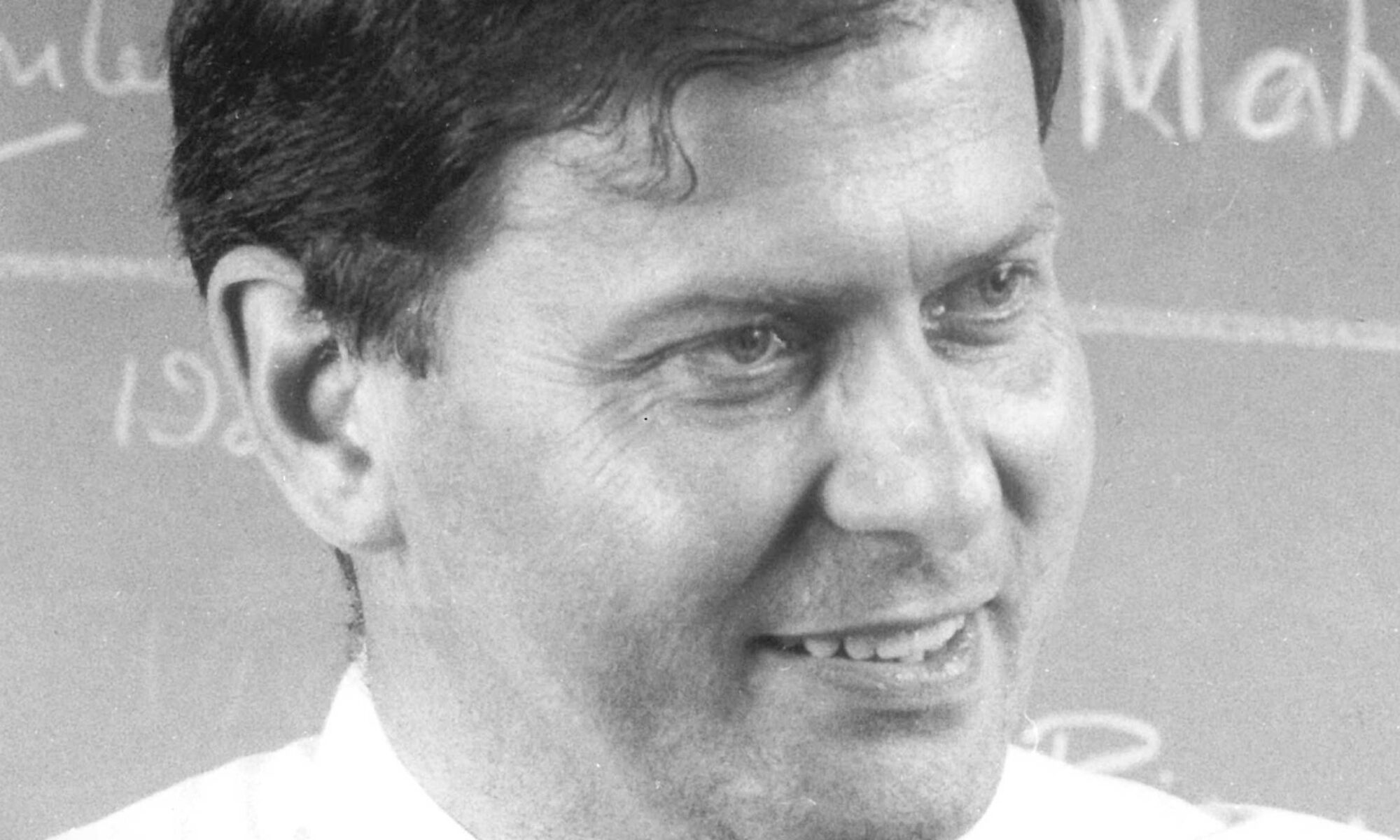
I am late to note the passing of Prof. Peter Haggett, a significant figure both at the University of Bristol and in Anglophone geography in the 20th century. There is an obituary for him on the University of Bristol website. I was a postgraduate ‘demonstrator’ teaching undergraduates spatial statistics in the Haggett laboratory throughout my PhD years at Bristol, one of the homes of the ‘quantitative revolution’ – not least because of Prof. Haggett being there. The above quote appears in the opening pages of Haggett’s (1990) book ‘The Geographer’s Art’ and seems appropriate to quote in recognising the significant contribution he made to the field. I have one book fro the significant library he slowly disposed of in his years as Emeritus professor, on the geography of telecommunications, taken from a table full of volumes that spanned a really diverse range of topics. I saw him only once, in a lecture in the re-inauguration of the Peel lecture theatre of the geography building, the oldest building of the university of Bristol. He was a modest man, keen to celebrate the work of others (in the lecture it was the second Chair of Geography at Bristol R.F. Peel) and alive to, and respectful of, the variety of standpoints within the discipline.
Kevin Cox, on his blog, offers some reflections on the extent of the ‘disruption’ the spatial science that Haggett pioneered was for our discipline and his words are very much worth reading*. Finally, in ‘The Geographer’s Art’, Haggett himself claimed that while ‘the study of geography at university will give scientific insight, provides skills [and] a philosophical framework for environmental and global problems’ that he believed
‘[geography’s] most precious gift is none of these. Geographical skills can enrich all the remaining years of one’s life so that what is seen is understood and appreciated’.
Geography remains. So, I hope, the memory of Prof Haggett’s contribution does as well.
* Incidentally, Cox’s book Making Human Geography is an excellent overview of the development of geography as a (modern) academic discipline.
This video, made and shared by the activist group More Perfect Union, offers some ‘real world’ insights into what it is like living next to a huge data centre, in this case one of Meta’s. The resources these things require and the material effects that has on the surrounding communities are issues that perhaps deserve more critical public attention.
Dr Jack Lowe, of UWE’s Digital Cultures Research Centre and fellow geographer, has created the excellent new game Pin the Tale, that is available now. Here’s a video aboutthe project:
Our sense of place is increasingly shaped by digital platforms and the algorithms that curate our urban experiences. We rely on online ratings to choose restaurants, share events in local Facebook groups, and use Instagram to envision neighborhoods before visiting. This era of digital placemaking redistributes the power to narrate urban life, giving global tech companies an influential role in how cities are imagined and planned. At the same time, urban publics now manifest in new empirical formats—not just through surveys or town hall meetings but through digital traces such as texts, images, and likes left on proprietary platforms. A type of unstructured urban data that can be analyzed using various computational tools. Beyond the sensor-based tracking of physical objects that we associate with the “smart city,” we can now engage in a form of soft city sensing, leveraging digital data to gain new insights into urban sensemaking.
This panel brings together four researchers to explore the potentials and pitfalls in this intersection of digital placemaking and computational methods. Across their empirical case studies they examine how GPS tracking apps shape perceptions of outdoor spaces, how local debates on transport and sustainability unfold across social media, and how digital practices—ranging from fashion discourse to craft beer reviews—both root places in local culture and connect them to global networks. Looking across these cases, the four panelists will explore how computational urban studies:
a) expand the methodological toolkit for measuring and mapping the city
b) supplement traditional methods such as surveys and interviews
c) introduce unique challenges related to bias and transparency.
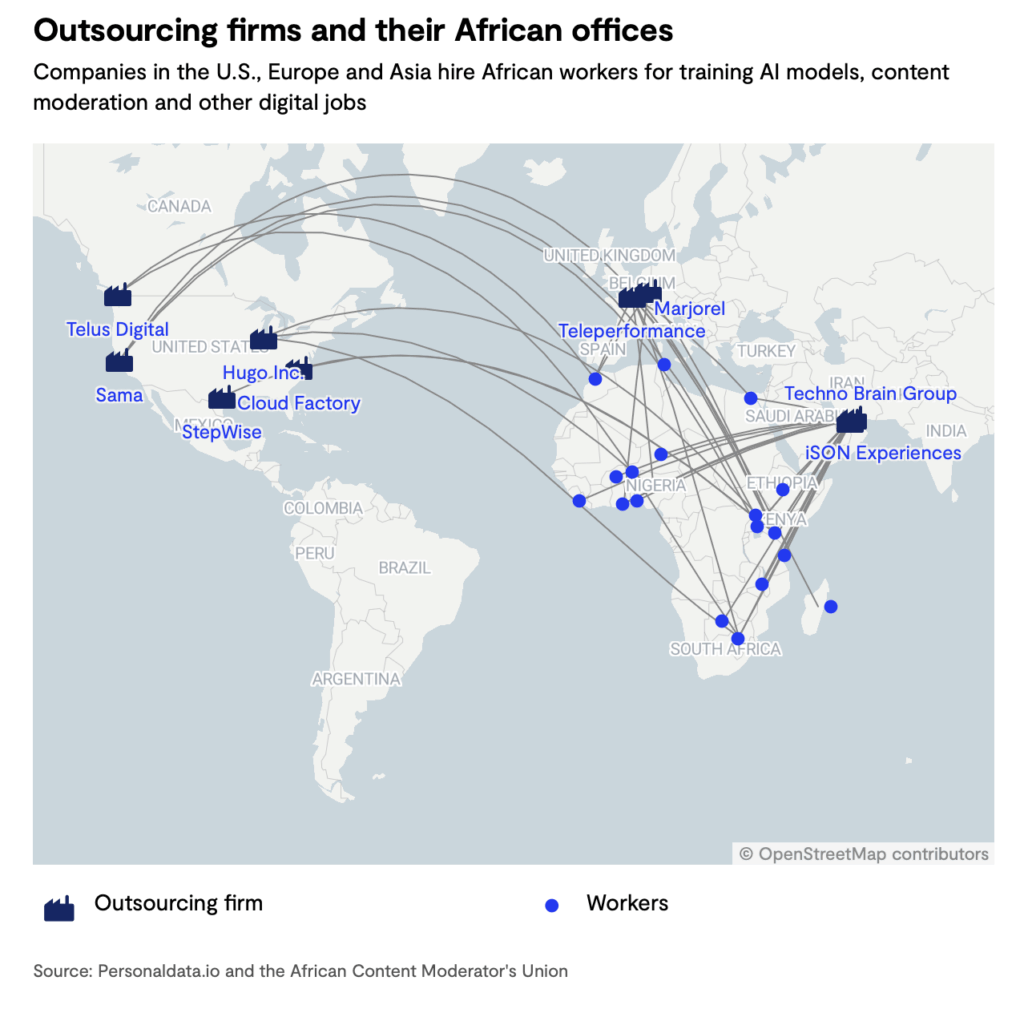
A new dataset, visualized as maps, reveals the extent to which African workers are indirectly employed in the tech sector, doing content moderation, customer service, and data annotation for AI models, among other jobs.