A ‘digital geographies’ working group for the RGS?

Prof. Gillian Rose has blogged about meetings she has been having with others about setting up a ‘digital geographies working group’ for the RGS. They are convening a meeting at this year’s RGS-IBG annual conference. Apparently you will be free to attend the meeting without registering for the conference. See Prof Rose’s blogpost for details.

I won’t be at the conference, so I won’t be at the meeting…

I suppose as someone that apparently has a stake in ‘digital’ things I should have an opinion – I confess I have mixed feelings. No doubt there are probably all sorts of conversations to be had, goodness knows there’s lots of people doing such research. I have no doubt that ambitious colleagues will drive such things forward. My one vague hope is that ‘professional’ geography doesn’t go the way of sociology and construct a ‘digital’ discursive regime…  For what its worth, I’ve very briefly posted on such things, following Kitchin et al’s draft position paper on this stuff.


Black flight & the new suburbia

I’ve just listened to an excellent programme on BBC Radio 4 by Hugh Muir concerning what he suggests is a move by people you might classify as BAME in the UK from urban areas to suburbs. Drawing on contemporary geographical research, this seems to me to be quite a good first year resource for urban/social geography, updating the 1990s story of suburbanisation we’re all familiar with teaching…

Here’s a link to the programme:

http://www.bbc.co.uk/programmes/b07jwt5s

Reblog> smart cities in the making: a new research project involving @ProfGillian

This is good news to belatedly share:

smart cities in the making: a new research project

I was really happy to hear from the Economic and Social Research Council last week that they are going to fund a research project that a great bunch of OU colleagues put together with me: Nick Bingham, Matt Cook, Parvati Raghuram, Sophie Watson and Oliver Zanetti.

Read more on Gillian’s blog.

Reflecting on a great paper on care-ful education by @JenniferJLea ~ self-discipline, devotion and the negotiation of authority

In between the marking I’ve been (at least) trying to catch up on all of the great work by colleagues in Geography at Exeter. One paper I’ve enjoyed reading is this by Jen Lea and Louise Cadman:

“It’s a fine line between “¦ self-discipline, devotion and dedication”: negotiating authority in the teaching and learning of Ashtanga yoga.

The article is for Cultural Geographies. Using empirical work on the learning and teaching of Ashtanga yoga Jen and Louise reflect on the kinds of (non-traditional?) authority that are practised in the re-shaping of selves that takes place.

Jen and Louise use Foucault’s later lectures at the Collège de France and the History of Sexuality to position understandings of authority in a few ways (they also draw on work produced by the Authority Research Network, which is worth checking out). The folding of ‘internal’ and ‘external’ authorities, that somewhat relate to logos and tekne, in the learning and teaching of yoga is a really interesting trope. Cultivating inner authority as forms of techniques of the self is negotiated with the formal positions and gestures that are a form of discipline. This is not (or does not have to be) a relation of ‘domination’. The negotiation of different forms of authority, in a pedagogical praxis, can be a form of care [in the vein of epimeleia]. Of course, and as Jen and Louise point out, there is potential that

[t]he application here of the self on the self is a potentially problematic process, as the self is not necessarily malleable and compliant, and the possibility of  failing  to become an expert of the self, and the consequences of this failure, are interesting future questions to ask (p. 14).
I think the most striking element of the paper for me, having recently returned to reading Stiegler again, is the resonance between Jen and Louise’s interpretation of Foucault, through their empirical case study, and Stiegler’s reading of Foucault in relation to care. This comes through most forcefully in Jen and Louise’s conclusion and I think this is great:
‘Regardless of the expense, let’s seek out new teachers.’ (Foucault, p.151)
Towards the close of his very last lecture course, Foucault urged the value of teachers, not necessarily because of special authority lodged in the figure of any one individual teacher, but because of the external authority residing in the
logos which the (good) teacher will teach. It is a Socratic move, passing beyond ‘a teacher of tekne who can pass on his teaching to students’ (Foucault, p.152) – as in the educator who goes through the motions of transmitting ‘technical’, repeated, rote knowledge – towards the model of a teacher who communicates the logos (‘the missing teacher’) as arguably deeper truths about the care of the self. Such a teacher ‘will have to take care of himself [sic] by listening to the language of mastery (maîtrise) that comes from the logos itself’ (Foucault, p.152). In short, both teacher and taught are here positioned in relation to the external authority of a broader accumulated, guiding wisdom, and as such we vacate the more conventional (top-down) picturing of authority’s educational geographies […]. Yet, we perhaps shift even further from Heelas’s self-absorbed account of authority, with its individualistic (bottom-up) picturing of authority’s new-spiritual geographies […]. The key relation – of how educators educate, or how maybe they ought best to educate – becomes more firmly about a negotiated stance with respect to an overall ‘armature for life’ (Foucault, p.152), externally anchored and derived. (Lea & Cadman, 2016 p. 14)
Care is thus mnemotechnical, folding logos and tekne. Anyway – read the full paper! It’s good stuff.
The Foucault refs in the second extended quote are from The Courage of Truth.

Checkout @TOPOSExeter for some great art & events

TOPOS Exeter show: art-articles

This is post is really an invite, from the cultural geographers at Exeter, to an exhibition & associated events that are taking please this week at TOPOS on St. Sidwell’s street – with input and support from Prof John Wylie (Head of Geography at Exeter), and from Ian Cook et al. and Paula Cutchlow’s magnificent Museum of Contemporary Commodities.

TOPOS is a distinctive space for artistic installation/ exhibition/ discussion in Exeter, hosted and run by Volkhardt Mueller and is well worth a visit. So, please do!

This week’s new exhibition, Art-Articles, by Berlin artist Konstantin Bayer, offers a set of installations and objects which comment upon, and invite direct exploration of, contemporary encounters with commodification, originality, materiality and nature. See the link below for details of Bayer’s distinctive approach and products:

There will be a private viewing at TOPOS on Wed May 11th 17.30 – 18.30, and the exhibition will have regular opening hours in the days following (details here). There will also be a conversation/discussion event at TOPOS, on the themes of Landscape, Art & Commodity, Friday May 13th, 18.00 – 21.00

Please visit the TOPOS website for details of how to find it. And consider following them on Twitter for more information.

And here is a link to book a place at the discussion event on Friday: https://www.eventbrite.co.uk/e/topos-conversation-art-landscape-commodity-tickets-25235555225

The Museum of Contemporary Commodities in EXETER

The Museum of Contemporary Commodities

Just a quick note to let you know that the brilliant Paula Crutchlow has brought “The Museum of Contemporary Commodities” (MoCC) to Exeter for the majority of May.

There’s lots going on, much of it creative and interesting – so if you’re in Exeter or nearby: come and visit!

Two immediate things this week:

RIGHT NOW!: help re-create the internet in paper with Artist Louise Ashcroft from 11 -2 in the Exeter University Forum.

TOMORROW: sign up to do a data walkshop with Alison Powell from the LSE on Saturday from 10-1. Places have to be booked, and the Eventbrite page is here https://www.eventbrite.com/e/mocc-data-walkshop-tickets-24464719635

Please do visit the MoCC website for lots more events and activities taking place this month and visit the shop:

87 Fore St,
Exeter
EX46RT

Open 10:00-18:00pm Weds-Sat, 4th-21st May.

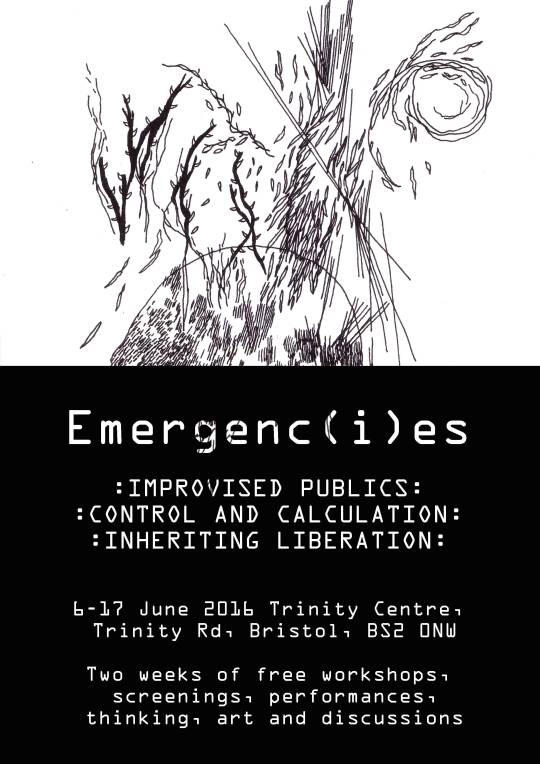
Reblog> Improvised Publics :: Control and Calculation :: Inheriting Liberation :: 6-17 June 2016

This event looks really interesting, check out the website for more information…

Emergenc(i)es – an event in Bristol between 6th and 17th June

Emergenc(i)es is an invitation to consider the emergency of the current historical moment.

The exhibition will dwell in the question of emergence within emergency.

Performance, education activities, visual art, screenings, installations, workshops and a library-cum-pharmacy will create time and space to diagnose, explore and understand the world we live in.

Enter – Relate – Improvise – Diagnose – Inherit – Public – Liberate – Gather

All activities are free to attend, thanks to generous funding from Awards for All.

Reblog> Launch Event: Researching Alternative Worlds: New political orientations in Geography

I’m taking part in the launch event of the Bristol Geography MSc Society & Space blog alongside some excellent and distinguished alumni of the course. It promises to be an interesting event!

The Official Launch of the Society and Space MSc Blog

4.00pm, Hepple Lecture Theatre, School of Geographical Science, University of Bristol

Register here

alternative worlds cover photos-1

On Wednesday 27th April, we will be officially launching the Society and Space MSc blog with a panel discussion event bringing together Society and Space alumni to discuss a common concern to all of their work – the role of academia in creating alternative social worlds. The Society and Space MSc Course is the principle Human Geography research training Master’s programme within the School of Geographical Sciences at the University of Bristol. As a Master’s degree that emphasises social and political theory, the programme trains students to think about social and cultural geographies from a critical perspective while also interrogating the political and ethical components inherent to these geographies. The programme has produced a range of alumni who have, in the course of their research, continue to contemplate and develop the issues, theories and debates they first encountered on the Master’s programme.

To officially launch the Society and Space blog, we have invited back Society and Space alumni – including James Ash, Emma Roe, Sam Kinsley, Nathan Eisenstadt, Owain Jones and Julian Brigstocke – to take part in a panel discussion centred upon pressing questions concerning our role as researchers in mapping alternative social worlds. What is the role of academic research in investigating, creating and sustaining alternative social worlds? When is academia useful and effective? What are we doing wrong, and what should we be doing more of?

Although a Master’s programme in Cultural Geography, the Society and Space MSc attracts students from a range of backgrounds and a variety of disciplines, such as journalism, English literature, philosophy, fine art and cultural studies. Due to the wide spectrum of backgrounds and interests of those who enrol in the course, as well as the dynamic nature of Human Geography as a subject, the contents covered in the Society and Space programme stimulate a range of conversations about the nature of sociality, the world we live in, and potential futures that may lie ahead of us. We expect that this diversity and broad outlook will be reflected in the work our speakers will present and the discussions that ensue. In addition to being a highly theoretical course, there is a strong, grounded political and ethical focus to the Master’s programme. Consequently, the issues debated, discussed and encountered throughout the Society and Space course are in direct conversation with ‘real’ issues – today’s hot topics and current political and ethical debates. In a context of austerity and the neoliberalisation of academia, the role of academia in researching and co-creating an alternative future is surely one such topic.

Alternative Worlds Poster-1

For a taste of the themes that the panel discussion will traverse, please have a look at abstracts provided by some of our panellists:

Dr James Ash, University of Newcastle

In this short reflection I offer one way of thinking about how we frame social science research questions. In doing so I want to caution against approaches which, however well meaning, centre on ‘big’ problems, framed in a general sense in relation to the concept of world. While issues such as climate change, poverty, homelessness and debt, amongst myriad others are undoubtedly real, there is an issue when assuming that a set of general problems are experienced within a shared horizon of meaning that is implied in the use of the term world. Rather than framing social problems in terms of big or small, or general or particular, I want to argue that such problems can be more productively framed in terms of what Simondon terms the abstract and the concrete. Drawing upon vignettes from the research design of an ESRC project on debt and digital interfaces, I demonstrate how Simondon’s work can be applied to specific societal problems.


Dr Nathan Eisenstadt, University of Bristol 

In this brief intervention I reflect on my doctoral work exploring paradoxes of freedom enacted in contemporary anarchist spaces. I propose that while performed inconsistently and in contradictory ways, the liberatory and egalitarian character of these practices lies in their capacity for an undoing of oneself with the help of compassionate others. Wonderful as this may sound – it has its edges. In closing I call attention to the failure of self-reflection and attempts to make spaces ‘safer’ when collectively established norms are radically transgressed.


Dr Sam Kinsley, University of Exeter

Computation is being used, within and without academia, to make ever grander and more detailed claims about our world. Yet, the (many) ‘worlds’ that emerge from what are generically referred to as ‘algorithms’ can be seen to fall foul of well-known fallacies of empiricism, in relation to their supposed lack of theoretical basis and apparent exhaustive reach. So, in light of grand claims made on behalf of ‘big data’ research and a contemporary predilection for the study of ‘algorithms’, I argue for a critical interrogation of the forms of world-ing propounded by such an ‘algorithmic imaginary’. In so doing, I suggest we reflect on what can be called a dialectic of ‘stupidity’ and ‘knowledge’, following Bernard Stiegler (2015), that undergirds our contemplation of such world-ings. My aim here is to tackle the inherent politics of this logic of worlds and how critical social scientists might engage.


Professor Owain Jones, Bath Spa University

My short presentation will reflect upon my experience of being in the first (very small) cohort of the MSc and then also devising and teaching the Nature and Society module from 2003-2006. I did not do an academic degree but an arts practice based degree so the MSc really marked my ‘conversion’ to academia and to geography. I can say without any exaggeration that doing the course was a life transforming and enhancing experience (as university (PG) education should be). The very possibility of imagining and enacting alternative worlds was very much part of that. My subsequent academic and professional life stands upon the very strong foundations put in place by the MSc and I think this is the case for many others too. I will offer some reflections upon why the course was so effective in this way. In part this was simply about being in a centre of excellence where there was a powerful intellectual momentum in which the conceptual and imaginative tools for questioning the trajectories of modernity were set out . But it was also about openness, spirit and collegiality with the staff and PG cohorts.

In addition to the panel discussion – which will be followed by time for audience questions – there will be a brief introduction by the Society and Space Blog Editors, before our very own Dr JD Dewsbury will recount his experience as first a student and then a lecturer on the MSc and map out how the course has changed and developed over the years.

The event will take place at 4.00pm, in the Hepple Lecture Theatre, School of Geographical Science, University of Bristol (see map). The discussion will be followed by a drinks reception. If you intend to attend (and we hope you do!), please confirm your attendance here.

We look forward to meeting you on 27th April.

The Editors