Reblog> Internet Addiction watch “Are We All Addicts Now? Video

Twitter

Via Tony Sampson. Looks interesting >

This topic has been getting a lot of TV/Press coverage here in the UK.Here’s a video of a symposium discussing artistic resistance, critical theory strategies to ‘internet addiction’ and the book Are We All Addicts Now? Convened at Central St Martins, London on 7th Nov 2017. Introduced by Ruth Catlow with talks by Katriona Beales, Feral Practice, Emily Rosamond and myself…

@KatrionaBeales @FeralPractice @TonyDSpamson @EmilyRosamond & @furtherfield

Algorave?

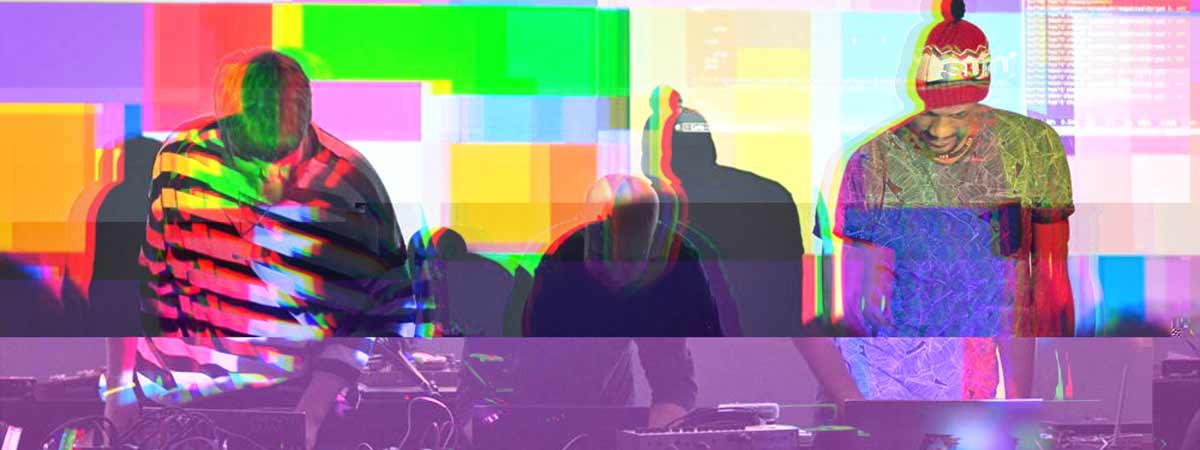
Algorave live coders

It occurs to me that my reference to Algorave in the last blogpost might not be something people know about… so:

Algorave is made from “sounds wholly or predominantly characterised by the emission of a succession of repetitive conditionals“. These days just about all electronic music is made using software, but with artificial barriers between the people creating the software algorithms and the people making the music.

Here’s the inimitable Alex McLean explaining more:

University of Bristol Jean Golding Institute’s Data Week 2018

The black cat in the film the matrix credited as deja vu or a glitch in the matrix

Just come across this via a colleague. Lots of interesting things on at the Jean Golding Institute as part of their ‘data week‘, including live-coding/algorave!

University of Bristol Data Week Timetable
Date Time Workshop Venue
Monday 25 June 10.00 – 13.00 Beginning Python 1.07, Merchant Ventures Building, BS8 1UB
Tuesday 26 June 09.00 – 17.00 Introduction to R in 6 hours 1.08, Merchant Ventures Building, BS8 1UB
Tuesday 26 June 09.00 – 12.00 A hands on introduction to 3D digitisation* LG05, 8-10 Berkeley Square, BS8 1HH
Tuesday 26 June 09.30 – 12.30 Introduction to Shiny 1.07, Merchant Ventures Building, BS8 1UB
Tuesday 26 June 13.00 – 16.00 A hands on introduction to 3D digitisation* LG05, 8-10 Berkeley Square, BS8 1HH
Tuesday 26 June 13.30 – 16.30 Introduction to ggplot2 1.07, Merchant Ventures Building, BS8 1UB
Wednesday 27 June 09.00 – 17.00 Introducing modern Generalized Additive Models 1.08, Merchant Ventures Building, BS8 1UB
Wednesday 27 June 10.00 – 13.00 Intermediate Python 1.07, Merchant Ventures Building, BS8 1UB
Wednesday 27 June 14.00 – 15.30 Colour as data Hepple Lecture Theatre, Geographical Sciences, BS8 1SS
Thursday 28 June 10.00 – 13.00 Data analysis in Python 1.07, Merchant Ventures Building, BS8 1UB
Thursday 28 June 10.00 – 12.00 An introduction to open research 1.20, 35 Berkeley Square, BS8 1JA
Friday 29 June 10.00 – 12.00 Introduction to machine learning 1.20, 35 Berkeley Square, BS8 1JA
Friday 29 June 14.00 – 16.00 Live-Coding / Algorave workshop Bill Brown Design Suite, Queen’s Building, Woodland Road, BS8 1TR

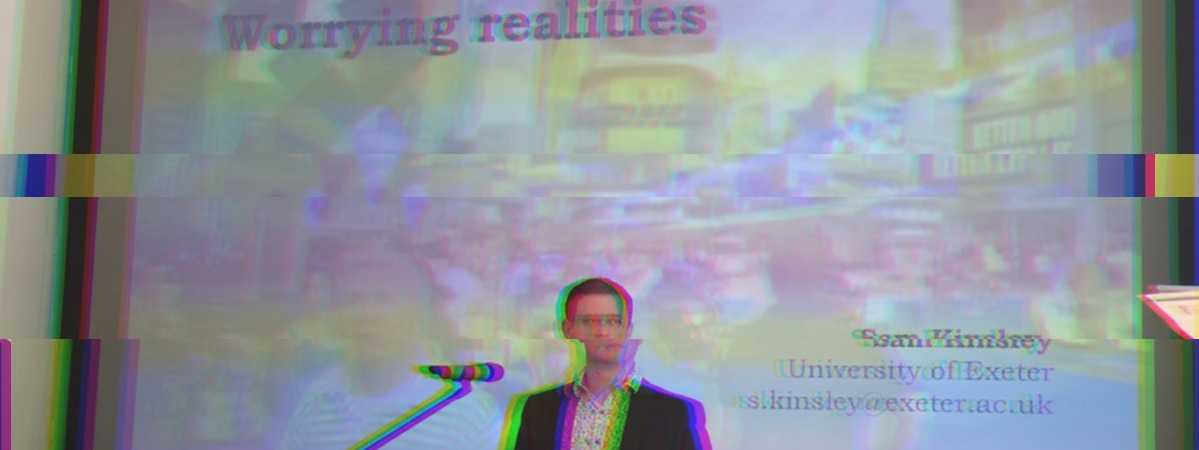
Worrying realities – doing spatial theory for digital geographies

worrying realities - kinsley 2018

I wrote something new… haven’t done that in a while for lots of reasons.

I was compelled to do it because I accepted the kind invitation of colleagues at the wonderful Leibniz Institute for Research on Society and Space for their Spring Academy 2018, themed: “virtuality and socio-materiality”.

I gave a talk called “Worrying realities – doing spatial theory for digital geographies”. In the talk I concerned myself, and maybe those listening, with the ways in which forms of spatial theory get ‘done’ in relation to ‘digital’ or ‘virtual’ phenomena, sometimes generalised as proper nouns… ‘the digital’ and so on. I was not interested, and I still am not, with ‘policing’ the correct theory here, instead I pointed out some habits of theorising space in relation to mediation that I think are interesting and that perhaps those of us interested in doing, talking about and writing about ‘digital geographies’ maybe need to reflect upon sometimes. In particular, I think what Theodore Adorno diagnoses as an ‘ontological need’ pertains, and we perhaps need to be a little more reflexive about how that plays out.

So, I’m sharing a PDF of the slides with the notes I’ve written up. [Now the revised PDF.]

In any case, I don’t know what to do with this… I’d like to write it up, not sure where it would go..? Any comments or arguments, or suggestions for venues to which it might be submitted, are gratefully received 🙂

Please take this material in the spirit in which it is shared – as an attempt to open a conversation. Please also give credit where it’s due – this is not (yet) published but these are my current ideas and I’m sharing them in good faith.

Tarleton Gillespie on “Custodians”

Facebook logo reflected in a human eye

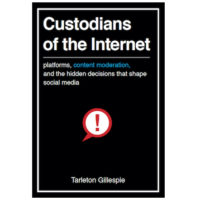
Custodians of the Internet – Tarleton GillespieOver on the Culture Digitally site Tarleton Gillespie discusses his new book Custodians of the Internet, reflecting on some of the meanings of “custodian” and how they variously relate to the topic of the book – content moderators for social media services. Gillespie is an astute observer and analyst of contemporary ‘digital culture’ (I struggle to think of another noun right now) and the issue of moderation is certainly timely.

 I thought I would explain the book’s title, particularly my choice of the word “custodians.” This title came unnervingly late in the writing process, and after many, many conversations with my extremely patient friend and colleague Dylan Mulvin. “Custodians of the Internet” captured, better than many, many alternatives, the aspirations of social media platforms, the position they find themselves in, and my notion for how they should move forward.

Read more on Culture Digitally.

Data materiality – a new project by Scott Rodgers

A huge array of overhead wires on a street

This new project at Birkbeck by Scott Rodgers & Joel McKim looks really interesting:

Data Materiality: collaborative BIRMAC/Vasari project

[…]

Data Materiality

The expanded presence and impact of data, and arrival of so-called Big Data, has become an accepted, background feature of contemporary life. But while data clearly matters, the question arising now is: just how does data come to ‘matter’? What are the sometimes unseen material infrastructures that bring data into being, into circulation and into action? What are the social and political structures, policies and institutions through which data comes to have effects? And what might it mean to think about data – as suggested by Sarah Pink and others – as ‘broken’: as always already implicated in ordinary processes of maintenance and repair?

Data Materiality – a three-year collaborative project co-sponsored by the Birkbeck Centre for Interdisciplinary Research in Media and Culture, and the Vasari Centre for Art and Technology – seeks to address these questions. By data ‘materiality’ we mean not only the ways in which data crystallises into physical forms and depends on material technical and social infrastructures, but also the related ways in which data comes to matter, in and through practical action, collective imaginaries, or biological conditions. So we are interested in questioning the proliferating network of data centres, fibre-optic cables and server farms that underpin our data usage, but we also wish to explore perhaps less tangible or apparent infrastructures of data – materialities that might include, for instance, digital objects and artefacts, from network protocols to markup languages, as well as the labour and organizational structures putting data to work.

Our key aim in exploring data materiality is to get beyond the idea of data as a raw or unprocessed and, as Lisa Gitelman has suggested, understand the ordinary material conditions under which data is induced and deduced. We wish to ask, in other words, how does data leave its traces on the world? And how does the world leave its traces on data?

Read more on Scott’s website.

Reblog > OxChain Conference – Blockchain and the Global South

Blockchain visualisation

Interesting conference from the project led by Chris Speed.

OxChain Conference Programme

One-day conference on Blockchain and the Global South hosted by OxChain.

Keynote speakers: Michel Bauwens of the Peer to Peer Foundation, Lord Christopher Holmes, author of Distributed Ledger Technologies for Public Good, and Ric Tighe, Oxfam ICT in-programme.

22 May 2018, Coin Street Conference Centre, Waterloo, London

Panel sessions include Session 1: Power, Transparency and Accountability in Blockchain for International Development, Session 2: Peer-to-Peer Economies (A): Natural Resource Governance, Session 3: Peer to Peer Economies (B): Supply Chains and Development, Session 4: Crypto-philanthropy and development: The Future of Giving? along with lunchtime demonstrations of platforms and designs.

Panel submissions are closed but there are limited spaces available to register. For more information please contact k.symons@ed.ac.uk.

Registration essential. Contact c.cooke@ed.ac.uk to register.

Updates to follow on the day!