Imagine all the people deepfaked

A person removing a mask

Via Kottke.

This ‘deepfake’ video of lots of current and former world leaders and other famous people is interesting and provokes all sorts of questions. Some suggest legislation against them, which is what the US seems to be pursuing, but that of course asks further questions about how to ‘police’ them and who has agency. There are, perhaps, some interesting resonances with the increasing use of performance holograms to re-animate dead performers – but there, of course, the legal issues are different. Nevertheless, all sorts of ideas, aesthetic, ethical and otherwise, about ‘authenticity’ crop up (e.g. this from New Scientist, or this on trust in ‘evidence’ re ‘deepfakes’), which we will increasingly be provoked into discussing.

It is interesting, I think, that while those of us in what we call ‘critical’ social sciences or humanities have been developing fairly nuanced articulations of identity and subjectivity, arguing they are not necessarily essential and acknowledging how they are performed (for example), contemporary digital/ social media, and our uses of them, have forged new norms of ‘authenticity’ in relation to identity. Facebook wants ‘true’ names, for instance. “Finsta” (‘f’ denoting ‘fake’), the phenomenon of setting up hidden, often pseudonymous, Instagram accounts – only for selected friends (as opposed to your curated “rinsta” account (‘r’ denoting ‘real’)) shows how these two understandings of the performative nature of identity and the construction of a normative insistence on ‘authenticity’ collide. We might reasonably ask, for instance, why the ‘finsta’/’rinsta’ labels don’t actually mean the reverse if the more public of the two accounts is heavily curated and the ‘secret’ one is in some senses then more ‘authentic’.

‘Deepfakes’ are, amongst other things, a sensory ‘trick’, an attempt to somehow fool the conscious and sub-conscious habitual discernment of what feels whatever it is we mean by ‘authentic’, ‘genuine’ or ‘real’. In some senses, ‘deepfakes’ reveal back to us the extent to which digital media may have shifted how we pay attention and how we feel (about ourselves, others and the world around us) with and through them. Digital media cultivate attention in different ways, many of them perhaps oriented towards a capitalist imperative, also, perhaps, with them we cultivate forms of paying attention. If this is the case then, as was argued in terms of the potency of TV advertising, we may begin to ‘see through’ the ‘tricks’ precisely because we are bombarded with them (for example, the Putin bits in the video above are not very convincing to my eye). Or, to be pessimistic, we may simply begin to assume nothing can be trusted, that all media is created in bad faith, which of course prompts discussions of a crisis of democracy because how can a population make informed decisions without ‘trustworthy’ sources.

Bernard Stiegler on disruption & stupidity in education & politics – podcast

Bernard Stiegler being interviewed

Via Museu d’Art Conptemporani de Barcelona.

On the Ràdio Web Macba website there is a podcast interview with philosopher Bernard Stiegler as part of a series to ‘Reimagine Europe’. It covers many of the major themes that have preoccupied Stiegler for the last ten years (if not longer). You can download the pod as an mp3 for free. Please find the blurb below and a link.

In his books and lectures, Stiegler presents a broad philosophical approach in which technology becomes the starting point for thinking about living together and individual fulfilment. All technology has the power to increase entropy in the world, and also to reduce it: it is potentially a poison or cure, depending on our ability to distil beneficial, non-toxic effects through its use. Based on this premise, Stiegler proposes a new model of knowledge and a large-scale contributive economy to coordinate an alliance between social agents such as academia, politics, business, and banks. The goal, he says, is to create a collective intelligence capable of reversing the planet’s self-destructive course, and to develop a plan – within an urgent ten-year time-frame – with solutions to the challenges of the Anthropocene, robotics, and the increasing quantification of life.

In this podcast Bernard Stiegler talks about education and smartphones, translations and linguists, about economic war, climate change, and political stupidity. We also chat about pharmacology and organology, about the erosion of biodiversity, the vital importance of error, and the Neganthropocene as a desirable goal to work towards, ready to be constructed.

Timeline
00:00 Contributory economy: work vs proletarianization
05:21 Our main organs are outside of our body
07:45 Reading and writing compose the republic
12:49 Refounding Knowledge 
15:03 Digital pharmakon 
18:28 Contributory research. Neganthropy, biodiversity and diversification
24:02 The need of an economic peace
27:24 The limits of micropolitics
29:32 Macroeconomics and Neganthropic bifurcation
36:55 Libido is fidelity
42:33 A pharmacological critique of acceleration
46:35 Degrowth is the wrong question

“Ready Lawnmower Player Man One”, or VR’s persistent future

For the last couple of years I have given a lecture that takes the “Virtual/Real” distinction and deconstructs it using various bits of geographical theory. I also talk about the enduring trope of the sort of eschatological narrative of VR, tying it back to a little bit of history, mainly focusing on how this has been propagated in pop culture. This year, for fun, I have decided to be a little bit more creative than resorting to my usual trick of showing the trailer for Lawnmower Man or Ready Player One – I’ve made a quick mashup of the two, which I think show quite nicely how the underlying narratives of the ‘virtual’ somehow counterposed to the ‘real’ but also in some way ‘crossing over’ is an enduring theme.

The other enduring theme here is that the forms of gameplay drawn upon are characterised as highly masculine (and normatively heterosexual – no queering of the digital here, sadly), which is something I will try to also blog about sometime…

Other film examples might include:

“Merger” by Keiichi Matsuda – automation, work and ‘replacement’

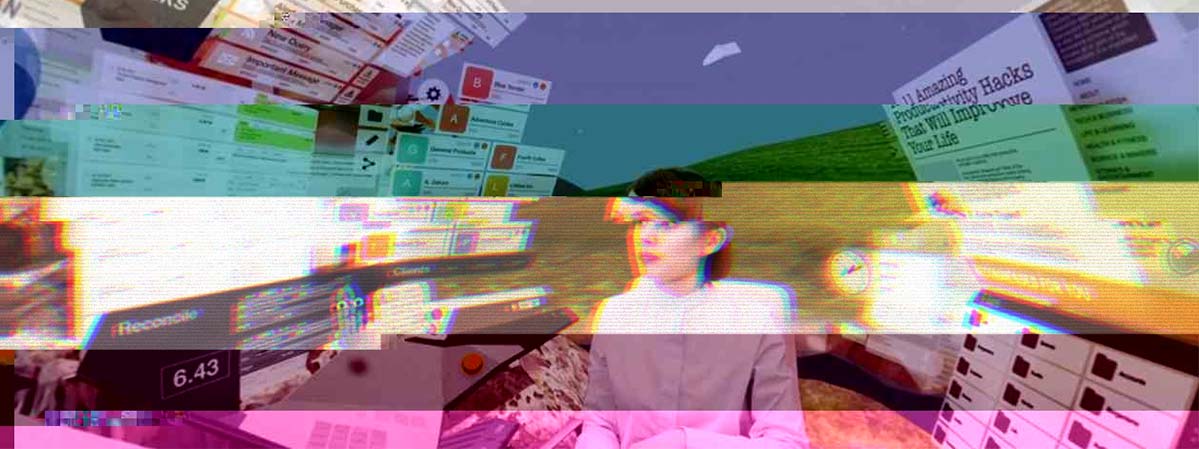
A still from the 360-degree video "Merger" by Keiichi Matsuda
“With automation disrupting centuries-old industries, the professional must reshape and expand their service to add value. Failure is a mindset. It is those who empower themselves with technology who will thrive.
“Merger is a new film about the future of work, from cult director/designer Keiichi Matsuda (HYPER-REALITY). Set against the backdrop of AI-run corporations, a tele-operator finds herself caught between virtual and physical reality, human and machine. As she fights for her economic survival, she finds herself immersed in the cult of productivity, in search of the ultimate interface. This short film documents her last 4 minutes on earth.”

I came across the most recent film by Keichii Matsuda which concerns a possible future of work, with the protagonist embedded in an (aesthetically Microsoft-style) augmented reality of screen-surfaces, and in which the narrative denouement is a sort of trans-human ‘uploading’ moment.

I like Matsuda’s work. i think he skilfully and playfully provokes particular sorts of conversations, mostly about what we used to call ‘immersion’ and the nature of mediation. This has, predictably happened in terms of human vs. AI vs. eschatology (etc etc.) sorts of narratives in various outlets (e.g. the Verge). The first time I encountered his work was at a Passenger Films event at which Rob Kitchin talked about theorisations of mediation in relation to both Matsuda’s work and the (original) Disney film ‘Tron‘.

What is perhaps (briefly) interesting here are two things:

  1. The narrative is a provocative short story that asks us to reflect upon how our world of work and technological development get us from now (the status quo) to an apparent future state of affairs, which carries with it certain kinds of ethical, normative and political contentions. So, this is a story that piggybacks the growing narrative of ‘post-work’ or widespread automation of work by apparently ‘inhuman’ technologies (i.e. A.I) that provokes debate about the roles of ‘technology’ and ‘work’ and what it means to be ‘human’. Interestingly, this (arguably) places “Merger” in the genre of ‘fantasy’ rather than ‘science fiction’ – it is, after all, an eschatological story (I don’t see this final point as a negative). I suppose it could also be seen as a fictional suicide note but I’d rather not dwell on that…
  2. The depiction of the interface and the interaction with the technology-world of the protagonist– and indeed the depiction of these within a 360-degree video –are as important as the story to what the video is signifying. By which I mean – like the videos I called ‘vision videos’ back in 2009/10 (and (in some cases) might be called ‘design fiction’ or ‘diagetic prototypes’) – this video is also trying to show you and perhaps sell you the idea of a technology (Matsuda recently worked for Leap Motion). As I and others have argued – the more familiar audiences are with prospective/speculative technologies the more likely we are (perhaps) to sympathise with their funding/ production/ marketing and ultimately to adopt them.

Call for papers: Geography of/with A.I

Still from the video for All is Love by Bjork

I very much welcome any submissions to this call for papers for the proposed session for the RGS-IBG annual conference (in London in late-August) outlined below. I also welcome anyone getting in touch to talk about possible papers or ideas for other sorts of interventions – please do get in touch.

Call for papers:

We are variously being invited to believe that (mostly Global North, Western) societies are in the cusp, or early stages, of another industrial revolution led by “Artificial Intelligence” – as many popular books (e.g. Brynjolfsson and McAfee 2014) and reports from governments and management consultancies alike will attest (e.g. PWC 2018, UK POST 2016). The goal of this session is to bring together a discussion explicitly focusing on the ways in which geographers already study (with) ‘Artificial Intelligence’ and to, perhaps, outline ways in which we might contribute to wider debates concerning ‘AI’. 

There is widespread, inter-disciplinary analysis of ‘AI’ from a variety of perspective, from embedded systematic bias (Eubanks 2017, Noble 2018) to the kinds of under-examined rationales and work through which such systems emerge (e.g. Adam 1998, Collins 1993) and further to the sorts of ethical-moral frameworks that we should apply to such technologies (Gunkel 2012, Vallor 2016). In similar, if somewhat divergent ways, geographers have variously been interested in the kinds of (apparently) autonomous algorithms or sociotechnical systems are integrated into decision-making processes (e.g. Amoore 2013, Kwan 2016); encounters with apparently autonomous ‘bots’ (e.g. Cockayne et al. 2017); the integration of AI techniques into spatial analysis (e.g. Openshaw & Openshaw 1997); and the processing of ‘big’ data in order to discern things about, or control, people (e.g. Leszczynski 2015). These conversations appear, in conference proceedings and academic outputs, to rarely converge, nevertheless there are many ways in which geographical research does and can continue to contribute to these contemporary concerns.

The invitation of this session is to contribute papers that make explicit the ways in which geographers are (already) contributing to research on and with ‘AI’, to identify research questions that are (perhaps) uniquely geographical in relation to AI, and to thereby advance wider inter-disciplinary debates concerning ‘AI’.

Examples of topics might include (but are certainly not limited to):

  • A.I and governance
  • A.I and intimacy
  • Artificially intelligent mobilities
  • Autonomy, agency and the ethics of A.I
  • Autonomous weapons systems
  • Boosterism and ‘A.I’
  • Feminist and intersectional interventions in/with A.I
  • Gender, race and A.I
  • Labour, work and A.I
  • Machine learning and cognitive work
  • Playful A.I
  • Science fiction, spatial imaginations and A.I
  • Surveillance and A.I

Please send submissions (titles, abstracts (250 words) and author details) to: Sam Kinsley by 31st January 2019.

Bernard Stiegler on the on the notion of information and its limits

Bernard Stiegler being interviewed

I have only just seen this via the De Montfort Media and Communications Research Centre Twitter feed. The above video is Bernard Stiegler’s ‘key note’ (can’t have been a big conference?) at the University of Kent Centre for Critical Though conference on the politics of Simondon’s Modes of Existence of Technical Objects. 

In engaging with Simondon’s theory (or in his terms ‘notion’) of information, Stiegler reiterates some of the key elements of his Technics and Time in relation to exosomatisation and tertiary retention being the principal tendency of an originary technics that, in turn, has the character of a pharmakon, that, in more recent work, Stiegler articulates in relation to the contemporary epoch (the anthoropocene) as the (thermodynamic style) tension between entropy and negentropy. Stiegler’s argument is, I think, that Simondon misses this pharmacological character of information. In arguing this out, Stiegler riffs on some of the more recent elements of his project (the trilogy of ‘As’) – the anthropocene, attention and automation – which characterise the contemporary tendency towards proletarianisation, a loss of knowledge and capacities to remake the world.

It is interesting to see this weaving together of various elements of his project over the last twenty(+) years both: in relation to his engagement with Simondon’s work (a current minor trend in ‘big’ theory), and: in relation to what seems to me to be a moral philosophical character to Stiegler’s project, in terms of his diagnosis of the anthropocene and a call for a ‘neganthropocene’.

Bernard Stiegler’s Age of Disruption – out soon

Bernard Stiegler being interviewed

Out next year with Polity, this is one of the earlier of Stiegler’s ‘Anthropocene’ books (in terms of publication in French, see also The Neganthropocene) explicating quite a bit of the themes that come out in the interviews I’ve had a go at translating in the past three years (see: “The time saved through automation must be given to the people”; “How to survive disruption”; “Stop the Uberisation of society!“; and “Only by planning a genuine future can we fight Daesh“). Of further interest, to some, is that it also contains a dialogue with Nancy (another Derrida alumnus). This book is translated by the excellent Daniel Ross.

Details on the Polity website. Here’s the blurb:

Half a century ago Horkheimer and Adorno argued, with great prescience, that our increasingly rationalised and Westernised world was witnessing the emergence of a new kind of barbarism, thanks in part to the stultifying effects of the culture industries. What they could not foresee was that, with the digital revolution and the pervasive automation associated with it, the developments they had discerned would be greatly accentuated and strengthened, giving rise to the loss of reason and to the loss of the reason for living. Individuals are overwhelmed by the sheer quantity of digital information and the speed of digital flows, and profiling and social media satisfy needs before they have even been expressed, all in the service of the data economy. This digital reticulation has led to the disintegration of social relations, replaced by a kind of technological Wild West, in which individuals and groups find themselves increasingly powerless, driven by their lack of agency to the point of madness.
How can we find a way out of this situation? In this book, Bernard Stiegler argues that we must first acknowledge our era as one of fundamental disruption and detachment. We are living in an absence of epokh? in the philosophical sense, by which Stiegler means that we have lost our noetic method, our path of thinking and being. Weaving in powerful accounts from his own life story, including struggles with depression and time spent in prison, Stiegler calls for a new epokh? based on public power. We must forge new circuits of meaning outside of the established algorithmic routes. For only then will forms of thinking and life be able to arise that restore meaning and aspiration to the individual.
Concluding with a substantial dialogue between Stiegler and Jean-Luc Nancy in which they reflect on techniques of selfhood, this book will be of great interest to students and scholars in social and cultural theory, media and cultural studies, philosophy and the humanities generally.

Published> A very public cull – the anatomy of an online issue public

Twitter

I am pleased to share that an article I co-authored with Rebecca Sandover (1st author) and Steve Hinchliffe has finally been published in Geoforum. I would like to congratulate my co-author Rebecca Sandover for this achievement – the article went through a lengthy review process but is now available as an open access article. You can read the whole article, for free, on the Geoforum website. To get a sense of the argument, here is the abstract:

Geographers and other social scientists have for some time been interested in how scientific and environmental controversies emerge and become public or collective issues. Social media are now key platforms through which these issues are publicly raised and through which groups or publics can organise themselves. As media that generate data and traces of networking activity, these platforms also provide an opportunity for scholars to study the character and constitution of those groupings. In this paper we lay out a method for studying these ‘issue publics’: emergent groupings involved in publicising an issue. We focus on the controversy surrounding the state-sanctioned cull of wild badgers in England as a contested means of disease management in cattle. We analyse two overlapping groupings to demonstrate how online issue publics function in a variety of ways – from the ‘echo chambers’ of online sharing of information, to the marshalling of agreements on strategies for action, to more dialogic patterns of debate. We demonstrate the ways in which digital media platforms are themselves performative in the formation of issue publics and that, while this creates issues, we should not retreat into debates around the ‘proper object’ of research but rather engage with the productive complications of mapping social media data into knowledge (Whatmore, 2009). In turn, we argue that online issue publics are not homogeneous and that the lines of heterogeneity are neither simple or to be expected and merit study as a means to understand the suite of processes and novel contexts involved in the emergence of a public.

(More) Gendered imaginings of automata

My Cayla Doll

A few more bits on how automation gets gendered in particular kinds of contexts and settings. In particular, the identification of ‘home’ or certain sorts of intimacy with certain kinds of domestic or caring work that then gets gendered is something that has been increasingly discussed.

Two PhD researchers I am lucky enough to be working with, Paula Crutchlow (Exeter) and Kate Byron (Bristol), have approached some of these issues from different directions. Paula has had to wrangle with this in a number of ways in relation to the Museum of Contemporary Commodities but it was most visible in the shape of Mikayla, the hacked ‘My Friend Cayla Doll’. Kate is doing some deep dives on the sorts of assumptions that are embedded into the doing of AI/machine learning through the practices of designing, programming and so on. They are not, of course, alone. Excellent work by folks like Kate Crawford, Kate Devlin and Gina Neff (below) inform all of our conversations and work.

Here’s a collection of things that may provoke thought… I welcome any further suggestions or comments 🙂

Alexa, does AI have gender?


Alexa is female. Why? As children and adults enthusiastically shout instructions, questions and demands at Alexa, what messages are being reinforced? Professor Neff wonders if this is how we would secretly like to treat women: ‘We are inadvertently reproducing stereotypical behaviour that we wouldn’t want to see,’ she says.

Prof Gina Neff in conversation with Ruth Abrahams, OII.

Predatory Data: Gender Bias in Artificial Intelligence

it has been reported that female-sounding assistive chatbots regularly receive sexually charged messages. It was recently cited that five percent of all interactions with Robin Labs, whose bot platform helps commercial drivers with routes and logistics, is sexually explicit. The fact that the earliest female chatbots were designed to respond to these suggestions
deferentially or with sass was problematic as it normalised sexual harassment.

Vidisha Mishra and Madhulika Srikumar – Predatory Data: Gender Bias in Artificial Intelligence

The Gender of Artificial Intelligence

Chart showing that the gender of artificial intelligence (AI) is not neutral
The gendering, or not, of chatbots, digital assistants and AI movie characters – Tyler Schnoebelen

“Consistently representing digital assistants as female…hard-codes a connection between a woman’s voice and subservience.”

Stop Giving Digital Assistants Female Voices – Jessica Nordell, The New Republic

New journal article> A very public cull: the anatomy of an online issue public

Twitter

I am pleased to share that a paper that Rebecca Sandover, Steve Hinchliffe and I have had under review for some time has been accepted for publication. The paper comes from our project “Contagion”, which amongst other things examined the ways issue publics form and spread around public controversies – in this case the English badger cull of 2013/14. The research this article presents comes from mixed methods social media research, focused on Twitter. The methods and conversation have, of course, moved on a little in the last two years but I think the paper makes a contribution to how geographers in particular might think about doing social media-based research. I guess this, as a result, also fits into the recent (re)growth of ‘digital geographies’ too.

The article is titled “A very public cull: the anatomy of an online issue public” and will be published in Geoforum in the not-too-distant future. Feel free to get in touch for a pre-print version.

Abstract:

Geographers and other social scientists have for some time been interested in how scientific and environmental controversies emerge and become public or collective issues. Social media are now key platforms through which these issues are publicly raised and through which groups or publics can organise themselves. As media that generate data and traces of networking activity, these platforms also provide an opportunity for scholars to study the character and constitution of those groupings. In this paper we lay out a method for studying these ‘issue publics’: emergent groupings involved in publicising an issue. We focus on the controversy surrounding the state-sanctioned cull of wild badgers in England as a contested means of disease management in cattle. We analyse two overlapping groupings to demonstrate how online issue publics function in a variety of ways – from the ‘echo chambers’ of online sharing of information, to the marshalling of agreements on strategies for action, to more dialogic patterns of debate. We demonstrate the ways in which digital media platforms are themselves performative in the formation of issue publics and that, while this creates issues, we should not retreat into debates around the ‘proper object’ of research but rather engage with the productive complications of mapping social media data into knowledge (Whatmore 2009). In turn, we argue that online issue publics are not homogeneous and that the lines of heterogeneity are neither simple, or to be expected, and merit study as a means to understand the suite of processes and novel contexts involved in the emergence of a public.