CFP> Moral Machines? The ethics and politics of the digital world, Helsinki, March 2019

Man with a colander on his head attached to electrodes

This looks like an interesting event, though I’m not entirely sure what Stielger would/will say about “the machine’s capability of non-embodied and non-conscious cognition” ?. Via Twitter.

Moral Machines? The ethics and politics of the digital world

6–8 March 2019, Helsinki Collegium for Advanced Studies, University of Helsinki

With confirmed keynotes from N. Katherine Hayles (Duke University, USA) and Bernard Stiegler (IRI: Institut de Recherche et d’Innovation at the Centre Pompidou de Paris)

As our visible and invisible social reality is getting increasingly digital, the question of the ethical, moral and political consequences of digitalization is ever more pressing. Such issue is too complex to be met only with instinctive digiphilia or digiphobia. No technology is just a tool, all technologies mark their users and environments. Digital technologies, however, mark them much more intimately than any previous ones have done since they promise to think in our place – so that they do not only enhance the homo sapiens’ most distinctive feature but also relieve them from it. We entrust computers with more and more functions, and their help is indeed invaluable especially in science and technology. Some fear or dream that in the end, they become so invaluable that a huge Artificial Intelligence or Singularity will take control of the whole affair that humans deal with so messily.

The symposium “Moral Machines? The Ethics and Politics of the Digital World” welcomes contributions addressing the various aspects of the contemporary digital world. We are especially interested in the idea that despite everything they can do, the machines do not really think, at least not like us. So, what is thinking in the digital world? How does the digital machine “think”? Our both confirmed keynote speakers, N. Katherine Hayles and Bernard Stiegler, have approached these fundamental questions in their work, and one of our aims within this symposium is to bring their approaches together for a lively discussion. Hayles has shown that, for a long time, computers were built with the assumption that they imitate human thought – while in fact, the machine’s capability of non-embodied and non-conscious cognition sets it apart from everything we call thinking. For his part, Bernard Stiegler has shown how technics in general and digital technologies in particular are specific forms of memory that is externalized and made public – and that, at the same time, becomes very different from and alien to individual human consciousness.

We are seeking submissions from scholars studying different aspects of these issues. Prominent work is done in many fields ranging from philosophy and literary studies to political science and sociology, not forgetting the wide umbrella of digital humanities. We hope that the symposium can bring together researchers from the hitherto disconnected fields and thus address the ethics and politics of the digital world in a new and inspiring setting. In addition to the keynotes, our confirmed participants already include Erich Hörl, Fréderic Neyrat and François Sebbah, for instance.

We encourage approaching our possible list of topics (see below) from numerous angles, from philosophical and theoretical to more practical ones. For example, the topics could be approached from the viewpoint of how they have been addressed within the realm of fiction, journalism, law or politics, and how these discourses possibly frame or reflect our understanding of the digital world.

The possible list of topics, here assembled under three main headings, includes but is not limited to:

  • Thinking in the digital world
    • What kind of materiality conditions the digital cognition?
    • How does nonhuman and nonconscious digital world differ from the embodied human thought?
    • How do the digital technologies function as technologies of memory and thought? What kind of consequences might their usage in this capacity have in the long run?
  • The morality and ethics of machines
    • Is a moral machine possible?
    • Have thinking machines made invalid the old argument according to which a technology is only as truthful and moral as its human user? Or can truthfulness and morals be programmed (as the constructors of self-driving cars apparently try to do)?
    • How is war affected by new technologies?
  • The ways of controlling and manipulating the digital world
    • Can and should the digital world be politically controlled, as digital technologies are efficient means of both emancipation and manipulation?
    • How can we control our digital traces and data gathered of us?
    • On what assumptions are the national and global systems (e.g., financial system, global commerce, national systems of administration, health and defense) designed and do we trust them?
    • What does it mean that public space is increasingly administered by technical equipment made by very few private companies whose copyrights are secret?

“Moral Machines? The Ethics and Politics of the Digital World” is a symposium organized by two research fellows, Susanna Lindberg and Hanna-Riikka Roine at the Helsinki Collegium for Advanced Studies, University of Helsinki. The symposium is free of charge, and there will also be a public evening programme with artists engaging the digital world. Our aim is to bring together researchers from all fields addressing the many issues and problems of the digitalization of our social reality, and possibly contribute towards the creation of a research network. It is also possible that some of the papers will be invited to be further developed for publication either in a special journal issue or an edited book.

The papers to be presented will be selected based on abstracts which should not exceed 300 words (plus references). Add a bio note (max. 150 words) that includes your affiliation and email address. Name your file [firstname lastname] and submit it as a pdf. If you which to propose a panel of 3–4 papers, include a description of the panel (max. 300 words), papers (max. 200 words each), and bio notes (max. 150 words each).

Please submit your proposal to moralmachines2019[at]gmail.com by 31 August 2018. Decisions on the proposals will be made by 31 October 2018.

For further information about the symposium, feel free to contact the organizers Susanna Lindberg (susanna.e.lindberg[at]gmail.com) and Hanna-Riikka Roine (hanna.roine[at]helsinki.fi).

SuperTag ‘scanner will end checkout woes’ – 1994

Still image taken from the Microsoft Future Vision of Retail, circa 2010

In this front page article from 6th January 1994, The Guardian Technology Editor reports that the “SuperTag” scanner, from “newly privatised British Technology Group” will “read the entire contents of a supermarket trolley at a glance” … “The day cannot be too far off when the weekly shop ordered from home will be collected later already in the trolley”.

Except of course we just get the supermarket to deliver to our door instead… anyway, a nice piece of the ‘automative imagination‘ in play… (also, good to compare to this).

40 years of automation anxiety in the UK through BBC clips [video]

Industrial factory robot arms

I’ve just done a rough edit of some snippets from BBC programmes that I think shows an interesting pattern to the ways that automation has been discussed by the UK national broadcaster over the last 40 years. In each case, automation is a significant issue – it needs to be urgently addressed, but that hasn’t yet happened.

Out of the three programmes, the first two are fairly significant in their onward influence.

The first, the 1978 “Now the Chips Are Down” Horizon episode was reportedly a significant influence for the BBC’s own Computer Literacy Project, which spawned the BBC Micro Computer.

The second, the 1980 (middle of three) episode(s) of “The Silicon Factor” was a part of the Computer Literacy Project. Alongside the three-part series, the producers created a report (for the BBC Continuing Education Department): “Microelectronics“, which was commissioned by the outgoing late-1970s Labour government’s Department for Education and the Manpower Services Commission. I thoroughly recommend watching the programmes and looking at the report if you’re interested in the histories of computing and automation in the UK.

The third, as far as I know – less significant in it’s onward influence, is a 2015 episode of Panorama: “Could a Robot Do My Job?” Interesting here because the rhetoric is nearly identical to that of “The Silicon Factor” – we need to take advantage of the revolution.

I’ve got more to say about this and I need to do a bit more thinking but wanted to share, because I think it’s interesting! This video (or a revised version) will form a part of my paper for a double session on ‘New Geographies of Automation(?)‘ at the RGS-IBG conference in August 2018 concerning the ways that we imagine automation.

“How will you manage fallout from [robot] displaced labor?” KPMG

Gigolo Jane and Gigolo Joe robots in the film A.I.

From KPMG’s Strategic Visions on the Sourcing Market 2016, p. 32. Via Jamie Peck’s excellent Offshore.

How will you manage fallout from displaced labor?

The automation of human jobs may cause some unrest, so prepare to have honest, open discussions with your organization. Resistance may come not only from the workers in automatable roles but also from directors who may fear erosion in their span of control, as they potentially go from managing employees to managing bots.


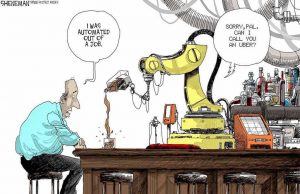
Cartoon about automation by Drew Sheneman

WhatsApp Research Awards for Social Science and Misinformation

A person removing a mask

Via Moira Weigel. Deadline is 12/08/2018.

WhatsApp Research Awards for Social Science and Misinformation

WhatsApp cares about the safety of our users and is seeking to inform our understanding of the safety problems people encounter on WhatsApp and what more we can do within WhatsApp and in partnership with civil society to address the problem. For this first phase of our program, WhatsApp is commissioning a competitive set of awards to researchers interested in exploring issues that are related to misinformation on WhatsApp. We welcome proposals from any social science or related discipline that foster insights into the impact of technology on contemporary society in this problem space. The WhatsApp Research Awards will provide funding for independent research proposals that are designed to be shared with WhatsApp, Facebook, and wider scholarly and policy communities. These are unrestricted monetary awards that offer investigators the freedom to deepen and extend their existing research portfolio. Applications are welcome from individuals with established experience studying online interaction and information technologies, as well as from persons seeking to expand their existing research into these areas.

Core Areas of Exploration

We will seriously consider proposals from any social science and technological perspective that propose projects that enrich our understanding of the problem of misinformation on WhatsApp. High priority areas include (but are not limited to):

  • Information processing of problematic content: We welcome proposals that explore the social, cognitive, and information processing variables involved in the consumption of content received on WhatsApp, its relation to the content’s credibility, and the decision to promote that content with others. This includes social cues and relationships, personal value systems, features of the content, content source etc. We are interested in understanding what aspects of the experience might help individuals engage more critically with potentially problematic content.
  • Election related information: We welcome proposals that examine how political actors are leveraging WhatsApp to organize and potentially influence elections in their constituencies. WhatsApp is a powerful medium for political actors to connect and communicate with their constituents. However, it can also be misused to share inaccurate or inflammatory political content. We are interested in understanding this space both from the perspective of political actors and the voter base. This includes understanding the unique characteristics of WhatsApp for political activity and its place in the ecosystem of social media and messaging platforms, distribution channels for political content, targeting strategies, etc.
  • Network effects and virality: We welcome proposals that explore the characteristics of networks and content. WhatsApp is designed to be a private, personal communication space and is not designed to facilitate trends or virality through algorithms or feedback. However, these behaviors do organically occur along social dimensions. We are interested in projects that inform our understanding of the spread of information through WhatsApp networks.
  • Digital literacy and misinformation: We welcome proposals that explore the relation between digital literacy and vulnerability to misinformation on WhatsApp. WhatsApp is very popular in some emerging markets, and especially so among new to Internet and populations with lower exposure to technology. We are interested in research that informs our efforts to bring technology safely and effectively into underserved geographical regions. This includes studies of individuals, families and communities, but also wider inquiries into factors that shape the context for the user experience online.
  • Detection of problematic behavior within encrypted systems: We welcome proposals that examine technical solutions to detecting problematic behavior within the restrictions of and in keeping with the principles of encryption. WhatsApp’s end-to-end encrypted system facilitates privacy and security for all WhatsApp users, including people who might be using the platform for illegal activities. How might we detect illegal activity without monitoring the content of all our users? We are particularly interested in understanding and deterring activities that facilitate the distribution of verifiably false information.

Program Format

Our preference is for proposals based on independent research, in which the applicant develops conceptual tools, gathers and analyzes data, and/or investigates relevant issues. Each awardee will retain all intellectual property rights to their data and analyses. WhatsApp staff may provide guidance, but investigators are responsible for carrying out the scope of work.

The program will make unrestricted awards of up to $50,000 per research proposal. All applications will be reviewed by WhatsApp research staff, with consultation from external experts. Payment will be made to the proposer’s host university or organization as an unrestricted gift.

In addition to the award monies, WhatsApp invites award recipients to attend two workshops:

  1. The first workshop will provide awardees with a detailed introduction to how the WhatsApp product works as well as context on the focus area of misinformation. It will also enable participants to receive feedback from WhatsApp research staff and invited guests on their research proposals. We hope this will facilitate international collaborations across researchers and teams in this area. The tentative date for this event is October 29-30, in Menlo Park, CA.
  2. A second workshop will allow awardees to present their initial research findings to WhatsApp and other awardees, providing an opportunity to contextualize their findings with each other. Our hope is that upon completion of the research, award recipients will seek to share their research with the wider public. Tentative date is April 2019, exact date will be updated on this page at a later time.

WhatsApp will arrange and pay for the travel and accommodation of one representative from each awardee. This will be in addition to the research award amount.

Data

  • No WhatsApp data will be provided to award recipients;
  • All data from award research efforts will be owned by the researcher, and need not be shared with WhatsApp.

Applications, Eligibility & Participant Expectations

  • Applications must be written in English and include the following:
    • A research title, identification of the Principle Investigator (PI) and their institutional affiliation for the purposes of the proposed research;
    • A brief program statement (double-spaced, 12 point font, not to exceed 5 pages) that specifies the proposed work. This statement should include the following elements:
      • specification of question(s) being asked;
      • clear statement of the methodology together with examples of when/where this approach has given research insights;
      • plan for any data collection, analysis, and/or conceptual work;
      • description of the expected research outputs and findings;
      • relevance for our understanding of user experiences in online environments.
    • A 1-page bio and CV for the PI together with selected publication references. Summary bios of any other team members or collaborators.
    • A clear statement of the budget requested.
  • Preference will be given to research conducted in countries where WhatsApp is a prominent medium of communication (India, Brazil, Indonesia, Mexico, etc.).
  • Preference will be given to proposals from researchers, or collaborations with researchers, based in the country/countries being researched.
  • WhatsApp will accept applications from researchers who hold a PhD. In exceptional cases, we will review applications from individuals without PhD’s who have shown a high-level of achievement in social science or technological research.
  • The award is restricted to social science and technological research that contributes to generalized scientific knowledge and its application. Documentaries, journalism, and oral history projects are not eligible.
  • Awards will be made to an awardee’s university department, research institute or organization; all applicants must therefore be affiliated with an organization that supports research and can process external funding awards. All awards will be made in US dollars.
  • Proposals may be submitted by individuals with no prior experience in social media or Internet research. We welcome proposals from researchers who seek to expand their research portfolio into the area of information and communication technologies.
  • All award recipients are strongly encouraged to attend the two WhatsApp workshops associated with this program. Travel and accommodation will be arranged and paid for by WhatsApp.
  • The proposed research should be carried out by the date of the second workshop, in April 2019. Presentation materials that comprise the final report should be written in English and made available for WhatsApp and the other award recipients by the date of the final workshop. All rights to these materials will be held by the award recipient.
  • Once awardees have accepted their awards, WhatsApp will publicly share the details of the selected applicants by posting a summary of the results together with the PI’s name and the title of the proposal on the Facebook Research blog. This information may also be included in other presentations or posts relating to this effort.

By applying to this award, you are agreeing to the following:

  • You are affiliated with an institution that supports research and can process external funding awards.
  • If chosen, your institution will receive the award as a gift in US dollars and in the amount decided solely by WhatsApp.
  • You acknowledge that you have been invited to two, in-person, WhatsApp workshops (tentatively in October 2018 and April 2019).
  • You acknowledge that WhatsApp will publicly disclose your name and the proposal title as an award recipient.
  • You plan to attend and present the research findings at the second, WhatsApp workshop, likely to be held in Menlo Park, CA, USA in late April, 2019. The workshops and presentations will be conducted in English. Interpretation will be provided if needed. Note: airfare, hotel and transportation to be arranged and paid for by WhatsApp.

Timing and Dates

Applications are due by August 12, 2018, 11:59pm PST. Award recipients will be notified of the status of their application by email by September 14, 2018.

Questions

For all questions regarding these awards, please contact us.

“The Rise of the Robot Reserve Army” – interesting working paper

Charlie Chaplin in Modern Times

Saw this via Twitter somehow…

The Rise of the Robot Reserve Army: Automation and the Future of Economic Development, Work, and Wages in Developing Countries – Working Paper 487

Lukas Schlogl and Andy Sumner

Employment generation is crucial to spreading the benefits of economic growth broadly and to reducing global poverty. And yet, emerging economies face a contemporary challenge to traditional pathways to employment generation: automation, digitalization, and labor-saving technologies. 1.8 billion jobs—or two-thirds of the current labor force of developing countries—are estimated to be susceptible to automation from today’s technological standpoint. Cumulative advances in industrial automation and labor-saving technologies could further exacerbate this trend. Or will they? In this paper we: (i) discuss the literature on automation; and in doing so (ii) discuss definitions and determinants of automation in the context of theories of economic development; (iii) assess the empirical estimates of employment-related impacts of automation; (iv) characterize the potential public policy responses to automation; and (v) highlight areas for further exploration in terms of employment and economic development strategies in developing countries. In an adaption of the Lewis model of economic development, the paper uses a simple framework in which the potential for automation creates “unlimited supplies of artificial labor” particularly in the agricultural and industrial sectors due to technological feasibility. This is likely to create a push force for labor to move into the service sector, leading to a bloating of service-sector employment and wage stagnation but not to mass unemployment, at least in the short-to-medium term.

Unfathomable Scale – moderating social media platforms

Facebook logo reflected in a human eye

There’s a really nice piece by Tarleton Gillespie in Issue 04 of Logic themed on “scale” that concerns the scale of social media platforms and how we might understand the qualitative as well as quantitative shifts that happen when things change in scale.

“The Scale is just unfathomble“

But the question of scale is more than just the sheer number of users. Social media platforms are not just big; at this scale, they become fundamentally different than they once were. They are qualitatively more complex. While these platforms may speak of their online “community,” singular, at a billion active users there can be no such thing. Platforms must manage multiple and shifting communities, across multiple nations and cultures and religions, each participating for different reasons, often with incommensurable values and aims. And communities do not independently coexist on a platform. Rather, they overlap and intermingle—by proximity, and by design.

…

The huge scale of the platforms has robbed anyone who is at all acquainted with the torrent of reports coming in of the illusion that there was any such thing as a unique case… On any sufficiently large social network everything you could possibly imagine happens every week, right? So there are no hypothetical situations, and there are no cases that are different or really edgy. There’s no such thing as a true edge case. There’s just more and less frequent cases, all of which happen all the time.

…

No matter how they handle content moderation, what their politics and premises are, or what tactics they choose, platforms must work at an impersonal scale: the scale of data. Platforms must treat users as data points, subpopulations, and statistics, and their interventions must be semi-automated so as to keep up with the relentless pace of both violations and complaints. This is not customer service or community management but logistics—where concerns must be addressed not individually, but procedurally.

However, the user experiences moderation very differently. Even if a user knows, intellectually, that moderation is an industrial-sized effort, it feels like it happens on an intimate scale. “This is happening to me; I am under attack; I feel unsafe. Why won’t someone do something about this?” Or, “That’s my post you deleted; my account you suspended. What did I do that was so wrong?”