
A really accessible and lovely talk by Professor Chris Speed (at Edinburgh) about the ways in which the everyday production of data and what that means for us, as citizens/tech users, and how we negotiate value.
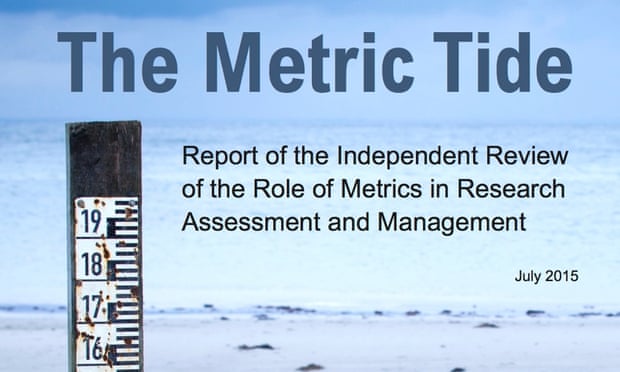
Repost> The metric tide: an agenda for responsible indicators in research
The launch of the report on the review into the role of metrics in HE over on the Gaurdian,..
The metric tide: an agenda for responsible indicators in research
Across research, the metric tide is rising. An independent report published today argues that we have the opportunity to influence how it washes through higher education and research.
Yesterday’s Budget brought good news for those vice-chancellors who have been lobbying to raise student tuition fees above the current £9,000 annual cap. But it came with a sting in the tail: George Osborne said that fees could rise in line with inflation only for those universities “that demonstrate excellence in teaching”. This will be assessed through a new Teaching Excellence Framework, or TEF, to be introduced alongside the Research Excellence Framework (REF), which is used to allocate around £1.6 billion each year on the research side of the system.
Good quote further down:
Metrics should support, not supplant, expert judgement. In our consultation with the research community, we found that peer review, despite its flaws and limitations, continues to command widespread support. We all know that peer review isn’t perfect, but it is still the least worst form of academic governance we have, and should remain the primary basis for assessing research papers, proposals and individuals, and for assessment exercises like the REF. At the same time, carefully selected and applied quantitative indicators can be a useful complement to other forms of evaluation and decision-making. A mature research system needs a variable geometry of expert judgement, quantitative and qualitative indicators. Academic quality is highly context-specific, and it is sensible to think in terms of research qualities, rather than striving for a single definition or measure of quality.
Bill Cronon on why bother studying Geography in a ‘digital age’
Over the Times Higher site there’s a write-up of the inaugural British Academy Lecture in Geography by Bill Cronon, worth a read:
Can history and geography survive the digital age?
A leading historical geographer has called on both his disciplines to find better ways of “navigating the digital world”. William Cronon, who is Frederick Jackson Turner and Vilas research professor of history, geography and environmental studies at the University of Wisconsin-Madison, was delivering the first in a new series of British Academy lectures in geography at London’s Royal Geographical Society on 7 July.
He was interested, he told the audience, in “the bridge between the academy and its many publics”. But although history and geography ranked “among the greatest synthesizing disciplines” and could help to “make the world more meaningful, more legible, for everyone”, academics had shown themselves to be far too “old media” and ran the risk of “isolating [them]selves in a pay-wall universe”.
“History has traditionally required long-form prose,” explained Professor Cronon, and it now counted as “the only academic discipline in the United States which still generally requires a monograph for tenure”. At the same time, most students no longer “read for pleasure” and “a growing number of academic administrators come from disciplines which no longer have a use for books”.
The increasing use of citation indices and impact factors, Professor Cronon went on, encouraged academics to write in the “smallest publishable units” to a specialised, elite readership. As journals have “preformed audiences”, books have essentially been left behind. And with “academics now often required to underwrite the costs of journal publication”, this put a particular burden on “underfunded disciplines”.
Technical problems only exacerbated these structural issues. “Computers are just not suitable for long-form reading,” suggested Professor Cronon. Although tablets and e-readers were more academic-friendly, the now-dominant smartphone “clearly favours content which is very brief – some students have even abandoned email”.
Furthermore, “no file format is less suitable to a smartphone than a PDF”, quite apart from the fact that PDFs often were hidden away behind paywalls, were difficult to access and were “invisible” to search engines. In the longer term, Professor Cronon reflected, academics might need to prepare for a world in which “our intellectual endeavours take place in app space”.
Despite these major challenges, however, he concluded his lecture – titled “Who reads geography or history anymore? The challenge of audience in a digital age” – on an optimistic note, suggesting that “the disciplines are better suited to the digital world than it might seem”.
He pointed, for example, to a project where he and his students had created a digital tool for interpreting a major cemetery to members of the public.
More generally, despite recurrent questions about whether they were analytical and scientific enough, historians and geographers have always relied on stories, maps and descriptions. Professor Cronon urged them to be “stalwart in refusing to let the word ‘mere’ appear in front of ‘stories’ or ‘maps'”, since “compelling stories and revelatory maps” can be deeply illuminating.
“We describe the world as richly and incisively as we can,” he added. “There’s no need to apologise. Leaning in to stories and maps is how we can navigate the digital world.”
Robot-caused death
A robot has tragically caused the death of a VW worker, we learn in today’s news coverage. According to Wikipedia (yes, I know…) this is, quite remarkably, only the third reported industrial robot-caused fatality.
The first two reported deaths of workers caused by manufacturing robots happened in the late 1970s and early 1980s:
Robert Williams was killed in Detroit by a parts recovery robot in the Ford Flatrock Casting Plant (Michigan) in January 1979. A circuit judge in the US found the manufacturer of the equipment criminally liable and ordered Unit Handling Systems USD$10m to the Williams family.
Kenji Urada was killed in Akashi (near Kobe) by an industrial robot in a Kawasaki Heavy Industries plant in July 1981.
There is a temptation to think about some kind of intentionality (however weak) or malign tendency by the machine here, largely because of the word ‘robot’ and because of the detailed imagination of what constitutes the entities we might commonly understand to be referred to by that term. The chatter on Twitter about the sad VW incident certainly seems to invoke the kind of Asimov-style Sci-Fi robotics of I, Robot and the Terminator.
The corollary to this is, of course, that we have become very used to seeking blame located in a single figure of a ‘wrong-doer’. Indeed, we have sought (in the UK) to enshrine this in law after a fashion by holding senior manager personally to account in corporate manslaughter cases. Thus it is unsurprising that TIME magazine report that:
Prosecutors are still deciding whether to bring charges and whom they would pursue.
One can argue, however, that a desire for singular culpability is misconceived. The workers tragically killed in all three of cases were involved in complex assemblages or systems that, even with contemporary safety systems, have contingencies that might lead to undesirable ends. In this way, while the contexts are very different, the worker in today’s robotically enable factory is a distant relation of the 19th century mill worker powerfully described by Friedrich Engels.
Workers both in the 19th century and today have to be alive to the operation of a complex and continent manufacturing system, with many kinds of rules and procedures that circumscribe a place for the human body and its function within industrial manufacturing. If one places their body outside of that circumscribed place, or if the rules of circumscription shift (by accident or design) then the body is at risk of harm.
There may all sorts of factors that lead to a manufacturing accident, but I would hazard that they are more often than not a condition of what it means to work and how that work is designed: how the body fits within the system, or how that system is programmed to accommodate the body, rather than a malign or supernatural robotic agency.
For example: Urada was trapped by the work arm of the robot which pinned him against a machine which cuts gears and was killed. He had entered a prohibited area around the robot to repair it. According to factory officials, a mesh fence around the robot would have shut off the power when unhooked, but instead of opening it, Urada had apparently jumped over the fence. He set the machine on manual control but accidentally brushed against the on-switch, and the claw of the robot pushed him against the machine tooling device.
A grizzly story and one might look at the safety procedures and equipment. There are of course standards and codes of practice for safe working with robots (by the ANSI and the HSE for example). Nevertheless, it remains the case that Urada transgressed those procedures putting himself at risk. We can only speculate about why he did so, but again that is a condition of work, not of robots as such.
All three of the deaths caused by manufacturing robots are tragic and all three have and will no doubt prompt questions about how complex systems of manufacture that may be hazardous to the human body can be made as safe as possible. They could, and perhaps should, also prompt questions about how we work (see, for example, this article in the FT).
Greenfield on the politics of Uber as ‘socially corrosive mobility’
On his occasional blog Speedbird, Adam Greenfield has written an entertaining and incisive blogpost about the ‘mobility brokers’ Uber – the software-sorted unlicensed alt-taxi providers.
The post is worth a read for the trenchant dissection of how Uber is a kind of sigil of some of the questionable politics arising from the so-called ‘smart city’. For example:
– Interpersonal exchanges are more appropriately mediated by algorithms than by one’s own competence.
This conception of good experience is not the only thing suggesting that Uber, its ridership or both are somewhat afraid of actual, unfiltered urbanity. Among the most vexing challenges residents and other users of any large urban place ever confront is that of trust: absent familiarity, or the prospect of developing it over a pattern of repeated interactions, how are people placed (however temporarily) in a position of vulnerability expected to determine who is reliable?Like other contemporary services, Uber outsources judgments of this type to a trust mechanic: at the conclusion of every trip, passengers are asked to explicitly rate their driver. These ratings are averaged into a score that is made visible to users in the application interface: “John (4.9 stars) will pick you up in 2 minutes.” The implicit belief is that reputation can be quantified and distilled to a single salient metric, and that this metric can be acted upon objectively.
Drivers are, essentially, graded on a curve: their rolling tally, aggregated over the previous 500 passenger engagements, must remain above average not in absolute terms, but against the competitive set. Drivers whose scores drop beneath this threshold may not receive ride requests, and it therefore functions as an effective disciplinary mechanism. Judging from conversations among drivers, further, the criteria on which this all-important performance metric is assessed are subjective and highly variable, meaning that the driver has no choice but to model what they believe riders are looking for in the proverbial “good driver,” internalize that model and adjust their behavior accordingly.
What riders are not told by Uber – though, in this age of ubiquitous peer-to- peer media, it is becoming evident to many that this has in fact been the case for some time – is that they too are rated by drivers, on a similar five-point scale. This rating, too, is not without consequence. Drivers have a certain degree of discretion in choosing to accept or deny ride requests, and to judge from publicly-accessible online conversations, many simply refuse to pick up riders with scores below a certain threshold, typically in the high 3’s.
This is strongly reminiscent of the process that I have elsewhere called “differential permissioning,” in which physical access to everyday spaces and functions becomes ever-more widely apportioned on the basis of such computational scores, by direct analogy with the access control paradigm prevalent in the information security community. Such determinations are opaque to those affected, while those denied access are offered few or no effective means of recourse. For prospective Uber patrons, differential permissioning means that they can be blackballed, and never know why.Uber certainly has this feature in comment with algorithmic reputation-scoring services like Klout. But all such measures stumble in their bizarre insistence that trust can be distilled to a unitary value. This belies the common-sense understanding that reputation is a contingent and relational thing – that actions a given audience may regard as markers of reliability are unlikely to read that way to all potential audiences. More broadly, it also means that Uber constructs the development of trust between driver and passenger as a circumstance in which algorithmic determinations should supplant rather than rely upon (let alone strengthen) our existing competences for situational awareness, negotiation and the detection of verbal and nonverbal social cues.
Interestingly, despite its deployment of mechanisms intended to assess driver and passenger reliability, the company goes to unusual lengths to prevent itself from being brought to accountability. Following the December 2014 Delhi rape incident, police investigators were stunned to realize that while Uber had been operating in India for some time, neither the .in website nor any other document they had access to listed a local office. They were forced to register for the app themselves (as well as download a third-party payment application) simply so they could hire an Uber car and have the driver bring them to the place where he believed his employers worked. Here we see William Gibson’s science-fictional characterization of 21st-century enterprise (“small, fast, ruthless. An atavism”¦all edge”) brought to pungent life.
To Save the World… Preface by Bernard Stiegler for Michel Bauwens’ new book
Michel Bauwens, peer-to-peer activist and founder of the Peer-to-Peer Foundation, has a new book out, in French, entitled Saving the World: Towards a post-capitialist society with peer-to-peer. In the book Michel, with his collaborator Jean Lievens, argues that a new distributed and de-centralised economic model is necessary to shake up the world and drive us towards a post-capitalist society. In a wide-ranging, impassioned and ambitious, perhaps idealistic, diagramming of a new mode of living and working Bauwens reaches for a different way of performing economics and the political.
The book has a preface by Bernard Stiegler that has been shared on the Peer-to-Peer Foundation website and so I have translated it. I have offered this to the foundation and I would be pleased if it is of use to them or to anyone else. The copyright of the text remains under the license attributed to the original book.
Preface by Bernard Stiegler
To Bauwens, M. and Lievens, J. 2015. Sauver le monde. Vers une société post-capitaliste avec le peer-to-peer, Editions Les Liens Qui Libèrent. [Saving the World: Towards a post-capitalist society with peer-to-peer]
Over the course of the next twenty years, automation will instigate the decline of a society founded on salaried jobs: 49% of jobs will disappear in the United States, 43% in Great Britain, 50% in Belgium, 56% in Italy and Poland[1]. This huge transformation, resulting from the integration of digital automation, constitutes the horizon for the argument put forward here by Michel Bauwens. He has studied and promoted the new model of production made possible by digital technologies and founded in peer-to-peer relations, which thereby surpasses the proletarianisation that has hitherto been the basis for industrial capitalism – here, proletarianisation principally signifies the loss of knowledge.
Like Ars Industrialis and the Institute for Research and Innovation, the P2P Foundation sets out the principle that digital reticulation is no longer a model based on the functional opposition between production and consumption. Rather it is based on the constitution of communities of knowledge developed through relations between peers – that is to say, on the reconstitution of knowledge (of life skills [savoir vivre], know how [savoir faire], and theoretical knowledge [savoir théoriser]) which have been systematically dismantled over the last 250 years. This discourse affirms the possibility of salvation: it attempts to save the world. Such claims will no doubt be scoffed at by sceptics of all persuasions – they are deniers, who, like climate sceptics, are still trying to ‘convince the Marquise that everything is fine’ [2]… against all available evidence.
The evidence is the profound collapse of social cohesion in every industrial society on Earth and the devastating effects on those societies on the margins of industrialisation. Nothing is being done in the short period of time we have available in the near-future to address these issues, and this damage will only cascade like an uncontrollable chain reaction. This situation arises through what we have called, since the beginning of the 21st Century, the Anthropocene.
The Anthropocene constitutes an unsustainable acceleration of entropic becoming–to the extent to which it perturbs the meteorological, oceanographic, atmospheric, hydrological and demographic equilibriums while depleting fuel as well as social, psychic and physical or cultural energies–which threatens a world which it should, in fact, be saving.
A real salvation implies a radical change in the organization of work, of social and economic relations, which take into account the changes already accomplished by digitisation beginning with the emergence of the World Wide Web and which goes beyond the state of affairs that these relations have installed, to understand the global domination of the increasingly sprawling reticular industries, stemming from the California model of Silicon Valley, so well described by Evgeny Morozov in “the rise of data and the death of politics” [3].
The present model of voluntary or involuntary contribution imposed by the data economy exploited by the “Big Four”, and by those prospering within their ecosystem, is not only unjust but also bankrupt and hyper-proletarianising: Far from deproletarianising individuals it remotely controls them, as they increasingly rely on mimetic technologies driven by an intensive calculation through algorithms, processing massive data sources in real-time, which form a new kind of “crowds”, in the sense that Freud discusses the crowd psychology of Gustave Le Bon [4].
This is possible because bottom-up networks capture value and hyper-standardise behaviour (they hyper-proleterianise in this sense) storing and monopolising them through top-down processing of data produced by the crowds, mobs and other reticulated masses sublimated by intensive computing. I believe, like Gert Lovinck, that in this respect the emergence of social networks in the first decade of the 21st century constitutes a dangerous turn as the dynamics of peer to peer submit to statistical models that perpetuate herding behaviour through user profiling and our many algorithmic doubles.
The transition to a true peer-to-peer economy, however, is, in time, inevitable for four reasons:
1. In the current system based upon wage labour, stemming from Fordism and regulated by the Keynsian belief in the redistribution of purchasing power through employment (despite neoliberalism first weakening the system by reducing wage redistribution and now through speculative devices) a massive process of automation will engender a systematic insolvency and lead to a collapse of consumer capitalism.
2. On top of the destructive effects of the macroeconomic system, the anthropocene will itself generate telluric toxic effects that may only be countered by the promotion and maintenance of new forms of negentropic potential.
3. Thales, “the first geometrician”, initiated the canon of rational thought (logos) in the peer to peer model, which Socrates furthered through dialogic practices, and as the principle of development for the Greek city, as a process of collective individuation based on the maximum expression of the possibilities of psychic individuation for every citizen – this installing knowledge and the culture of knoweldge at the heart of collective being, exactly the opposite of the decomposition of knowledge that is today pushing towards what some have called the functional stupidity [5] of cognitive capitalism.
4. Only knowledge has the capacity to produce new negentropic potential, and only social organisations based on systemic enhancement and culture made possible through reticular parity will enable a move beyond the anthropocene, to “save the world”, and enter into what would therefore be called the “neganthropocene”.
At Ars Industrialis and IRI, we think that this requires a new model for the redistribution of the extraordinary gains in production made possible by a full and widespread automation, which must be taken as a template for new ways of organising work amongst peers.
This is why we advocate a [citizens’] contributory income, granted to everyone, in order to cultivate their abilities (as suggested by Amartya Sen) and provided that they regularly use those abilities in contributory projects, themselves supported by mutual credit granted by contributory banks, and within the most diverse forms of socialisation: associations, public services and businesses. The modalities of realising such approaches should be experimented within the areas which will make the choice [of which economic system to pursue], in particular in order to maximally expose their younger generations to the consequences of automation, and the possibility of producing capacities to exceed it.
Automation, with the failure to appropriate free time in order to increase knowledge in all its forms (life skills [savoir vivre], know how [savoir faire], and theoretical knowledge [savoir théoriser]), can only drive through a mortifying acceleration of entropy. By contrast, deproletarianisation is a reconstruction of knowledges, which are individual and collective capacities and which transform any time saved through negentropic possibilities.
This is why, for us, it seems essential to confirm and realise the opportunities created by Michel Bauwens through his extraordinary practical and theoretical knowledge of the dynamics of peer to peer, and respond to the “Web We Want” initiative [6] launched by Tim Berners-Lee in March 2014, by proposing a new model of architecture based on the valorisation of interpretable and incalculable singularities – calculation being the entropic reduction of the singular into the particular.
Notes.
1. These figures have been suggested by Jeremy Bowles (Bruegel Institute), as a part of a study conducted by the Oxford Martin School by Carl Benedikt Frey and Michael Osborne, and featured in the Belgian newspaper Le Soir on 19th July 2014: http://www.oxfordmartin.ox.ac.uk/downloads/academic/The_Future_of_Employment.pdf
2. I am fairly sure this refers to a comical jazz song, “Tout va très bien, Madame la Marquise“, recorded in 1936 by Ray Ventura’s band The Collegiate Five, in which the Marquise is told over the phone by various servants that everything is fine at home, excepts for a series of disasters. It has been suggested the song is a metaphor for France’s lack of concern for the approach of WWII –Trans.
3. Evgeny Morozov, “The rise of data and the death of politics”, The Observer, 20th July 2014, http://www.theguardian.com/technology/2014/jul/20/rise-of-data-death-of-politics-evgeny-morozov-algorithmic-regulation
4. This has been demonstrated by Thomas Berns and Antoinette Rouvroy in “Gouvernementalité algorithmique et perspectives d’émancipation: le disparate comme condition d’individuation par la relation?” [Algorthimic governmentality and perspectives on emancipation: disparity as a condition of individuation by relation?] Reseaux v.31 n.177: pp. 163-196 (2013) [ http://works.bepress.com/antoinette_rouvroy/47/ ]. I am developing, myself, this analysis in The Automatic Society, to be published by Fayard.
5. Mats Alvesson and André Spicer “A stupidity-based theory of organizations”, Journal of Management Studies v.49 n.7: pp. 1194-1220 (2014) [ http://jourhavandesociolog.se/wp-content/uploads/2013/02/joms1072.pdf ].
6. For information on the Web We Want initiative see: https://webwewant.org/ –Trans.
Algorithmic Practices: Emergent interoperability in the everyday
This year the RGS-IBG Annual Conference will be coming to the University of Exeter, my institution, and there are some exciting sessions already in the pipelines. I wanted to bring one to the attention of those that happen to look at this website:
Algorithmic Practices: Emergent interoperability in the everyday
Sponsored by: the History and Philosophy of Geography Study Group
Convened by: Eric Laurier and Chris Speed (Edinburgh) and Monika Buscher (Lancaster)
An ever-increasing proportion of the interactions that we have with digital platforms, apps and devices are mediated according to complex algorithms. Whether it be the real time analytics that draw us into playing a game on our phone, or tailored recommendations built from our historical searching and buying habits, we structure our daily lives in response to ‘performative infrastructures’ (Thrift, 2005: 224), most of them hidden deliberately by their makers.
Yet, in responding to the summons, the predictions, the recommendations, the help, the calculations that occur as platforms try to anticipate our next actions, we are learning how they work and don’t work. In our ad hoc assemblies of devices, apps and screens we short cut and re-make algorithms. For instance, in disaster response, ad hoc interoperability and agile response are creating incentives for ‘systems of systems’ that allow locally accomplished convergence of diverse information systems, with implications for data surge capacity as well as protection and privacy (Mendonça et al 2007).
Described as “a structured approach to real-time mixing and matching of diverse ICTs to support individuals and organizations in undertaking response”, emergent interoperability maybe becoming common place in less dramatic daily practices as individuals negotiate the range of algorithms that “react and reorganize themselves around the users” (Beer 2009).
This panel invites papers and presentations that provide insight into conditions and settings in which emergent operability and interoperability occurs within society.
Areas of interest:
- Dashboards, decongestion, security and the other promises of smart cities (Kitchin 2014
- Wayfaring, wayfinding and other mobilities with map apps (Brighenti 2012)
- Changing forms of participation and collaboration through social media algorithms
- Responding to and attempting to manipulate predicted actions and recommendations
- The production of calculated publics (Gillespie 2014)
- Political contestation of algorithms
- Ad hoc systems
- Textures of communication in digital and traditional media
The deadline is Friday 6th February 2015.
Email speakers, title and abstract to eric [dot] laurier [at] ed.ac.uk
References:
Beer, D. (2009) Power through the algorithm? Participatory web cultures and the technological unconscious. New Media & Society. London: SAGE. Vol 11(6): 985–1002.
Brighenti, A. M. (2012). New Media and Urban Motilities: A Territoriologic Point of View. Urban Studies, 49(2), 399–414.
Gillespie, T (2014) The Relevance of Algorithms, pp167-194 in Media Technologies, Essays on Communication, Materiality and Society ed. Tarleton Gillespie, Pablo Boczkowski, and Kirsten Foot. Cambridge, MA: MIT Press.
Kitchin, R. (2014). Thinking critically about and researching algorithms. The Programmable City Working Paper 5, Maynooth
Mendonça, D., Jefferson, T., & Harrald, J. (2007). Emergent Interoperability: Collaborative Adhocracies and Mix and Match Technologies in Emergency Management. Communications of the ACM, 50(3), 44-9.
Thrift, N. (2005) Knowing Capitalism. London: Sage.
Cultural Geographies article published – Memory Programmes
My article in Cultural Geographies has been published as part of the first issue of 2015. You can find it amongst a really interesting set of papers including two theme sections on habit and on technology, memory and collective knowing. Other articles in the issue include those by J-D Dewsbury and David Bissell, Andrew Lapworth, my colleague Jen Lea, Maria Hynes & Scott Sharpe, and Matthew Wilson.
A reminder about my article, Memory Programmes:
The aim of the article is to interrogate some key elements of how software has become a means of ‘industrialising’ memory, following Bernard Stiegler. This industrialisation of memory involves conserving and transmitting extraordinary amounts of data. Data that is both volunteered and captured in everyday life, and operationalised in large-scale systems. Such systems constitute novel sociotechnical collectives which have begun to condition how we perform our lives such that they can be recorded and retained.
To investigate the programmatic nature of our mediatised collective memory the article has three parts. The first substantive section looks at a number of technologies as means of capturing, operating upon and retaining our everyday activities in ‘industrial’ scale systems of memory. Particular attention is paid to the quasi-autonomous agency of these systems, that appear to operate at a scale and speed that exceeds a human capacity of oversight.
In the second section I look at the mnemonic capabilities of networked technologies of digital mediation as ‘mnemotechnologies’. Following Stiegler, these are technologies and technical supports that both support and reterritorialise what we collectively understand about our everyday lives.
The conclusion of the article addresses the ways in which an ‘industrialisation of memory’ both challenges and transforms the ways in which we negotiate collective life.
A political economy of Twitter data – revised and published on LSE Impact blog
Last year I wrote a blog post for the Contagion project website, building from the experience of attempting to do research with Twitter data as relative novices. Putting the pragmatic techniques of doing such to one side, it became striking that doing this kind of research with Twitter’s apparatus is neither easy, nor, when one delves a bit deeper, is it ‘free’.
The post was been picked up by the LSE Impact blog, who asked to re-blog it, which was very nice of them. So, you can find a slightly updated (numbers, sources and bit more nuance in the argument) version of the blog post there.
The question I end up posing is: “Should researchers be using data sources (however potentially interesting/valuable) that restrict the capability of reproducing our research results?” This is not easily answered, not least when so many ‘non-academic’ researchers are merrily plugging away producing social scientific research, increasingly consumed by the general public, which is gaining influence, and which, perhaps, could benefit from some critical engagement…
Please do read the post and get in touch if you’d like to discuss this, and any of our research, further.
A political economy of twitter data?
Over on our Contagion project website, I have written a blog post concerning some issues around whether or not and how we can or should access and use Twitter data in research.
Here’s the beginning:
Many of the research articles and blogs concerning conducting research with social media data, and in particular with Twitter data, offer overviews of their methods for harvesting data through an API. An Application Programming Interface is a set of software components that allow third parties to connect to a given application or system and utilise its capacities using their own code. Most of these research accounts tend to make this process seem rather straight forward. Researchers can either write a programme themselves, such as, or can utilise one of several tools that have emerged that provide a WYSIWYG interface for undertaking the connection to the social networking platform, such as implementing yourTwapperKeeper, COSMOS or using a service such as ScraperWiki (to which I will return). However, what is little commented upon is the restrictions put on access to data through many of the social networking platform APIs, in particular Twitter. The aim of this blog post is to address some of the issues around access to data and what we are permitted to do with it.