Some thoughts about how ‘algorithms’ are talked about & what it might mean to study them

A while ago, in a grump, I tweeted something along the lines of “I’m fairly convinced that most social scientists who write about algorithms do not understand what that term means”… Provocative I know, but I was, like I said, in a grump. Rob Kitchin tweeted me back saying that he looked forward to the blogpost – well here it is – finally.

I’m afraid its not going to be a well-structured and in-depth analysis of what one may or may not mean by the word algorithm because, well, other people have already done that. What I want to offer here is an expression of the anxiety that lay behind my grumpy tweet and means of mitigating that. So, this is a post that uses other people’s work to address:

  • what is an algorithm?
  • how/should we analyse/study them?

To be totally open from the start, my principle sources here are:

So, what do we mean when we use the word ‘algorithm’?

To begin with a straight-forward answer from Paul Ford:

“Algorithm” is a word writers invoke to sound smart about technology. Journalists tend to talk about “Facebook’s algorithm” or a “Google algorithm,” which is usually inaccurate. They mean “software.”

Algorithms don’t require computers any more than geometry does. An algorithm solves a problem, and a great algorithm gets a name. Dijkstra’s algorithm, after the famed computer scientist Edsger Dijkstra, finds the shortest path in a graph. By the way, “graph” here doesn’t mean  but rather 

Or, as Rob Kitchin notes in his working paper it is (following Kowalski) “logic+control“, such that (citing Miyazaki) the term denotes a form of:

specific step-by-step method of performing written elementary arithmetic… [and] came to describe any method of systematic or automatic calculation.

This answers a simple definitional question: “what is an algorithm?” but doesn’t quite answer the question I’ve posed: “what do we mean when we use the word algorithm?”, which Ford gestures towards when suggesting journos (and one might include a lot of academics here) use the word ‘algorithm’ when they mean ‘software’. As Gillespie notes

there is a sense that the technical communities, the social scientists, and the broader public are using the word in different ways

There isn’t a single/singular meaning of the word then (of course!) and after decades of post-structuralism that really shouldn’t be a surprise… nevertheless there is a kind of discursive politics being performed when we (geographers, social scientists etc etc) invoke the term and idea of an ‘algorithm’, and we perhaps need to reflect upon that a little more than we do. I may be wrong, perhaps we just need to let the signifier/signified relation flex and evolve – my main motivation for addressing this question is that I think we do already have useful words that address what is being suggested in the use of the word ‘algorithm’ – amongst these words are: code, function (as in software function), policy, programme, protocol (e.g. Ã  la Alexander Galloway), rule and software.

What is salient about the technical definition of an algorithm to how we might use the word more broadly is the sense of a (logical) model of inferred relations between things formally defined in code that is developed through iteration towards a particular end. As Gillespie notes:

Engineers choose between them based on values such as how quickly they return the result, the load they impose on the system’s available memory, perhaps their computational elegance. The embedded values that make a sociological difference are probably more about the problem being solved, the way it has been modeled, the goal chosen, and the way that goal has been operationalised.

What quickly takes us away from simply thinking about a function defined in code is that the programmes or scripts upon which the algorithms are founded need to be validated in some way – to test their effectiveness, and this involves using test data (another word that has become fashionable). The selection of the data also necessarily has embedded assumptions, values and workarounds which, as Gillespie goes on to suggest: “may also be of much more importance to our sociological concerns than the algorithm learning from it.” The code that represents the algorithm is instantiated either within a software programme – a collection of instructions, operations, functions etc. etc. – that is bundled together as what we used to call an ‘application’ or it might exist in a ‘script’ of code that gets pulled into use as and when – for example: in the context of a website. As Gillespie argues:

these exhaustively trained and finely tuned algorithms are instantiated inside of what we might call an application, which actually performs the functions we’re concerned with. For algorithm designers, the algorithm is the conceptual sequence of steps, which should be expressible in any computer language, or in human or logical language. They are instantiated in code, running on servers somewhere, attended to by other helper applications (Geiger 2014), triggered when a query comes in or an image is scanned. I find it easiest the think about the difference between the “book” in your hand and the “story” within it. These applications embody values as well, outside of their reliance on a particular algorithm.

This is often missed when algorithms are invoked, all-too-quickly, in the discussion of contemporary phenomena that involve the use of computing in some way. Like Kitchin says in his working paper:

As a consequence, how algorithms are most often understood is very narrowly framed and lacking in critical reflection.

Indeed, I’d go further, there’s a weird sense in which some discussions of ‘algorithms’ connote the dystopian sci-fi of The Matrix, or The Terminator. Ian Bogost has gone so far as to suggest that this is a form of ‘worship’ of the idea of an ‘algorithm’, suggesting

algorithms hold a special station in the new technological temple because computers have become our favorite idols.


And as Gillespie noted in an earlier piece:

there is an important tension emerging between what we expect these algorithms to be, and what they in fact are

Yet, as with production of religious texts, there are people making decisions every step of the way in the production of software. On top of that, there were decisions made by people in all of the steps of the development and production of the other technologies and infrastructures upon which that software rely.

What we mean when we use the word ‘algorithm’ is, as Gillespie argues (much better than I), a synecdoche: “when we settle uncritically on this shiny, alluring term, we risk reifying the processes that constitute it. All the classic problems we face when trying to unpack a technology, the term packs for us”.

Calling the complex sociotechnical assemblage an “algorithm” avoids the need for the kind of expertise that could parse and understand the different elements; a reporter may not need to know the relationship between model, training data, thresholds, and application in order to call into question the impact of that “algorithm” in a specific instance. It also acknowledges that, when designed well, an algorithm is meant to function seamlessly as a tool; perhaps it can, in practice, be understood as a singular entity. Even algorithm designers, in their own discourse, shift between the more precise meaning, and using the term more broadly in this way.

How should we study algorithms?

Here, I’m not totally sure I can add much to what Kitchin has written in his working paper. This has been adroitly summarised by John Danaher on his blog, and he produced this brilliant graphic:
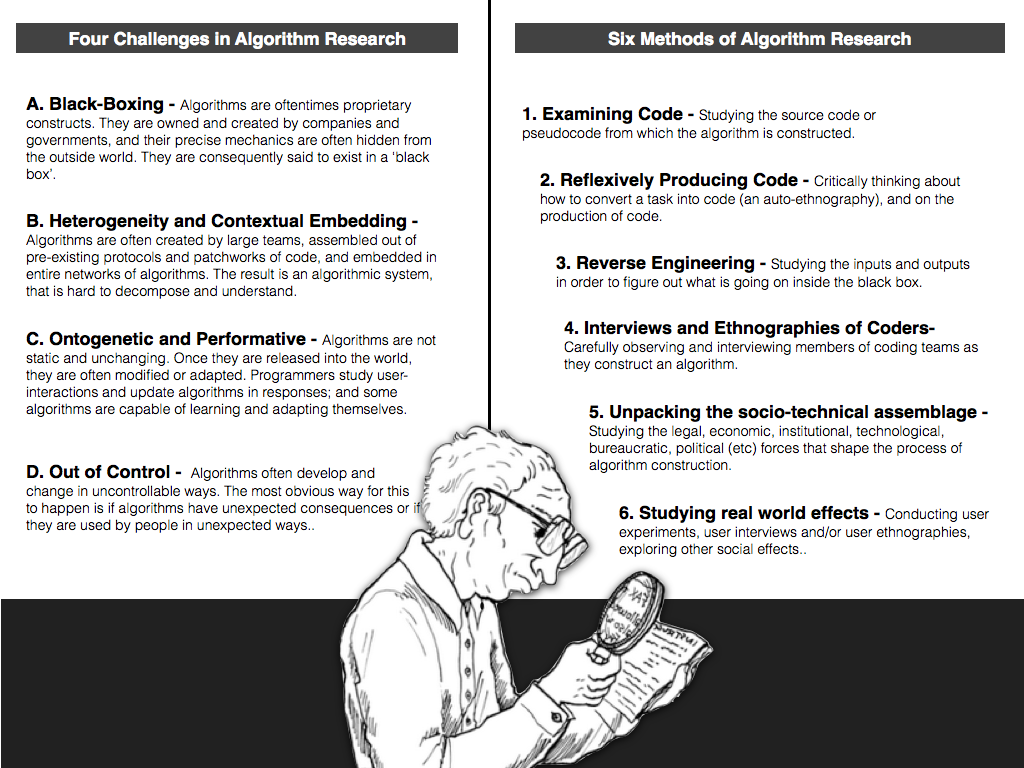
The challenges and methods for studying algorithms


We need to be alive to the challenge that most software we may be interested in is proprietary, although not always and we can look to repositories like GitHub for plenty of open source code, and so it may actually prove impossible to gain access to the code itself –– and here we’d really want the code of the whole programme, and perhaps the training data too. Likewise, software like any complex endeavour may well be the result of collective authorship and maintained by lots of different people. So there are complex sets of relations between people, laws, protocols, standards and many other considerations to negotiate – they are contextually embedded. Furthermore, the programmes we’re calling algorithms here actually have a hand in producing the world within which they exist –– they may bring new kinds of entities and relationships into existence, they may formulate new and different forms of spatial relation and understanding. In this sense they are ontogenetic and performative. Added to this, once ‘in the wild’ this performativity can render the kinds of outcomes of a programme unexpected and peculiar, especially once it is fed all sorts of data, adapted and adopted in unexpected ways.

How can we go about studying these kinds of socio-technical systems then? Well, rather than treat as discrete the six techniques offered by Kitchin (summarised above) – I’d argue we need to combine most of these. Even so, it may prove extremely difficult to actually gain access to code. Further, even if one might reflexively produce code and/or attempt to reverse engineer software –– some systems are the product of companies with such extensive resources that it may well prove near-impossible to do so. Where social scientists might find more traction and actually be able to make a more valuable contribution is, as Kitchin suggests, looking t the full sociotechnical assemblage. We can look at the wider institutional, legal and political apparatuses (the dispositifs) and we can certainly look at the various kinds of relation the assemblages make and how they are enrolled in performing the world they inhabit.

Make no mistake – this kinds of research is necessarily hard. I’m not sure I can imagine papers in geography journals that tie the a/b testing logs of experiments in how a given system works and commit logs to version control systems (even if you could access them!) to particular forms of experience and/or their political consequences… but it might be worth a go. Perhaps this difficulty is why we see (and I am as guilty as any of this) papers written in abstract terms, focusing on the (social) theoretical ways we can talk about these sociotechnical systems in broad terms.

Like Bogost, I can see a kind of pseudo-theological romancing of the ‘algorithm’ and the agency of software in much of what is written about it, and its sort of easy to see why – it is so abundant and yet relatively hidden. We see effects but do not see the systems that produce them:

Algorithms aren’t gods. We need not believe that they rule the world in order to admit that they influence it, sometimes profoundly. Let’s bring algorithms down to earth again.

The algorithm as synecdoche is a kind of ‘talisman’, as Gillespie argues, that reveals something of what Stiegler calls our ‘originary technicity’ – the sense in which we (humans) have always already been bound up in technology and its the forgetting and then remembering of this that forges our ongoing reconstitution (transindividuation) of ourselves.

So, I’d like to end with Kitchin’s argument:

it is clear that much more critical thinking and empirical research needs to be conducted with respect to algorithms [and the software and sociotechnical systems in which they are necessarily embedded] and their work.

Addendum:

It is worth noting that both Gillespie and Kitchin draw on another paper that is very much worth reading by Nick Seaver, who reminded me of this on Twitter, take a look:

“Knowing Algorithms“, presented at Media in Transition 8, Cambridge, MA, April 2013 [revised 2014].

For these companies you, walking down the street, are a data point

I’ve been collecting the promotional videos of various companies that surveil ‘public’ spaces to garner information that, using the logics applied to web analytics, they see as valuable commercial intelligence.

The rationale that is common throughout is that the aggregate crowd on the street, in a shopping centre, or in any form of apparently ‘public’ space are fair game for surveillance measurement and in turn address (albeit by their commercial partners – retailers etc. etc.). In fact, this is merely a technical or perhaps social problem – not a political one. It’s a technical problem for them because as the chap from Placemeter says “it’s all data” and its ‘waiting’ to be harvested. It’s a social problem for them only insofar as it’s about improving ‘services’ for us as consumers (not as citizens, as families or any other part of our skein of identity). It is NOT a political problem for them – it’s not an issue of who has the right to the city, who has a right to privacy or what might constitute reasonable expectations of any of those things. It certainly is never couched in terms of there needing to be governance of these activities – at least in these kinds of videos.

So, the videos are interesting artefacts of the formulation of what pervasive media/ubiquitous computing and smart cities look like and how they are performed…

A reasonable article about Placemeter is in/on the Guardian Cities section.

Museum of Contemporary Commodities

I have meant, and singularly failed, to blog about this fantastic project for a while, so I mean to makes amends now:

The Museum of Contemporary Commodities (MoCC) is an artistic, collaborative and activist project cooked up by the excellent Paula Crutchlow – who just so happens to be a PhD student in Exeter Geography Dept. The project is a collaboration with my colleague Ian Cook and several other interesting and exciting people – not least the folk at Furtherfield.

Funnily enough, I learned about MoCC when it was in its larval stages before I joined the department at Exeter – Ian and Paula held a ‘Thinkering Day’ here in Devon and we explored some ideas around what MoCC could be… the event was supported by REACT (hence why I learned about it) – here’s a snazzy video:

You should definitely explore the MoCC website to learn more, but here’s how MoCC is explained on the Furtherfield website:

The Museum of Contemporary Commodities (MoCC) is neither a building nor a permanent collection of stuff – it’s an invitation. To consider every shop, online store and warehouse full of stuff as if it were a museum, and all the things in it part of our collective future heritage.

Imagine yourself as this museum’s curator with the power to choose what is displayed and how. To trace and interpret the provenance and value of these things and how they arrived here. To consider the effects this stuff has on people and places close by or far away, and how and why it connects them.

What do we mean by things or stuff? Everything that you can buy in today’s society. The full range of contemporary commodities available to consume.

Please join us on our journey by browsing and adding to our collection, attending an event, and becoming a researcher. We are currently curating connections between trade-place-data-values.

There are further events planned and lots more exciting things to come so keep an eye on both the Furtherfield and the MoCC websites.

Reblog> Data and the City Workshop (31/08-01/09)

The Programmable City project team are running a(nother!) interesting workshop/event at the end of the month, just before the RGS annual conference. See the details below:

Data and the City Workshop

The Programmable City Project is hosting a two day workshop on the relations between data and the city.  The Data and the City Workshop will take place on August 31st and September 1st 2015 and will bring together 20 invited experts in the field and the ProgCity team.  A description of the workshop and the agenda are below with links to some of the papers to be presented that are already available online…

Read more in the original post – including the schedule.

Workshop> Exploring Virtual Control, UCL (olympic park)

UCL urban lab are hosting an interesting workshop called ‘exploring virtual control’ at the London olympic park.

“The UCL Urban Laboratory is hosting a workshop on Tuesday 18 August in the Queen Elizabeth Olympic Park to interrogate the mechanics of control within privatised public spaces. If you have any interest in the privatisation of cities, security design, city governance policy or the post-Olympic legacy”

It’s something of a coup to have it at the olympic park – and got me thinking of Francisco Klauser’s excellent work on these forms of control.

Here’s some more details:

This workshop held at the Queen Elizabeth Olympic Park in Stratford serves as an introduction to the mechanics of control within privatised public spaces. Participants will learn about the way in which privatised public spaces are planned, built and monitored, before devising their own ways of mapping and documenting private public spaces. The workshop is organised by UCL Urban Laboratory, and led by the artists and built environment researchers Max Colson and Ollie Palmer, as part of a current exhibition hosted by RIBA. Book here.

The workshop consists of a series of structured group exercises and conversations, during which participants will choose to work on a photographic or mapping project. Please state your preference when applying.

Ollie Palmer is an award-winning artist, freelance designer and brand consultant based in London. He has worked commercially with BBC Worldwide, UCL and the V&A Museum, as well as leading projects for a number of other UK-based companies. As an artist, he has exhibited work at the V&A Museum and The Science Museum’s Museum of Science and Industry in Manchester, as well as being selected as artist-in-residence at the Palais de Tokyo in Paris.

Max Colson is an artist based in London using photography, video and animation. He was the artist-in-residence at UCL Urban Laboratory between September 2014 and June 2015, funded by a grant from the Leverhulme Trust. Virtual Control: Security and the Urban Imagination, his first UK solo exhibition, is at RIBA 6 July – 21 September in London this summer. He was selected as one of the UK winners of the 2013 Flash Forward Emerging Photographer competition, and was shortlisted in the OPEN14 at Brighton Photo Fringe. He has exhibited in C/O Berlin, London, and this summer as part of ‘Data Rush’ at the Noorderlicht Photo Festival.

Limited places are available for this workshop. Tickets cost £20 or £15 for concessions (students/disabled/unemployed/over 65). Please book on the UCL Online Store. Contact Jordan Rowe for more details.

What might happen when ‘things’ design themselves?

I’ve been meaning to flag this for a while… Chris Speed at Edinburgh (who gave the ‘dancing with data‘ talk I posted a while ago) is leading a project called ThingTank:

The ThingTank project identifies that ‘things’ may soon know more about lives than we do and may also be able to make suggestions about what is missing. The purpose of this project is to explore the potential for identifying novel patterns of use within the data that is streamed through the interaction between people and things, and things and things. Our project builds on research and innovation that has been established by the three investigators across the fields of Internet of Things, Social Experience Design and Machine Learning. Through a better understanding of how what data can tell us about how we use objects, new models of use will emerge and reinvigorate the role of things and people within design and manufacturing.

The project offers some interesting provocations both as research outcomes and as innovation in methods. It’s worth looking at this write-up by Chris on his website Fields.

The web and its territories

(Well… DNS and territories)

Two things I’ve read recently converged in my mind and reminded me of work in geography undertaken a while ago about the ways apparently abstract or immaterial aspects of the internet are intimately tied up with traditional geo-political borders and territories.

First, as James Bridle finishes his essays about geographic Top Level Domains (gTLDs) for the Citizen-Ex project – its really interesting to reflect on the often fraught and muddy geo-politics of the domain name system (DNS), which Bridle expresses beautifully. The stories about the Libyan (.ly), Syrian (.sy) and British Indian Ocean Territory (.io) domains are especially arresting.

Second, over on Culture Digitally, Adam Fish wrote a post about the growth in interest in the high seas, the upper reaches of the atmosphere and space for creating extra-legal territories for ‘unencumbered’ innovation and for the delivery of services without the need for territorial wrangling:

Technical approaches towards national internet sovereigntyincluding IP address blocking, domain names, key words, and packet filtering. Non-technical forms of censorship include laws, regulations, threats, bribes, and arrests of publishers, ISPs, and authors. Reporters without Borders identifies 19 countries – including the US and the UK – along with Cuba, China, Iran, and North Korea, all of which use one or several of these tactics to create a distinct national internet.

Certainly, what governments want for their people and what the people want for themselves frequently diverge. But while we may agree that internet censorship by authoritarian dictatorships is an affront to free communication, can we really put our faith in Facebook’s drones? It is possible to overthrow a government and depose a dictator but it is nearly impossible to revolt against corporate drones and extraterritorial CEOs.

Both of these reminded me of a few things in geography: of work in  by Mark Wilson about 15 years ago and (of course) by Matthew Zook (also about 15 years ago [e.g.]) concerning the economic geographies of the infrastructures of the internet(s). It also strongly reminded me of Alexander Murphy‘s paper in the Annals of AAG a couple of years ago about ‘Territory’s continuing allure‘. It is interesting, amongst the hyperbole of immateriality and of ‘off-shore’ data centres through which our exhaust data are analysed and sold on, that (the idea of) territory maintains certain kinds of political-economic importance in particular circumstances.

As Murphy contends (in a different context but I suggest the argument holds in relation to the examples above):

if Agnew (1999, 504) is right that the spatialities of power will change “as material conditions and associated modes of understanding of them change” (italics added), then the continu- ing hold of modernist conceptions of territory on the political–geographic imagination (see Gregory 1994) must be seen as fundamental to any effort to understand the character and prospects of the current system (p. 1214)

…

Novel spatialities of power call out for a reinvention of the linguistic terms and conceptual frameworks we use to make sense of the world (see, e.g., Allen’s [2011] call for a consideration of what he terms topologies of power). At the same time, if we are to make sense of the circumstances and struggles shaping the political future, we must not underplay territory’s continuing ideological hold and practical significance … We also need to factor in the enduring significance of territorially based worldviews that continue to shape the perspective and ideas of billions of people–and by extension the institutions and regimes that circumscribe their lives.(p. 1224)


Reblog> The Internet of Someone Else’s Things

In a post on TechCrunch Jon Evans runs through the various ways we might have to rethink ownership in a tightly vertically integrated economy of an ‘internet of things’. The article resonates with the talk “Dancing with Data” by Chris Speed that I posted a few weeks ago, about markets, value and how we can understand our everyday uses of digital technologies.

As Chris argues, you/we are already enrolled into markets through the ‘data exhausts‘ of our stuff and as Jon Evans argues in the article, even as the ‘owner’ of the physical device you have no real control over whether or where that data exhaust goes. As Evans goes on to say, there is increasingly a variety of forms of ownership of any given device: there’s physical possession, legal ownership and the ultimate power to command it (what you might call “root” access). Likewise, in an article in The Atlantic (to which Evans links)  Madrigal and Meyer point out the peculiarities of interoperation that an Internet of Things requires:

Most “smart-home” devices right now aren’t talking to each other directly over a local wifi network. Instead, they’re talking to enormous and  centralized data centers, which are then talking to each other, which are then (finally) sending instructions back to different devices in your home.

Evans goes on to argue that we could think about ownership another way:

the possibility of a decentralized Internet of Things; smart things which don’t communicate with any central server, but rather with a peer-to-peer, perhaps blockchain-based network. Consider the way FireChat is being used in Hong Kong, so that protestors can communicate despite the authorities’ control of the mobile networks. You don’t always actually need a central server, especially if you have a distributed-consensus system – like a blockchain – for longer-term data storage and algorithmic coordination.

It’s an interesting, relatively short, article with plenty of links to follow up – worth a read!

The Internet Of Someone Else’s Things

Trojan Horse

The Internet Of Things is coming. Rejoice! “¦Mostly. It will open our collective eyes to petabytes of real-time data, which we will turn into new insights and efficiencies. It will doubtless save lives. Oh, yes: and it will subtly redefine ownership as we know it. You will no longer own many of the most expensive and sophisticated items you possess. You may think you own them. But you’ll be wrong.

They say “possession is nine-tenths of the law,” but even if you physically and legally own a Smart Thing, you won’t actually control it. Ownership will become a three-legged stool: who physically owns a thing; who legally owns it; “¦and who has the ultimate power to command it. Who, in short, has root.

Read the rest of the article.

UK now a mobile-first country

Ofcom, the quango that regulates communications activities in the UK (i.e. broadcasting, mobile phones and internet service provision), has released a report that suggests that the UK population (according to their survey) generally prefers to use their ‘smartphones’ as the principle means of accessing the internet.

They include a few other interesting findings:

During 2014, 4G subscriptions leapt from 2.7 million to 23.6 million.

…

Smartphone users with 4G are shopping online more than those without 4G (55% of 4G users do this compared with 35% of non-4G users); banking more online (55% versus 33%); watching more TV and video clips online (57% versus 40%); making more face-to-face and voice calls over the internet (28% versus 20%); using services such as Snapchat to send more photos and videos (49% versus 36%); and instant messaging more with services such as WhatsApp (63% versus 50%).

…

One in three adults (34%) turn over and check their phones within five minutes of waking up. For young people, checking social media messages before breakfast is even more crucial – around half (49%) of young people aged 18-24 check their phones within five minutes of waking up.

…

Most 16-24 year olds are watching on-demand and catch up programmes on computers and smartphones rather than on a TV connected to a set-top box.