In Disruption – new book by Bernard Stiegler

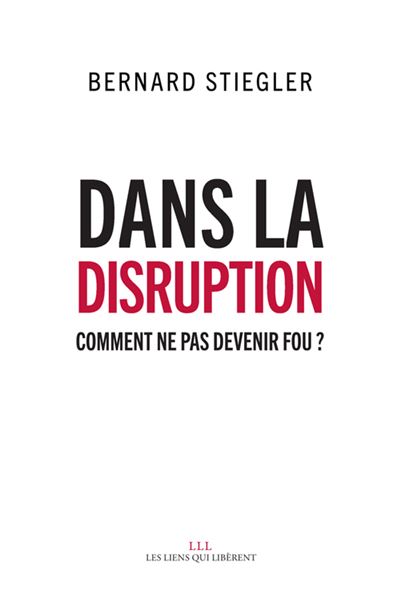
Yet another new book by Bernard Stiegler has been published in French recently: Dans la Disruption – Comment ne pas devenir fou?

One might translate this as: “In Disruption – How do we not go mad?”

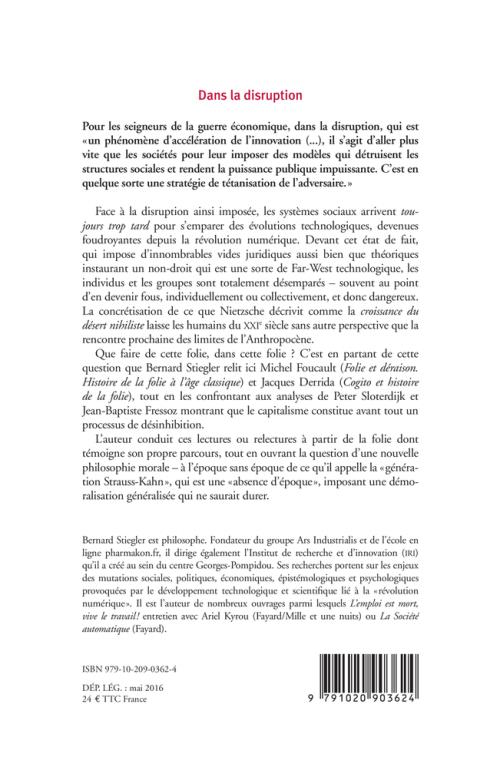
Here’s the front and back covers, and I offer a quick translation of the back cover blurb…


For the lords of economic war disruption is “a phenomenon of the acceleration of innovation (…) which is going to happen more quickly in societies that allow them to impose programmes that destroy social structures and render public power impotent. This is a kind of strategy of tetanising one’s adversary”.

Facing the disruption thus imposed, social systems always arrive too late to seize technological evolution, now thundering ahead in the digital revolution. Faced with this state of affairs, which requires countless legal and theoretical loopholes establishing a lawlessness which is a kind of techonlogical Wild-West, individuals and groups are totally lost, often to the point of going mad, individually or collectively, and therefore becoming dangerous. The concretisation of what Nietzsche described as a growing desert of nihilism leaves 21st Century humans with no other perspective than facing the next of the limits of the Anthropocene.

What can be done with such madness, in such madness? It is by starting with this question, that Bernard Stiegler rereads Michel Foucault (Madness and civilisation: A history of insanity in the Age of Reason) and Jacques Derrida (Cogito and the History of Madness) while confronting Peter Sloterdijk and Jean-Baptise Fressoz’s analyses of capitalism as above all a process of disinhibition.

The author conducts these readings or re-readings starting from the forms of madness which reflects his own course, opening out the question of a new moral philosophy – in an age without age [l’époque sans époque], which he calls the “Strauss-Kahn generation”, that is a “lack of age” [“absence d’époque”], which imposes a general demoralisation that cannot last.

Stiegler: Stop the uberisation of society!

Posted below is a translation of a piece co-authored by Bernard Stiegler with Ariel Kyrou (journo),  Yann Moulier-Boutang (writer) and Bruno Teboul (Director of innovation at Keyrus) and published in Libération on the 10th April.

I suppose it doesn’t really propose anything especially novel, if you’re familiar with others involved in debates around “postcapitalism”, automation, worklessness and universal income (e.g. Srnicek and Williams, or Mason). What is perhaps novel is an application of the ideas in a distinctly European flavour, with examples in France and in the context of a much more robust unionised response to Uber (and the task/gig economy).

Anyway, it’s an interesting read I think…

The piece is rather conversational in tone and uses idioms I have only been able to infer (not being a fluent and native speaker) so it was quite difficult to translate, and so I’m pretty sure there are errors. As usual clarifications or original French are in [square brackets].

Stop the uberisation of society!

Libération, 10th April

The war by taxi companies against an Uber society cannot be reduced to the storyline of a film depicting an ancient evil battling benevolent forces of modernity. If on the one hand the participatory economy threatens our social structures, it can also, on the other, make possible a society with greater solidarity.

Since the first moves towards the draft Thévenoud law in June 2014[1], the urban transport soap opera has generated multiple variations on the theme of the standard storyline. On one side are the taxi federations, which have been labelled a horde of grumpy medieval malthusians by Uber, who in the opening of the second act of the performance of the trial of the 11th February demanded a whopping €100m in damages from Uber, on the other the ‘white knight’ of the new economic order, the high-tech Robin Hood of its pleb users whose UberPop service enables simple fellows in search of employment the opportunity to offer at cut-price their talents for automotive locomotion, between February 2014 and July 2015. This tale of jokers against modernisers is more attractive than the G7, queen of opaque rentier sorcery, who could not turn themselves with the wave of a magic wand into the cinderella of Parisian Transport.

Except that the movie script of the ancient evil against the benevolent ‘disruptors’ rings as hollow as any Hollywood blockbuster: seen quickly, soon forgotten. It works in the short-term, like the groan of the indefinite vigil for a taxi at 3 o’clock in the morning in the banlieue, but it hardly takes us any distance towards solving the questions about the future of our society and the search for sustainable solutions to the crisis we are experiencing.

Let’s not misunderstand this scenario: the agonism presented by this contemporary drama [série du moment] is neither the ardent need to pit global start-ups against French corporatism [corporatismes franchouillards] nor its exact opposite, namely the obligation to defend the capitalism of tired old barons against the hyper-capitalism of the rulers of the digital future. No, the issue that should be obvious to everyone with a stake in the debate is the urgent need to think about the society we want, and then act in order to build it.

For why should we anoint an ‘uberisation of the economy’ without interrogating its ideology and long-term deleterious effects? Uber, which declares only a fraction of its profits in France thanks to a complex form of tax evasion through the Netherlands, Bermuda and Delaware, is participating in the liquidation of our social structures. It embodies a short circuit that threatens the fragile economic balance between taxation, social law, transport policy, infrastructure investment at the local level and the pensions system. Worse still: its social and economic logic foreshadows the advent of a futuristic no-man’s land in which the a priori ideal of liberty becomes monetised against an a posteriori generalised casualisation throughout society. Indeed, the rictus predatory behaviour of platforms like Uber, Lyft and others such as Amazon’s Mechanical Turk is founded upon a low intensity of capital, little infrastructure, a minimum of salaried employees with more independent or self-employed workers.

The uberisation process forms the first wave in the tsunami of automation. Its primary consequence will be a net loss of five million jobs in industrialised countries by 2020, according to a report published on the 18th of January by the oracles of the World Economic Forum in Davos, the shameless apostles of the “fourth industrial revolution”. This deeply unappealing assertion has been amplified by several studies in the last three years (by Oxford, MIT, the Breugel Institute and Roland Berger) which predict around 47% fewer people in employment by 2025. This slow but inexorable extinction of of the salaried world effects not only warehouse workers, supermarket cashiers and lorry drivers but also barristers, solicitors, journalists, those working in medicine, and so on. Why should it remain necessary to use human beings for tasks that are reducible to systematic procedures? Which in our data economy robots and algorithms will soon perform much more efficiently. The combination of robotics and ‘big data’, algorithms and network effects, is already transforming us into the involuntary gravediggers for salaried employment. Welcome to a world that is ultimately ‘flexible’, boosted by robotic automation [robotisation] and work on the meter. A world where users and customers constantly account for themselves, where each becomes their own big brother and where most of the activity in every market, like with car insurance, will increasingly play out more in an automated big data-driven fashion than according to laws or to forms of trust that are not based in calculation.

Nevertheless we should beware skewed perspectives: such a world is not inevitable. The digital gives us an opportunity to reconsider work not only in terms of jobs doomed to become ever more precarious, provoking anxiety about self-exploitation, but also as a part of a project for a contributory society in which salaried employment would be one means amongst many, rather than an end in itself. A company like TaskRabbit certainly creates use value through its platform of small on-demand jobs, but it keeps for itself and its shareholders the [accompanying] exchange value in the form of profit. In contrast, Loconomics is a co-operative owned by those who use it to advertise their services. Against the platforms of the so-called sharing economy (which it is in name only) Trebor Scholz endorses a ‘platform cooperativism’ [2] to build a society of commons that operates beyond solely economic and financial dimensions.

This shambles needs to be urgently addressed. Thinking in the long-term, this is political in the principal sense of the word. To buckle down to the future of work equally concerns: expertise in data to use and liberate ourselves from algorithms and a care for people without the need for machines; to classify work in a way that is both protective of our ways of life and much less administrative than today; to examine the establishment of an adequate basic income, structurally justified by massive unemployment due to automation and the coming slow death of employment; to experiment with the extension of the regime of casual work in the context of a true society of contribution, with the acquisition and sharing of knowledge by and between everyone; to study tax reform based upon the principles of a financial transactions tax [la taxe pollen], beginning with the establishment of a European tax on the flows of High Frequency Trading, to finance a universal income.

Rather than the two opposing and yet complimentary nightmares that are the integral uberisation of society and the sovereignist protection of the capitalism of yesteryear we prefer the realisation of a dream: to imagine, to experiment, to build, step by step, a freer society with greater solidarity; preferring disagreement to the brainwashing that has played out, historically, through the carrot and the stick, or, in our high-tech times, through a blind obedience to shiny artificial devices [l’obéissance aveugle à de rutilantes mécaniques artificielles et augmentées].

1. For more information on the Thévenoud law see this article – Sam.

2. See this article on Medium by Scholz.

Reblog> Everyday Code

An interesting post by Mark Purcell on his paper at the AAG:

Everyday Code

Here is the text from my talk at the AAG conference last week. It was for a really great session organized by Joe Shaw and Mark Graham (who are at the Oxford Internet Institute) on “An Informational Right to the City”.

Everyday Code: The Right to Information and Our Struggle for Democracy

Introduction

Henri Lefebvre proposed a right to information, and he thought that right must be associated with a right to the city. I want to urge us to understand both those rights in the context of Lefebvre’s wider political project. That wider project was the struggle for self-management, what Lefebvre often called “autogestion,” and what I prefer to call democracy.

Lefebvre articulates his wider political vision in terms of what he called a “new contract of citizenship between State and citizen.”

Read the full post.

Inspector Rory Gillard

Dear Sir,

“ENOUGH IS ENOUGH..”

Its now crystal clear to you in the time past that you have been dealing with fraudsters because our investigation report have shown that you have an outstanding payment.Nevertheless the deed has been done and the only way to remedy the situation is to proceed to pay you an approved compensation fund of $6.5million only as approved for listed certified scam victims by the United Nations Debts Reconciliation Committee United Kingdom). Thus the payment will come via ATM VISA CARD and sine our paying bank is duly inter switched,you will be permitted to make a maximum withdrawal of $5000 on daily basis in any ATM VISA CENTER that is nearest to you any where in the world.The original copy of your ATM VISA CARD shall be delivered by Diplomatic COURIER service within 5 working days from the date of your response email. Please to avoid wrong delivery of your ATM VISA CARD you are kindly expected to reply immediately and re-confirm, Your preferred home or office delivery address Thank You Inspector Rory Gillard Scotland Yard Police UK.

Thank You

Inspector Rory Gillard
Scotland Yard Police UK.

Found in my junk folder…

Reblog> Programme for Streams of Consciousness, Warwick, 21-22 April

Via Tony Sampson. All the names you’d expect/want to see and a few more… (can’t help finding it amusing that Thrift is opening the event).

It’d be interesting to hear what Rouvroy has to say…

Streams of Consciousness: Data, Cognition and Intelligent Devices

Download here short and full draft pdf versions of the programme

Register for the conference here 

Thursday 21st April


9.00 to 9.45: REGISTRATION AND COFFEE
9.45 to 10.00: OPENING ADDRESS
Nathaniel Tkacz, Centre for Interdisciplinary Methodologies, University of Warwick
10.00 TO 10.45: KEYNOTE SPEAKER 
Professor Nigel Thrift

10.45 to 13.00: PLENARY SESSION
Tony Sampson, University of East London 
Understanding Neurocapitalism or What Happens When Gramsci Does Human Computer Interaction
Nick Srnicek, Independent Researcher
The Eyes of the State
Antoinette Rouvroy, University of Namour (Video Conference)
Title TBC

13.00 to 14.00: LUNCH

14.00 to 16.00: BREAK OUT SESSIONS 
SESSION A: DATIFIED SELF
Sun-Ha Hong, University of Pennsylvania 
Data’s Intimacy: Machinic Sensibility and the Quantified Self
Elpida Prasopoulou, Coventry University 
The Body in the Internet of Things: An Auto-ethnography on Wearables
Aleksandra K. Przegalinska, Kozminski University 
Productivity 3.0: Mindtracking and the New Transparent Labour
Ana Viseu, Universidade Euroepia (TBC) 
Bodies, Data and the Question of Physiological Narcissism
SESSION B: ALGORITHMS, MODELS AND CALCULATIVE DEVICES
 
Nathan Coombs, University of Edinburgh 
Intractable Algorithms: Representational Uncertainty in the German High-Frequency Trading Act
Tyler Reigeluth, Université Libre de Bruxelles 
“Let’s misbehave!”: The politics of Behaving with Algorithm
Jérémy Grosman, University of Namour 
A Prediction, not an Oracle – Neural Network, between Algorithms and Metaphors
Charalampos Fytros, Lancaster University 
Mediating Solvency
SESSION C: EXPERIENCE, AFFECT, ATTENTION, INTERACTION
Miguel Prado, University of West England
Noise and Cognition in the Age of Big Data
Darshana Jayemanne, University of Melbourne
The Body Eclectic: Massively Multiplayer Mimesis
John McManus, Oxford University
Football Fans, Mimesis and the Enchanting Properties of Smartphone Use
Craig Hamilton, Birmingham City University 
Can Algorithms Make You Cry?: Popular Music and Machine-Derived Curation

16.00 to 16.15: COFFEE BREAK

16.15 to 18.30: PLENARY SESSION
Steve Fuller, University of Warwick 
Neuroscience as the Mind Instrumentalised: Telescope vs. Microscope
Michael Wheeler, University of Stirling 
The Knowledge Ecology: Epistemic Credit and the Technologically Extended Mind
Caroline Bassett, University of Sussex 
The Hubris of the ‘Artificial Intelligentsia’: Eliza and the Simulation of Smart

19.30: CONFERENCE DINNER

Friday 22nd April


09.00 to 11.00: PLENARY SESSION
Louise Amoore, Durham University 
Title TBC
David Berry, University of Sussex
Human Reason and Algorithmic Judgement
James Ash, Newcastle University 
The Interface Envelope: Power, Cognition and Gaming

11.15 to 11.30: COFFEE BREAK

11.30 to 13.10: BREAK OUT SESSIONS
SESSION A: PLATFORMS, INTERFACES AND SENSORS
Jacob Johanssen, University of Westminster 
Not Belonging to One’s Self: Affect and Alienation on Facebook’s Site Governance Page
Alex Gekker, Utrecht University
Numbers are Magic: Numerical User Interfaces and Disconnect
Heather Ford – Oxford Internet Institute
Ode to the Infobox
Alison Powell – London School of Economics and Political Science
A Goose in The Stream: Animals, ‘Accidents’ and Sensing Citizenships beyond the Calculative
SESSION B: ROBOTS, DRONES AND AI 
Tero Karppi, Marc Böhlen and Yvette Granata, SUNY Buffalo
Killer Robots and Cultural Techniques
Ramon Bloomberg, Goldsmiths College
Becoming Platform
Beatrice Fazi, University of Sussex
Can a Machine Think Anything New?
Marc Böhlen (Video Conference), Tero Karppi and Yvette Granata – SUNY Buffalo
Robot Control
SESSION C: AESTHETICS AND VISUALISATIONS
Roxana Fabius, Barad College
Business Intelligence and Aesthetic Criticality
Jonathan Gray, University of Amsterdam; Liliana Bounegru, University of Amsterdam, University of Groningen, University of Ghent; Stefania Milan, Amsterdam University; and Paolo Ciuccarelli Density Design, Politecnico di Milano 
Ways of Seeing Data
Lukasz Mirocha, University of Warsaw 
Challenging Technology Obfuscation Through Aesthetics of Real-time Visual Media: An Analysis of Glitches in Post-digital Consumer Mapping and Navigation Systems

13.10 to 14.00: LUNCH

PLENARY SESSION 14.00 to 16.15
Natasha Dow-Schüll, NYU (Video Conference)
From Mood Ring to MuseTM: Digital Sensor Technology and the Mediation of Sentience
Satinder Gill – Cambridge University 
Performing Knowledge: The Mediating Body
Will Davies – Goldsmiths College 
How Are We Now?: Mood as a Real-Time Indicator

16.15 to 16.30: COFFEE BREAK


PLENARY SESSION 16.30 to 17.15
Michael Dieter, University of Warwick
Title TBC
Jennifer Gabrys, Goldsmiths College
Digital Infrastructures of Withness: Constructing a Speculative “Smart” City

18.00 to 18.15: DISCUSSION AND CLOSING REMARKS

Internet of Things, ownership and Ts & Cs

iot-toothpaste
Toothpaste terms of service

Decided to make a spoof image that follows some others’ attempts to satirically reflect on the kinds of business models that seem to be creeping in for ‘Internet of Things’ products and services. My impetus is that I’ve enjoyed some of the recent posts on the @internetofshit satirical twitter stream, which lampoons IoT business ideas. These got me thinking…

Many of the successful posts take to the extreme a model we are already experiencing – which is that we do not necessarily totally control those things we think we own. I am aware that other folk will probably have commented in more depth and with greater nuance, but there we are… this is just a blogpost! (I welcome suggestions for further reading though)

For example – I recently bought a Kindle Paperwhite and to remove the inbuilt advertising I had to pay (in addition to the retail price) a £10 fee to ‘unsubscribe’ from ‘Special Offers‘. So, I had bought the device but to remove the adverts I had to pay more.

This, of course, resonates with the inkjet printer business model – in which the printer manufacturer can almost give away some models because the ink itself is highly lucrative, which led to stories comparing it’s value to that of gold…

In my most recent lecture for my third-year option module (Geographies of Technology) I addressed some of these issues and invited the students to consider the following questions when thinking about an ‘internet of things and places’:

Questions of ownership/responsibility:

  • Whose things?
  • Whose data?
  • Who has access? How? When? Where?

Questions of power:

  • How are decisions made on the basis of the data?
  • How doe these decisions influence our lives?

Questions of value:

  • How can/should we negotiate the value(s) of our data?
  • What are we willing to give(-up) for perceived benefits?
    • When does giving away lots of data become not worth it?

Later the same day, on the train home, I idly tweeted a speculative satirical scenario:

Which led me to create a still image (above). I think there’s a lot of scope of using speculative design techniques in a satirical way to provoke more debate about the kinds of relationship we want to enter into with and through the technologies we bring into our everyday lives. My key inspiration here is Anne Galloway‘s work, especially the beautiful Counting Sheep project.

A politics and economics of attention

Just before Christmas (and just before injuring myself) I took part in an ESRC-funded seminar concerning the politics and economics of attention, alongside my colleague Clive Barnett and others.

Jessica Pykett very kindly invited me to talk on the back of the theme issue of Culture Machine Patrick Crogan and I co-edited back in 2012.

There are slides from the talks plus an interesting commentary by Rupert Alcock now posted to the Behaviour Change and Psychological Governance website.

My slides are on ResearchGate…

Reblog> Digital Interfaces, Credit and Debt – new project from @ash_ecotechnics & @BenAndersonGeog

Not really sure how I missed this announcement last week but there you go… An interesting new ESRC-funded project led by James Ash concerning the growth of personal/’pay day’ loans (“High Cost, Short-Term Credit”) that are accessed through mediation, such as an ‘app’. Kudos to James and team for landing this with success rates with the ESRC as low as they are – a great achievement.

I’m sure it’ll be a great project!

Digital Interfaces, Credit and Debt

I am happy to formally announce that I am primary investigator on an ESRCfunded project entitled: ‘Digital Interfaces and Debt: understanding mediated decision making processes in high cost short term credit products’ with co-investigators: Dr Ben Anderson and Dr Paul Langley. 

This 18 month project (2016-2018) seeks to understand how consumers access HCSTC (High Cost Short Term Credit), such as cash and pay day loans through digital interfaces, on personal computers and mobile devices and in turn how these interfaces shape decision making processes regarding the purchasing of credit. The project proposes a novel approach to debt as an everyday phenomenon that is mediated through the relationship between technology and embodied practice. Understanding how people become indebted through digital interfaces is critical to analyzing and explaining contemporary indebtedness because 82% of cash and pay day loans, a key form of HCSTC, are now applied for and managed via digital interfaces on laptops, tablets and smart phones (Competition and Markets Authority, 2015). Through original empirical investigation with designers and users of mobile interfaces, debt support charities and financial regulators, the research will generate new evidence about everyday experiences of debt and indebtedness and contributes to important societal and academic debates about emerging forms of credit and problematic forms of economic subjectivity.

The project begins later this year and will have its own dedicated website and Twitter account, which will be publicized in due course.

Reblog> The Geopolitics of Context: Mordor, Russia and Google Translate, by @Pip__T

An interesting blogpost by Pip Thornton on the Royal Holloway Geopolotics & Security blog:

The Geopolitics of Context: Mordor, Russia and Google Translate

“One does not simply walk into the Russian Federation”

Over the last week several media outlets, and many more Twitter feeds, have been spreading news of a series of ‘glitches’ in Google Translate which saw the word Russia being synonymised with Mordor when translated from Ukrainian to Russian. Furthermore, Russians became occupiers and for a short time the name of the Russian Foreign Minister Sergey Lavrov returned the result sad little horse. 

vk-russia-to-ukraine

Twitter / Vadim Nakhankov (wired.co.uk)

Noting that ‘the terms mirror language used by some Ukrainians following Moscow’s annexation of Crimea in 2014″², some suggested the possibility of foul play; that the algorithm was ‘hacked by spies‘, ‘jokers’ or ‘mischievous pro-Kiev activists’,  or that the words had been inserted manually by users as alternative translations presumably in order to ridicule Russia and humiliate Lavrov. Other sources referred to a ‘bug’ or an ‘automated error’ in the algorithm, an explanation seemingly substantiated by the way Google quickly issued an ‘embarrassed apology’, stepping in to ‘fix’ their wayward algorithms as soon as the matter came to light.

Read the full post here.