2013 Design Fictions – postscapes awards

Postscapes have an annual ‘Internet of Things‘ awards, with projects nominated under various categories for which the viewing public (with net access) are invited to vote. This is the third year of the awards and the second in which I have been aware of a ‘design fiction‘ category.

Postscapes identify/define design fiction in the following way:

Grounded as much in imagination as reality, design fiction is about bending the rules. It’s about asking “What if?”, and using the remains to probe the edges of our changing world.

The results may only be props or prototypes – but the best ones, as recognized by the Design Fiction award, end up helping us navigate our near futures and the stories they share.

(I’ve discussed how we might go about defining this sort of thing elsewhere on this blog and collected examples of similar kinds of fictions.)

Last year (in the awards for 2012), the ‘design fiction’ category was ‘won’ by the slightly creepy and maybe a little bit flawed ‘ear hacking’:

Ear Hacking from David Chatting on Vimeo.

In which we are asked to believe that there is a direct correlation between basic features of audio playback and our activity – in particular as runners. Anyway, it serves to demonstrate that humour works well in fostering and audience for design fiction. Notably, this ‘beat’ Google’s now infamous ‘project glass‘ video which, of course, was the forerunner for ‘glass‘.

In the running for the 2013 design fiction awards are a few interesting projects, you can see the whole list on the posts capes website but here are a couple that I think are in some way provocative…

Anne Galloway’s Design Culture Lab investigations of the Merino wool industry (see ‘counting sheep‘), with the lovely ‘bone knitter‘ that produces custom knitted casts for knitting back together broken limbs, and the rather unsettling ‘PermaLamb‘, vision of custom GM lamb production. Check out the ‘counting sheep‘ website for more, its worth exploring.

BoneKnitter during the knitting process.

James Bridle’s ‘surveillance spaulder’, a pithy and playful imagining of a device that viscerally reminds the wearer of their being surveilled:

Spike Jonze’s soon-to-be released film ‘Her’, in the tradition of various imaginings of AI (e.g. Brian Aldiss):

[NB. posting them here doesn’t necessarily mean approval…]


“Ethnographies from [a] future” and the co-production of knowledge

Its strange when you come across work that significantly overlaps your own and both the author of that work and you have been doing the work for a while and yet not consciously encountered one another… something about particular disciplinary contexts or discursive regimes going on perhaps (which is quite sad).

Anyway, through the wonders of twitter, I ran across the work of Laura Forlano in the guise of an article on ethnography matters, who is at the Institute of Design at Illinois Institute of Technology and, of course, has done the obligatory visiting scholarship with the Comparative Media Programme at MIT (discursive regimes, see?). Forlano attempts to conduct ethnographic research around future technologies. In many ways Forlano’s work echoes that of ‘futurologists’ like the commercial researchers at Institute for the Future, sniffing out ‘signals’ of potential futures and then working these up into articulations of a possible world. What is interesting about where Forlano goes with this work is that she is looking towards how to engage prospective ethnographic work around emergent practices and technologies with speculative design practice.

At the end of the article in ethnography matters Forlano makes some interesting assertions about the uses of ethnography and political importance of making one’s work relevant to, or the basis of, interventions in the world – its worth quoting at length here:

As ethnographers, it is not enough to describe social reality, to end a project when the last transcripts and field notes have been analyzed and written up. We must find new ways to engage and collaborate with our subjects (both human and nonhuman). We need better ways of turning our descriptive, analytical accounts into those that are prescriptive, and which have greater import in society and policy. We may do this by inhabiting narratives, generating artifacts to think with and engaging more explicitly with the people formerly known as our “informants” as well as with the public at large.

This is not to suggest that every ethnographer should do it all, or that ethnographers are not already traversing the boundaries between analyst, activist and artist. Most likely, our best work will be (and is already being) done in teams where description and analysis can inform design but at the same time, we can innovate within our own skillsets and practices. We can compare across our many field sites and topics and create design fictions that interrogate the issues and themes that come to the fore.

This will require new venues for publication (targeting both scholarly audiences and the broader public) and new criteria for gaining credit for our work. For example, how will an ethnographer’s work of design fiction be presented, peer-reviewed and published? Will it be in the form of a textual narrative, a series of photos or an exhibit of artifacts? As ethnographers from the future, it is our responsibility to find ways to move beyond existing social realities through the probing of alternative socio-technical realities in order to affect positive change in society and this, it seems, is a perfect job for speculative design.

What strikes me about Forlano’s interesting provocation here, beyond the echo of Marx’s 11th thesis on Feuerbach, is two things:

1) I think this work is definitely already being done, which is in and of itself quite interesting. Design fiction and other speculative work has a good foothold in the academy around the world. For example, Anne Galloway’s recent work concerning speculative design practice for the New Zealand wool industry (see Anne’s own contribution to ethnography matters) and Chris Speed’s formulation of what he calls ‘design informatics‘. Furthermore, work by Lucy Suchman and others (who have worked in both/between academic and industrial research) around ethnomethodologies of prototyping and other speculative design practices offers a fairly rich conceptual basis to explore. Equally, this has fed into (activist) pedagogical innovation like the work of my colleague Ian Cook et al. with “follow the things“.

2) To ‘move beyond existing social realities… in order to affect positive change in society’ does, very much, need alternative means of engaging with the world, the means by which it is delineated and disciplined and this is requires more than dissemination and publishing of research results. To take Forlano’s provocation seriously we need more co-design, more contributive systems of working together, bridging disciplinary and other delineations, to forge action-research and knowledge exchange projects. I would suggest that this is exemplified in the working methods of the Pervasive Media Studio. Rapid, collaborative projects that act as a means of co-producing knowledge and new things in the world blur the kinds of disciplinary and discursive boundaries by which people and activities can be commonly categorised and separated. The co-production of knowledge in this way is more than ‘just’ publishing articles or patents, it is about making that knowledge operational [Both Simon Moreton and Jon Dovey have blogged about this on the Research and Enterprise in Arts and Creative Technologies (REACT) knowledge exchange hub website].

Smart cities, design fiction

At the RGS-IBG annual conference at the end of August I presented a paper in the session ‘Smart Cities: discourses, policies, and technologies in the making’, convened by Ola Söderström and Francisco Klauser. It was an interesting a energetic session of critical discussion and analysis of the ways in which the idea of the ‘smart city’ is being freighted into marketing, policy, corporate strategy and, of course, into building projects.

My own contribution was a little divergent from the main thrust of the discussion, still focussing on the discursive regimes of the smart cities agenda(s) but looking at the kinds of spatial imaginary enacted in research and development that attempt to lend some materiality to the not-yet (potentially never) built. The presentation stems from some of my PhD work, which resulted in a paper called ‘Representing things to come‘. On the back of that work and a critical engagement with ideas around ‘design fiction’ I was invited to participate in a project for the ‘Open City’ strand of the European Capital of Culture Guimarães 2012 programme. Working with folks from the Pervasive Media Studio and filmmaker Geoff Taylor, we held a workshop with the citizens of Guimarães to think about ways of imagining alternative future ‘smart cities’. The result was a ‘design fiction’ film based on scenarios imagined during the workshop. You can find the film on the Open City website.

I have put a PDF of the conference paper up here.

Examples of Design Fiction

I am aware that I have referred several times to ‘Design Fiction‘ on this blog without really offering any examples of what might be meant by the term. I suppose I ought to confess that I am somewhat sceptical about the definition of such a ‘genre’ or practice too, but it is a useful provocation that enables some productive discussion about how particular forms of future are addressed in design practices. Below, then, and in no particular order are some examples of what might be characterised as ‘design fiction’.

Continue reading “Examples of Design Fiction”

A graphic record of my talk at 10 things I learnt – Design Wales

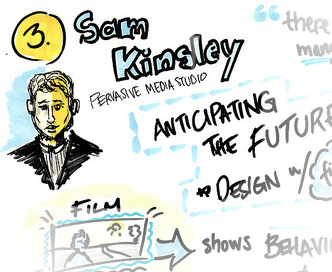
Last Friday, 9th March 2012, I gave a talk as part of the ’10 things I learnt’ event convened by Design Wales Forum, held at the Welsh Millennium Centre.  I was talking about ’10 things I have learned about anticipating technology futures’.  I gave some short provocations based on some of my research and drawing on the work of Julian Bleecker (Near Future Laboratory).  I’ll try and provide a write-up soon.

Today I received a tweet from @_auralab who has created some ‘sketch notes’ of the event. Here’s what Laura made of my talk! –

Sketch note of my talk by auralab

Click through to the Flickr stream of Laura Sorvala

The beginnings of a ‘Design Fiction’ bibliography

On Friday 10th February I will be talking about ‘design fiction’ for the Pervasive Media Studio’s lunchtime talk series. ‘Design Fiction’ describes ways of using storytelling techniques, especially in the form of video, to make speculative design ideas feel real. I have collected together the various resources from which I have drawn my materials for the talk into a preliminary bibliography that may be of use to others interested in the topic. Continue reading “The beginnings of a ‘Design Fiction’ bibliography”