Archive for the ‘past computing futures’ Category

A brief history of the future of pervasive media - Talk at the Pervasive Media Studio

Thursday, April 22nd, 2010

I will be giving a talk at the Pervasive Media Studio on Friday 14th May entitled ‘A brief history of the future of pervasive media’, which is broadly derived from my PhD research. The talk will be open to the public, so please feel free to come along! Here’s the bumpf:

Pervasive media, and the various forms of computing from which they are derived, stem from a tradition of anticipating future scenarios of technology use. Sam Kinsley’s PhD research concerned the ways in which those involved in pervasive computing research and development imaginatively envision future worlds in which they’re technologies exist.

This lunchtime talk examines the ways in which future people, places and things are imagined in the research and development of pervasive media. Examples taken from prospective pervasive computing research and development in the last twenty years will be explored as emblematic of such future gazing. The aim is to provide a broad means of understanding the rationales by which technological futures are invoked so that pervasive media producers can critically reflect on the role the idea of the future in their work. Such an understanding is important because a history of computing is in large part a history of places and things that were never created - a history of yesterday’s tomorrows.

Remembering the future: PARC 1987 & Microsoft 2006

Thursday, March 18th, 2010

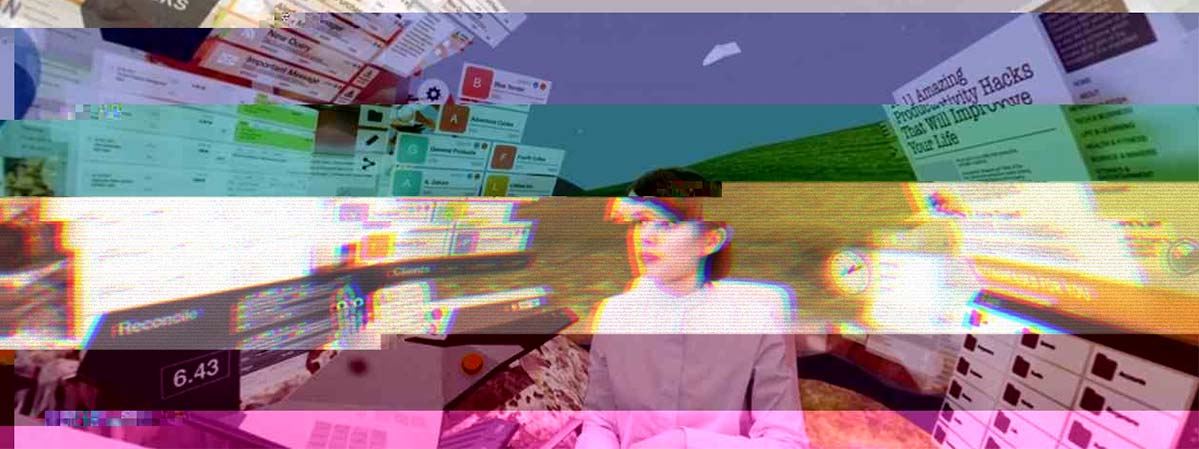
I was checking out the very engaging ‘Milestones‘ timeline on the PARC website and came across an image that evoked a sense of deja vu. The other place I had seen something very similar was in a Microsoft ‘Future Vision of Manufacturing‘ video. Here are the images:

Xerox PARC CoLab circa 1987


Microsoft Future Vision of Manufacturing collaborative screen circa 2006

The first image depicts the Xerox PARC ‘CoLab‘ collaborative workspace and tools research conducted in the late 1980s. Two people are working on the same sketch from different sides of the screen, which are actually located in different places. The second comes from the aforementioned Microsoft video. Two business men on different sides of the world discuss a wireframe of a proposed car seat, to be manufactured. Interestingly the Microsoft video came about 20 years after the PARC project documented in the first image.

Technology futures are not always novel, what is envisaged can have a significant heritage. Yesterday’s tomorrows can easily become today’s tomorrows with some deft recycling. As Picasso said: ‘good artists copy…’

Addressing ubicomp: Computing people, places and things

Saturday, March 13th, 2010

The following is an edited excerpt from my PhD thesis, which articulates the various ways we might understand what we mean by ‘ubiquitous computing’

‘The most profound technologies are those that disappear. They weave themselves into the fabric of everyday life until they are indistinguishable from it’ (Weiser, 1991).

‘The goal is to achieve the most effective kind of technology, that which is essentially invisible to the user… I call this future world “Ubiquitous Computing” (Ubicomp) ‘ (Weiser, 1993).

In the last 20 years the idea of ubiquitous computing has been reiterated, revised and extraordinarily expanded. Starting from the premise that computing might be un-tethered from the grey boxes that sit on desks and become ‘embedded in the woodwork’ of everyday life, ‘ubicomp’ has come to signify research agendas, an eponymous conference, technical goals, an ethos and a legacy. This thesis focuses upon the future orientation inherent to all of the threads that weave together to form ubicomp. From the outset the details of ubicomp have been positioned in the future. Weiser’s ‘Computer for the 21st Century’ popularised a research agenda in the guise of a vision that many subsequently adopted. Yet the article was doubly influential because, as Bell and Dourish observe, ‘it also set a rhetorical tone that many have adopted’. Therefore the same concern for near futures is present in contemporary ubicomp agendas, the papers presented in conferences, and the ways in which ‘advances’ in the field are measured.

There are a number of common threads to the various applications of ‘ubicomp’ as a descriptor for research activity. These themes all somewhat branch from the first and most obvious implication of calling it ‘ubiquitous’. It is worth situating the concept in its initial time-space, for when Weiser and his colleagues were experimentally developing the projects that came to make up the ubicomp project there were few affordable personal computers, no ‘World Wide Web’ and mobile telephones could barely fit into a handbag let alone a pocket. The initial experimental systems created as ‘ubi-comp’ at Xerox PARC under Weiser’s leadership were fixed at three scales of device, called ‘tabs’, ‘pads’ and ‘boards’. As Dourish observes, ubicomp proceeded on three tracks, which ‘were known as computation by the inch, the foot and the yard’ (Dourish, 2004), referring to the three types of device. Inch-scale ‘tabs’ were something akin to ‘computationally enhanced Post-It Notes’, foot-scale ‘pads’ were designed as what might now be recognised as ‘tablet PCs’, and yard-scale boards were epitomised by ‘LiveBoard’: ‘a large-scale display… supporting multiple pens, a sort of computationally enhanced whiteboard’. Of course these things were not supposed to exist in isolation, tabs, pads and boards were supposed to be prolific in number and scattered throughout the everyday environment:

‘In the everyday environment, information continually undergoes transformations and translations, and we should expect the same in a computationally enhanced version of that environment such as might be delivered to us by ubiquitous computing’ (Dourish, 2004).

(more…)

Ubiquitous Computing: Mark Weiser’s vision and legacy

Friday, March 12th, 2010

This is a sub-section of the first chapter of my PhD thesis, its my attempt to reflect on Mark Weiser’s legacy in the field of ubiquitous computing.

2009 marked the tenth anniversary of the death of Mark Weiser, a man that many believe earned the title ‘visionary’. As a Principal Scientist and subsequently Chief Technology Officer at Xerox PARC, Weiser has been identified as the ‘godfather’ of ubiquitous computing (ubicomp). In the years since his demise many of the ideas that Weiser championed have come to greater prominence. As Yvonne Rogers points out this influence has been felt across industry, government and commercial research, from the European Union’s ‘disappearing computer’ initiative to MIT’s ‘Oxygen’, HP’s ‘CoolTown’ and Philips ‘Vision of the Future’. All of these projects aspired to Weiser’s tenet of the everyday environment and the objects within being embedded with computational capacities such that they might bend to our (human) will. Within the research community, as Genevieve Bell and Paul Dourish remark ‘almost one quarter of all the papers published in the ‘Ubicomp’ conference between 2001 and 2005 cite Weiser’s foundational articles’.

(more…)

Ironic vision of augmented (hyper)reality

Thursday, February 11th, 2010

Timo Arnall points out this video, by a masters student(!), that depicts a slightly nightmarish, yet amusingly ironic, vision of a possible future world with augmented reality, whereby you earn money by subjecting yourself to advertising and depend upon instructions from the system for even basic tasks.

The latter half of the 20th century saw the built environment merged with media space, and architecture taking on new roles related to branding, image and consumerism. Augmented reality may recontextualise the functions of consumerism and architecture, and change in the way in which we operate within it.

A film produced for my final year Masters in Architecture, part of a larger project about the social and architectural consequences of new media and augmented reality.

Augmented (hyper)Reality by Keiichi Matsuda

[via Timo Arnall & Berg]

Ubiquitous Computing video circa. 1991

Thursday, May 28th, 2009

“Coined by the Xerox Palo Alto Research Center’s (PARC) Computer Science Laboratory (CSL), [Ubiquitous Computing] describes a vision of the future. Just as electric motors have disappeared into the background of everyday life, PARC scientists envision a future where mobile computational devices will be similarly transparent. Potentially numbering the 100s per person these devices are nothing like those you use today. They are mobile. They know their location, and they communicate with their environment.”

I have no idea if I’m allowed to put this up but it seems a desperate shame that this video isn’t held in one complete file, easily accessible to the public and to researchers, given the historical significance of the work conducted on ubicomp at PARC by Mark Weiser et al. during hte late 80s early 90s. Please see the original files here: http://www.ubiq.com/hypertext/weiser/UbiMovies.html and read more about Mark Weiser by sticking his name in Google.

Please note that I had to edit out 2 minutes of the more technical stuff to get the video down to under 10mins.

Motorola’s “2000 A.D”

Tuesday, April 21st, 2009

In 1990 Motorola produced a video depicting a Ubicomp type vision that was a little more conservative than some other ‘vision videos’ being produced around the same time but has many of the usual constituent elements. What is striking is that the use of mobile phones must have been ‘futuristic’ then but one can’t help considering it banal now…


Motorola part 1
Uploaded by donaldtheduckie

Motorola 1990 part 2
Uploaded by donaldtheduckie

Motorola 1990 part 3
Uploaded by donaldtheduckie

I am indebted to Paleo-future for these videos, it seems to be a gold mine of an archive!!

NTT Docomo’s ‘vision of the future’ (2010)

Wednesday, April 8th, 2009

NTT Docomo have created a few vision videos (but this one is easily accessible via YouTube), many seemed to target the end of this decade. The video below uses yet another schmultzy storyline full of pathos in which to situate (and thus ‘humanise’) apparently futuristic everyday technologies. NTT Docomo depict a rather unsettlingly monolithic future of technology, in which everyone and everything is connected together and monitored. A prime example of the apparently easy trade-off between privacy and seamless integration of systems without any consideration of political repercussions…

Future vision of disaster - ubicomp to the rescue?!

Tuesday, April 7th, 2009

Liz Goodman pointed out this peculiar ubicomp style vision of the apparently everyday being disrupted by disaster. I would echo Liz’s criticism that it (rather poorly) depicts a pretty awful future. Another (recent) ‘past computing future’ video to add to the list though.


The Ambient Life from Buro Knapzak on Vimeo

The at-best amoral (and probably, at worst, deeply unpleasant) use of a disaster that bears striking resemblance to various recent tragic events is astounding. I would hazard, to animate is not only cheaper but it retains the almost clinical cleanliness of (usually) anodyne ‘future vision’ videos. The narrative is facile to the point of being slightly offensive: the producers use this disaster imagery just to set up quite boring and glib analysis of communications infrastructure. That aside, the graphical aesthetic is, I suppose, interesting. As Liz says:

Do, however, watch it for the moment when an epileptic jogger recovers from an almost-seizure (monitored in real-time by the sort of highly paid doctor who wouldn’t be caught dead doing real-time monitoring in the US) just before a plane (!) rams into a skyscraper and the scenario turns to disaster in a busy city. Crowds running wildly, people checking their mobile phones (?) as debris rains down on them.

The above video, entitled “The Ambient Life“, was apparently made for the Freeband Communication research initiative, which is a Dutch national programme of research in and around ‘ambient intelligence’ (a largely European synonym for Ubicomp).

Nokia’s “connected lifestyle” (2005)

Tuesday, April 7th, 2009

Another past vision of the future of a branded pervasive media that fits within the canon of ubiquitous computing, this time from Nokia in 2005. The video below was a part of a presentation at the Nokia Connection 2005 conference.