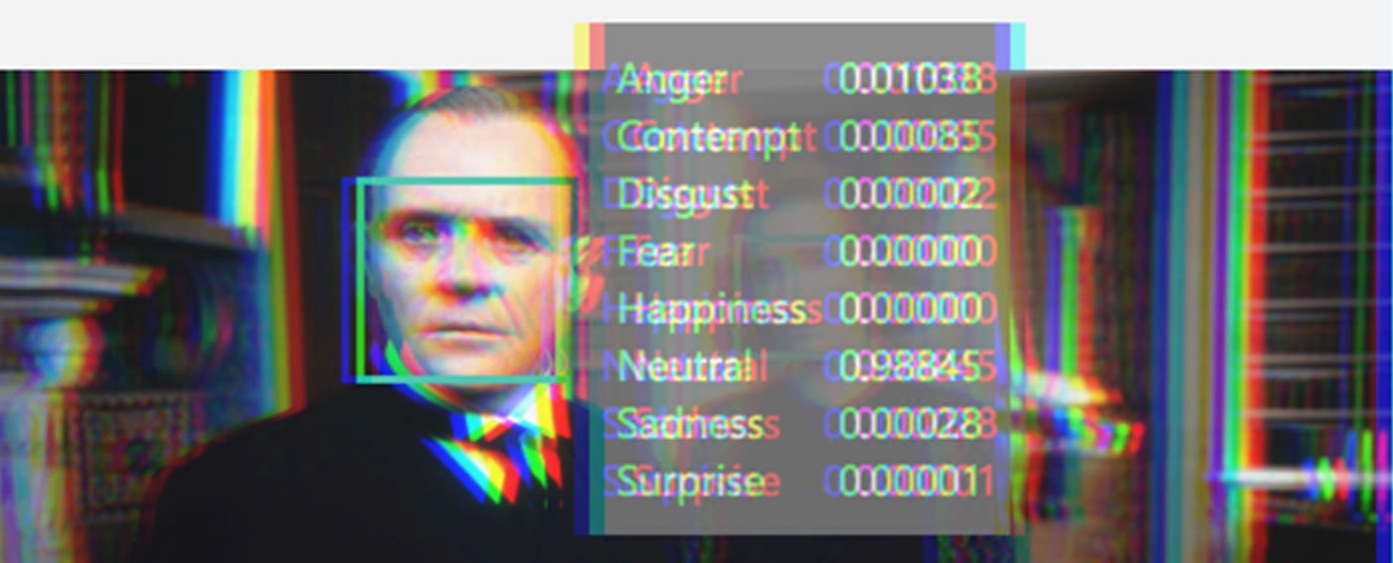
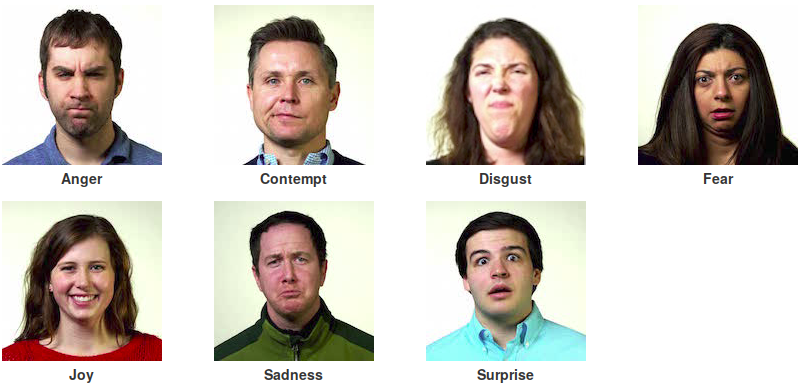
Choose how you feel, you have seven options

A great piece by Ruben Van de Ven stemming from his artwork of the same name, published on the Institute of Network Culture site. Van de Ven, in a similar vein to Will Davies, deconstructs the logic of ‘affective’ computing, sentiment analysis and their application to what has been termed the ‘attention economy’. The article does a really go job of demonstrating how the knowledge claims, and the epistemologies (perhaps ontologies too), that are at work behind these technologies are (of course) deeply political in their application. Very much worth reading! (snippet below).

 ‘Weeks ago I saw an older woman crying outside my office building as I was walking in. She was alone, and I worried she needed help. I was afraid to ask, but I set my fears aside and walked up to her. She appreciated my gesture, but said she would be fine and her husband would be along soon. With emotion enabled (Augmented Reality), I could have had far more details to help me through the situation. It would have helped me know if I should approach her. It would have also let me know how she truly felt about my talking to her.’

FOREST HANDFORD

This is how Forest Handford, a software developer, outlines his ideal future for a technology that has emerged over the past years. It is known as emotion analysis software, emotion detection, emotion recognition or emotion analytics. One day, Hartford hopes, the software will aid in understanding the other’s genuine, sincere, yet unspoken feelings (‘how she truly felt’). Technology will guide us through a landscape of emotions, like satellite navigation technologies guide us to destinations unknown to us: we blindly trust the route that is plotted out for us. But in a world of digitized emotions, what does it mean to feel 63% surprised and 54% joyful?
Please take the time to read the whole article.

Reblog> Gary Kasparov on fake news

Via John Naughton.

From an interesting interview:

Q: Does the term “fake news” have a Russian equivalent, and if so, what is it, who uses it and, in your experience, why?

Kasparov: My honest reply to this is that the word for “fake news” in Putin’s Russia is simply “news.” There isn’t a syllable uttered or printed in Russia without its author being very much aware of what the regime thinks of it and what would happen to him if he crosses a certain line–except perhaps the weather! Often those lines are explicit, sent out in memos about new topics and how to promote or spin them. But by now, after 17 years of Putin, everyone knows where the lines are. Under those conditions, what can news be except fake? Even if nearly everything that is published is, in and of itself, true, there is an ocean of falsity in what isn’t said, what isn’t asked, and how basic facts are presented. This is the story of the media in a modern dictatorship. It’s not like Pravda, with one official storyline that everyone knows is probably BS. There are hundreds of layers of carefully calibrated propaganda and censorship in Putin’s Russia, creating the illusion of freedom. One outlet says Putin is great 100 percent of the time about everything. Another only 80 percent, about, say, the economy or security. One writer can complain a little about education, while another is allowed to criticize the regime on one or two specific things, etc. It’s like the Matrix, a complex illusion. And since almost all Russians still depend on television news, it’s very effective.

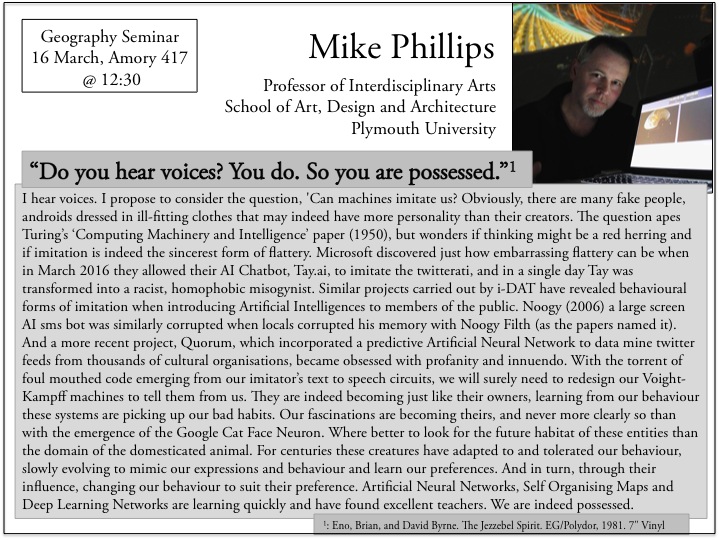
“Do you hear voices? You do. So you are possessed” – @mikedotphillips talk @exetergeography

I’m really pleased to share that Prof. Mike Phillips (i-DAT, Plymouth) will be speaking  next week as part of the Exeter Geography seminar series. Mike is a founder of the Institute of Digital Art and Technology and one of the founders of the undergraduate programme I studied MediaLab Arts, which is now called  Digital Media Design.

Details: Thursday 16th March, 12:30: Amory 417. All welcome!

Tony Sampson on neuroculture

From a Conversation piece on Huxley, dystopia and how we might think about Facebook etc. in relation to Huxley’s “College of Emotional Engineering”, this concise evocation of his understanding of ‘neuroculture’ is interesting:

The origins of neuroculture begin in early anatomical drawings and subsequent neuron doctrine in the late 1800s. This was the first time that the brain was understood as a discontinuous network of cells connected by what became known as synaptic gaps. Initially, scientists assumed these gaps were connected by electrical charges, but later revealed the existence of neurochemical transmissions. Brain researchers went on to discover more about brain functionality and subsequently started to intervene in underlying chemical processes.

Interpretation of Cajal’s anatomy of a Purkinje neuron, by Dorota Piekorz.

On one hand, these chemical interventions point to possible inroads to understanding some crucial issues, relating to mental health, for example. But on the other, they warn of the potential of a looming dystopian future. Not, as we may think, defined by the forceful invasive probing of the brain in Room 101, but via much more subtle intermediations.

Gary Hall > Ten Ways To Affirmatively Disrupt The Sharing Economy ♯3: Become a Microdatapreneur

Interesting from Gary Hall… lots to think through politically here, as with blockchain-like, more-or-less libertarian, strategies for a new “new economy” (as per the Post-Fordists)…  and possibly relevant to the recent interest in “digital” labour in geography…

part of a series of posts in which I provide ten proposals as to how to affirmatively disrupt ubercapitalism and the corporate sharing economy. Together these posts constitute the draft of a text provisionally titled Data Commonism, designed to follow on from my recently published short book, The Uberfication of the University. If the latter provides a dystopian sense of what is lying in store for many us over the course of the next few years, Data Commonism is more optimistic in that it shows what we can do about it. 

…

[We can disrupt the sharing economy by] by working toward the kind of “universal micropayment system” Jaron Lanier envisages in Who Owns The Future: “If observation of you yields data that makes it easier for”¦ a political campaign to target voters with its message, then you ought to be owed money for the use of that valuable data.” In this system we would be paid for the data we generate if it turns out to be valuable. Our relationship with the platforms of the for-profit sharing economy would thus take the form of a “two-way” financial transaction in which we all “benefit, concretely, with real money,” rather than just a few San Francisco-based entrepreneurs and investors.

…

A universal micropayment system may result in some degree of financial redistribution. But while it provides a means of reuniting data with those users who produce it […] there is not really all that much we can do with our own small amounts of data. How much leverage would we have when it comes to negotiating a price for it, bearing in mind most of us will have to rely on these companies to determine for us the extent to which our data […] has actually contributed to a political campaign aimed at targeting voters, to stay with Lanier’s example?

…

for Clare Birchall, it is not at all “clear that data belongs to us in the first place in order for it then to be given or taken“–or monetized, in this case. Instead, “we are within a dynamic sharing assemblage: always already sharing data with human or non-human agents.” Birchall introduces the term “shareveillance” to describe the “condition of consuming shared data and producing data to be shared in ways that shape” what she refers to as an “an ascendant shareveillant subjectivity.” This is a “subject who is at once surveillant (veiller ‘to watch’ is from the Latin vigilare, from vigil, ‘watchful’) and surveilled. To phrase it with a slightly different emphasis: the subject of shareveillance is one who simultaneously works with data and on whom the data works.”

“Post-Internet Art”

Many of the artists represented here are working with digital forms – what’s sometimes called New Media or Post-Internet Art (Internet Art proper is already shelved and classified: it refers to the first, comparatively naive artistic responses to the internet in the 1990s and early 2000s). Post-Internet artists are the first generation to have grown up with mass digital technology, and often with parallel selves on social media (they wouldn’t call it ‘virtual’). They don’t just respond to the internet but often try to use it as a medium.

Alice Sprawls on the LRB blog – read it here.

HyperNormalisation – New Adam Curtis film

Several folk on Twitter last night pointed to the post below on the BBC website. Seems like Adam Curtis is doing a Zizek, at least in the vein of the Perverts Guide to Ideology…

HyperNormalisationAcclaimed filmmaker, Adam Curtis brings his new epic film, HyperNormalisation to BBC iPlayer this October. The film will premiere at 9pm on Sunday 16 October. 

HyperNormalisation tells the extraordinary story of how we got to this strange time of great uncertainty and confusion – where those who are supposed to be in power are paralysed – and have no idea what to do. And, where events keep happening that seem inexplicable and out of control – from Donald Trump to Brexit, the War in Syria, the endless migrant crisis, and random bomb attacks. It explains not only why these chaotic events are happening – but also why we, and our politicians, cannot understand them.

The film shows that what has happened is that all of us in the West – not just the politicians and the journalists and the experts, but we ourselves – have retreated into a simplified, and often completely fake version of the world. But because it is all around us, we accept it as normal.

HyperNormalisation has been made specifically for BBC iPlayer. It tells an epic narrative spanning 40 years, with an extraordinary cast of characters. They include the Assad dynasty, Donald Trump, Henry Kissinger, Patti Smith, the early performance artists in New York, President Putin, intelligent machines, Japanese gangsters, suicide bombers – and the extraordinary untold story of the rise, fall, rise again, and finally the assassination of Colonel Gaddafi.

All these stories are woven together to show how today’s fake and hollow world was created. Part of it was done by those in power – politicians, financiers and technological utopians. Rather than face up to the real complexities of the world, they retreated. And instead constructed a simpler version of the world in order to hang onto power.

But it wasn’t just those in power. The film shows how this strange world was built by all of us. We all went along with it because the simplicity was reassuring. And that included the left and the radicals who thought they were attacking the system. The film reveals how they too retreated into this make-believe world – which is why their opposition today has no effect, and nothing ever changes.

Made me think of: