Some interesting papers: mothering with social media, archaeologies of e-waste, and performing tasks with wifi

Just wanted to flag some more interesting papers that have recently come out.

First, Robyn Longhurst‘s fantastic work on mothering with Skype and other social media has been really productive of some great papers and the latest in Social & Cultural Geographies is no exception. There’s some really lovely empirical work here and some interesting discussion of method too. I will be giving this paper to some of my students precisely because of this methods discussion. Good stuff!

Mothering, digital media and emotional geographies in Hamilton, Aotearoa New Zealand

This article traces a line between two literatures that can usefully be drawn into deeper conversation: geographies of digital media, and geographies of emotion. Its broad theoretical aim is to ascertain what insights might be gleaned by increasingly bringing together these two literatures. The more specific and primary aim, however, is an empirical one and that is to offer a materially grounded example of 35 mothers who live in Hamilton, Aotearoa New Zealand who use digital media to communicate with their children. Particular attention is paid to the capacities of different digital media, both individually and combined, to help facilitate, but certainly not guarantee, different emotions. The research is informed by a feminist geographical reading of theories of digital media and emotion. Findings illustrate that increasingly mothers are making use of digital media, both singularly and collectively, to increase the chances of a particular desired emotional outcome with their child or children. This article concludes that bodies, devices, screens, sounds and images comingle to mediate emotions over time and space.

Second, Sy Taffel has written another interesting article (following on from the paper he contributed to our theme issue of Culture Machine in 2012) concerning the desirable and undesirable materialities of electronic devices, not least when they are discarded and thrown away. This paper is part of an interesting forum convened by Angela Piccini. (You’ll find Sy’s piece between pp. 78-85):

Archaeologies of Electronic Waste

The toxicity and volume of electrical waste (commonly referred to as e-waste) forms one material legacy of contemporary digital culture which emphasizes the importance of paying attention to the deleterious material impacts of technological assemblages upon human and ecological systems, and asks serious questions about the sustainability and ethical orientation of current technocultural systems. Globally, around 50 million tonnes of e-waste are generated each year, and this waste is considered to be toxic due to the presence of a “witch’s brew” of substances which are highly hazardous to humans and other biotic systems. Whilst there exist inter-, supra-, and national laws and conventions mandating that most OECD nations (the US being a notable exemption) cannot legally export hazardous wastes to non-OECD nations, there exists a vibrant illegal market in exporting e-waste which is systematically mislabelled as working second-hand electronics goods for sale in emerging markets, with an estimated 50–100 shipping containers of illegally exported e-waste arriving daily in Hong Kong. This short essay seeks to sketch several ways that media archaeology and archaeologies of media provide productive apertures through which to consider issues surrounding e-waste, whilst contextualizing how media archaeology fits within the broader field of materialist media studies.

Thirdly, and by no means least, Sung-Yueh Perng has written a really thoughtful and interesting article on how the apparently ‘immaterial’ infrastructure of wi-fi is enrolled in ‘human-signal assemblages’ through which are performed the intricacies of everyday life. Again, some really lovely empirical work here and a nuanced synthesis of empirics and theory – with an interesting reading together of Adrian Mackenzie’s work on wireless communications, Ingold’s refrain of the ‘taskscape’ and the technocultural spatial imaginaries that have emerged in Taipei around these technologies.

Performing Tasks With Wi-Fi Signals in Taipei

This article examines the process of constructing, repairing, and improvising “human–signal assemblages” by drawing on in-depth interviews and virtual ethnography regarding the engineering of Wi-Fi connectivity in Taipei, Taiwan. It is demonstrated that spatial, temporal, infrastructural, and embodied orchestrations of Wi-Fi signals both reinforce and challenge prescribed ways of conducting daily tasks. Continuity and change, enacted by attempts to incorporate Wi-Fi signals into daily urban life, are explored by discussing a wide range of practices performed by government entities, local companies and initiatives, and users themselves. Particular attention is paid to the ways in which machines, the city landscape, discourses, maps, and signs grow and multiply, as well as intersect and intervene with each other at various levels, locales, and stages of establishing Wi-Fi connections. The article thus argues for the importance of “machine juggling” as a skillful performance that mends, maintains, and improvises Wi-Fi-enabled urban everyday rhythms.

Margaret Hamilton, Nasa software engineer & her ‘code’ printed out

I’ve put this picture on my office door:

Margaret Hamilton is an inspirational figure and we really should know more about her and her work!

Hamilton is now 78 and runs Hamilton Technologies, the Cambridge, Massachusetts-based company she founded in 1986. She’s lived to see “software engineering” – a term she coined – grow from a relative backwater in computing into a prestigious profession.

In the early days, women were often assigned software tasks because software just wasn’t viewed as very important. “It’s not that managers of yore respected women more than they do now,” Rose Eveleth writes in a great piece on early women programmers for Smithsonian magazine. “They simply saw computer programming as an easy job. It was like typing or filing to them and the development of software was less important than the development of hardware. So women wrote software, programmed and even told their male colleagues how to make the hardware better.”

“I began to use the term ‘software engineering’ to distinguish it from hardware and other kinds of engineering,” Hamilton told Verne’s Jaime Rubio Hancock in an interview. “When I first started using this phrase, it was considered to be quite amusing. It was an ongoing joke for a long time. They liked to kid me about my radical ideas. Software eventually and necessarily gained the same respect as any other discipline.”

Right on, Margaret.

The above quote is from this piece on vox.com by Dylan Matthews is worth reading – it contains lots of interesting bits and pieces, not least the fact that Apollo code was literally ‘hard wired’: it was woven in wire… astonishing to anyone who simply fires up a text editor and then uploads via ftp etc. etc. now…

The process of actually coding in the programs was laborious, as well. The guidance computer used something known as “core rope memory”: wires were roped through metal cores in a particular way to store code in binary. “If the wire goes through the core, it represents a one,” Hamilton explained in the documentary Moon Machines. “And around the core it represents a zero.” The programs were woven together by hand in factories. And because the factory workers were mostly women, core rope memory became known by engineers as “LOL memory,” LOL standing for “little old lady.”

Coded language online

By which I mean code as cipher or ‘secret’ (sort of) rather than code as in mark-up…

The UK Child Exploitation and Online Protection centre and ParentZone maintain a website for parents called parentinfo.org that has recently published a guide to “online teen speak“, with the rationale that parents should know what their children are up to.

There are some entertaining examples and it just goes to confirm I am now ‘old’ because I simply don’t recognise some of this stuff…

Now, in a way I have some sympathy with this rationale insofar as anyone (not just people of a given age bracket) can be naive in their behaviour through mediated communications. Whereas the more established risks of rumour and defamation might feel more distant the risks of the permanence of anything one posts online and its potential to spread unimaginably quickly are much more immediate and can be forcefully, sometimes tragically, felt.

Nevertheless, depending on your political persuasion, one might feel that there ought to be some limits to the oligopticon; that perhaps we ought not to be spying on one another all the time. It is thus striking that the rationale for ‘safety’ (in this case the entirely justified concern for the safety of our children) matches very closely to the sort of libertarian ‘nothing to hide’, radical transparency ideology of both the advertising moguls/data sharks at the helm of corporations such as Facebook and the supporters of technologies such as the blockchain. It is interesting (to me anyway) that the bounds of the conversation around privacy have moved so much in only 10 years… When the Labour government talked about introducing a national ID card around 2005ish, campaigns such as No2ID garnered a lot of support based on an appeal to arguments about personal privacy that are already (perhaps) beginning to seem slightly irrelevant, if one has maintained a use of Facebook, Google, Dropbox, PayPal, loyalty cards etc.

There is, of course, a significant difference between the perceived threats to ‘privacy’ by corporations hoovering up our data and the risk to personal safety from those with malign intentions – and I certainly don’t want to overly confuse the two… but the same rationale for an national identity card – to catch those with undesirable intentions – sits behind the perceived need to surveil our children and, indeed, was the rationale for ContactPoint here in the UK. This takes some very careful and nuanced unpacking (although it has attracted press commentary, e.g.) that I don’t think I’m best-placed to do here, but I wanted to record a reflection on this anyway.

The other thing that occurred to me while reading the press coverage of the guide to ‘teen speak’ was that this really isn’t new. As was made very evident by an episode of Fry’s English Delight on BBC Radio 4 the other week – there is a very, very long history of secret languages, and these are often used by groups that feel in a minority, or are a clique… from back slang, or ‘pig latin’ to medical slang (says the person most likely to be TTFO). But the power of these dialects is that they are secret – so what will a handy guide to them being published online do… we shall see… I’ll wait to hear from friends and colleagues with children that fall within the age group…

As an aside, ParentZone are convening an interesting looking conference in October on the Digital Family… worth a look if you’re that way inclined.

Reblog> CFP An Informational Right to the City? Rethinking the Production, Consumption, and Governance of Digital Geographic Information

Over on the OII blog for the ‘Connectivity, Inclusion and Inequality Group’, Jo Shaw has posted an interesting CFP for the AAG in San Francisco next year. Andy Merrifield will make an awesome discussant!

CfP at AAG 2016: An Informational Right to the City? Rethinking the Production, Consumption, and Governance of Digital Geographic Information

After presenting our paper on the same theme at ICCG 2015 in Palestine, myself and Mark Grahamare planning a session for the Association of American Geographers’ annual meeting in San Francisco during Spring 2016. The session aims to provide a space for discussion and research that seeks to ask what a ‘right to the city’ looks like in our increasingly digital world. Interested contributors should read the call for papers below and drop myself or Mark an email to express interest.


An Informational Right to the City? Rethinking the Production, Consumption, and Governance of Digital Geographic Information

Organisers: Joe Shaw and Mark Graham (University of Oxford)
Discussant: Andy Merrifield

Henri Lefebvre (2003:251) once talked of the right to information as a complement to the right to the city. Since then, information communication technologies have become integrally embedded into much of everyday life. The speed of these developments has also obfuscated many changes and processes that now envelop and define the urban experience. This includes changes in systems of abstract spatial representation through geographic information, and the economies surrounding this information as a commodity. The representations which are produced and mediated through this digital information are now contributing to an urban space that is densely digitally layered (Graham, M., M. Zook, and A. Boulton. 2013). These digital ‘abstract’ spaces are essential to the production and re-production of our socio-economic world (Lefebvre, 1991). From Wikipedia to Google Maps and TripAdvisor, the code and content that relates to a building is now potentially as important as its bricks and mortar. These processes raise new questions of spatial justice and the urbanization of information: Which spaces are seen, and which are hidden? How is information produced, for whom, and who consumes it? How does information change material places? Who are the powerful actors in these events, and who are powerless? And finally, is the broader concept of an ‘informational right to the city’ now required? If so, how should it be envisioned and put into practice? This session invites submissions concerned with the production, consumption, and governance of urban geographic information, and it encourages research and reflections that seek to rethink what informational rights we have in our hybrid material/digital cities.


Lefebvre, H. (1991). The production of space. (D. Nicholson-Smith & D. N.- Smith, Eds.). Oxford: Oxford : Blackwell.
Lefebvre, H. (2003). Henri Lefebvre: key writings. (S. Elden, E. Lebas, & E. Kofman, Eds.). New York: New York.
Graham, M., Zook, M., & Boulton, A. (2013). Augmented reality in urban places: contested content and the duplicity of code. Transactions of the Institute of British Geographers, 38(3), 464–479.

Please email abstracts of no more than 300 words to Mark Graham (mark.graham@oii.ox.ac.uk) or Joe Shaw (joe.shaw@oii.ox.ac.uk) by Friday 2nd October 2015. Successful submissions will be contacted by 9th October 2015 and will be expected to pay the registration fee and submit their abstracts online at the AAG website by October 29th 2015.

Reblog> CFP: Towards a geographical software studies

Nick Lally has posted this interesting call for papers for the AAG next year in San Francisco, an apposite location for such a discussion 🙂 I am sure that there are plenty of geographers who can and will offer some fascinating reflections on this. I hope you consider contributing…

Toward a geographical software studies

A series of sessions for the Annual Meeting of the Association of American Geographers in San Francisco, March 29-April 2, 2016

Ryan Burns (Temple University)
Nick Lally (University of Wisconsin–Madison)

A growing body of recent geographic scholarship has focused its attention on software and algorithms. Some of these studies analyze geographic technologies –GIS and the geoweb, for example– as such, while others investigate a myriad of digital technologies that have become ubiquitous within the spaces of everyday life. These software/code objects interact with and modulate the world in complex ways, enact processes that connect humans and nonhumans, and become entangled with social, cultural, political, and economic systems. Moreover, software created to visualize data is used to produce knowledge about urban environments and everyday life, but obscure the processes and contexts which underlie its development. Engaging these topics, geographers have developed concepts like the “automatic production of space” (Thrift and French 2002), “software-sorted geographies” (Graham 2005), and “code/space” (Kitchin and Dodge 2011) to describe how software and space are co-constituted in the contemporary world. Productive research is building on these topics to explore new ways geographies are produced (Rose, Degen, and Melhuish 2014), governed (Amoore 2011), materialized, represented (Woodward et al. 2015), and lived through software (Kinsley 2014).

This session seeks to bring together a range of spatial thinkers who are producing new studies, theories, and methods for understanding and producing software. We welcome submissions that address all facets of software: the context of its production, its internal operational logics, the material work it does in the world, and its spatial distribution of social and political effects. Suggested themes could include:

“¢ Radical, feminist, or postcolonial political theories of software, software production, and/or hacking. What are the liberatory potentials/limits of coding or software and its critiques?
“¢ The political economy of software, code, attentional economies, and the audience as commodity.
“¢ Methodological contributions for the study of software (deconstruction, ethnography, reading code, reverse-engineering, archival research, hacking, writing software, visual studies, understanding processes, online research, etc)
“¢ Software and visual and affective epistemology.
“¢ The materiality of software and the work it does in the world (the production of space, embodiment, urbanization, social sorting, securitization, infrastructure, etc).

Amoore, L. 2011. Data Derivatives: On the Emergence of a Security Risk Calculus for Our Times. Theory, Culture & Society 28 (6):24–43.

Graham, S. D. 2005. Software-sorted geographies. Progress in Human Geography 29 (5):562–580.

Kitchin, R., and M. Dodge. 2011. Code/space: software and everyday life. Cambridge, Mass: MIT Press.

Kinsley, S. 2014. The Matter of “Virtual” Geographies. Progress in Human Geography 38(3): 364-384.

Rose, G., M. Degen, and C. Melhuish. 2014. Networks, interfaces, and computer-generated images: learning from digital visualisations of urban redevelopment projects. Environment and Planning D: Society and Space 32 (3):386–403.

Thrift, N., and S. French. 2002. The automatic production of space. Transactions of the Institute of British Geographers 27 (3):309–335.

Woodward, K., J. P. Jones, L. Vigdor, S. A. Marston, H. Hawkins, and D. P. Dixon. 2015. One Sinister Hurricane: Simondon and Collaborative Visualization. Annals of the Association of American Geographers :1–16.

Please submit a 250 word abstract to Nick (nlally [AT] wisc [DOT] edu) and Ryan (ryan.burns [AT] temple [DOT] edu) by October 9th, 2015.

BBC’s “Future-proofing” radio programme on blockchain – pretty good!

I happened to be driving at around 8ish last night and the car radio was by default on Radio 4 so I caught a bit of the latest programme in the ‘FutureProofing‘ series. Ordinarily such things tend to annoy me, cos I am grumpy, but listening to the programme about block chain last night I confess I was rather impressed. Timandra Harkness and Leo Johnson present an interesting account.

Blockchain is a difficult thing to explain and harder still to attempt to articulate how it might be used, beyond the libertarian goals of particular uses of crypto-currencies. The programme last night excelled in this regard covering lots of interesting angles. They end up having an interesting debate about politics and government.

There’s some interesting interviewees too:

Janina Lowisz (‘blockchain girl’) – ‘ambassador for bitnation‘

Mike Hearn – software developer & bitcoin advocate

Nathaniel Popper –journalist, author of ‘digital gold’

Susanne Tarkowski Tempelhof – CEO of bitnation

Steven Lukes – Prof. of Sociology at NYU

Vinay Gupta – of the Ethereum (blockchain) project

Some thoughts about how ‘algorithms’ are talked about & what it might mean to study them

A while ago, in a grump, I tweeted something along the lines of “I’m fairly convinced that most social scientists who write about algorithms do not understand what that term means”… Provocative I know, but I was, like I said, in a grump. Rob Kitchin tweeted me back saying that he looked forward to the blogpost – well here it is – finally.

I’m afraid its not going to be a well-structured and in-depth analysis of what one may or may not mean by the word algorithm because, well, other people have already done that. What I want to offer here is an expression of the anxiety that lay behind my grumpy tweet and means of mitigating that. So, this is a post that uses other people’s work to address:

  • what is an algorithm?
  • how/should we analyse/study them?

To be totally open from the start, my principle sources here are:

So, what do we mean when we use the word ‘algorithm’?

To begin with a straight-forward answer from Paul Ford:

“Algorithm” is a word writers invoke to sound smart about technology. Journalists tend to talk about “Facebook’s algorithm” or a “Google algorithm,” which is usually inaccurate. They mean “software.”

Algorithms don’t require computers any more than geometry does. An algorithm solves a problem, and a great algorithm gets a name. Dijkstra’s algorithm, after the famed computer scientist Edsger Dijkstra, finds the shortest path in a graph. By the way, “graph” here doesn’t mean  but rather 

Or, as Rob Kitchin notes in his working paper it is (following Kowalski) “logic+control“, such that (citing Miyazaki) the term denotes a form of:

specific step-by-step method of performing written elementary arithmetic… [and] came to describe any method of systematic or automatic calculation.

This answers a simple definitional question: “what is an algorithm?” but doesn’t quite answer the question I’ve posed: “what do we mean when we use the word algorithm?”, which Ford gestures towards when suggesting journos (and one might include a lot of academics here) use the word ‘algorithm’ when they mean ‘software’. As Gillespie notes

there is a sense that the technical communities, the social scientists, and the broader public are using the word in different ways

There isn’t a single/singular meaning of the word then (of course!) and after decades of post-structuralism that really shouldn’t be a surprise… nevertheless there is a kind of discursive politics being performed when we (geographers, social scientists etc etc) invoke the term and idea of an ‘algorithm’, and we perhaps need to reflect upon that a little more than we do. I may be wrong, perhaps we just need to let the signifier/signified relation flex and evolve – my main motivation for addressing this question is that I think we do already have useful words that address what is being suggested in the use of the word ‘algorithm’ – amongst these words are: code, function (as in software function), policy, programme, protocol (e.g. Ã  la Alexander Galloway), rule and software.

What is salient about the technical definition of an algorithm to how we might use the word more broadly is the sense of a (logical) model of inferred relations between things formally defined in code that is developed through iteration towards a particular end. As Gillespie notes:

Engineers choose between them based on values such as how quickly they return the result, the load they impose on the system’s available memory, perhaps their computational elegance. The embedded values that make a sociological difference are probably more about the problem being solved, the way it has been modeled, the goal chosen, and the way that goal has been operationalised.

What quickly takes us away from simply thinking about a function defined in code is that the programmes or scripts upon which the algorithms are founded need to be validated in some way – to test their effectiveness, and this involves using test data (another word that has become fashionable). The selection of the data also necessarily has embedded assumptions, values and workarounds which, as Gillespie goes on to suggest: “may also be of much more importance to our sociological concerns than the algorithm learning from it.” The code that represents the algorithm is instantiated either within a software programme – a collection of instructions, operations, functions etc. etc. – that is bundled together as what we used to call an ‘application’ or it might exist in a ‘script’ of code that gets pulled into use as and when – for example: in the context of a website. As Gillespie argues:

these exhaustively trained and finely tuned algorithms are instantiated inside of what we might call an application, which actually performs the functions we’re concerned with. For algorithm designers, the algorithm is the conceptual sequence of steps, which should be expressible in any computer language, or in human or logical language. They are instantiated in code, running on servers somewhere, attended to by other helper applications (Geiger 2014), triggered when a query comes in or an image is scanned. I find it easiest the think about the difference between the “book” in your hand and the “story” within it. These applications embody values as well, outside of their reliance on a particular algorithm.

This is often missed when algorithms are invoked, all-too-quickly, in the discussion of contemporary phenomena that involve the use of computing in some way. Like Kitchin says in his working paper:

As a consequence, how algorithms are most often understood is very narrowly framed and lacking in critical reflection.

Indeed, I’d go further, there’s a weird sense in which some discussions of ‘algorithms’ connote the dystopian sci-fi of The Matrix, or The Terminator. Ian Bogost has gone so far as to suggest that this is a form of ‘worship’ of the idea of an ‘algorithm’, suggesting

algorithms hold a special station in the new technological temple because computers have become our favorite idols.


And as Gillespie noted in an earlier piece:

there is an important tension emerging between what we expect these algorithms to be, and what they in fact are

Yet, as with production of religious texts, there are people making decisions every step of the way in the production of software. On top of that, there were decisions made by people in all of the steps of the development and production of the other technologies and infrastructures upon which that software rely.

What we mean when we use the word ‘algorithm’ is, as Gillespie argues (much better than I), a synecdoche: “when we settle uncritically on this shiny, alluring term, we risk reifying the processes that constitute it. All the classic problems we face when trying to unpack a technology, the term packs for us”.

Calling the complex sociotechnical assemblage an “algorithm” avoids the need for the kind of expertise that could parse and understand the different elements; a reporter may not need to know the relationship between model, training data, thresholds, and application in order to call into question the impact of that “algorithm” in a specific instance. It also acknowledges that, when designed well, an algorithm is meant to function seamlessly as a tool; perhaps it can, in practice, be understood as a singular entity. Even algorithm designers, in their own discourse, shift between the more precise meaning, and using the term more broadly in this way.

How should we study algorithms?

Here, I’m not totally sure I can add much to what Kitchin has written in his working paper. This has been adroitly summarised by John Danaher on his blog, and he produced this brilliant graphic:
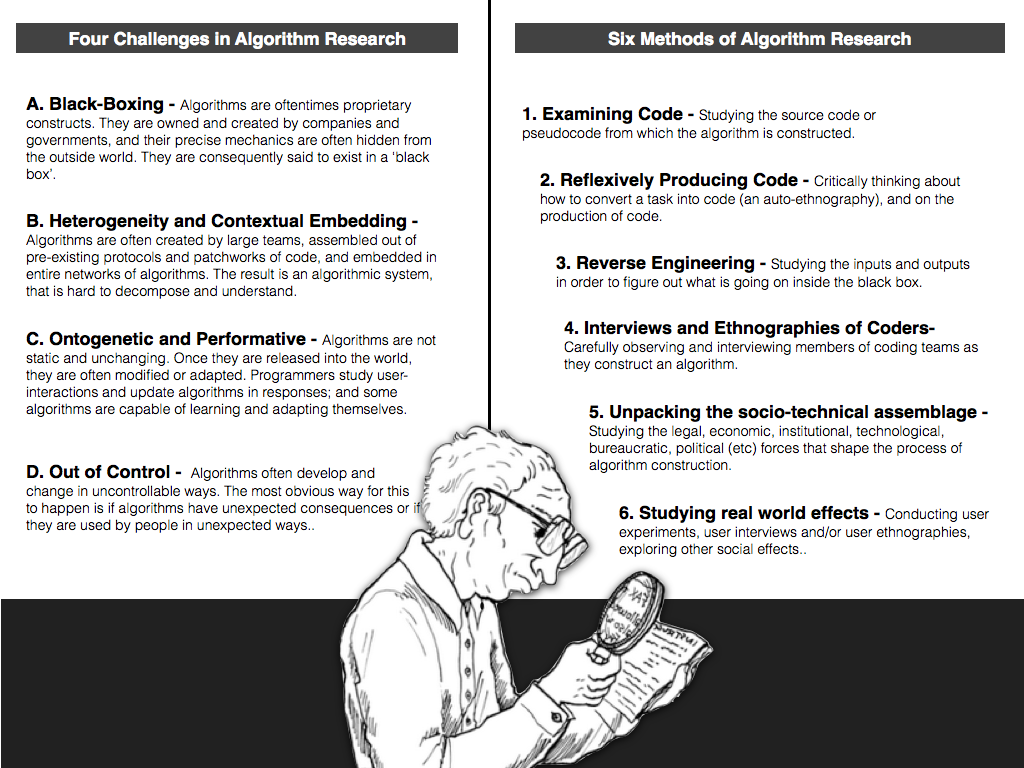
The challenges and methods for studying algorithms


We need to be alive to the challenge that most software we may be interested in is proprietary, although not always and we can look to repositories like GitHub for plenty of open source code, and so it may actually prove impossible to gain access to the code itself –– and here we’d really want the code of the whole programme, and perhaps the training data too. Likewise, software like any complex endeavour may well be the result of collective authorship and maintained by lots of different people. So there are complex sets of relations between people, laws, protocols, standards and many other considerations to negotiate – they are contextually embedded. Furthermore, the programmes we’re calling algorithms here actually have a hand in producing the world within which they exist –– they may bring new kinds of entities and relationships into existence, they may formulate new and different forms of spatial relation and understanding. In this sense they are ontogenetic and performative. Added to this, once ‘in the wild’ this performativity can render the kinds of outcomes of a programme unexpected and peculiar, especially once it is fed all sorts of data, adapted and adopted in unexpected ways.

How can we go about studying these kinds of socio-technical systems then? Well, rather than treat as discrete the six techniques offered by Kitchin (summarised above) – I’d argue we need to combine most of these. Even so, it may prove extremely difficult to actually gain access to code. Further, even if one might reflexively produce code and/or attempt to reverse engineer software –– some systems are the product of companies with such extensive resources that it may well prove near-impossible to do so. Where social scientists might find more traction and actually be able to make a more valuable contribution is, as Kitchin suggests, looking t the full sociotechnical assemblage. We can look at the wider institutional, legal and political apparatuses (the dispositifs) and we can certainly look at the various kinds of relation the assemblages make and how they are enrolled in performing the world they inhabit.

Make no mistake – this kinds of research is necessarily hard. I’m not sure I can imagine papers in geography journals that tie the a/b testing logs of experiments in how a given system works and commit logs to version control systems (even if you could access them!) to particular forms of experience and/or their political consequences… but it might be worth a go. Perhaps this difficulty is why we see (and I am as guilty as any of this) papers written in abstract terms, focusing on the (social) theoretical ways we can talk about these sociotechnical systems in broad terms.

Like Bogost, I can see a kind of pseudo-theological romancing of the ‘algorithm’ and the agency of software in much of what is written about it, and its sort of easy to see why – it is so abundant and yet relatively hidden. We see effects but do not see the systems that produce them:

Algorithms aren’t gods. We need not believe that they rule the world in order to admit that they influence it, sometimes profoundly. Let’s bring algorithms down to earth again.

The algorithm as synecdoche is a kind of ‘talisman’, as Gillespie argues, that reveals something of what Stiegler calls our ‘originary technicity’ – the sense in which we (humans) have always already been bound up in technology and its the forgetting and then remembering of this that forges our ongoing reconstitution (transindividuation) of ourselves.

So, I’d like to end with Kitchin’s argument:

it is clear that much more critical thinking and empirical research needs to be conducted with respect to algorithms [and the software and sociotechnical systems in which they are necessarily embedded] and their work.

Addendum:

It is worth noting that both Gillespie and Kitchin draw on another paper that is very much worth reading by Nick Seaver, who reminded me of this on Twitter, take a look:

“Knowing Algorithms“, presented at Media in Transition 8, Cambridge, MA, April 2013 [revised 2014].

For these companies you, walking down the street, are a data point

I’ve been collecting the promotional videos of various companies that surveil ‘public’ spaces to garner information that, using the logics applied to web analytics, they see as valuable commercial intelligence.

The rationale that is common throughout is that the aggregate crowd on the street, in a shopping centre, or in any form of apparently ‘public’ space are fair game for surveillance measurement and in turn address (albeit by their commercial partners – retailers etc. etc.). In fact, this is merely a technical or perhaps social problem – not a political one. It’s a technical problem for them because as the chap from Placemeter says “it’s all data” and its ‘waiting’ to be harvested. It’s a social problem for them only insofar as it’s about improving ‘services’ for us as consumers (not as citizens, as families or any other part of our skein of identity). It is NOT a political problem for them – it’s not an issue of who has the right to the city, who has a right to privacy or what might constitute reasonable expectations of any of those things. It certainly is never couched in terms of there needing to be governance of these activities – at least in these kinds of videos.

So, the videos are interesting artefacts of the formulation of what pervasive media/ubiquitous computing and smart cities look like and how they are performed…

A reasonable article about Placemeter is in/on the Guardian Cities section.

Workshop> Exploring Virtual Control, UCL (olympic park)

UCL urban lab are hosting an interesting workshop called ‘exploring virtual control’ at the London olympic park.

“The UCL Urban Laboratory is hosting a workshop on Tuesday 18 August in the Queen Elizabeth Olympic Park to interrogate the mechanics of control within privatised public spaces. If you have any interest in the privatisation of cities, security design, city governance policy or the post-Olympic legacy”

It’s something of a coup to have it at the olympic park – and got me thinking of Francisco Klauser’s excellent work on these forms of control.

Here’s some more details:

This workshop held at the Queen Elizabeth Olympic Park in Stratford serves as an introduction to the mechanics of control within privatised public spaces. Participants will learn about the way in which privatised public spaces are planned, built and monitored, before devising their own ways of mapping and documenting private public spaces. The workshop is organised by UCL Urban Laboratory, and led by the artists and built environment researchers Max Colson and Ollie Palmer, as part of a current exhibition hosted by RIBA. Book here.

The workshop consists of a series of structured group exercises and conversations, during which participants will choose to work on a photographic or mapping project. Please state your preference when applying.

Ollie Palmer is an award-winning artist, freelance designer and brand consultant based in London. He has worked commercially with BBC Worldwide, UCL and the V&A Museum, as well as leading projects for a number of other UK-based companies. As an artist, he has exhibited work at the V&A Museum and The Science Museum’s Museum of Science and Industry in Manchester, as well as being selected as artist-in-residence at the Palais de Tokyo in Paris.

Max Colson is an artist based in London using photography, video and animation. He was the artist-in-residence at UCL Urban Laboratory between September 2014 and June 2015, funded by a grant from the Leverhulme Trust. Virtual Control: Security and the Urban Imagination, his first UK solo exhibition, is at RIBA 6 July – 21 September in London this summer. He was selected as one of the UK winners of the 2013 Flash Forward Emerging Photographer competition, and was shortlisted in the OPEN14 at Brighton Photo Fringe. He has exhibited in C/O Berlin, London, and this summer as part of ‘Data Rush’ at the Noorderlicht Photo Festival.

Limited places are available for this workshop. Tickets cost £20 or £15 for concessions (students/disabled/unemployed/over 65). Please book on the UCL Online Store. Contact Jordan Rowe for more details.

Reblog> Gilbert Simondon and the Philosophy of Information: An Interview with Jean-Hugues Barthélémy

Andrew Iliadis blogs that an interview he conducted with Jean-Hughes Barthélémy has been published. This is a really valuable contribution to anglophone scholarship on the work of Simondon and Andrew should be congratulated (well I do anyway!). This is well worth a look if you are interested in the philosophy of technology or in how we understand the idea of ‘information’.

GILBERT SIMONDON AND THE PHILOSOPHY OF INFORMATION: AN INTERVIEW WITH JEAN-HUGUES BARTHÉLÉMY

homeHeaderTitleImage_en_USThe new issue of Journal of French and Francophone Philosophy is out. It includes an interview that I conducted with Jean-Hugues Barthélémy entitled “Gilbert Simondon and the Philosophy of Information.” For those of you who don’t know, Barthélémy is a leading expert on Simondon as well as director of Centre international des études simondoniennes.

LINK: http://jffp.org/ojs/index.php/jffp/article/view/679/679