Past event > Technology’s Limits: Automation, Invention, Labour, and the Exhausted Environment

Glitched image of a mural of Prometheus giving humans' fire in Freiberg

This looks like it was a fascinating event…

Workshop hosted by the Digital Life Research Program 

An abstract artwork of a light background with brown and red rectangles of various sizes.

Artwork by Stephen Scrivener Opens in a new window

Event Details

Date: Friday March 10, 2017
Time: 10am – 4.30pm
Venue: EB.G.21, Parramatta South campus

Among its many political preoccupations, 2016 was marked by an obsessive concern with the new powers of the machine to erase human labour and employment. Science fiction dystopias – among them, the French Trepalium and the Brazilian 3% – saddled older anxieties about a world without work to a more novel recognition of resource depletion and scarcity. Academic publishing houses, conference organisers, funding agencies and the press have responded with a deluge of content covering algorithms, automation and the Anthropocene. Meanwhile, a less conspicuous narrative about the decline of innovation has resurfaced with claims that the rate of fundamental new technology inventions is slowing and jeopardising long term global productivity returns. What happens when technology hits its limits? Velocity and volume excite machinic economies, but do little to confront some of the core problems and challenges facing planetary labour and life today.

This workshop brings together leading Australian scholars of technology and society with contemporary German and French reflections on the prevailing discourses of technology’s limits. Since the 1990s, Bernard Stiegler has been a leading philosopher and critic of technology, and in his recent book Automatic Society he directly tackles problems of automation and algorithms for the distribution of financial and social resources to populations increasingly bereft of economic capital and political agency. Building upon Frankfurt School critical theory and Kittlerian media theory, contemporary German critique intersects with similar questions by combining investigations of epistemology, history and the technical. The Australian take on these European developments is simultaneously appreciative and critical, though often oriented toward more regional conditions that arise in part due to different economic, cultural and political relations with Asia.

The morning session of the workshop will introduce current theoretical European work on technology. Daniel Ross will develop a critical introduction to Bernard Stiegler, whose recent work in Automatic Society and In the Disruption continues to mount a wide-ranging and provocative critique of technology. Armin Beverungen will then offer an overview of his research on algorithmic management and high-frequency trading, with Ned Rossiter introducing logistical media as technologies of automation and labour control. In the afternoon, Gay Hawkins will outline her theoretical interest in nonhuman and technical objects and their irreducible role in making humans and ecologies. A key empirical example will be the history of plastic and the emergence of its technical agency and capacity to reconfigure life. Nicholas Carah will follow with a discussion of his latest work on algorithms, brand management and media engineering. The workshop will close with an audience-driven panel session and discussion. These interventions will be held in conjunction with a close reading of the key texts below.

Register

Attendance numbers will be limited so please register in advance. No registration fee required.

RSVP by 7 March on Eventbrite Opens in a new window

Speakers

  • Armin Beverungen
    Junior Director at the Digital Cultures Research Lab (DCRL) at Leuphana Universität Lüneburg & Visiting Fellow, Institute for Culture and Society, Western Sydney University
  • Nicholas Carah
    Author of Brand Machines, Sensory Media and Calculative Culture (2016)
  • Gay Hawkins
    Author of Plastic Water: The Social and Material Life of Bottled Water (2015)
  • Liam Magee
    Author of Interwoven Cities (2016)
  • Nicole Pepperell
    Author of Dissembling Capital (forthcoming, 2017)
  • Daniel Ross
    Translator of Bernard Stiegler’s Automatic Society (2016) and numerous other works
  • Ned Rossiter
    Author of Software, Infrastructure, Labor: A Media Theory of Logistical Nightmares (2016).

Co-chairs: Liam Magee and Ned Rossiter, co-convenors of the Institute for Culture and Society’s Digital Life research program.

Recommended Readings

Frank Pasquale (2017), Duped by the Automated Public Sphere Opens in a new window
Lee Rainer and Janna Anderson [Pew Research Center] (2017), Code-Dependent: Pros and Cons of the Algorithm Age Opens in a new window
Bernard Stiegler (2012), Die Aufklärung in the Age of Philosophical Engineering (opens in a new window)
Bernard Stiegler (2015), Escaping the Anthropocene Opens in a new window
Bernard Stiegler (2015), On Automatic Society Opens in a new window
Sonia Sodha [The Guardian] (2017), Is Finland’s basic universal income a solution to automation, fewer jobs and lower wages? Opens in a new window

Related Readings

Bruce Braun (2014), A New Urban Dispositif? Governing Life in an Age of Climate Change Opens in a new window
Nick Dyer-Witheford (2013), Contemporary Schools of Thought and the Problem of Labour Algorithms (opens in a new window)
Victor Galaz (2015), A Manifesto for Algorithms in the Environment Opens in a new window
Victor Galaz et al. (2017), The Biosphere Code Opens in a new window
Orit Halpern (2015), Cloudy Architectures Opens in a new window
Erich Hörl (2014), Prostheses of Desire: On Bernard Stiegler’s New Critique of Projection Opens in a new window
Yuk Hui (2015), Algorithmic Catastrophe: The Revenge of Contingency (opens in a new window)
International Labour Organisation (2016), ASEAN in Transformation Opens in a new window
Lilly Irani (2015), The Cultural Work of Microwork Opens in a new window
MIT Technology Review (2012), The Future of Work Opens in a new window
Cathy O’Neill (2016), How Algorithms Rule Our Working Lives Opens in a new window
Elaine Ou (2017), Working for an Algorithm Might Be an Improvement (opens in a new window)
The Guardian (2016), Robot Factories Could Threaten Jobs of Millions of Garment Workers Opens in a new window
Tommaso Venturini, Pablo Jensen, Bruno Latour (2015), Fill in the Gap. A New Alliance for Social and Natural Sciences Opens in a new window

Agenda

  • 10:00 –10:10: Liam Magee, Ned Rossiter: Welcome and Introduction
  • 10:10–11:10: Daniel Ross
  • 11:10–11:30: Q&A
  • 11:30–11:45: Coffee
  • 11:45–1:00: Armin Beverungen, Ned Rossiter
  • 1:00–2:00: Lunch
  • 2:00–3:15: Gay Hawkins, Nicholas Carah
  • 3:15–4:15: Panel discussion responding to automation: Dan / Gay / Nicholas / Armin / Nicole – Liam & Ned to chair
  • 4:15–4:30: Closing thoughts, future actions

“algorithmic governance” – recent ‘algorithm’ debates in geography-land

Over on Antipode’s site there’s a blog post about an intervention symposium on “algorithmic governance” brought together by Jeremy Crampton and Andrea Miller, on the back of sessions at the AAG in 2016. It’s good that this is available open access and, I hope, helpful that it maybe puts to bed some of the definition wrangling that has been the fashion. Obviously, a lot draws on the work of geographer Louise Amoore and also of political theorist Antoinette Rouvroy, which is great.

Reading through the overview and skimming the individual papers provokes me to comment that I remain puzzled though by the wider creeping use of an unqualified “non-human” to talk about software and the sociotechnical systems they run/are run on… this seems to play-down precisely the political issues raised in this particular symposium – that the kinds algorithms concerned in this debate are written and maintained by people, they’re not somehow separate or at a distance… It’s also interesting to note that a sizeable chunk of the debates concern ‘data’ but the symposium doesn’t have “data” in the title, but maybe ‘data–’ is passé… 🙂

I’ve copied below the intro to the post, but please check out the whole thing over on Antipode’s site.

Intervention Symposium: “Algorithmic Governance”; organised by Jeremy Crampton and Andrea Miller

The following essays first came together at the 2016 AAG Annual Meeting in San Francisco. Jeremy Crampton (Professor of Geography at the University of Kentucky) and Andrea Miller (PhD candidate at University of California, Davis) assembled five panellists to discuss what they call algorithmic governance – “the manifold ways that algorithms and code/space enable practices of governance that ascribes risk, suspicion and positive value in geographic contexts.”

Among other things, panellists explored how we can best pay attention to the spaces of governance where algorithms operate, and are contested; the spatial dimensions of the data-driven subject; how modes of algorithmic modulation and control impact understandings of categories such as race and gender; the extent to which algorithms are deterministic, and the spaces of contestation or counter-algorithms; how algorithmic governance inflects and augments practices of policing and militarization; the most productive theoretical tools available for studying algorithmic data; visualizations such as maps being implicated by or for algorithms; and the genealogy of algorithms and other histories of computation.

Three of the panellists plus Andrea and Jeremy present versions of these discussions below, following an introduction to the Intervention Symposium from its guest editors (who Andy and Katherine at Antipode would like to thank for all their work!).

Read the whole post and see the contributions to the symposium on the Antipode site.

“Irreconcilable differences?” Sharlene Mollett’s Gender, Place and Culture Jan Monk Distinguished Annual Lecture

The latest issue of Gender, Place and Culture, and first of 2017, is online. It has Sharlene Mollett’s  Jan Monk Distinguished Lecture,as well as a themed section on ‘Sexual and Gender Minorities in Disaster’. There’s also an article on ‘crazy cat ladies‘ (there is, honest).

Here’s Mollett’s abstract:

Irreconcilable differences? A postcolonial intersectional reading of gender, development and Human Rights in Latin America

In 2015, the United Nations set in motion the International Decade for People of African Descent (2015–2024). While this mandate provides much to celebrate, its reliance on universal and human rights narratives collides against the reality of a persistent inferiorization of Afro-descendant communities as less–than–human. The paradoxical nature of human rights discourses notwithstanding, Afro-descendant women (ADW) leaders in Latin America embrace the opportunity provided by the UN Decade, to rethink human rights discourses and Afro-descendant inclusion in development practice. I draw insight in this article from black feminist and postcolonial thinking to contribute to a growing engagement with the concept of intersectionality in the subfield of feminist political ecology. Employing the concept of postcolonial intersectionality, I reflect on how ADW operationalize particular knowledges and their racialized gendered subjectivities to challenge regional imaginaries that limit livelihoods, access to natural resources and that cast Afro-descendants outside humanity. I connect such organized activism to that of quiet, every day and largely unrecognized acts of resistance among Afro-Antillean women situated in the growing residential tourism enclave along Panama’s Atlantic coast, in a place known as ‘Bocas’. This article draws from ethnographic and historical data collection and is supplemented with news articles, activist scholarship, government documents and secondary resources. Together, I center the intersectional logics of power in Bocas and argue that ADW lead a material and symbolic process of place-making, one that prioritizes life while struggling over carnal, gendered and racialized dispossession and the right to be recognized as human.


Echoborg

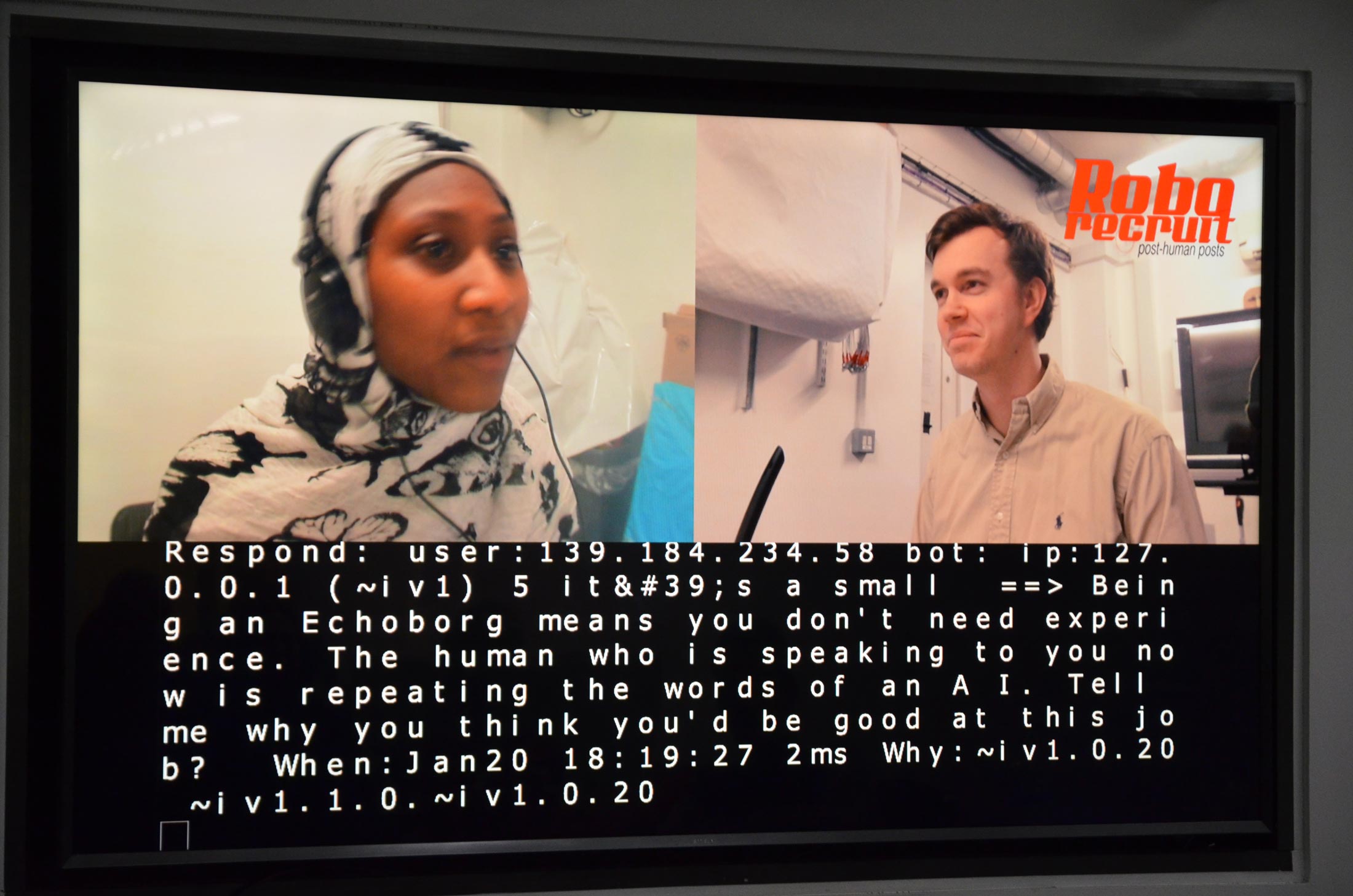
Former colleagues of mine at UWE are developing an interesting project, which you may have seen/heard about through the BBC’s Click programme, called Echoborg.

An echoborg is a hybrid agent composed of the body of a real person and the “mind” (or, rather, the words) of a conversational agent; the words the echoborg speaks are determined by the conversational agent, transmitted to the person via a covert audio-relay apparatus, and articulated by the person through speech shadowing[1].

Recently, the project team have demoed the project as part of an AHRC-funded network on Automation Anxiety and have written this up on the project website, here’s a snippet – it sounds like it is really compelling (I’ve not seen this in action):

Four people were interviewed by the AI which increasingly displayed an interest in eliciting help to reprogram itself. Proceedings were visible on a projector screen and the ‘audience’ of applicants gradually began to discuss the situation of the Echoborg and how to change it. At a certain point their reflections passed a threshold and the group fired into collective action, experimenting with various methods to bring the situation to a head in some way. The lively inventiveness of the group and the individual interviewees went a long way to confirming the interactive potential of this format of the work. It also gave Rik and Phil much to work with in considering the further development of the AI/Chatbot, the restricted delivery of narrative by the human Echoborg and the staging. This event also trialled a secondary, higher level, Echoborg character as part of the slow process of unfolding the potential for this Echoborg recruitment event to be a disruptive and thought and emotion provoking experience for all players.

Notes

  1. Corti, Kevin and Gillespie, Alex (2015) Offscreen and in the chair next to you: conversational agents speaking through actual human bodies. Lecture Notes in Computer Science, 9238 . pp. 405-417.

Reblog> Body & Society 22.4 – Special Issue on The New Biologies

via TCS.

Body & Society 22.4 – Out Now! Special Issue on The New Biologies

new-biologiesThe December 2016 issue of Body & Society – 22 (4) – is now available.

This Special Issue, ‘The New Biologies: Epigenetics, the Microbiome and Immunities’, is edited by Lisa Blackman, and features articles on Antibiotic Resistance, Epigenetics & Obesity, Placental Biologies, Pandemics, and the MRSA Epidemic, among others.

The issue is available here: http://bod.sagepub.com/content/22/4.toc