Theorising Bioart encounters after Simondon – paper by Andy Lapworth

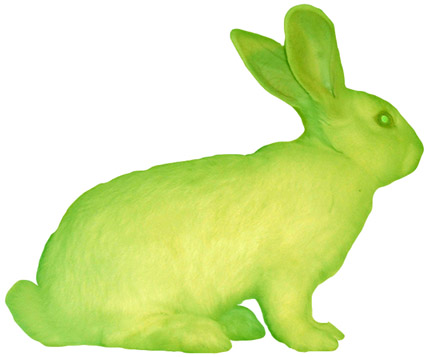
Alba the transgenic rabbit – bioart by Eduardo Kac

Andrew Lapworth, who recently finished a PhD in Geography at Bristol, has written a really interesting and accomplished article that has just come out as ‘Early Online‘ in Theory Culture & Society. I recommend reading it if you have any interest in the philosophy or sociological studies of science, technology and bioart. Sadly, its behind the paywall…

Here’s the abstract:

In recent years ‘bioart’ has been lauded in the social sciences for its creative engagements with the ontological stakes of new forms of biotechnical life in-the-making. In this paper I push further to explore the ontogenetic potentials of bioart-encounters to generate new capacities for thinking and perceiving the nonhuman agencies imbricated in the becoming of subjects. To explore this potential I stage an encounter with Gilbert Simondon’s philosophy of individuation, highlighting three implications for theorizations of the constitution and transformation of subjects. First, Simondon forces us to rethink the subject in terms of its transductive emergence from pre-individual processes, and its metastable susceptibility to ongoing transformations. Second, he substitutes voluntarist conceptions of thought with an involuntarist primacy of material encounters as the conditions for novel individuations. Finally, I argue that Simondon enables a thinking of the politics of the (bio)art-encounter in terms of its ontogenetic capacity to materially produce, rather than merely represent, new subjects and worlds.

Lazzarato on Guattari

Saw this via Keith Harris’ blog My Desiring-Machines…

The Alien Ecologies blog features a post outlining an essay by Maurizio Lazzarato (translated by Mary Neil) that is figured as a homage to Felix Guattari:

Maurizio Lazzarato: Homage to Felix Guattari

22799b239e

In this essay “Semiotic Pluralism” and the New Government of Signs Homage to Félix Guattari Maurizio Lazzarato (trans. Mary O’Neill) develops and extends Guattari’s a-signifying semiotics as part of his ongoing elaboration of financial capitalism.

As he’ll remind us capitalism for Guattari is a “semiotic category that affects all levels of production and all levels of the stratification of power”. Yet, Guattari’s use of semiotics had a duo aspect to it: 1) an signifying semiotics of representationalism; and, an a-signifying semiotics of infrastructural and empirical elements of material relations, a mapping rather than a tracing of these ubiquitous aspects of capital. Read his essay, definitely opens up Guattari’s thought in ways few have so far. His books of course deal with both debt and his incorporation of Guattari’s thought: see MIT Press.

Read the whole post or look at the article over on Alien Ecologies…

Reblog> New Publication: Crossing Over into Territories of the Body (Area)

Really interesting new article out in Area by Jen Jack Gieseking:

New Publication: Crossing Over into Territories of the Body (Area)

I am pleased to report that my new article in Area, “Crossing Over into Territories of the Body: Urban Territories, Borders, and Lesbian-Queer Bodies in New York City,” is available via preview! As I am unable to pay the $3k-$5k fee to make this article open access (per the Wiley-Blackwell requirement to do so), you can (legally) download a pre-print version of the article for free by clicking here are on the image to the left. Enjoy! The abstract is also below. Many thanks to Sara H. Smith and her student colleagues who brought to life the AAG 2012 sessions on bodies, borders, and territories together and this following special issue.

Read the whole post.

Psychometrics

Marvellous:

Psychometrics

By Alan Warburton

Psychometrics from Alan Warburton on Vimeo.

Late capitalist networked culture is obsessed with improving performance. TED speakers are cult idols, sharing their commandments for success and productivity. On social networks our friends become brands, and brands become our friends. Self-help books are interchangeable with business philosophies. In the conference room – and the weekend supplements – we learn how to shape ourselves, how to be consistent, how to operate. Reduce entropy. Maximise consistency. Become an industry of one.

You are an engine. One day you’ll fly away.

Created by Alan Warburton.
Music by Alan Warburton and Tom Hatfield.

Via @timoarnall

Reblog> Negotiating Affect in Media/Cultural Studies

Jussi Parikka blogs about an interesting review of Dean’s Blog Theory, Shaviro’s Post-Cinematic Affect and his own Insect Media, by Greg Goldberg.

Negotiating Affect in Media/Cultural Studies

I came across this earlier review essay “ Negotiating Affect in Media/Cultural Studies“ (PDF)  of Jodi Dean’s, Steven Shaviro’s and my own book (Insect Media) which might interest some people out there.

It was published in WSQ: Women Studies Quarterly 40 (1&2, Spring/Summer 2012).

Computing the human – biometrics and our dividual selves

Over on the excellent Aeon website there’s a beta section called ‘Ideas‘ that poses questions and solicits responses. One such question is: “How will biometrics transform surveillance culture?“. To which Kelly Gates (UCSD) offers an adroit response in the form of a short essay entitled ‘Computerising Humans‘.

Gates unpicks the technological deterministic fatalism of the expectation that the widespread deployment of biometric technologies is a foregone conclusion. She argues:

There’s also an assumption that in the very near future, these technologies will be capable of automatically identifying us with near-perfect accuracy, free of the messy cultural baggage that muddles the way humans identify one another. Human perception is inherently biased and flawed, according to this logic, while computers are inherently objective, free from error and prejudice.

It follows that, and as Gates goes on to argue, to invent the technology, be the owner of the data upon which it operates and then verify the ‘accuracy’ of that technology (as Facebook do with their facial recognition systems) means that one necessarily invents the accuracy of that technology as well. Likewise, in creating such systems and the parameters in which they (must) operate (to be effective) we necessarily circumscribe and predetermine their uses, and thus also invent their usefulness. Therefore, in this sense, by inventing the technology and its usefulness we invent the future in which it is necessary:

In other words, inventing the accuracy of biometric technologies involves making bigger claims about what they can do than their limited experimental results can support.

Of course, such a process of invention is also, necessarily, a (re)invention of our ‘selves’, in multiple. It is a kind of ontogenetic (and more specifically here, technogenetic process, as Gates highlights – although I prefer Simondon to Hayles on this point). The multiple nature of the data representations of our ‘selves’ convenes the various ways in which we are conceived as entities, in data and in flesh, and thus the multiple ways our identities are performed. We are reinvented by looking back at our-selves through  the ‘eyes’ of the technology: the surveillant relation between the unblinking gaze of the technology and our performance of identity is co-constituted.

Understanding ourselves as fully enmeshed with technologies might help us get a better sense of what biometrics portend for our already surveillant culture. We already conceive of ourselves as people with official identities composed of disembodied aggregates of transaction-generated data–digital representations of ourselves that circulate over networks. In fact, it is a necessary precondition of biometric system development that we conceive of ourselves in this way. In short, if computers are getting better at recognizing humans, it’s because humans are getting much better at looking at, and seeing themselves, much like computers.

A helpful way of understanding this is through the brief exposition of the ‘dividual’ Deleuze makes in his Postscript on the Societies of Control: “a physically embodied human […] that is endlessly divisible and reducible to data representations via the modern technologies of control, like computer-based systems” (as Robert Williams has it). If we look at the production and performance of our selves, as ‘dividuals’, we are, I would argue, confronting the necessity to un-think “the subject” (following J-D Dewsbury’s Deleuzian reading of Badiou). We accordingly consume our selves by trusting in the apparatuses of multiple surveillance (Facebook etc.) and are invited to deny what is incalculable.

Stiegler would perhaps argue that to combat our rendering as biometric surveillant subjects we must take care of our selves, of our incalculability; believe in that incalculability, and make that care a basis of our political economic relations. Of course, that is far easier said than done. Biometric technology does not necessitate the rendering of ‘dividuals’, that future is not a forgone conclusion, but it will take a lot of work to invent an alternative.

Reblog > Companion animals (and belonging)

Over on the excellent More-Than-Human Lab blog Anne Galloway discusses her prep for the RGS-IBG annual conference in <plug>Exeter</plug> and beautifully and evocatively opens out her experience of living with other (non-human) animals.

I feel like I know Anne’s cat Enid Coleslaw, I have seen lots of pictures through blogposts and social media and her stories about her life, I somewhat share in the experience of moving (nowhere near as far!!) with cats and watching them change and live their lives in new and perhaps surprising ways with us.

Read Anne’s blogpost and look at her photos. They are a joy.

I’ve started pulling together my paper for the Losing Ground – Gaining Ground session at the RGS Conference in Exeter in September, where I’ll be presenting on what it means to belong in the valley in which I live.Part of this involves sorting [Edit: casual (iPhone)] photos I’ve taken of the plants, animals and elements around us, and thinking about how I’ve learned the differences between native and endemic, abundant and protected, introduced and invasive species.

I started by choosing a set of representative images I’ve taken since moving here in mid-September last year. I didn’t select them to represent a linear progression of time, but sorted them by type of animal–cat, sheep, bird, insect, other–and selected my favourite ones.

Continue reading on More-Than-Human Lab.

Translation> Bernard Stiegler on holidays and the need to ‘deprogram’

Following on from the interview with the philosopher Bernard Stiegler about what he perceives to be the coming end of salaried employment, I spent some of the early hours of this morning (more baby-induced sleeplessness) reading and then translating a short interview with Stiegler about holidays and the need to deprogram. The interview appears on the website for Philosophie magazine.

In the interview, Stiegler argues (as he has elsewhere) that we are increasingly under pressure to ‘synchronise’ – to conform to particular patterns of thought and behaviour–especially consumerism – in the ongoing struggle of capitalism to find ever-more profit. This synchronisation, he says, is led by the ‘programme industries’ – mass media and so on – that want us to mindlessly submit to consumerism and commodification (through systems like Facebook). What is engendered is a form of ‘programming’, as an exercise of ‘psychopower’, which is something like the forms of ‘control’ envisaged by Deleuze (and drawn upon by Stiegler previously).

Stiegler’s answer to this is to identify the need to ‘deprogram’, using techniques of the self (following Foucault). He goes on to provide an example of what he does on holiday–which sounds suspiciously like work to me, but then its all about the otium, the pursuit of knowledge while free from the pressures of subsistence.

This is a fairly quick translation, so please read it as such. As usual clarifications and original French terms are in square brackets. All emphasis follows the original text.

Bernard Stiegler: “On holiday we attempt to rediscover the consistence in our existence”

The question of time extends throughout his body of work and through book after book, this philosopher sketches a picture of a society under the growing infleunce of the programme industries. The final stage of capitalism is the control and snychronisation of “available brain time”. This process in which the individual is standardised may cause a depression and violence without precedent, but philosophy can help to establish responses.


PM. What characterises the experience of time today?

B.S. Our era is characterised by synchronisation. The programme industries are attempting to synchronise all of our consciousnesses; a control over the life of the soul through television which establishes a pyschopower characteristic of our times. This process of synchronisation has its roots in the late 18th century, with the mechanical reproduction of the workers’ gestures through automation, in the service of what Michel Foucault described as biopower. Spread by the grand industrial revolution of the 19th century, synchronisation led to what Karl Marx describes as proletarianisation, the worker becomes proletarian. If a worker contributes to the creation of new forms of production, industrialisation makes work a form of slavery and establishes, instead, what Gilbert Simondon calls a loss of individuation for the worker. The movement that is individuation is no longer in the worker, Simondon says, but in the machine that replaces him as a “technical individual“. Wherever you go now, you have the same models of production and distribution. This globalisation comes at the price of a synchronisation of modes of life and thought. Today, this becoming is extended throughout all aspects of life and destroys the singularity of existence through consumerism, which liquidates life skills [savoir-vivre]. Within a decade, with a catastrophic evolution of television, the symbolic itself became an object of consumption and became un-symbolic: we no longer participate in the diachronisation of languages; we parrot Newspeak. The programme industries proletarianised symbolic production, and they destroyed singular and collective time.

PM. In this context, are holidays still possible?

BS. The latin term otium is often translated as “leisure”, it is what the Greeks called skholè, from which we get the work skoleion, which becomes “school”. School is for those who have been released from the obligation of providing for themselves and who can spend free time, without which no real expertise [connaissance véritable] is possible. Otium in Latin and skholè in Greek describe free-time for contemplation, through which we learn to live through a desire for truth: the possibility of reaching a time that is not given to subsistence (the time of slaves and proletarians), but which also is not given to existence (the time of the agora, of political debate). However, to establish lives [des existences], we must reach for what exceeds them and what I live to call consistencies [les consistances] – which the Greeks called idealities.

In this context, holidays must become an otium for the people. During a holiday, and holidays are a special case, we primarily try to deprogram – and to rediscover the consistency in our existence [la consistance dans son existence], for example through a change of scenery. However, human life is always programmed [programmée]. There are cosmic programmes, vital programmes, and socio-ethnic and symbolic programmes. These programmes are a condition of the social. But, these programmes can and should be reprogrammed, or suspended. Trigano, Disney and others have understood that this is a huge market, it is accordingly becoming more and more difficult to deprogram.

PM. How do you deprogram yourself?

BS. To deprogram oneself necessitates keeping to very specific schedules, which are what Foucault, once again, described as techniques of the self, echoing Seneca. Holidays are a moment to practice such programmes. Myself, I use relaxation as a form of deprogramming. When I go on holiday, I work early and write all morning. Then, I swim, a lot, until that state when physical exertion stimulates a rush–because the brain produces a lot of endorphins. Swimming thus becomes a journey within oneself, during the course of which I run back through my memory of everything I wrote several hours earlier. Then I lie in the sun, drained, and I let my mind empty, since this is how unlikely thoughts can arise: something un-programmed emerges from all of this. Then I return to writing: I note all that has arisen – first in the water, then in the sun – all through rereading and annotating what I wrote in the morning.

Under the sun, I sense that this mass of hydrogen that has been combusting for several billion years is a cosmic programme that intervenes in my physiological programmes – muscles, brain, various organs – and which, in this intervention, produces a difference, a change of programme which allows me to write another kind of programme: a book in which I comment generally on other books.

Books, when they are good, are thus deprogramming programmes, unlikely programmes, like poems, in which there must be, wrote Paul Claudel, “a number that prevents counting”.

Interview by Michel Eltchaninoff
Notes

SK–The sense in which ‘programme’ is used here plays on the double meaning of scheduling (of time, performance etc.) and codified instructions (for computers), but both have a sense of the rendering discrete the phenomena being programmed.

 

Morozov on selling personal data

In a piece over on New Republic, Evgeny Morozov (author of To Save Everything Click Here) outlines a version of ‘the attention economy’, in which, because it is mediated through digital media, everything that we do, every way we interact with people, places, services and things becomes an ‘asset class’, and traded in bulk. Ultimately, Morozov’s argument is not dissimilar to Bernard Stiegler’s critique of a ‘generalised proleterianisation‘ insofar as the grammatisation (capturing, storing and sorting as data) of ever-increasing parts of our lives we become subjectivised through systems of calculation at an industrial scale that results in a kind of ‘incapacitation’. As Morozov suggests:

[T]o sell our intimate data in bulk is to fully surrender our quest for autonomy, accepting a life where the most existential choices are shaped either by the forces of the market or by whatever war–be it on climate change or obesity–the government has enlisted us (rather than corporations) to fight. In this world, whether we become vegetarians, and even whether we end up thinking about it, might ultimately hinge on which player (the steakhouses, the supermarkets, the bureaucrats) has the most to gain from this switch. Our data constitutes our very humanity. To voluntarily treat it as an “asset class” is to agree to the fate of an interactive billboard. We shouldn’t unquestionably accept the argument that personal data is just like any other commodity and that most of our digital problems would disappear if only, instead of gigantic data monopolists like Google and Facebook, we had an army of smaller data entrepreneurs. We don’t let people practice their right to autonomy in order to surrender that very right by selling themselves into slavery. Why make an exception for those who want to sell a slice of their intellect and privacy rather than their bodies?

Worth a read anyway, in spite of being a bit dystopian…