William Gibson: The Zero History of waiting for the Great Dismal

[Originally posted on the DCRC website: http://www.dcrc.org.uk/blogs/william-gibson-zero-history-waiting-great-dismal]

Last night I attended William Gibson’s Bristol Festival Ideas talk.  This blog post represents some reflections on Gibson’s relationship with futurity as it came through in the question and answer session.

William Gibson’s appearance at his Bristol Festival of Ideas talk was delayed by an unanticipated train incident, an apparent ‘anomoly’, as Gibson quipped, for trains are ‘never’ delayed in the UK. This was a fittingly unanticipated eventuality – for the evening proved to focus on the characterisation of the future. Launching straight into a reading of an entire chapter from Zero History. In an unexpectedly high pitched and quite raspy voice, Gibson recounts a section of the character Milgrim’s story. Expressing his witty and insightful eye for detail, in the world crafted by Gibson for Zero History, Cafe Nero is ‘a tasty alternate reality Starbucks’. Gibson’s protagonist is investigating military fashion on behalf of global marketing company, ‘Blue Ant’, not least because ‘military contracting is essentially recession proof’. Indeed, the author proclaimed, the bulk of the 21st century street fashion for men is the fashion of the middle of previous century’s military. This forms a part of the basis for the book’s narrative.
Continue reading “William Gibson: The Zero History of waiting for the Great Dismal”
PhD: “Practising tomorrows? Ubiquitous computing and the politics of anticipation”

On Friday 26th February I submitted my PhD thesis, entitled “Practising tomorrows? Ubiquitous computing and the politics of anticipation“. I am now working as a Research Fellow in Digital Cultures, as part of the newly founded Digital Cultures Research Centre and the University of the West of England. [UPDATE: You can read the whole thesis here.]

Here is the abstract for the thesis:

This thesis describes the ways in which technological futurity is a complex array of performative and proactive dispositions towards the future that are irreducible to normative and deterministic understandings of ‘progress’. It takes ubiquitous computing as a significant case study because the future orientation practised in ubiquitous computing research and development is emblematic of the perpetual technological forecasting in which humanity engages. While ubiquitous computing has existed as an agenda for nearly 20 years it is still largely concerned with a future that has not (yet) been realised. In the context of ubiquitous computing this thesis argues that it is necessary to make the politics of anticipation, as the particular discursive and performative ways in which future-orientation is codified and conditioned, explicit in technology development. This thesis therefore enacts a critical framework that charts a discourse of anticipation, as the multiple means for articulating proactive future orientation, internal to which are anticipatory logics that structure and rationalise how such forms of futurity are practised.

The motivation and ambit of this research is to thereby describe a politics of anticipation as the ways in which the anticipation of technological futures is codified and contested, whilst performative and multiple. Empirically, the argument is made through the discussion of interviews conducted with a range of internationally significant practitioners of ubiquitous computing research and development, which were carried out in Silicon Valley, California, in 2008. Attending to discourse, logics and emergent politics of anticipation provides a means of making explicit how our ‘knowledge’ of technological futures is produced. It is therefore argued that we should attend to socio-technical futurity as inherently situated in the living present, with all of its associated concerns, and allow for the indeterminacy of the future.

Productive reductive computing

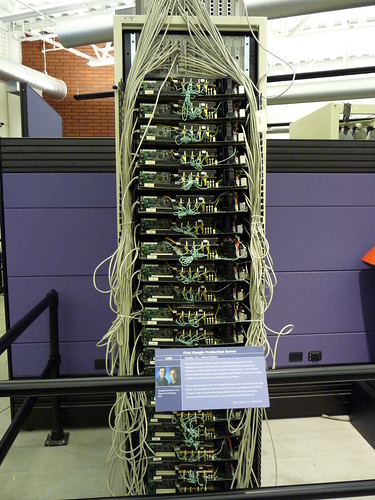
Google's first production server

Towards the end of a recent meeting with my supervisors I was asked a question that went something along the lines of: “do you buy the argument that if something is computational, that it is then necessarily reductive?” An excellent question I think. I suggested at the time, and still believe, there are two answers to this question that go together. First, by virtue of what computing ‘is’, as a machine-enabled set of processes that rely by and large on languages based in a formal logic, we must answer ‘yes’. Second, ‘computing’ as an activity and ‘computers’ as devices do not exist in a vacuum they are a part of our lives. I am writing a blog post using my laptop, connected to a network of other computers, run and maintained by people, allowing me to ‘publish’ my thoughts on a web site held on yet another computer, and hopefully some other people are reading this! Therefore, computing is definitely a part of the ‘politics of things‘, as suggested by Latour, with and by which we and others socialise.

My two answers are not mutually exclusive, “either/or”, they go together such that, I argue, we must increasingly see ‘computing’ as a connective capacity. Computing connects people with other people, people with ideas, information with things, etc etc. In this way, I have some sympathy for those, like Adam Greenfield, that suggest that “ubiquitous computing”, or something like it, was somewhat inevitable. However, I think hindsight definitely smoothes out the errors and stumblings along the way. If we think about ubiquitous computing as “the application of computational tools to human activity regardless of the shape and form of those tools”, following Scott Carter (whom I interviewed this summer), I think we can see computing as an ‘affordance’, the capacity to enable possible actions, which is innately connective. Here we might start looking to Gregory Bateson or Deleuze and Guattari to theorise such a connective capacity.

Why do I blog this? It is useful to keep probing concepts central to, and perhaps assumed, in one’s arguments, and I don’t want to lose sight of the fact that the idea of ‘computing’ is not neccesarily fixed.

Image: Google’s first server, held in the Computer History Museum, CA, taken by me.

Equus and becoming-animal

Etruscan black-figured depiction of a centaur on amphora - Flickr user: diffendale
Etruscan black-figured depiction of a centaur on amphora – Flickr user: diffendale

I saw the excellent production of Equus currently playing at the Theatre Royal Bath on Saturday. The cast gave a brilliant performance, I was particularly impressed with the ever-energetic Simon Callow and his masterful depiction of the psychiatrist Martin Dysart. Alfie Allen was also very good as Alan Strang.

All of the allusions to Freud got me thinking though…

“Afterwards, he says, they always embrace.

The animal digs his sweaty brow into his cheek… and they stand in the dark for an hour… like a necking couple.

And of all nonsensical things, I keep thinking about the horse… not the boy, the horse, and what he might be trying to do.

I keep seeing the huge head, kissing him with its chained mouth… nudging through the metal, some desire absolutely irrelevant… to filling its belly or propagating its own kind.

What desire could this be? Not to stay a horse any longer? Not to remain reined up forever in those particular genetic strings?

Is it possible, at moments we can’t imagine, a horse can add its sufferings together… the non-stop jerks and jabs that are its daily life… and turn them… into grief?

What use is grief… to a horse?

You see… I’m lost.”

The opening lines of Equus – Peter Shaffer

‘The politics of becoming-animal remains, of course, extremely ambiguous. For societies, even primitive societies, have always appropriated these becomings in order to break them, reduce them to relations of totemic or symbolic correspondence’

Deleuze & Guattari (2006) A Thousand Plateaus, London: Continuum – p. 273