
A video of the (full) debate/discussion on the ‘anthropocene’ between Stiegler and Sloterdijk held at Radboud Universiteit, in Nijmengen, Netherlands. Surprisingly good natured…
Thanks to Anne for pointing it out.
How to survive “disruption” – interview with Bernard Stiegler (translation)
In a recent interview with the French-language Swiss newspaper (or at least the web version) Le Temps, Bernard Stiegler addresses some of the key issues underlying his most recent book (not yet in translation) concerning disruption. Addressing in one sweep the ideological uses of the term by those involved in technological entrepreneurialism (especially in the US) and the wider sense in which (as he has previously argued) Stiegler sees a form of widespread dispossession of knowledge, of life skills and indeed of livelihood across Europe through the rapid political, social and technological changes to work and everyday life – Stiegler continues to argue for his favoured political response: an economy of contribution.
Of interest here, perhaps, is the brief discussion of his (and, I think, Ars Industrialis‘) collaboration in the creation of a Chair of Innovation [one of a number of proposed ‘research chairs’] to be based in Plaine Commune an urban unitary authority, or greater Paris borough (established through the creation of Metropolitan Greater Paris [Métropole du Grand Paris] as one of the nine Établissements publics territoriaux or boroughs/unitary authorities) on the Northern fringe of Paris that is designated as le Territoire de la Culture et de la création, or ‘the borough for creativity and culture‘. As I understand it Stiegler proposes Plaine Commune as ‘territoire contributif‘ – a sort of region of contribution [a territory or zone delineated as an area in which the economy of contribution might take precedence, along the same lines as ‘free trade zones‘ perhaps, but with a very different ethics/politics]. The principle role of the ‘chair’ is to oversee the pilot of a kind of basic or citizens’ income (broadly akin to a universal basic income) that Stiegler suggest will be implemented through a formal agreement of ‘contribution’ – whereby the income is granted on the premise that the young people given it will use it to subside their own personal development, in turn making them greater contributors to society.
As always, I have done my best to clarify and offer original French terms where I think it helps but done so in square brackets. I welcome comments and suggestions about this translation – please understand it to be a ‘rough’ version, I am nowhere near fluent enough for this to be considered particularly authoritative!
[See the original in French here].
How to survive “disruption”
The vacuity of the “data economy” or the revitalisation of our societies in a contributory mode? For Bernard Stiegler it’s time to choose …
Bernard Stiegler does not define disruption within the five hundred pages that begin with “Inshallah” and end with “we must dream”. The term, borrowed from nuclear physics, and in particular, experiments in closed rooms suggestively called “tokamaks” denotes a “sudden onset of instability”. In the jargon of our digital age the word now means the ability of an innovation to destabilize entire sectors of the economy and society. It is also worth noting that in the (not unrelated) terminology of the American Medical Association, a “disruptive physician” is a practitioner whose deplorable behavior undermines the health of those around him. So, we’re all clear then.
Bernard Stiegler does not define disruption because that is not his objective. His new book is placed in the disruption: the subject is us, who are totally enveloped within it – all of us, with our “processes of individuation” devastated by the conversion of our interior being into data that is delivered for automatic calculation. All of us, with our “protentions” (that is to say “the desire and expectation of the future”) short-circuited by algorithms. All of us, who face the “hegemonic becoming of disinhibition” [désinhibition devenue hégémonique] exemplified by the repulsive figure of Dominique Strauss-Kahn. We are all looking for tools to perform a split, the stakes of which are everything: on one side the void, on the other, if all goes well, the “reconstruction of a true society” [reconstitution d’une véritable société]. This is the conclusion of the French philosopher, theorist and practitioner of innovation, pioneer of digital and socio-technical thinking – and also, in previous lives, owner of a jazz club and former prison inmate, as he as highlighted himself – a combination of analysis with lived experience, which is, in this way, faithful to the foundations of phenomenology.
“How to not go mad?” Asks the subtitle of his book, and how did we arrive at such a question becoming inescapable? Via a long and winding path for society, answers Stiegler, that passes through “the inversion of the Enlightenment project” and leads to the “ultra-liberal capitalism” of the present, born from conservative revolutions that work towards the “pure and simple liquidation of public power”. Also, via a long technological path that has remained unthought since Plato, because philosophy essentially refuses to think technics. To represent the point where digital disruption converges with the climate crisis, Stiegler offers the testimony of a fifteen year old boy called Florian: “We no longer dream of having a family, of having children, a profession, ideals, because we are convinced that we are the last generation”. What is to be done? Surrender to madness? Allow suicidal thoughts to creep into the crevices of our minds like ivy? Let’s see…
Le Temps: Is the situation you describe the product of technology itself, or rather of the socio-political context?
Bernard Stiegler: When computing technologies can go four million times faster than us there are associated structural effects. However, we can use these tools in alternative ways to servicing the data economy. In any case, the web was not, initially, designed for capturing data: it was a space for publication, whose success was related to the opportunity to participate in public life through publication. In the Renaissance, printing opened out a public space that we call the Republic of Letters. The web potentially opens a new space that one can call the Digital Republic. The is what happened at first but quickly, and especially in the ten years since the introduction of social networks, the internet has become a system for capturing behaviour, for the development of what the Belgian lawyer Antoinette Rouvroy calls algorithmic governmentality, by which she means the control of individuals by algorithms.
– Is it still possible to split away from this?
– It is not only possible it is absolutely essential. The computational system as it functions today produces a standardisation, a homogenisation of existential spaces, which leads to a destruction of society. Increasingly, people are seen as the mediated reports of algorithms, and these are substituted for social systems. This results in a loss of a sense of existence that causes frustration, violence and madness, which is to say: despair and desensitisation [denoétisation]: the destruction of cognitive capacities. At an economic level, with the development of automation we see the destruction of more than half of the jobs in Europe and the United States. If we do not want to also thereby destroy half of the purchasing power, and thus consumption and economic activity, we must redistribute income outside of salaried employment, which exists less and less.
– We understand you have a plan…
– It shall be necessary to redistribute the gains made through automation through what we can call a contributory income, remunerating people who augment their capacities to act, in the sense understood by the Indian economist Amartya Sen. At the moment I am developing a project in the Seine-Saint-Denis district, which has more than 430,000 inhabitants, working with their unitary authority [l’établissement public territorial] Plaine Commune. Within the authority, we are creating a Chair of Contributive Research, in partnership with universities and businesses and with the support of three ministers. Primarily, this relates to the question of distributing a contributory income amongst several hundred young people drawn at random, whom we will support through a formal agreement [with them] based upon their acquisition of knowledge. The latter need not be purely academic, we are also speaking here of life skills [savior-vivre] and practical know-how [savoir-faire] in areas that could be [for example] sport or cooking.
In a famous study, Amartya Sen wondered why adult male mortality was higher in the New York neighbourhood of Harlem than in Bangladesh. In answering the problem he put forward an explanation based on [the idea of] collective knowledge that, he said, gave the Bangladeshis an ability to withstand incomparably greater adversity. In the Western world, people are thoroughly proletarianised: they no longer have [such] knowledge [savoirs], they only have the skills to operate a supermarket checkout, accounting software or financial data tools. They are therefore no longer capable of innovating [produire du changement], they only perpetuate the standardised nature of the system. A contributory income, on the contrary, remunerates people who acquire and enhance their capacities to enrich the social. We are also in favour of an unconditional income: both of these devices [dispostifs] are complimentary.
– So, in this way, there can be a future “in the disruption”…
– It is never too late for effective action [pour bien faire]. It is absolutely essential to develop an economy of contribution, using the algorithms that are already exploiting the data economy, that does not reject disruption, because that serves no purpose, because the reality of disruption is something nobody can prevent. This demands a new form of public power and a new European politics that develops an alternative model for these technologies. We must urgently reconstruct an ecology of dreams [une écologie du rêve], of thought [pensée], and social relations, and it must be created through experimentation, rather than solely through theorisation. Today we are in processes of denial, people do not want to hear talk of the extreme gravity of the situation. Yet as soon as there are real prospects [of change], they will [finally] be able to discuss it.
Bernard Stiegler, «Dans la disruption. Comment ne pas devenir fou?» (Editions Les Liens qui libèrent, 480 p.)
The Museum of Contemporary Commodities in EXETER

Just a quick note to let you know that the brilliant Paula Crutchlow has brought “The Museum of Contemporary Commodities” (MoCC) to Exeter for the majority of May.
There’s lots going on, much of it creative and interesting – so if you’re in Exeter or nearby: come and visit!
Two immediate things this week:
RIGHT NOW!: help re-create the internet in paper with Artist Louise Ashcroft from 11 -2 in the Exeter University Forum.
TOMORROW: sign up to do a data walkshop with Alison Powell from the LSE on Saturday from 10-1. Places have to be booked, and the Eventbrite page is here https://www.eventbrite.com/e/mocc-data-walkshop-tickets-24464719635
Please do visit the MoCC website for lots more events and activities taking place this month and visit the shop:
87 Fore St,
Exeter
EX46RT
Open 10:00-18:00pm Weds-Sat, 4th-21st May.
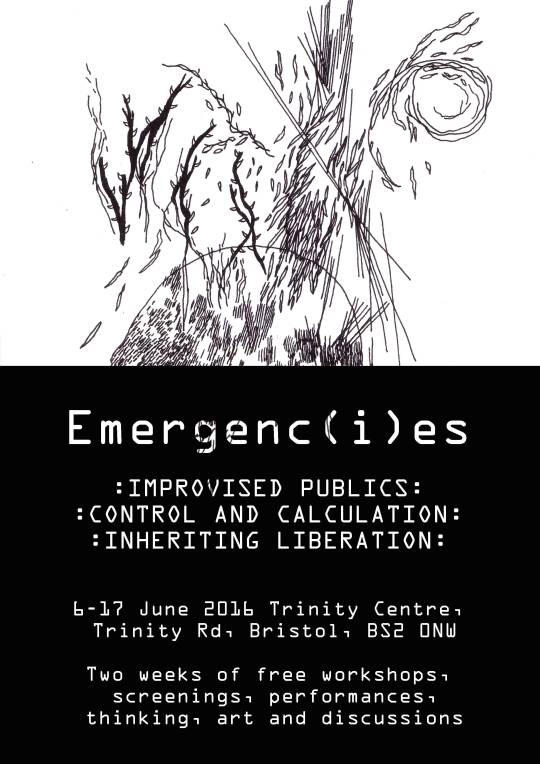
Reblog> Improvised Publics :: Control and Calculation :: Inheriting Liberation :: 6-17 June 2016
This event looks really interesting, check out the website for more information…
Emergenc(i)es is an invitation to consider the emergency of the current historical moment.
The exhibition will dwell in the question of emergence within emergency.
Performance, education activities, visual art, screenings, installations, workshops and a library-cum-pharmacy will create time and space to diagnose, explore and understand the world we live in.
Enter – Relate – Improvise – Diagnose – Inherit – Public – Liberate – Gather
All activities are free to attend, thanks to generous funding from Awards for All.
Feminism, Digital Culture and the Politics of Transmission – Deborah Withers
I don’t really know why I haven’t seen this before today(?!) but just wanted to flag this really interesting book by Deborah Withers, which I will be ordering ASAP…
Feminism, Digital Culture and the Politics of Transmission argues that despite the prevalence of generational narratives within feminism, the technical processes through which knowledge is transmitted across generations remain unexplored. Taking Bernard Stiegler’s concept of the already-there as its starting point the book considers how the politics of transmission operates within digital culture. It argues that it is necessary to re-orient feminism’s political project within what is already-there so that it may respond to an emergent feminist tradition.Grounded in the author’s work collecting and interpreting the music-making heritage of the UK Women’s Liberation Movement, it explores how digital technologies have enabled empassioned amateurs to make ‘archives’ within the first decade of the 21st century. The book reflects on what is technically and politically at stake in the organization and transmission of digital artifacts, and explores what happens to feminist cultural heritage when circuits shut down, stall or become diverted.
And here’s some praise from Patrick Crogan, whose opinion I trust:
A substantial, judicious, and highly effective mobilisation of key tenets of Stiegler’s work pertaining to memory, technology, and cultural transmission. Withers develops a cogent political reformulation of questions of memory, heritage, and archival matters of preservation and access in the digital age in this book project. Her use of Stiegler is central to this, and indeed represents an important introduction to his philosophical critique of the digital mediated world to an area where his ideas have particular relevance but are under-represented.
Patrick Crogan, Associate Professor of Digital Cultures, University of the West of England
In Disruption – new book by Bernard Stiegler
 Yet another new book by Bernard Stiegler has been published in French recently: Dans la Disruption – Comment ne pas devenir fou?
One might translate this as: “In Disruption – How do we not go mad?”
Here’s the front and back covers, and I offer a quick translation of the back cover blurb…

For the lords of economic war disruption is “a phenomenon of the acceleration of innovation (…) which is going to happen more quickly in societies that allow them to impose programmes that destroy social structures and render public power impotent. This is a kind of strategy of tetanising one’s adversary”.
Facing the disruption thus imposed, social systems always arrive too late to seize technological evolution, now thundering ahead in the digital revolution. Faced with this state of affairs, which requires countless legal and theoretical loopholes establishing a lawlessness which is a kind of techonlogical Wild-West, individuals and groups are totally lost, often to the point of going mad, individually or collectively, and therefore becoming dangerous. The concretisation of what Nietzsche described as a growing desert of nihilism leaves 21st Century humans with no other perspective than facing the next of the limits of the Anthropocene.
What can be done with such madness, in such madness? It is by starting with this question, that Bernard Stiegler rereads Michel Foucault (Madness and civilisation: A history of insanity in the Age of Reason) and Jacques Derrida (Cogito and the History of Madness) while confronting Peter Sloterdijk and Jean-Baptise Fressoz’s analyses of capitalism as above all a process of disinhibition.
The author conducts these readings or re-readings starting from the forms of madness which reflects his own course, opening out the question of a new moral philosophy – in an age without age [l’époque sans époque], which he calls the “Strauss-Kahn generation”, that is a “lack of age” [“absence d’époque”], which imposes a general demoralisation that cannot last.
Stiegler: Stop the uberisation of society!
Posted below is a translation of a piece co-authored by Bernard Stiegler with Ariel Kyrou (journo), Yann Moulier-Boutang (writer) and Bruno Teboul (Director of innovation at Keyrus) and published in Libération on the 10th April.
I suppose it doesn’t really propose anything especially novel, if you’re familiar with others involved in debates around “postcapitalism”, automation, worklessness and universal income (e.g. Srnicek and Williams, or Mason). What is perhaps novel is an application of the ideas in a distinctly European flavour, with examples in France and in the context of a much more robust unionised response to Uber (and the task/gig economy).
Anyway, it’s an interesting read I think…
The piece is rather conversational in tone and uses idioms I have only been able to infer (not being a fluent and native speaker) so it was quite difficult to translate, and so I’m pretty sure there are errors. As usual clarifications or original French are in [square brackets].
Stop the uberisation of society!
Libération, 10th April
The war by taxi companies against an Uber society cannot be reduced to the storyline of a film depicting an ancient evil battling benevolent forces of modernity. If on the one hand the participatory economy threatens our social structures, it can also, on the other, make possible a society with greater solidarity.
Since the first moves towards the draft Thévenoud law in June 2014[1], the urban transport soap opera has generated multiple variations on the theme of the standard storyline. On one side are the taxi federations, which have been labelled a horde of grumpy medieval malthusians by Uber, who in the opening of the second act of the performance of the trial of the 11th February demanded a whopping €100m in damages from Uber, on the other the ‘white knight’ of the new economic order, the high-tech Robin Hood of its pleb users whose UberPop service enables simple fellows in search of employment the opportunity to offer at cut-price their talents for automotive locomotion, between February 2014 and July 2015. This tale of jokers against modernisers is more attractive than the G7, queen of opaque rentier sorcery, who could not turn themselves with the wave of a magic wand into the cinderella of Parisian Transport.
Except that the movie script of the ancient evil against the benevolent ‘disruptors’ rings as hollow as any Hollywood blockbuster: seen quickly, soon forgotten. It works in the short-term, like the groan of the indefinite vigil for a taxi at 3 o’clock in the morning in the banlieue, but it hardly takes us any distance towards solving the questions about the future of our society and the search for sustainable solutions to the crisis we are experiencing.
Let’s not misunderstand this scenario: the agonism presented by this contemporary drama [série du moment] is neither the ardent need to pit global start-ups against French corporatism [corporatismes franchouillards] nor its exact opposite, namely the obligation to defend the capitalism of tired old barons against the hyper-capitalism of the rulers of the digital future. No, the issue that should be obvious to everyone with a stake in the debate is the urgent need to think about the society we want, and then act in order to build it.
For why should we anoint an ‘uberisation of the economy’ without interrogating its ideology and long-term deleterious effects? Uber, which declares only a fraction of its profits in France thanks to a complex form of tax evasion through the Netherlands, Bermuda and Delaware, is participating in the liquidation of our social structures. It embodies a short circuit that threatens the fragile economic balance between taxation, social law, transport policy, infrastructure investment at the local level and the pensions system. Worse still: its social and economic logic foreshadows the advent of a futuristic no-man’s land in which the a priori ideal of liberty becomes monetised against an a posteriori generalised casualisation throughout society. Indeed, the rictus predatory behaviour of platforms like Uber, Lyft and others such as Amazon’s Mechanical Turk is founded upon a low intensity of capital, little infrastructure, a minimum of salaried employees with more independent or self-employed workers.
The uberisation process forms the first wave in the tsunami of automation. Its primary consequence will be a net loss of five million jobs in industrialised countries by 2020, according to a report published on the 18th of January by the oracles of the World Economic Forum in Davos, the shameless apostles of the “fourth industrial revolution”. This deeply unappealing assertion has been amplified by several studies in the last three years (by Oxford, MIT, the Breugel Institute and Roland Berger) which predict around 47% fewer people in employment by 2025. This slow but inexorable extinction of of the salaried world effects not only warehouse workers, supermarket cashiers and lorry drivers but also barristers, solicitors, journalists, those working in medicine, and so on. Why should it remain necessary to use human beings for tasks that are reducible to systematic procedures? Which in our data economy robots and algorithms will soon perform much more efficiently. The combination of robotics and ‘big data’, algorithms and network effects, is already transforming us into the involuntary gravediggers for salaried employment. Welcome to a world that is ultimately ‘flexible’, boosted by robotic automation [robotisation] and work on the meter. A world where users and customers constantly account for themselves, where each becomes their own big brother and where most of the activity in every market, like with car insurance, will increasingly play out more in an automated big data-driven fashion than according to laws or to forms of trust that are not based in calculation.
Nevertheless we should beware skewed perspectives: such a world is not inevitable. The digital gives us an opportunity to reconsider work not only in terms of jobs doomed to become ever more precarious, provoking anxiety about self-exploitation, but also as a part of a project for a contributory society in which salaried employment would be one means amongst many, rather than an end in itself. A company like TaskRabbit certainly creates use value through its platform of small on-demand jobs, but it keeps for itself and its shareholders the [accompanying] exchange value in the form of profit. In contrast, Loconomics is a co-operative owned by those who use it to advertise their services. Against the platforms of the so-called sharing economy (which it is in name only) Trebor Scholz endorses a ‘platform cooperativism’ [2] to build a society of commons that operates beyond solely economic and financial dimensions.
This shambles needs to be urgently addressed. Thinking in the long-term, this is political in the principal sense of the word. To buckle down to the future of work equally concerns: expertise in data to use and liberate ourselves from algorithms and a care for people without the need for machines; to classify work in a way that is both protective of our ways of life and much less administrative than today; to examine the establishment of an adequate basic income, structurally justified by massive unemployment due to automation and the coming slow death of employment; to experiment with the extension of the regime of casual work in the context of a true society of contribution, with the acquisition and sharing of knowledge by and between everyone; to study tax reform based upon the principles of a financial transactions tax [la taxe pollen], beginning with the establishment of a European tax on the flows of High Frequency Trading, to finance a universal income.
Rather than the two opposing and yet complimentary nightmares that are the integral uberisation of society and the sovereignist protection of the capitalism of yesteryear we prefer the realisation of a dream: to imagine, to experiment, to build, step by step, a freer society with greater solidarity; preferring disagreement to the brainwashing that has played out, historically, through the carrot and the stick, or, in our high-tech times, through a blind obedience to shiny artificial devices [l’obéissance aveugle à de rutilantes mécaniques artificielles et augmentées].
1. For more information on the Thévenoud law see this article – Sam.
2. See this article on Medium by Scholz.
Reblog> Postcapitalist Futures: Talk at Bristol
Via Mark Purcell…
The University of Bristol’s School of Geographical Sciences will host the 6th annual Bassett lecture on Tuesday 3rd May 2016 at 4pm.This year’s speaker is Nick Srnicek, who will be presenting under the title ‘Postcapitalist Futures’ (details below).
The lecture will take place in the Peel Lecture Theatre, School of Geographical Sciences, University Road, Bristol, BS8 1SS
Abstract:
What does the future of work hold? This talk will examine the current capitalist conjuncture, outlining the changing technological and economic conditions of work. The social democratic era of good jobs, it will be shown, is over – and the left must grapple with this shift. In place of full employment, we should be arguing for full unemployment. This talk will try and show both why this is necessary, and how this is possible.
Biography
Nick Srnicek is the co-author, with Alex Williams, of both Inventing the Future: Postcapitalism and a World Without Work (Verso, 2015) & “#ACCELERATE MANIFESTO for an Accelerationist Politics” (2013). He is the co-editor of The Speculative Turn (Re.press, 2011 with Levi Bryant and Graham Harman) and is currently working on a new book entitled Postcapitalist Technologies (Polity, forthcoming).
The Bassett Lecture:
The Bassett Lecture is held every year in honour of Dr. Keith Bassett, a critical geographer and long-time Senior Lecturer in the School of Geographical Sciences. Though formally retired, Dr. Bassett continues to write, teach, and contribute to the intellectual life of the School and University. The lecture series recognizes Dr. Bassett’s work and contributions in the fields of social and geographical theory, critical geographies of political economy, urbanism, social movements and social justice, political ecology, and critical socio-legal studies.
All Welcome!
No booking required, for enquiries contact: tom.keating [at] bristol.ac.uk
Reblog> Diverse Economies and Livable Worlds
This looks interesting, via Nicholas Crane :
Diverse Economies and Livable Worlds
As part of an infrastructure for the construction of what Mark Purcell recently called ‘Joyful Geography,’ the editors of the Diverse Economies and Livable Worlds Book Series (with University of Minnesota Press) are soliciting book proposals. The recent Making Other Worlds Possible (2015) indicates a direction for the series. I cut and paste Kevin St. Martin’s announcement of the series below.
***
Diverse Economies and Liveable Worlds Book Series
University of Minnesota Press
The Diverse Economies and Liveable Worlds Book Series offers a space where the theoretical and political conversations opened up by an anti-capitalocentric vision of economy can take place. The core concerns of this series are diverse economies as both a mode of inquiry and as actually existing, potential, and transformative economies. The series is explicitly focused on undoing our understanding of capitalism as a conceptual container. Thinking outside this container is what allows us to veer from the singularity, inequities, and degradations associated with ‘capitalism’. The Diverse Economies research program initiated by J.K. Gibson-Graham has carved out a new intellectual territory for interrogating and performing ‘more than capitalist’ worlds that is attracting many scholars. At the same time, on the ground, a plethora of movements are forging forms of post-capitalist politics that imagine and enact liveable worlds in which economies are refocused on meeting the needs of people and the planet. The series will attract established and emerging scholars who are pushing at the boundaries of thinking about how we represent and enact ‘the economy’, how we recognize and theorize economic diversity, and what a post-capitalist politics here and now might be.
The editors of this Book Series are J.K. Gibson-Graham k.gibson[at]westernsydney.edu.au, Maliha Safri msafri[at]drew.edu , Kevin St. Martin kstmarti[at]rci.rutgers.edu, and Stephen Healy stephen.healy[at]gmail.com.
We welcome book proposals from a wide range of fields including Architecture and Design, Anthropology, Assemblage and More than Human Studies, Business and Organization Management, Communications and Media, Economics:, Environmental Humanities, Geography, Philosophy, Political Science, Regional Planning, Sociology and Women’s Studies.
For more information please contact the Series Editors.
Does critical geography need a shock to thought? On Purcell’s ‘joyful geography’
Over on his blog Path to the Possible Mark Purcell has written a thoughtful and interesting piece diagnosing a slip into a kind of cynicism, or perhaps a rut in ‘critical’ thinking in geography, that the predominant disposition of criticality in ‘critical geography’ is of being against– : “against colonialism, against capitalism, against racism, etc.”.
Purcell argues that a negative consensus of what constitutes ‘criticality’ has developed that has created an orthodoxy of negation:
“I worry that we have become inordinately attached to singing in this key, that we have become unable to do anything other than cancel what we oppose.”
Indeed, this echoes a criticism of the over-coding of the various readings of what one might mean by ‘neo-liberalism’ by James Ferguson in Antipode that, as Clive Barnett summarises: “identifies a standard style of critique as denunciation of exploitation, inequality and oppression” but that can also be rather limited.
In this way we might understand such an orthodoxy of a perpetuation of an adaption to the contemporary milieu, in the form of a negation of its conditions (such as, for example, labelling everything ‘neoliberalism’) rather than an adoption and then rethinking the practices/processes of the conditions that produce it [I’m riffing on Stiegler’s distinction between adaption (as a tendency towards dis-individuation) and adoption (as a tendency towards co-individuation)]. This ‘orthodoxy of negation’ (as I have chosen to call it) can be characterised as a kind of entropy, a slip from proactive thought into what might be a kind of un-thinking or ‘unreason’ and ‘stupidity’ (as Stiegler has it in States of Shock). Stupidity is a necessary tendency for all of us insofar as it is the precondition for knowledge, but we need a shock to thought in order to reinvigorate our capacities for knowledge. Of course, we are overburdened by shocks (as Naomi Klein outlines in The Shock Doctrine) that appear to arrive with increasing frequency. Rather than submit to simply adapting to the onslaught of ever-more-frequent shocks, following Stiegler’s analysis, we need to engender a therapeutic form of ‘shock’ to our thinking that doesn’t simply confirm a status quo of the orthodoxy of negation.
Reading this together with the argument presented by James Ferguson, who argues:
“what if politics is really not about expressing indignation or denouncing the powerful? What if it is, instead, about getting what you want? … Denunciatory analyses often treat government as the simple expression of power or domination–the implication apparently being that it is politically objectionable that people should be governed at all. But any realistic sort of progressive politics that would seek a serious answer to the question “what do we want?” will have to involve an exploration of the contemporary possibilities for developing genuinely progressive arts of government.”
Thus the habitual ruts of critique that Ferguson calls the “antis” (anti-globalisation, anti-neo-liberalism, anti-privatisation, etc.) in which any exercise of power is considered in some way dubious are, perhaps analogous to the forms of ‘stupidity’ (of entropy) that Stiegler argues against. I am not offering a simple and pejorative sweeping dismissal of any of those so-called “anti–” positions, neither am I making a glib appeal to Marx’s 11th thesis on Feuerbach. Nevertheless, I am suggesting that a more affirmative attitude might be necessary and that we all need to be aware of our own ‘stupidity’ (otherwise there’s simply no hope for individuation!).
I welcome a call for ‘joyfulness’ in research and in ‘critique’, a more affirmative attitude towards the exercise of power in the face of the orthodoxy of negation and all of this reminded me of Clive’s excellent reading of James Ferguson’s paper, upon which some of this post has been based. So, for me (and for what its worth) I guess I would advocate a kind of practical joyfulness – one that aspires to the same precepts of communing, of mutual aid, of solidarity that Purcell discusses in his blogpost and begins from the everydayness of doing geography (as an academic, as a teacher, as an activist and so on).
I’ve hardly slept due to a poorly child but I do think it’s worth reading all of these things I’ve linked here together to formulate a way of moving forward… just my grain de sel”Ž 🙂