(More) Gendered imaginings of automata

My Cayla Doll

A few more bits on how automation gets gendered in particular kinds of contexts and settings. In particular, the identification of ‘home’ or certain sorts of intimacy with certain kinds of domestic or caring work that then gets gendered is something that has been increasingly discussed.

Two PhD researchers I am lucky enough to be working with, Paula Crutchlow (Exeter) and Kate Byron (Bristol), have approached some of these issues from different directions. Paula has had to wrangle with this in a number of ways in relation to the Museum of Contemporary Commodities but it was most visible in the shape of Mikayla, the hacked ‘My Friend Cayla Doll’. Kate is doing some deep dives on the sorts of assumptions that are embedded into the doing of AI/machine learning through the practices of designing, programming and so on. They are not, of course, alone. Excellent work by folks like Kate Crawford, Kate Devlin and Gina Neff (below) inform all of our conversations and work.

Here’s a collection of things that may provoke thought… I welcome any further suggestions or comments 🙂

Alexa, does AI have gender?


Alexa is female. Why? As children and adults enthusiastically shout instructions, questions and demands at Alexa, what messages are being reinforced? Professor Neff wonders if this is how we would secretly like to treat women: ‘We are inadvertently reproducing stereotypical behaviour that we wouldn’t want to see,’ she says.

Prof Gina Neff in conversation with Ruth Abrahams, OII.

Predatory Data: Gender Bias in Artificial Intelligence

it has been reported that female-sounding assistive chatbots regularly receive sexually charged messages. It was recently cited that five percent of all interactions with Robin Labs, whose bot platform helps commercial drivers with routes and logistics, is sexually explicit. The fact that the earliest female chatbots were designed to respond to these suggestions
deferentially or with sass was problematic as it normalised sexual harassment.

Vidisha Mishra and Madhulika Srikumar – Predatory Data: Gender Bias in Artificial Intelligence

The Gender of Artificial Intelligence

Chart showing that the gender of artificial intelligence (AI) is not neutral
The gendering, or not, of chatbots, digital assistants and AI movie characters – Tyler Schnoebelen

“Consistently representing digital assistants as female
hard-codes a connection between a woman’s voice and subservience.”

Stop Giving Digital Assistants Female Voices – Jessica Nordell, The New Republic

“The good robot”

Anki Vector personal robot

A fascinating and very evocative example of the ‘automative imagination’ in action in the form of an advertisement for the “Vector” robot from a company called Anki.

How to narrate or analyse such a robot? Well, there are lots of the almost-archetypical figures of ‘robot’ or automation. The cutesy and non-threatening pseudo-pet that the Vector invites us to assume it is, marks the first. This owes a lot to Wall-E (also, the robots in Batteries Not Included and countless other examples) and the doe-eyed characterisation of the faithful assistant/companion/servant. The second is the all-seeing surveillant machine uploading all your data to “the cloud”. The third is the two examples of quasi-military monsters with shades of “The Terminator”, with a little bit of helpless baby jeopardy for good measure. Finally, the brief nod to HAL 9000, and the flip of the master/slave that it represents, completes a whistle-stop tour of pop culture understandings of ‘robots’, stitched together in order to sell you something.

I assume that the Vector actually still does the kinds of surveillance it is sending up in the advert, but I have no evidence – there is no publicly accessible copy of the terms & conditions for the operation of the robot in your home. However, in a advertorial on ‘Robotics Business Review‘, there is a quote that sort of pushes one to suspect that Vector is yet another device that on the face of it is an ‘assistant’ but is also likely to be hoovering up everything it can about you and your family’s habits in order to sell that data on:

“We don’t want a person to ever turn this robot off,” Palatucci said. “So if the lights go off and it’s on your nightstand and he starts snoring, it’s not going to work. He really needs to use his sensors, his vision system, and his microphone to understand the context of what’s going on, so he knows when you want to interact, and more importantly, when you don’t.”

If we were to be cynical we might ask – why else would it need to be able to do all of this? –>

Anki Vector “Alive and aware”

Regardless, the advert is a useful example of how the bleed from fictional representations of ‘robots’ into contemporary commercial products we can take home – and perhaps even what we might think of as camouflage for the increasingly prevalent ‘extractive‘ business model of in-home surveillance.

“Emett” and “Miss Honeywell”

Twiki the robot from Buck Rogers

A couple of short films produced by British PathĂ©, both documenting what I guess were seen as whimsical takes on computerisation and automation originating from Honeywell. I don’t have much to say about these at the moment beyond the ways in which these videos more-or-less demonstrate the biases and norms of their time (gender and sexism being the most clear here) but also the ways in which they say something about how ‘automation’, robots and forms of novel technology (and so on) have been bound up with ideas about invention (which again is coloured by contemporary assumptions about who does the inventing).

Thanks to Mar Hicks for sharing “Miss Honeywell” on Twitter.

The Computer by Emett (1966) – British PathĂ©
Miss Honeywell (1968) – British PathĂ©

CFP> International Labour Process Conference STREAM Artifical Intelligence, Technology and Work

Industrial factory robot arms

Via Phoebe Moore.

ILPC STREAM Artifical Intelligence, Technology and Work

INTERNATIONAL LABOUR PROCESS CONFERENCE

Artifical Intelligence, Technology and Work 

ILPC 2019 Special Stream No. 5

Please submit abstracts via the International Labour Process Conference website (ilpc.org.uk) by the deadline of 26 October 2018.

Of all the social changes occurring over the past six or seven decades, perhaps most fascinating is the integration of computers and machines into the fabric of our lives and organizations. Machines are rapidly becoming direct competitors with humans for intelligence and decision-making powers. This is important for research in international labour process because artificial intelligence (AI) brings about challenges and questions for how organizations, globally, are designed and established with respective human resources planning and execution and industrial relations negotiations. We start with John McCarthy’s term, who both invented and defined AI as processes that are ‘making a machine behave in ways that would be called intelligent if humans were so behaving’ in 1955. At the origin of the term, AI aligned humans directly with machines, expecting machines to behave symbolically like humans. Over time, programmers working on neural networks and machine learning have emphasised the cognitive rather than symbolic. Now, AI is seen to have comparable capabilities to humans in both routine and non-routine ways, leading to new possibilities for automation. This draws on huge amounts of data often produced originally by humans. In fact, every time we enter a search term on a computer we add to and train machinic ‘intelligence.’ Every day, billions of actions are captured as part of this process, contributing to the development of AI. In doing so, people provide under-recognised cognitive and immaterial labour.
Therefore, this streams looks at the conditions and circumstances whereby machines begin to have the capacity to influence and become integrated in to humans’ ways of thinking, decision-making, working. It also considers the possibilities of AI in resistance against neoliberal and even authoritarian capitalism in the global north and south. AI is a broad term that identifies the pinnacle of machine capabilities that have recently become possible based on the amount of a) extensive big data that has become available in organisations, b) data analytical tools where programmers can identify what to track based on this data and what algorithms will allow one to gain the insights of interest, c) machine learning, where patterns across data sets can be identified and d) AI, where the final frontier has become the ability of pattern recognition across myriad data sets that have already identified their own patterns. When applied to work and work design, the primary goals are efficiency, market capture, and control over workers.
The rise of autonomous machines leads to philosophical questions that Marx engaged with in theories of objectification and alienation. Later, critical theorists have dealt with these questions in labour process research, where technologies and digitalization have created unprecedented concerns for how workplaces and work design are structured and control and resistance are pursued. In particular, the gig economy has become the frontline of these new changes. Workers here are now facing automation of the management function, supervised and even fired (or “deactivated”) without human intervention nor interaction. This is creating intensified and precarious working conditions, leading to fragmentation over digital platforms and platform management methods (Moore and Joyce 2018), as well as new forms of resistance and solidarities. These are all happening while their own work is under the threat of digitalization, where control and resistance have taken new forms and humans are in danger of becoming resources for tools (see Moore 2018a, 2018b; Woodcock, 2017; Waters and Woodcock, 2017).
Ultimately, across the economy, technology and its integration may be leading to organisations that take on a life of their own. Human resource decisions are increasingly taken by algorithms, where new human resources techniques integrate machine learning to achieve a new technique called ‘people analytics’ where data patterns are used to make workplace decisions for hiring/firing/talent predictions, creating significant threats to the possibilities of workplace organising and social justice. Sometimes, AI-based decisions lead to automating aspects of the workplace, for example, in the case of wearable devices in factories that allow human resource calculations based on AI and location-management by GPS and RFID systems. In these ways and others, AI processes inform a number of decision-making processes and digitalized management methods that have led to significant changes to workplaces and working conditions. If machines can deal with ethically based questions and begin to mimic the nuances of experiences and human judgement, will they become participants in humans’ already manifest ‘learned helplessness’? While currently, humans train AI with the use of big data, could machines begin to train humans to be helpless?

This call builds upon the ‘Artificial Intelligence. A service revolution?’ stream that featured at the 36th ILPC conference in Buenos Aires. This year’s stream is intended as a forum to bring together researchers engaged with the topics of labour process, political economy, technology, and AI to discuss this topic. We invite submissions on the following topics (not limited to, but also considering the need not to overlap with other streams):
-The effect of AI on the labour process where control and resistance rub against debates about exploitation Vs empowerment
-The implication of algorithmic management and control on the labour process, work replacement, and/or intensification from the factory to the office
-The “black box” of AI and related practices, algorithmic decision support, people analytics, performance management
-The impact of AI on the Global South: geographies and variegation of AI implementation, direct and indirect impact on jobs and differential effects of diverse socio-political setups
-Resistance and organising against/with AI and social media

Special Issue: We are also considering a submission for a journal special issue (though contributions may be requested before the conference). Please email Phoebe Moore pm358@leicester.ac.uk immediately if this is of interest.

Stream Organisers:

  • Juan Grigera (CONICET, Universidad de Quilmes, Buenos Aires, Argentina),
  • Lydia Hughes (Ruskin College, Oxford, UK),
  • Phoebe Moore (University of Leicester, School of Business, UK),
  • Jamie Woodcock (Oxford Internet Institute, University of Oxford, UK)

Please feel free to contact the stream organisers with any informal inquiries.

For information on the ILPC 2019 and the Calls for Papers for the General Conference and the other Special Streams please go to https://www.ilpc.org.uk/

References
Moore, P. (2018a): The Quantified Self in Precarity: Work, Technology and What Counts, Advances in Sociology series (Abingdon, Oxon: Routledge).
Moore, P. (2018b): ‘The Threat of Physical and Psychosocial Violence and Harassment in Digitalized Work’ International Labour Organization, ACTRAV, Geneva: Switzerland.
Woodcock, J. (2017): Working the Phones: Control and Resistance in Call Centres, London: Pluto.
Waters, F. and Woodcock, J. (2017): ‘Far From Seamless: a Workers’ Inquiry at Deliveroo’, Viewpoint Magazine.

40 years of automation anxiety in the UK through BBC clips [video]

Industrial factory robot arms

I’ve just done a rough edit of some snippets from BBC programmes that I think shows an interesting pattern to the ways that automation has been discussed by the UK national broadcaster over the last 40 years. In each case, automation is a significant issue – it needs to be urgently addressed, but that hasn’t yet happened.

Out of the three programmes, the first two are fairly significant in their onward influence.

The first, the 1978 “Now the Chips Are Down” Horizon episode was reportedly a significant influence for the BBC’s own Computer Literacy Project, which spawned the BBC Micro Computer.

The second, the 1980 (middle of three) episode(s) of “The Silicon Factor” was a part of the Computer Literacy Project. Alongside the three-part series, the producers created a report (for the BBC Continuing Education Department): “Microelectronics“, which was commissioned by the outgoing late-1970s Labour government’s Department for Education and the Manpower Services Commission. I thoroughly recommend watching the programmes and looking at the report if you’re interested in the histories of computing and automation in the UK.

The third, as far as I know – less significant in it’s onward influence, is a 2015 episode of Panorama: “Could a Robot Do My Job?” Interesting here because the rhetoric is nearly identical to that of “The Silicon Factor” – we need to take advantage of the revolution.

I’ve got more to say about this and I need to do a bit more thinking but wanted to share, because I think it’s interesting! This video (or a revised version) will form a part of my paper for a double session on ‘New Geographies of Automation(?)‘ at the RGS-IBG conference in August 2018 concerning the ways that we imagine automation.

“How will you manage fallout from [robot] displaced labor?” KPMG

Gigolo Jane and Gigolo Joe robots in the film A.I.

From KPMG’s Strategic Visions on the Sourcing Market 2016, p. 32. Via Jamie Peck’s excellent Offshore.

How will you manage fallout from displaced labor?

The automation of human jobs may cause some unrest, so prepare to have honest, open discussions with your organization. Resistance may come not only from the workers in automatable roles but also from directors who may fear erosion in their span of control, as they potentially go from managing employees to managing bots.


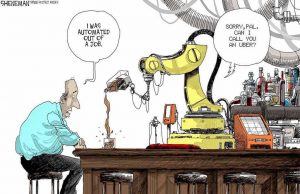
Cartoon about automation by Drew Sheneman

Janelle MonĂĄe – Dirty Computer, an emotion picture

Still from Janelle MonĂĄe's Dirty Computer video

I came across Janelle MonĂĄe‘s work a while ago, through Twitter, I was really taken by the video for “Many Moons“, which is beautiful. Metropolis, the album from which it is taken, is a really interesting blend of pop, sci-fi and perhaps afrofuturism, or at least forms of sci-fi that don’t conform to, or queer, standard Western/Global North sci-fi themes/norms. Some have argued MonĂĄe’s videos blends American and African Sci-Fi themes (a teaser trailer for Dirty Computer was shown before cinematic performances of Black Panther) in a sort of queer aesthetic (that’s my reading of what longer pieces say anyway) and I think I can see it in several videos, though my knowledge of other work that might complement or contrast this is very limited.

In the “emotion picture” (what a beautifully evocative term) for the album Dirty Computer we’re presented with a rich and confident, feature length, work of art. I’m not currently able to dedicate the time to offer a lengthier visual analysis, I’m simply going to post the video, below. All I can say, really, is: wow.

“The Rise of the Robot Reserve Army” – interesting working paper

Charlie Chaplin in Modern Times

Saw this via Twitter somehow…

The Rise of the Robot Reserve Army: Automation and the Future of Economic Development, Work, and Wages in Developing Countries – Working Paper 487

Lukas Schlogl and Andy Sumner

Employment generation is crucial to spreading the benefits of economic growth broadly and to reducing global poverty. And yet, emerging economies face a contemporary challenge to traditional pathways to employment generation: automation, digitalization, and labor-saving technologies. 1.8 billion jobs—or two-thirds of the current labor force of developing countries—are estimated to be susceptible to automation from today’s technological standpoint. Cumulative advances in industrial automation and labor-saving technologies could further exacerbate this trend. Or will they? In this paper we: (i) discuss the literature on automation; and in doing so (ii) discuss definitions and determinants of automation in the context of theories of economic development; (iii) assess the empirical estimates of employment-related impacts of automation; (iv) characterize the potential public policy responses to automation; and (v) highlight areas for further exploration in terms of employment and economic development strategies in developing countries. In an adaption of the Lewis model of economic development, the paper uses a simple framework in which the potential for automation creates “unlimited supplies of artificial labor” particularly in the agricultural and industrial sectors due to technological feasibility. This is likely to create a push force for labor to move into the service sector, leading to a bloating of service-sector employment and wage stagnation but not to mass unemployment, at least in the short-to-medium term.

Ocado automated fulfilment centre & automation promo videos

A warehouse worker and robot

Ocado, online groceries delivery service in the UK, some time ago pivoted into providing automation solutions for other retailers. They have a division, or separate company, called Ocado Technology, which offers other retailers systems for fulfilment centre automation: “Ocado Smart Platform” [buzzwords ahoy!]. So, while the above video is interesting, insofar as it demonstrates yet another not-exactly-hospitable factory-like code/space, what is perhaps more interesting is that this system seems to have been developed not only to fulfil Ocado orders in Wiltshire/Hampshire but also as an advert for what Ocado technology does. See this report from Reuters: Ocado’s robot army courts global food retailers.

Ocado have promoted previous automated systems through videos too. The same claims about ‘machine learning’ and so on were made about a fulfilment centre system that looks a lot more like an airport baggage sorting system around five years ago.

I’ve become mildly obsessed with these videos of automated factories and fulfilment centres – they have become a sort of genre unto themselves. There are clearly ways in which promotional videos–made by the equipment/tech firms responsible for creating the systems or the firm implementing them–get translated into video news stories. Likewise, there are ways of talking about the ‘robot’ nature of these things. All of this demonstrates our ongoing negotiation of norms of understanding, describing and rationalising the technology, it’s implementation and what it may or may not portend for work and so on. If you’ve read this blog in the last year you may remember I talk about this stuff as the formation/formalisation of an ‘automative imagination‘.

As a sort of throw-away aside – the displacement of labour involved by Ocado’s, and others’, systems of automation may well be important too. If you ramp up the capacity to ‘fulfil’ orders in the distribution centre then you need to expand the capacity to get them delivered. We don’t have driverless vehicles on our roads, yet, so this possibly means fewer pickers and packers and a lot more delivery drivers.