Digital work and automation link dump

Charlie Chaplin in Modern Times

Ok. Whilst I was not blogging I kept finding things through twitter and reading blogs that I find interesting. I kept thinking “oh, I ought to write something about that”… the thing is, I haven’t had the time and I don’t have the time now. So… I’m going to do a sort of annotated link thingamajig so that I don’t lose these things (I have over 45 tabs open in Chrome on my phone, this is unworkable) and also to share and to maybe invite other people to comment on this stuff..?!

The future of work, a history by Kevin Baker – A relatively long piece of writing that charts a history of American worrying about the replacement of the human worker with machines. Some interesting historical details that help contextualise some of the alarmism today. What I like about this is that the piece ends by reminding us all that there are choices to be made, which are political, but it also highlights how inescapable forms of determinism are (as Sally Wyatt so expertly tells us).

Tech culture, unions and the blind spot of meritocracy by Wendy Liu in Technology and The Worker (#2) –an interesting piece by Wendy Liu that documents a conversation with Xavier Denis a former engineer at Shopify about what working in the US tech. market is like – the sorts of working conditions, norms and management practices.

Automation, skills use and training by Ljubica Nedelkoska and Glenda Quintin (OECD) — A report that builds upon and that authors claim improves assessments of the potential for the automation of particular kinds of work. “Beyond the share of jobs likely to be significantly disrupted by automation of production and services, the accent is put on characteristics of these jobs and the characteristics of the workers who hold them.” This contributes to the ongoing arguments around the likelihood or not of job/role/work automation.

What can machine learning do? Workforce implications by Erik Brynjolfsson (MIT) and Tom Mitchell (Carnegie Mellon) in Science – A short-ish “Insights” article that makes some fairly grandiose and sweeping claims about the ‘impacts’ of automation on the workforce (with an American focus). Some references are made but if you follow them up it seems to me that the statements they are used to support make fairly big leaps. This, in contrast to the OECD report, is a stoking of the now brightly burning fire of the imaginings of automation.

The Guardian view on automation: put human needs first – A Grauniad editorial that passes comment on the above OECD report. It’s interesting to see the reception, interpretation and sometimes misrepresentation (I don’t think that’s what the Graun are doing here) of these academic economic reports. This plays into the general, normative, discussions and senses of the risks and/or realities of automation (this is a part of what I want write a book about).


BBC Click offer a Twitter-length version of ‘what it’s like to work with robots’.

Dr Easy.

Shynola re-imagine/visualise the opening section of Matthew De Abaitua’s novel Red Men – a PKD-like imaginative exploration of the emergence of AI.

The Incomplete Vision of John Perry Barlow by April Glaser (Slate) – Reflecting upon Barlow’s “Declaration of the independence of cyberspace” and the rise of EFF following his death earlier this year. Fits nicely with Fred Turner’s work examining the hippy-libertarian nexus of Silicon Valley moguls. In many ways this gets at some of the ideological foundations and/or misgivings of automation talk.

Face Recognition Glasses Augment China’s Railway Cops by Bibek Bhandari (SixthTone) – An article about the alleged deployment of facial recognition through AR glasses for Chinese police. Predictable comparisons to “Black Mirror” and other forms of dystopianism.

The Ethics Advisory Group of the European Data Protection Supervisor Report on Data Ethics (2018) [PDF] – On the back of the GDPR and contemporary debates around privacy in light of perennial controversies with Facebook and others the Ethics Advisory Group published a report claiming that: “The objective of this report is thus not to generate definitive answers, nor to articulate new norms for present and future digital societies but to identify and describe the most crucial questions for the urgent conversation to come.” The report is written by J. Peter Burgess, Luciano Floridi, Aurélie Pols and Jeroen van de Hoven.

The network Uber drivers built by Alex Rosenblat – an article that addresses some of the ways that Uber drivers have collectively organised in order to manage working with a quasi-automated system in which the policies are not necessaerily in the best interests of the worker.

Artificial Intelligence Technology Strategy (Report of Strategic Council for AI Technology) ( a Japanese government report) [PDF] – A 25 page report written for the Japanese government. It’s fairly dry and dense and has some crazy Powerpoint-style diagrams but it is sort of interesting as a documenting of an apparently strategic governmental approach to “AI”.

Why the Luddites matter : Librarian Shipwreck – A good blogpost on who the Luddites really were and framing them as an interesting means of getting at how popular understandings of technology might be found wanting.

Sci-Fi doesn’t have to be depressing: welcome to Solar Punk by Tom Cassauwers – What if we don’t write dystopian science fiction but build imaginary worlds based on positive and affirmative uses of technology? That is the premise of what is called ‘Solar Punk’, as outlined here by Tom Cassauwers – who charts the movement with Sarena Ulibarri, an editor who is a key proponent of the sub-genre.

Our driverless future on CNN Money – a video feature on driverless cars with four episodes and a couple of additional videos. There’s some interesting interviews and it’s not all boosterism. It’s sort of emblematic of the current discourse on automation. If nothing else this is probably useful for teaching purposes as there are some clips that nicely sum up some of the key questions being asked.

A reminder: CFP > New Geographies of Automation? RGS-IBG 2018, Cardiff

Still from the video for All is Love by Bjork

A friendly reminder and invitation to submit ideas for the below proposed session for the RGS-IBG annual conference in late August in Cardiff.

My aim with this session is to convene a conversation about as wide a range of tropes about automation as possible. Papers needn’t be empirical per se or about actually existing automation, they could equally be about the rationales, promises or visions for automation. Likewise, automation has been about for a while, so historical geographies of automation, in agriculture for example, or policies for automation that have been tried and failed would be also welcome.

There all sorts of ways that ‘automation’ has been packaged in other rubrics, such as ‘smart’ things, cities and so on, or perhaps become a ‘fig leaf’ or ‘red herring’ to cover for unscrupulous activities, such as iniquitous labour practices.

I guess what I’m driving at is – I welcome any and all ideas relevant to the broad theme!

New Geographies of Automation?

Please send submissions (titles, abstracts (250 words) and author details) to me by 31st January 2018.

This session invites papers that respond to the variously promoted or forewarned explosion of automation and the apparent transformations of culture, economy, labour and workplace we are told will ensue. Papers are sought from any and all branches of geography to investigate what contemporary geographies of automation may or should look like, how we are/could/should be doing them and to perhaps question the grandiose rhetoric of alarmism/boosterism of current debates.

Automation has been the recent focus of hyperbolic commentary in print and online. We are warned by some of the ‘rise of the robots’ (Ford 2015) sweeping away whole sectors of employment or by others exhorted to strive towards ‘fully automated luxury communism’ (Srnicek & Williams 2015). Beyond the hyperbole it is possible to trace longer lineages of geographies of automation. Studies of the industrialisation of agriculture (Goodman & Watts 1997); Fordist/post-Fordist systems of production (Harvey 1989); shifts to globalisation (Dicken 1986) and (some) post-industrial societies (Clement & Myles 1994) stand testament to the range of work that has addressed the theme of automation in geography. Indeed, in the last decade geographers have begun to draw out specific geographical contributions to debates surrounding ‘digital’ automation. From a closer attention to labour and workplaces (Bissell & Del Casino 2017) to the interrogation of automation in governance and surveillance across a range of scales (Amoore 2013, Kitchin & Dodge 2011) – the processes and experiences of automation have (again) become a significant concern for geographical research.

The invitation of this session is for papers that consider contemporary discussions, movements and propositions of automation from a geographical perspective (in the broadest sense).

Examples of topics might include (but are certainly not limited to):

  • Promises of ‘smart’ and ‘intelligent environments
  • Identity, difference and machines
  • ‘Algorithmic’ places/spaces
  • Activism for/against automation
  • Autonomous weapons systems
  • Robotics and the everyday
  • Techno-bodily relations of automation
  • Working with robots
  • AI, machine learning and cognitive work
  • Automation and bias
  • Sovereignty, law-making and automated systems
  • Automated governance and policing
  • Boosterism and tales of automation
  • The economics of automation
  • Material cultures of robots
  • Mobilities and materialities of ‘driver-less’ vehicles

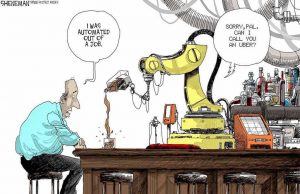
Cartoon about automation by Drew Sheneman

The Guardian of automation

Still from the video for All is Love by Bjork

I have been looking back over the links to news articles I’ve been collecting together about automation and I’ve been struck in particular by how the UK newspaper The Guardian has been running at least one story a week concerning automation in the last few months (see their “AI” category for examples, or the list below). Many are spurred from reports and press releases about particular things, so it’s not like they’re unique in pushing these narratives but it is striking, not least because lots of academics (that I follow anyway) share these stories on Twitter and it becomes a self-reinforcing, somewhat dystopian (‘rise of the robots’) narrative. I’m sure that we all adopt appropriate critical distance when reading such things but… there is a sense in which the ‘robots are coming for our jobs’ sort of arguments are being normalised and sedimented without a great deal of public critical reflection.

We might ask in response to the automation taking jobs arguments: who says? (quite often: management consultants and think tanks) and: how do they know? It seems to me that the answers to those questions are pertinent and probably less clear, and so interesting(!), than one might imagine.

Here’s a selection of the Graun’s recent automation coverage:

CFP: RGS-IBG 2018 – New geographies of automation?

Still from the video for All is Love by Bjork

New Geographies of Automation?
Please send submissions (titles, abstracts (250 words) and author details) to me by 31st January 2018.

This session invites papers that respond to the variously promoted or forewarned explosion of automation and the apparent transformations of culture, economy, labour and workplace we are told will ensue. Papers are sought from any and all branches of geography to investigate what contemporary geographies of automation may or should look like, how we are/could/should be doing them and to perhaps question the grandiose rhetoric of alarmism/boosterism of current debates.

Automation has been the recent focus of hyperbolic commentary in print and online. We are warned by some of the ‘rise of the robots’ (Ford 2015) sweeping away whole sectors of employment or by others exhorted to strive towards ‘fully automated luxury communism’ (Srnicek & Williams 2015). Beyond the hyperbole it is possible to trace longer lineages of geographies of automation. Studies of the industrialisation of agriculture (Goodman & Watts 1997); Fordist/post-Fordist systems of production (Harvey 1989); shifts to globalisation (Dicken 1986) and (some) post-industrial societies (Clement & Myles 1994) stand testament to the range of work that has addressed the theme of automation in geography. Indeed, in the last decade geographers have begun to draw out specific geographical contributions to debates surrounding ‘digital’ automation. From a closer attention to labour and workplaces (Bissell & Del Casino 2017) to the interrogation of automation in governance and surveillance across a range of scales (Amoore 2013, Kitchin & Dodge 2011) – the processes and experiences of automation have (again) become a significant concern for geographical research.

The invitation of this session is for papers that consider contemporary discussions, movements and propositions of automation from a geographical perspective (in the broadest sense).

Examples of topics might include (but are certainly not limited to):

  • AI, machine learning and cognitive work
  • Automation and bias
  • Autonomy, agency and law-making
  • Automated governance
  • Boosterism and tales of automation
  • The economics of automation
  • Material cultures of robots
  • Mobilities and materialities of ‘driver-less’ vehicles
  • Robotics and the everyday
  • Techno-bodily relations of automation
  • Working with robots

Cartoon about automation by Drew Sheneman

UK Government ramping up ‘robotic process automation’

Still from George Lucas' THX1138

Quite by chance I stumbled across the twitter coverage of a UK Authority event entitled “Return of the Bots” yesterday. There were a range of speakers it seems, from public and private sectors. An interesting element was the snippets about the increasing use of process automation by the UK Government.

Here’s some of the tweets I ‘favourited’ for further investigation (below). I hadn’t quite appreciated where government had got to. It would be interesting to look into the rationale both central and local government are using for RPA – I assume it is cost-driven(?). I hope to follow up some of  this…

John Danaher interview – Robot Sex: Social and Ethical Implications

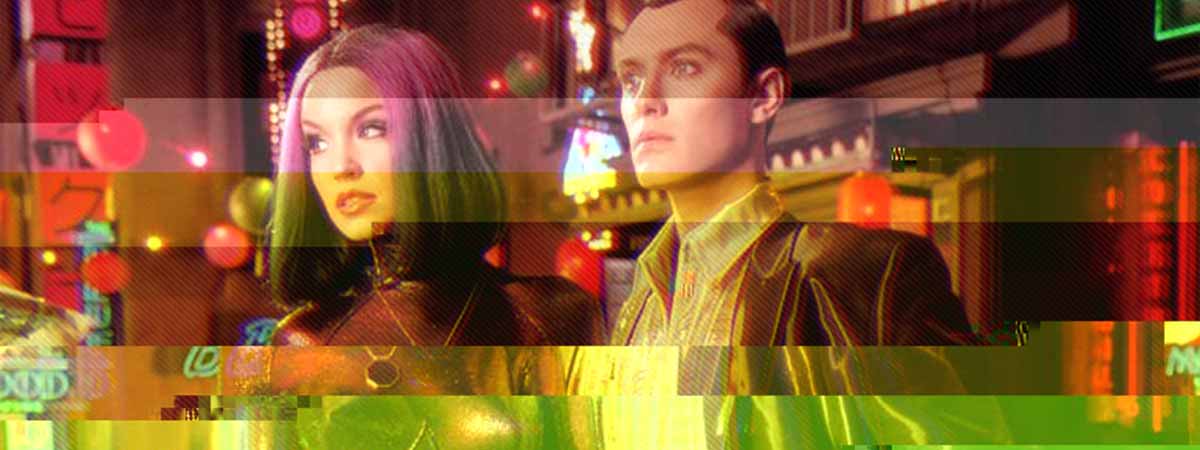
Gigolo Jane and Gigolo Joe robots in the film A.I.

Via Philosophical Disquisitions.

Through the wonders of the modern technology, myself and Adam Ford sat down for an extended video chat about the new book Robot Sex: Social and Ethical Implications (MIT Press, 2017). You can watch the full thing above or on youtube. Topics covered include:

  • Why did I start writing about this topic?
  • Sex work and technological unemployment
  • Can you have sex with a robot?
  • Is there a case to be made for the use of sex robots?
  • The Campaign Against Sex Robots
  • The possibility of valuable, loving relationships between humans and robots
  • Sexbots as a social experiment

Be sure to check out Adam’s other videos and support his work.

Autumnal AI links

Facial tracking system, showing gaze direction, emotion scores and demographic profiling

Another blogpost where I’m just gonna splurge some links cos they’re just sitting as open tabs in my browser and I may as well park them and share them at the same time, in case anyone else is interested…

(If you’re somehow subscribed to this blog and don’t like this, let me know and I’ll see if I can set-up another means of doing this… I used to use del.icio.us, remember that?!)

Here’s some A.I. things from my browser then:


Adversarial attacks on machine learning

There’s been quite a bit of chat about the ways particular kinds of neural nets used in machine vision systems are vulnerable to techniques that either create mis-recognition of images or feed into training a mis-recognition.

danah boyd made this part of her public talks earlier this year, drawing upon a ‘shape bias’ study by Google researchers. Two recent overview pieces on The Verge and Quartz are accessible ways into such issues too.

Other stories on news sites (e.g.) have focussed on the ways machine vision systems that could be used in ‘driverless’ cars for recognising traffic signs can be ‘fooled’, drawing upon another study by researchers at four US institutions.

Another story doing the rounds has been the model of a 3D printed turtle that was used to fool what is referred to as “Google’s object detection AI” into classifying it as a gun, many of these accounts start with the same paper boyd cites move on to discuss work such as the ‘one pixel’ hack for confusing neural nets by researchers at Kyushu and then discuss a paper on the 3D printed turtle model as ‘adversarial object’ by researchers at MIT.

A Facebook spokesperson says the company is exploring securing against adversarial examples, shown through a research paper published in July 2017, but they apparently haven’t yet implemented anything. Google, where a number of the early ‘adversarial’ examples were researched, have apparently declined to comment on whether its APIs and deployed ‘AI’ are secured, but researchers there have recently submitted papers to conferences on the topic.

A reasonable overview of this kind of research is available on Popular Science by Dave Gershgorn: “Fooling The Machine“. Artist James Bridle (who else?!) has also written and made some provocative work in response to these kinds of issues, e.g. Autonomous Trap 001 and Austeer.


Biases and ethics of AI systems

There’s, of course, tons on the ways biases are encoded into ‘algorithms‘ and software but there’s been a little more attention to this sort of thing in relation to AI appearing in my social media stream this year…

Vice’s Motherboard covered a story concerning the ways in which a sentiment analysis system by Google appeared to classify statements about being gay or a jew as ‘negative’.

Sky News covered a story about an apparent case of erroneous arrests at the Notting Hill Carnival this year (2017) that were allegedly caused by facial recognition systems.

An interesting event at the Research and Development department at Het Nieuwe Instituut addresses ‘the ways that algorithmic agents perform notions of human race’. Decolonising Bots included Ramon Amaro, Florence Okoye and Legacy Russell.


The Financial Services Board have an interesting report out concerning: Artificial intelligence and machine learning in financial services, which seems well worth reading.


Defending corporate R&D in AI

Facebook’s head of AI is fed up with the negative, or apocalyptic, references used for describing AI, e.g. the terminator. It’s not just a whinge, there’s some interesting discussion in this interview on The Verge.

Technology policy pundit Andrea O’Sullivan says the U.S. needs to be careful not to hamstring innovation by letting ‘the regulators ruin AI‘.


Finally, the British Library have an event on Monday 6th November called: “AI: Where Science meets Science Fiction“, which may or may not be interesting… it will be live-streamed apparently.

Reblog> Robots: ethical or unethical?

Twiki the robot from Buck Rogers

From Peter-Paul Verbeek.

ROBOTS: ETHICAL OR UNETHICAL?

To highlight the relevance of the UNESCO World Commission on the Ethics of Scientific Knowledge and Technology (COMEST) and to present its recent report on the ethics of robotics, the Permanent Delegation of the Kingdom of the Netherlands to UNESCO will organize a lunch debate on “Robots: ethical or unethical?” during the 39th General Conference, on Friday 10 November 2017, in Room X from 13:00 to 14:15.

The session will be opened by H.E. Ambassador Lionel Veer and Ms Nada Al-Nashif, Assistant Director-General for Social and Human Sciences, and will be moderated by Prof. Peter-Paul Verbeek, COMEST member and philosopher.

The issues addressed will be the following:

· What change caused by robots can we expect? Presented by Prof. Vanessa Evers, University of Twente

· Which are the ethical dilemmas? Presented by Prof. Mark Coeckelbergh, University of Vienna

· How can we ensure that innovation is ethical? Presented by Prof. Peter-Paul Verbeek, University of Twente (COMEST member)

The presentations will be followed by an interactive debate with the audience and by a reflection on the role of UNESCO and the COMEST on these issues.

Our vascilating accounts of the agency of automated things

Rachael in the film Blade Runner

“There’s no hiding behind algorithms anymore. The problems cannot be minimized. The machines have shown they are not up to the task of dealing with rare, breaking news events, and it is unlikely that they will be in the near future. More humans must be added to the decision-making process, and the sooner the better.”

Alexis Madrigal

I wonder whether we have if not an increasing then certainly a more visible problem with addressing the agency of automated processes. In particular automation that functions predominantly through software, i.e. stuff we refer to as ‘algorithms’ and ‘algorithmic’, possibly ‘intelligent’ or ‘smart’ and perhaps even ‘AI’, ‘machine learning’ and so on.  I read three things this morning that seemed to come together to concretise this thought: Alexis Madrigal’s article in The Atlantic – “Google and Facebook have failed us“, James Somers’ article in The Atlantic – “The coming software apocalypse” and LM Sacacas’ blogpost “Machines for the evasion of moral responsibility“.

In Madrigal’s article we can see how the apparent autonomy of the ‘algorithm’ becomes the fulcrum around which machinations around ‘fake news’, in this case regarding the 2nd October 2017 mass shooting in Las Vegas. The apparent incapacity of an automated software system to perform the kinds of reasoning attributable to a ‘human’ editor is diagnosed on the one hand, and on the other the speed at which such breaking news events taking place and the volume of data being processed by ‘the algorithm’ led to Google admitting that their software was “briefly surfacing an inaccurate 4chan website in our Search results for a small number of queries”. Madrigal asserts:

It’s no longer good enough to shrug off (“briefly,” “for a small number of queries”) the problems in the system simply because it has computers in the decision loop.

In Somers’ article we can see how decisions made by programmers writing software that processed call sorting and volume for the emergency services in Washington State led to the 911 phone system being inaccessible to callers for six hours one night in 2014. As Somers describes:

The 911 outage… was traced to software running on a server in Englewood, Colorado. Operated by a systems provider named Intrado, the server kept a running counter of how many calls it had routed to 911 dispatchers around the country. Intrado programmers had set a threshold for how high the counter could go. They picked a number in the millions.

Shortly before midnight on April 10, the counter exceeded that number, resulting in chaos. Because the counter was used to generating a unique identifier for each call, new calls were rejected. And because the programmers hadn’t anticipated the problem, they hadn’t created alarms to call attention to it. Nobody knew what was happening. Dispatch centers in Washington, California, Florida, the Carolinas, and Minnesota, serving 11 million Americans, struggled to make sense of reports that callers were getting busy signals. It took until morning to realize that Intrado’s software in Englewood was responsible, and that the fix was to change a single number.

Quoting an MIT Professor of aeronautics (of course) Nancy Leveson, Somers observes: “The problem,” Leveson wrote in a book, “is that we are attempting to build systems that are beyond our ability to intellectually manage.”

Michael Sacasas in his blogpost refers to Madrigal’s article and draws out arguments that the complex processes of software development, maintenance and the large and complicated organisations such as Facebook are open to those working there to work in a ‘thoughtless’ manner:

“following Arendt’s analysis, we can see more clearly how a certain inability to think (not merely calculate or problem solve) and consequently to assume moral responsibility for one’s actions, takes hold and yields a troubling and pernicious species of ethical and moral failures. …It would seem that whatever else we may say about algorithms as technical entities, they also function as the symbolic base of an ideology that abets thoughtlessness and facilitates the evasion of responsibility.”

The simplest version of what I’m getting at is this: on the one hand we attribute significant agency to automated software processes, this usually involves talking about ‘algorithms’ as quasi- or pretty much autonomous, which tends to infer that whatever it is we’re talking about, e.g. “Facebook’s algorithm”, is ‘other’ to us, ‘other’ to what might conventionally be characterised as ‘human’. On the other hand we talk about how automated processes can encode the assumptions and prejudices of the creators of those techniques and technologies, such as the ‘racist soap dispenser‘.

There’s a few things we can perhaps note about these related but potentially contradictory narratives.

First, they perhaps infer that the moment of authoring, creating, making, manufacturing is a one-off event – the things are made, the software is written and it becomes set, a bit like baking a sponge cake – you can’t take the flour, sugar, butter and eggs out again. Or, in a more nuanced version of this point – there is a sense that once set in train these things are really, really hard to change, which may, of course, be true in particular cases but also may not be a general rule. A soap dispenser’s sensor may be ‘hard coded’ to particular tolerances, whereas what gets called ‘Facebook’s algorithm’, while complicated, is probably readily editable (albeit with testing, version control and so on). This kind of narrative freights a form of determinism – there is an implied direction of travel to the technology.

Second, the kinds of automated processes I’m referring to here, ‘algorithms’ and so on, get ‘black boxed’. This is not only on the part of those who create, operate and benefit from those processes—like those frequently referred to Google, Facebook, Amazon and so on—but also in part by those who seek to highlight the black boxing. As Sacasas articulates: “The black box metaphor tries to get at the opacity of algorithmic processes”. He offers a quote from a series of posts by Kevin Hamilton which illustrates something of this:

Let’s imagine a Facebook user who is not yet aware of the algorithm at work in her social media platform. The process by which her content appears in others’ feeds, or by which others’ material appears in her own, is opaque to her. Approaching that process as a black box, might well situate our naive user as akin to the Taylorist laborer of the pre-computer, pre-war era. Prior to awareness, she blindly accepts input and provides output in the manufacture of Facebook’s product. Upon learning of the algorithm, she experiences the platform’s process as newly mediated. Like the post-war user, she now imagines herself outside the system, or strives to be so. She tweaks settings, probes to see what she has missed, alters activity to test effectiveness. She grasps at a newly-found potential to stand outside this system, to command it. We have a tendency to declare this a discovery of agency—a revelation even.

In a similar manner to the imagined participant in Searle’s “Chinese Room” thought experiment, the Facebook user can only guess at the efficacy of their relation to the black boxed process. ‘Tweaking our settings’ and responses might, as Hamilton suggest, “become a new form of labor, one that might then inevitably find description by some as its own black box, and one to escape.” A further step here is that even those of us diagnosing and analysing the ‘black boxes’ are perhaps complicit in keeping them in some way obscure. As Evan Selinger and Woodrow Hartzog argue: things that are obscure can be seen as ‘safe’, which is the principle of cryptography. Obscurity, for Selinger & Hartzog, “is a protective state that can further a number of goals, such as autonomy, self-fulfillment, socialization, and relative freedom from the abuse of power”. Nevertheless, obscurity can also be an excuse – the black box is impenetrable, not open to analysis and so we settle on other analytic strategies or simply focus on other things. A well-worn strategy seems to be to retreat to the ontological, to which I’ll return shortly.

Third, following from above, perhaps the ways in which we identify ‘black boxes‘ or the forms of black boxing we do ourselves over-simplifies or elides complexity. This is a difficult balancing act. A good concept becomes a short-hand that freights meaning in useful ways. However, there is always potential that it can hide as much as it reveals. In the case of the phenomena outlined in the two articles above, we perhaps focus on the ends, what we think ‘the algorithm’ does – the kinds of ‘effects’ we see, such as ‘fake news’ and the breakdown of an emergency telephone system, or even a ‘racist soap dispenser’. It is then very tempting to perform what Sally Wyatt calls a ‘justifactory’ technological determinism – not only is there a ’cause and effect’ but these things were bound to happen because of the kinds of technological processes involved. By fixing ‘algorithms’ as one kind of thing, we perhaps elide the ways in which they can be otherwise and, perhaps more seriously, elide the parts of the process of the development, resources, use and reception of those technologies and their integration into wider sociotechnical systems and society. These things don’t miraculously appear from nowhere – they are the result of lots of actions and decisions, some banal, some ‘strategic’, some with good intentions and some perhaps morally-questionable. By black boxing ‘the algorithm’, attributing ‘it’ with agency and making it ‘other’ to human activities we ignore or obscure the organisational processes that make it possible at all. I argue we cannot see these things as completely one thing or the other: the black boxed entity or the messy sociotechnical system, but rather as both and need to accommodate that sort of duality in our approaches to explanation.

Fourth, normative judgements are attached to the apparent agency of an automated system when it is perceived as core to the purpose of the business. Just like any other complicated organisation whose business becomes seen as a ‘public good’ (energy companies might be another example), competing, perhaps contradictory, narratives take hold. The purpose of the business may be to make money–in the case of Google and Facebook this is of course primarily through advertising, requiring attractive content to which to attach adverts–but the users perhaps consider their experience, which is ‘free’, more important. It seems to have become received wisdom that the very activities that drive the profits of the company, by boosting content that drives traffic and therefore serves more advertising and I assume therefore resulting in more revenue, run counter to accepted social and moral norms. This exemplifies the competing understandings of what companies like Google and Facebook do – in other words, what their ‘algorithms’ are for. This has a bearing on the kinds of stories we then tell about the perceived, or experienced, agency of the automated system.

Finally (for now), there is a tendency for academic social scientific studies of automated software systems to resort to ontological registers of analysis. There may be all sorts of reasons used as justification for this, such as specific detail of a given system is not accessible, or (quite often) only accessible through journalists, or the funding isn’t available to do the research. However, it also pays dividends to do ‘hard’ theory. In the part of academia I knock about in, geography-land and it’s neighbours, technology has been packaged up into the ‘non-human’ whereby the implication is that particular kinds of technology are entirely separate from us, humans, and can be seen to have ‘effects’ upon us and our societies. This is trendy cos one can draw upon philosophy that has long words and hard ideas in it, in particular: ‘object oriented ontology‘ (to a much lesser extent the ‘bromethean‘ accellerationists). The generalisable nature of ‘big’ theory is beguiling, it seems to permit us to make general, perhaps global, claims and often results in a healthy return in the academic currency of citations. Now, I too am guilty of resorting to theory, which is more or less abstract, through the work of Bernard Stiegler in particular, but I’d like to think I haven’t disappeared down the almost theological rabbit hole of trying to think objects in themselves through abstract language such as ‘units‘ or ‘allopoetic objects‘ and ‘perturbations’ of non-human ‘atmospheres’.

It seems to me that while geographers and others have been rightly critical of simplistic binaries of human/technical, there remains a common habit of referring to a technical system that has been written by and is maintained by ‘humans’ as other to whatever that ‘human’ apparently is, and to refer to technologically mediated activities as somehow extra-spatial, as virtual, in contra-distinction to a ‘real’. This is plainly a contradiction. On the one hand this positions the technology in question (‘algorithms’ and so on) as totally distinct from us, imbued with an ability to act without us and so potentially powerful. On the other hand if that technology is ‘virtual’ and not ‘real’ it implies it doesn’t count in some way. While in the late 90s and early 00s the ‘virtual’ technologies we discussed were often seen as somewhat inconsequential, the more contemporary concerns about ‘fake news’, malware and encoded prejudices (such as racism) have made automated software systems part of the news cycle. I don’t think it is a coincidence that we’ve moved from metaphors of liberty and community online to metaphors of ‘killer robots’, like the Terminator (of course there is a real prospect of autonomous weapons systems, as discussed elsewhere).

In the theoretical zeal of ‘decentering the human subject’ and focusing on the apparent alterity of technology, as abstract ‘objects’, we are at risk of failing to address the very concerns which are expressed in the articles by Madrigal and Somers. In a post entitled ‘Resisting the habits of the algorithmic mind‘, Sacasas suggests that automated software systems (‘algorithms’) are something like an outsourcing of problems solving ‘that ordinarily require cognitive labor–thought, decision making, judgement. It is these very activities–thinking, willing, and judging–that structure Arendt’s work in The Life of the Mind.’ The prosthetic capacity of technologies like software to in some way automate some of these processes might be liberating but they are also, as Sacasas suggests, morally and politically consequential. To ‘outsource the life of the mind’ for Sacasas means to risk being ‘habituated into conceiving of the life of the mind on the model of the problem-solving algorithm’. A corollary to this supposition I would argue is that there is a risk in the very diagnosis of this problem that we habituate ourselves to a determinism as well. As argued in the third point, above, we risk obscuring the organisational processes that make such sociotechnical systems possible at all. In the repetition of arguments that autonomous, ‘non-human’, ‘algorithms’ are already apparently doing all of these problematic things we will these circumstances upon ourselves. There is, therefore, an ethics to thinking about and analysing automation too.

Where does this leave us? I think it leaves us with some critical tools and tasks. We perhaps need not to shy away from the complexity of the systems we discuss – the ideas and words we use can do work for us, ‘algorithm’ for example freights some meaning, but we perhaps need to be careful we don’t obscure as much as we reveal. We perhaps need to use more, not fewer, metaphors. We definitely need more studies that get at the specificity of particular forms, processes and work of automation/automated systems. All of us, journalists and academics alike, need to perhaps use our words more carefully, or use more words to get at the issues.

Simply hailing the ‘rise of the robots’ is not enough. I think this reproduces an imagination of automation that is troubling and ought to be questioned (what I’ve called an ‘automative imaginary’ elsewhere, but maybe that’s too prosaic). For people like me in geography-land to retreat into ‘high’ theory and to only discuss abstract ontological/ metaphysical attributes of technology seems to me to be problematic and is a retreat from that part of the ‘life of the mind’ we claim to advance. I’m not arguing we need not retreat from theory we simply need to find a balance. A crucial issue for social science researchers of ‘algorithms’ and so on is that this sort of work is probably not the work of a lone wolf scholar, I increasingly suspect that it needs multi-disciplinary teams. It also needs to, at least in part, produce publicly accessible work (in all senses of ‘accessible’). In this sense work like the report on ‘Media manipulation and disinformation online‘ by Data & Society seems like necessary (but by no means the only) sorts of contribution. Prefixing your discipline with ‘digital’ and reproducing the same old theory but applied to ‘digital’ things won’t, I think, cut it.