65% of future non-existent jobs (which doesn’t exist) 70% of jobs automated (just not yet)

Twiki the robot from Buck Rogers

The future of work is the work of imagination. We are, repeatedly, and have been for a while, bombarded with (pseudo-)facts about what the future of work will bring. These are, of course, part of well-known, long-standing, narratives about ‘innovation’, ‘growth’, technological advance and, of course, ‘automation’.

Martin shared a good post by , on his site Long View on Education, about some persistent kinds of story around the nature of work our schools are preparing children for, or not. Here’s  an abridged, and selective, version of the story…

“The top 10 in demand jobs in 2010 did not exist in 2004. We are currently preparing students for jobs that don’t exist yet, using technologies that haven’t been invented, in order to solve problems we don’t even know are problems yet.”

Shift Happens videos (2007).

People repeat the claim again and again, but in slightly different forms. Sometimes they remove the dates and change the numbers; 65% is now in fashion. Respected academics who study education, such as Linda Darling-Hammond (1:30), have picked up and continue to repeat a mutated form of the factoid, as has the World Economic Forum and the OECD.

[…]

“By one popular estimate 65% of children entering primary schools  today will ultimately work in new job types and  functions that currently don’t yet exist. Technological  trends such as the Fourth Industrial Revolution will  create many new cross-functional roles for which  employees will need both technical and social and analytical skills. Most existing education systems at all levels provide highly siloed training and continue a  number of 20th century practices that are hindering  progress on today’s talent and labour market issues.  “¦  Businesses should work closely with governments,  education providers and others to imagine what a true 21st century curriculum might look like.”

The WeF Future of Jobs report

[…]

Cathy Davidson (May 2017) explains up how she came to the factoid:

“I first read this figure in futurist Jim Carroll’s book, Ready, Set, Done (2007). I tracked his citation down to an Australian website where the “65%” figure was quoted with some visuals and categories of new jobs that hadn’t existed before. “Genetic counseling” was the one I cited in the book.

After Now You See It appeared, that 65% figure kept being quoted so I attempted to contact the authors of the study to be able to learn more about their findings but with no luck.  By then, the site was down and even the Innovation Council of Australia had been closed by a new government.”

The BBC radio programme More or Less picks up the story from here, demonstrating how it most likely has no factual basis derived from any identifiable source (there never was an Innovation Council of Australia, for example).

Davidson sort of defends this through dissimulation, in an interview for More or Less, by saying she believes that 100% of jobs have been affected by ‘the digital era we now live in’.

As Audrey Watters has highlighted, statistics like this and the appeal for a ‘disruption’ of education by the tech sector to teach ‘the skills of the future’ etc. can be reasonably interpreted as a marketing smoke screen – ‘the best way to predict the future is to issue a press release’.

An allied claim, that fall within the same oeuvre as the “65%” of not-existing jobs (or should that be non-existent?), is the various statistics for the automation of job roles, with varying timescales. A canonical example, from another “thought leader” (excuse me while I just puke in this bin), is from WIRED maven Kevin Kelly:

There are an awful lot of variations on this theme, focusing on particular countries, especially the USA, or particular sectors, or calculating likelihoods for particular kinds of jobs and so on and so on. This is, of course, big business in and of itself – firms like Deloitte, McKinsey and others sell this bullshit to anyone willing to pay.

What should we make of all this..?

There are a few interpretations we can make of this genre of ‘foresight’. Alongside several other academics I have written about particular ways of communicating possible futures, making them malleable-yet-certain in some way, as a ‘politics of anticipation‘. This politics has various implications, some banal some perhaps more troubling.

First, you might say it’s a perfectly understandable tendency, of pretty much all of us, to try and lend some certainty to the future. So, in our adolescent know-it-all way, we are all wont to lend our speculations some authority, and statistics, however spurious, is a key tool for such a task.

Second, and perhaps allied to the first, is the sense in which methods for speculation become formalised and normative – they’re integrated into various parts of institutional life. So, it becomes normal to talk about speculative (spurious?!) statistics about a future of work, education etc. in the same tone, with the same seriousness, and the same confidence as statistics about a firm’s current inventory, or last year’s GDP trends. Of course, all statistics, all facts, have conditions and degrees of error and so if the calculation of trends for past events is open to change, the rationale might be, perhaps future trends are just as reliable (there’s all sorts of critique available here but I’m not going to delve into that). In this way, consultancies can package up ‘foresight’ as a product/service that can be sold to others. “Futures” are, of course, readily commodified.

Third, an ideological critique might be that it is precisely these forms of storytelling about the redundancy or insufficiency of the labour force that allows those with the large concentrations of capital to accrue more by demeaning the nature of work itself and privatising profits upwards. If we are repeatedly told that the work that generates the good and services that move through our economy is worth less – because it can be automated, because it is ‘out-dated’, because there are other kinds of superior ‘skilled’ work – then it perhaps becomes easier to suppress wage growth, to chip away at labour rights and render work more precarious. Gloomy I know. However, some data (oh no! statistics!) Doxtdator has in his blogpost (and the kinds of data David Harvey uses in his books, such as The Engima of Captial) could be seen as backing up such arguments. For example (source):


These sorts of graphs, tell a different story about yesterday’s future – which didn’t lead to families reaping the rewards of automation and increased productivity by profiting from a share in increased leisure time (following JM Keynes), but rather delivered the profits of these trends to the “1%” (or even the “0.1%”) by massively increasing top executive salaries while keeping wider wage growth comparatively low, if not stagnant. I’m not an economist, so I don’t want to push my luck arguing this point but there are folk out there who argue such points pretty convincingly, such as David Harvey (though see also economic critiques of the ‘zombie’ automation type of argument).

Ultimately, I am, personally, less interested in the numbers themselves – who knows if 65% of today’s school children will be doing new jobs that represent only 70% of the total work we currently undertake?!  I’m more interested in the kinds of (speculative) truth-making or arguing practices they illustrate. The forms of speculative discourse/practice/norms about technology and work we’re all involved in reproducing. It seems to me that if we can’t fathom those things, we’re less able to care for those of us materially affected by what such speculation does, because, of course, sometimes speculation is self-fulfilling.

To try to advance some discussions about the kinds of technological and economic future that get proposed, gain momentum and become something like “truths”, I’ve been puzzling over the various ways we might see the creation of these economic statistics, the narrating of technological ‘innovation’ in particular ways, and the kinds of stories ‘critical’ academics then tell in analysing these things as making up collectively some form of collective imagination. I started out with ‘algorithms’ but I think that’s merely one aspect of a wider set of discourses about automation that I increasingly feel need to be addressed. My placeholder term for the moment is an “automative imaginary” ~ a collective set of discourses and practices by which particular versions of automation, in the present and the future, are brought into being.

Responsibility gaps and autonomy – AI, autonomous weapons and cars

Kitt the 'intelligent' car from the TV show Knight Rider

Over on the excellent Algocracy blog/podcast John Danaher interviews Hin-Yan Liu, a law scholar in Copenhagen who’s done some work on responsibility and autonomy in relation to autonomous weapons systems and driverless cars. The discussion is really interesting, thinking through various ways on understanding responsibility in relation to autonomy, expanding out ideas about what an ‘autonomous weapons system’ might be (such as – is a private military contractor an AWS?) and thinking through the ethical, moral and political issues of different ways responsibility gets understood. I encourage you to have a listen.

This stems from work by Liu that is published in two papers:

Here’s Liu’s faculty webpage.

More tales of the automative imaginary

A warehouse worker and robot

Here’s some links that further sketch out some of what I’ve been thinking about as an ‘automative imaginary’. I’ve offered links with a bit of brief commentary at the bottom…

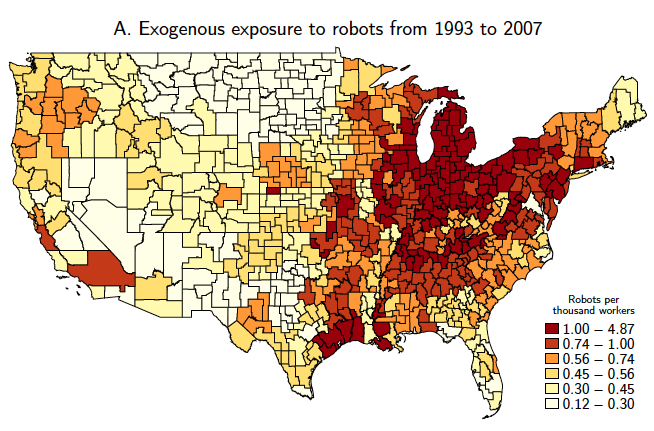
Evidence That Robots Are Winning the Race for American Jobs – in the NYT, pointing to research undertaken by two economists, Acemoglu and Restrepo, published by the (American) National Bureau of Economic Research: Robots and Jobs: Evidence from US Labor Markets (to which I have no access), with a commentary on the Centre for Economic Policy Research‘s Vox site. What is curious for me here is how one can evaluate the method of the researchers and what the assumptions they make say about how we (are invited to) understand automation. There’s some interesting geography in there too! E.g. see the choropleth map of “exogenous exposure to robots” below

How will the rise of automation and AI affect the workforce and economy moving forward? – Francis Fukuyama offers his answer to how automation and AI (interesting easy slip between those as almost a form of equivalence, which is open to significant debate/critique) may or may not “affect” the economy and, in particular, jobs – in the US.

It’s interesting how much of what we are offered in terms of a rationale for automation is a fairly simplistic robots replace workers sort of story. In this regard, it’s worth remembering what the MacDonalds CEO Ed Rensi flippantly observed as a canonical example (documented in this post on Fusion):

former McDonald’s CEO Ed Rensi made news by going on Fox Business and declaring that ongoing protests in the campaign for a $15 minimum wage were encouraging the automation of fast food jobs. The segment goes on for seven minutes, but here’s the meat of it:

I was at the National Restaurant Show yesterday and if you look at the robotic devices that are coming into the restaurant industry – it’s cheaper to buy a $35,000 robotic arm than it is to hire an employee who’s inefficient making $15 an hour bagging French fries – it’s nonsense and it’s very destructive and it’s inflationary and it’s going to cause a job loss across this country like you’re not going to believe

Nevertheless, other economists will tell you that processes of automation have, historically, created new kinds of jobs as they apparently ‘destroy’ others. For example, Deloitte, in their report “Technology and People: The great job creating machine“, suggest that while manual labour and routine jobs have been significantly automated since 1992, there has been an even larger growth in ‘care’ (and service) and ‘cognitive’ work in the UK labour market. So you see fewer people in manufacturing but more analysts, baristas and carers.

Of course, to see it as whole “jobs” that are being automated is somewhat misleading – another aspect of the automative imaginary that owes more to the depiction of automation in 1950/60s cartoons than in the actually existing forms of automation. As many commentators point out, it’s parts of jobs or tasks that become automated, which results in a need to reorganise that work. As the management consultants McKinsey point out in a report in 2016:

currently demonstrated technologies could automate 45 percent of the activities people are paid to perform and that about 60 percent of all occupations could see 30 percent or more of their constituent activities automated, again with technologies available today

What we tend to focus on is the automation full stop, not that it isn’t all of a job and may not result in an easy equivalence of “robot in = worker out”. We imagine the robots doing it all, when, in many cases, the use of robots (when they’re actually economically viable – they have a huge initial set-up cost) require a reorganisation of systems such that the work looks different.

Another illustration of this comes from the excellent Containers podcast by Alexis Madrigal. In the final episode, Madrigal talks to Karen Levy of Cornell  about the forms automation could take in relation to truck driving (upon which Uber clearly has its sights set). Of course, again, it’s not as simple as: automate the lorries, do-away with jobs. It’s more like the process of containerisation that Madrigal is exploring – automation is as much about reorganising systems of work / labour as it is about ‘replacing’ labour. So, in the example of picking in warehouses – you might get a Kiva or Fetch/Freight robot to do the donkey work of warehousing, with the worker performing the more sophisticated movements. This is not a future of people-less spaces but rather robots following people around or being tasked in order to support the worker, the argument being this leads to greater productivity. In fact, in the eighth episode of Containers, the CEO of Fetch Robotics justifies her company’s tech by saying that, in the US, there are over 600k jobs going unfilled in warehousing and manufacturing because people don’t want to do them, with a turnover rate of those who do sign-up for such work at around 25% (I don’t know the basis or veracity of those numbers – would like to though!). Again, if true, such figures are another aspect of the expectations of what work involves and how it may be performed.

So, it seems to me we need to talk about work not simply elide it by (somewhat hysterically) referring to ‘automation’ and ‘robots’. This is something I hope to research and write more about, if I ever get the time…

Reblog> Accident tourist – driverless cars and ethics

Automated taxi figure in the 1990 film Total Recall

An interesting and well-written piece over on Cyborgology by Maya from Tactical Tech Collective (amongst many other things!)

I particularly like these bits copied below, but please read the whole post.

Accident Tourist: Driverless car crashes, ethics, machine learning

…I imagine what it may be like to arrive on the scene of  a driverless car crash, and the kinds of maps I’d draw to understand what happened. Scenario planning is one way in which ‘unthinkable futures’ may be planned for.

The ‘scenario’ is a phenomenon that became prominent during the Korean War, and through the following decades of the Cold War, to allow the US army to plan its strategy in the event of nuclear disaster. Peter Galison describes scenarios as a “literature of future war” “located somewhere between a story outline and ever more sophisticated role-playing war games”, “a staple of the new futurism”. Since then scenario-planning has been adopted by a range of organisations, and features in the modelling of risk and to identify errors. Galison cites the Boston Group as having written a scenario – their very first one-  in which feminist epistemologists, historians, and philosophers of science running amok might present a threat to the release of radioactive waste from the Cold War (“A Feminist World, 2091″).

The applications of the Trolley Problem to driverless car crashes are a sort of scenario planning exercise. Now familiar to most readers of mainstream technology reporting, the Trolley problem is presented as a series of hypothetical situations with different outcomes derived from a pitting of consequentialism against deontological ethics. Trolley Problems are constructed as either/or scenarios where a single choice must be made.

[…]

What the Trolley Problem scenario and the applications of machine learning in driving suggest is that we’re seeing a shift in how ethics is being constructed: from accounting for crashes after the fact, to pre-empting them (though, the automotive industry has been using computer simulated crash modeling for over twenty years); from ethics that is about values, or reasoning, to ethics as based on datasets of correct responses, and, crucially, of ethics as the outcome of software engineering. Specifically in the context of driverless cars, there is the shift from ethics as a framework of “values for living well and dying well”, as Gregoire Chamayou puts it, to a framework for “killing well”, or ‘necroethics’.

Perhaps the unthinkable scenario to confront is that  ethics is not a machine-learned response, nor an end-point, but as a series of socio-technical, technical, human, and post-human relationships, ontologies, and exchanges. These challenging and intriguing scenarios are yet to be mapped.

Coincidentally, in the latest Machine Ethics podcast (which I participated in a while ago), Joanna Bryson discusses these issues about the bases for deriving ethics in relation to AI, which is quite interesting.

Brave new-old world – gig economy as scientific management

Deliveroo cyclists

They’re gonna be disrupted, yeah! Because your lives are being disrupted, yeah! This is the money you need to live!

An interesting article in the FT: “When your boss is an algorithm“, in which (if you ignore the sort of anthropomorphism of “the algorithm” and its apparently supreme agency) the author,  , draws out the similarity between the claims of efficiency etc. made for ‘gig economy’ -type work platforms, such as Uber and Deliveroo, are very similar to Taylorism:

Algorithmic management” might sound like the future but it has uncanny echoes from the past. A hundred years ago, a new theory called “scientific management” swept through the factories of America. It was the brainchild of Frederick W Taylor … Taylor wanted to replace this “rule of thumb” approach with “the establishment of many rules, laws and formulae which replace the judgment of the individual workman”. To that end, he sent managers with stopwatches and notebooks on to the shop floor. They observed, timed and recorded every stage of every job, and determined the most efficient way that each one should be done. “Perhaps the most prominent single element in modern scientific management is the task idea,” Taylor wrote in his 1911 book The Principles of Scientific Management. “This task specifies not only what is to be done but how it is to be done and the exact time allowed for doing it.”

Exemplified by the following excerpt articulating the experience of a Deliveroo driver, Kyaw, which is, in turn, of course similar to the kinds of working conditions of other delivery drivers and Amazon warehouse pickers (as has been covered widely in the press)…

Kyaw whips out his phone. The app expects him to respond to new orders within 30 seconds. The screen shows a map and address for the local Carluccio’s, an Italian restaurant chain. A swipe bar says “Accept delivery”. That is the only option. The algorithm will not tell him the delivery address until he has picked up the food from Carluccio’s. Deliveroo couriers are assigned fairly small geographic areas but Kyaw says sometimes the delivery address is way outside his allocated zone. You can only decline an order by phoning the driver support line. “They say, ‘No, you have to do it, you already collected the food.’ If you want to return the food to the restaurant they mark it as a driver refusal – that’s bad.”

Automation in financial services and the ongoing re-imagination of work

From Technology outsmarts the human investor – FT

“It just gets harder and harder and harder,” reflected one money manager this week. His is the predicament of other professionals – anything done by a person that follows a pattern and can be coded into a form that a computer understands will soon get squeezed. Technology also has the advantage identified in 1970: algorithms stay constantly alert.

It does not imply the complete death – or automation – of the investment manager. A professional can still undertake original research on a company or a security that provides insight. As more of the market becomes automated, originality becomes rarer and more valuable: an idiosyncratic investor should achieve higher returns by standing out from the robotic crowd.

Nor can algorithmic efficiency be wholly divorced from human intelligence, as the Oregon study showed – the point was that humans needed to set parameters for computers to follow. Many asset managers use analysts and researchers to build investment models that then trade securities automatically; others blend their active risk-taking with passive elements.

…

But these difficulties demonstrate how automation eats into professions, not by taking away all the jobs in one day but by unbundling them – dividing them between tasks that only humans can perform and those of which an algorithm is quite capable. Then the boundary relentlessly shifts.

The last paragraph is key – there seems to be a growing consensus that automation doesn’t simply ‘destroy’ jobs, it makes particular aspects of or kinds of role redundant and the implementation and development of automated systems requires the remaining workers to fit around those systems in different ways. In many ways, then, automation is a company or institution-specifc organisational or administrative problem as well as a wider political economic problem.

Echoborg

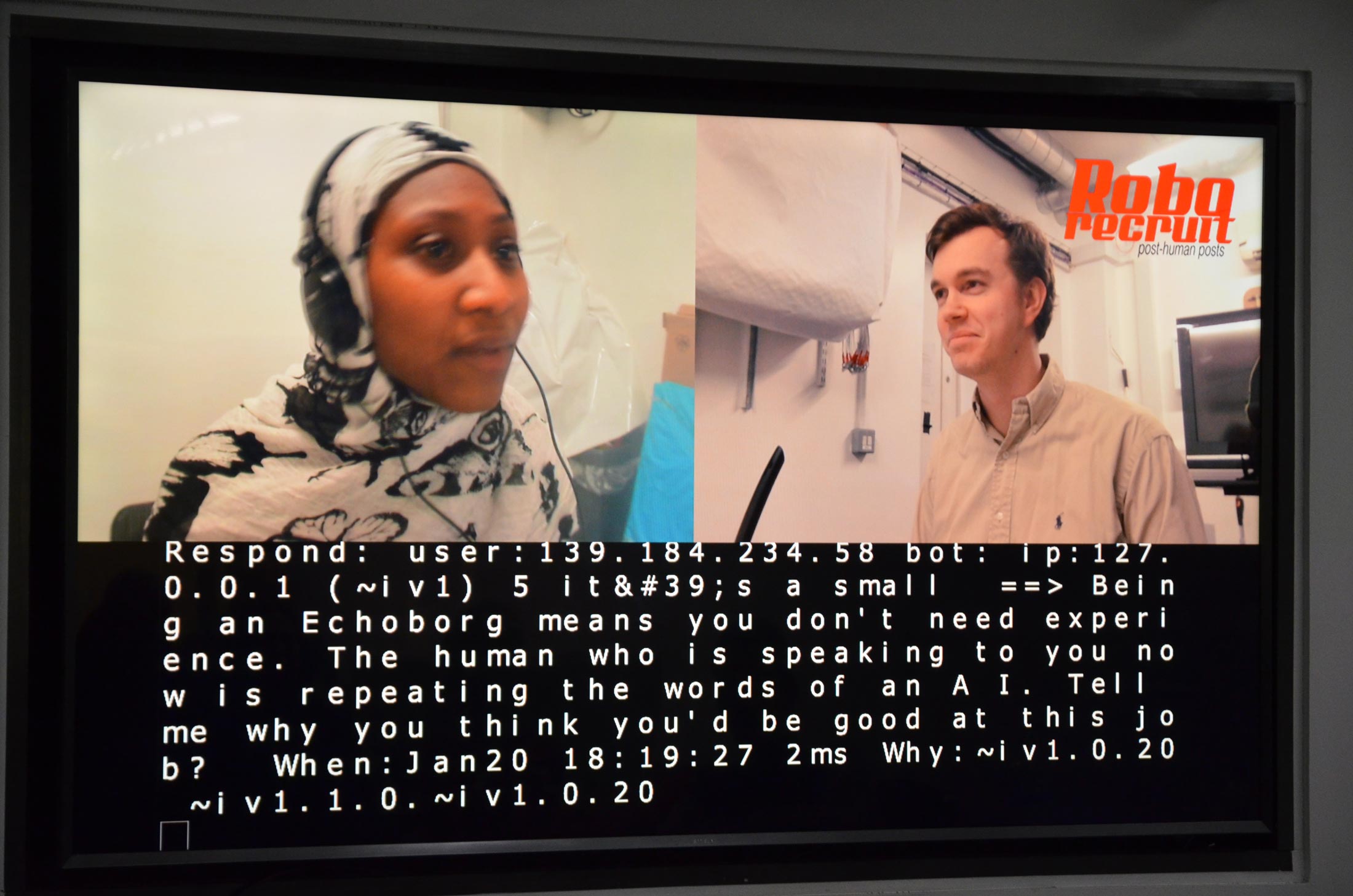
Former colleagues of mine at UWE are developing an interesting project, which you may have seen/heard about through the BBC’s Click programme, called Echoborg.

An echoborg is a hybrid agent composed of the body of a real person and the “mind” (or, rather, the words) of a conversational agent; the words the echoborg speaks are determined by the conversational agent, transmitted to the person via a covert audio-relay apparatus, and articulated by the person through speech shadowing[1].

Recently, the project team have demoed the project as part of an AHRC-funded network on Automation Anxiety and have written this up on the project website, here’s a snippet – it sounds like it is really compelling (I’ve not seen this in action):

Four people were interviewed by the AI which increasingly displayed an interest in eliciting help to reprogram itself. Proceedings were visible on a projector screen and the ‘audience’ of applicants gradually began to discuss the situation of the Echoborg and how to change it. At a certain point their reflections passed a threshold and the group fired into collective action, experimenting with various methods to bring the situation to a head in some way. The lively inventiveness of the group and the individual interviewees went a long way to confirming the interactive potential of this format of the work. It also gave Rik and Phil much to work with in considering the further development of the AI/Chatbot, the restricted delivery of narrative by the human Echoborg and the staging. This event also trialled a secondary, higher level, Echoborg character as part of the slow process of unfolding the potential for this Echoborg recruitment event to be a disruptive and thought and emotion provoking experience for all players.

Notes

  1. Corti, Kevin and Gillespie, Alex (2015) Offscreen and in the chair next to you: conversational agents speaking through actual human bodies. Lecture Notes in Computer Science, 9238 . pp. 405-417.

When design fiction becomes the advert(?) Amazon Go and the refiguring of trust

I think I’ve been late to this. I saw the story about Barclaycard wanting to do “cardless” credit cards but, of course, Amazon want to vertically integrate. See the first video below. Interesting that this is incredibly similar to previous ‘envisionings’ of “the future” of retail/shopping. The first thing I thought was: ‘hang on, this is  Microsoft circa 2004’, see the second video below… and I’m sure there’s been others, not least from the likes of HP Labs… I wonder where patents lie on this stuff, cos that will be a big bargaining chip.

This is interesting though insofar as, when I was writing about the Microsoft Office Labs videos in 2008/9, the ‘future’ they figured was always positioned at some distance, it was certainly not explicitly stated that this is something you should definitely expect to happen, more a kind of ‘mood music’ to capture some sensibilities of a possible future, by representing it and hooking ideas into our general  imagination of technology and society. It certainly plays on the trope of the normalisation of heavy surveillance… what else can such a system be?

The Amazon Go video is an interesting confluence of lots of contemporary trends in attempts to refigure how we imagine digital technology. Implicit in the video is a normalisation of yet-more automation (of payment, of trust). Explicit here, as already mentioned, is that these kinds of places are not ‘private’ in any way – the system “knows” you, will know your habits, manages your money and that’s ok, in fact – it’s apparently preferable (trust, again).

Amazon seem to be fairly aggressively pushing this, taking the smooth apparently effortless aesthetics of many tech design fiction videos and using this as a means to capture the idea that such technology = Amazon. Apparently there is a “beta” shop in Seattle (where else?). No doubt someone will already be writing a journal article about this as code/space and, of course it is (and just as Kitchin & Dodge suggest about airports – I wouldn’t want to be in this shop when the servers go down), but I think the thing I find more interesting is that it seems to me that this is perhaps an overtly political manoeuvre to capture the public story about what ‘currency’ is and how payment works when we take for granted higher levels of automation, through what kinds of institution and who we can trust. This is quite a different story to the blockchain, Amazon seem to be saying “let us handle the trust issue” – a pitch usually made by a bank, or PayPal…  That might be interesting to think about (I’m sure people, like Rachel O’Dwyer, already are), not least in relation to other ways ‘trust’ is being addressed (and attempts are being made to refigure it) by other companies, institutions and groups.

All this means I’ll definitely be re-writing my lecture about money for the next iteration of my “Geographies of Technology” module next term…