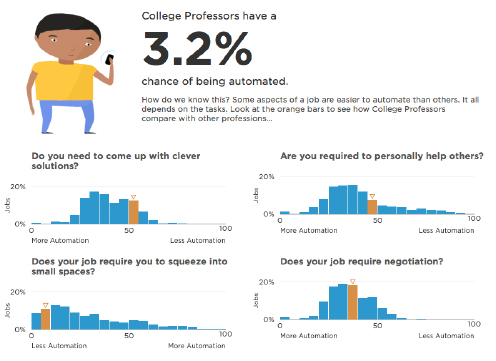
Do ‘robots’ replace (‘human’) jobs?

prof-automation

‘Robots’ (or automated systems for manufacturing and distribution) seem to be on-trend amongst social scientists[1] (following on the heels of economists [especially those trying to peddle reports predicting futures] and tech evangelists), so here’s a deceptively simple question:

Do ‘robots’ (i.e. automation) replace/destroy jobs?

Lots of coverage across various media will give you an answer that is pretty much a categorical ‘yes’. In specific industries this is true, up to a point. It is true that jobs in specific manufacturing firms that bring in ‘robots’ do become redundant.

As this AP story on Yahoo (based on bits from Rand and some academic economists) suggests: “General Motors, for instance, now employs barely a third of the 600,000 workers it had in the 1970s. Yet it churns out more cars and trucks than ever.” However, as another bit of economic research from Deloitte attests that between 1992 & 2014 total employment rose by 23%. Indeed, academic economists Georg Graetz and Guy Michaels argue in a paper that “robots had no significant effect on total hours worked, [however] there is some evidence that they reduced the hours of both low-skilled and middle-skilled workers”.

So, what of this apparent paradox? Well, apparently, the jobs being replaced by automated processes are in specific sectors and at the same time those processes have removed jobs we have had a larger growth in other sectors, such as care (at least according to Deloitte). Bodily energy, in the wielding of a hammer etc. has been replaced by an automated machine process but various ‘caring’, ‘cognitive’ and ‘creative’ forms of work have massively grown in number [2].

I’m not an economist and neither can I necessarily verify the numbers and so on, but I am interested in the ways we use this information and these ideas of creation and destruction of jobs/work to tell stories about our social/economic future [3]. We are asked to buy into various forms of technological determinism. A particularly pungent example of this is the ways in which ‘algorithms‘, and the kinds of agency of computer system that word connotes, are said to have particular (mostly problematic or sinister) effects. Following Sally Wyatt’s excellent work on technology development we can point out some of the ways this determinism is functioning:

  1. We can be selectively descriptive in our technological determinism – explain and define specific processes as having an origin and impulse from particular technologies. Here, the story about GM above, is a kind of what Wyatt terms descriptive technological determinism.
  2. We can simply assume the technology leads in a particular direction as a kind of common sense. Many of us cannot imagine life without some of our technological supports: e.g. electric power, artificial light and so on. We already have things like this, so they will surely lead to other (faster, ‘smarter’, more sophisticated etc etc) things. Some robots have existed in manufacturing for some time, so that surely means we will have more, and perhaps in other parts of our life (automated home here we come!). This is a form of what Wyatt terms normative technological determinism.
  3. The most readily understood version of determinism in relation to technology is when we say: “x” will happen because of technology developments (in particular ways). This is rather common in relation to ‘robots’ – for instance Deloitte in another report on “the state of the State” suggest around 865k jobs will be lost to automation by 2030. This is what Wyatt calls justifactory technological determinism.
  4. We have methods for making claims about the world and these make particular kinds of normative and epistemological assumptions about technology development, innovation and use. In this way there are forms of what Wyatt calls methodological determinism (and maybe that’s part of what I’m doing here too).

Of course, this isn’t only about the rationale of future orientation – it is also about the kinds of imagination that rationale both draws upon and produces. If we tell stories about the apparent destruction of working time then we can also tell stories about how that may lead to an increase in leisure time – as JM Keynes famously argued in his Economic Possibilities for Our Grandchildren. 

One of the more interesting arguments in the imagining of an automated future is what a given society should do with the apparent wealth of time freed up by the robots. The ‘universal basic income‘ is one such story – that everyone should be granted a share of the wealth of the productivity gains through the granting of a universal stipend that covers the basic cost of living. Here we enter the realm of (depending on your standpoint) attempting to think beyond capitalism – in the vein of ‘accelerationism‘ and so on (and, of course, there are critiques of this).

Like many forms of discussion about the development of technology, the gap in thinking about automation, I think, is  the easy slip into affirming the stories we are told about technological development without questioning the assumptions and rationale of those stories and without attempting to tell our own. For example, while I am a great admirer of Bernard Stiegler’s work I think he falls into this trap when building parts of his narrative about an economy of contribution. It seems to me that there is perhaps some thinking to be done on what I’ve begun to call (for my own thinking purposes) the ‘automative imaginary’, the work it does and the ways it might be put into question.

We, geographers and social scientists, can and should collaborate in the study and development of automation, algorithms, robots, and so forth. However, we should retain our critical stance on all generalised attempts to declare that these technologies and systems have done this or that to young people, leisure time, jobs, and so on. This doesn’t preclude seeing how automating systems can be used to increase what gets measured as productivity, for example as the GM case discussed above does, or to determine behavior, for example as Natasha Schüll does in reference to Las Vegas slot machines. However, such instances usually depend upon a very specific context that we need to unpick. We should speak up for a critical and playful perspective to counter the rise of the apparent certainty that a particular version of modeling will ‘predict’ technological futures. We can and should be provocative [4].

Notes

  1. See for example the articles and upcoming conference sessions on robots in human geography: Social Geography II: Robots, robotic futures, digital\\human\\labour.
  2. It is interesting to note that for a while now, there has been a compelling counter narrative to the ‘robots are taking/will take our jobs’ story, which is a rather more familiar one: globalisation and post-Fordism. This story argue that rather than ‘re-shoring’ manufacturing to automated hi-tech plants, manufacturers are still paying for cheap labour ‘off shore’ and instituting ever leaner practices through ‘supplemental’ (to traditional human labour) robots. Likewise, Amazon, the apparent champion of robotising their processes, have a growing workforce, and have had for several years.
  3. It is depressingly predictable that these claims seem to rely upon the systematic dismissal or forgetting of work more-often-than-not identified as in some way female (such as care work), which has actually significantly grown, when focussing upon traditionally normative male work, like manual labour. Likewise, there is no accounting for the quality of work being generated by automation, which may be badly paid,  more precarious and less regular.
  4. For example: Counting Sheep, The Museum of Contemporary Commodities, Uninvited Guests

Video> Imagining automation – public talk

I gave a talk for the SW Futurists meet up group this week and they’ve recorded the talks. There are two speakers: Lucas Godfrey (Edinburgh) talked about the challenges of creating models of phenomena in the world so that you can automate things. I talked about the politics of the kinds of stories we tell about automation and how they orient our understandings of how automation might function. Both are included in the video but I’ve skipped to the start of my talk below.

Feel free to leave comments, ask questions etc. using the “Comments” function below… this presentation is sort of based on two bits of work about automation that have been developing as academic presentations. The first is about how we tell stories about work in relation to automation, and way we use ‘algorithm’ as a proxy for that idea. The second is about how we imagine what apparently automated/automatic technologies are doing and what they can do. I think both of these things constitute what I’ve come to call an “automative imaginary”… I started out calling this “algorithmic–“, but I don’t think that ‘s what I have ever really meant. I also don’t think, another fashionable term, “robots” is a particularly helpful way to frame the ideas I’m interested in. Anyway, I’m hoping to develop this into a journal article.

Talk: ‘imagining automation’, part of ‘Human centred design in the age of automation’

I’m doing a talk on 25th October for the ‘SW Futurists’ meet-up. The event is called “Human centred design in the age of automation” and I’ll be talking about how ‘automation’ gets imagined and what kinds of power or agency those imaginings might have.

There are two speakers, the other is Lucas Godfrey a design researcher at Edinburgh – who had a hand in inviting me to speak. 

There’s web page for the event on meetup.com with descriptions of both talks.

The blurb for my talk is here:

Imagining automation 
We are told that we face the widespread automation of jobs, that we are increasingly subject to ever more complex and intrusive ‘algorithmic’ surveillance and that complex computational systems, such as Google’s search, know us better than we know ourselves. What are the bases of such claims? How much do they say about the world we live in? and do such claims say more about the stories we tell about digital technologies? By talking through some examples, ranging from ill-fated chatbots to production lines and missions to Mars I invite you to consider with me some possible answers to these questions. In doing so, I hope we can reflect a little more on the power of the stories we tell about technology and how such power gets exercised.

Behaviourism, productivity & the ‘quantified self’

metronome.gif

Steven Poole, in the New Statesman, on “How the craze for Apple Watches, Fitbits and other wearable tech devices revives the old and discredited science of behaviourism“:

Arguably, this authoritarian strand of behaviourist thinking is what morphed into the subtly reinforcing “choice architecture” of nudge politics, which seeks gently to compel citizens to do the right thing (eat healthy foods, sign up for pension plans) by altering the ways in which such alternatives are presented.

By contrast, the Apple Watch, the Pavlok and their ilk revive a behaviourism evacuated of all social concern and designed solely to optimise the individual customer. By ­using such devices, we voluntarily offer ourselves up to a denial of our voluntary selves, becoming atomised lab rats, to be manipulated electronically through the corporate cloud. It is perhaps no surprise that when the founder of American behaviourism, John B Watson, left academia in 1920, he went into a field that would come to profit very handsomely indeed from his skills of manipulation – advertising. Today’s neo-behaviourist technologies promise to usher in a world that is one giant Skinner Box in its own right: a world where thinking just gets in the way, and we all mechanically press levers for food pellets.

Echoes a common trope of theorising “subjectiv(is)ation” as a process (often labelled “neoliberal”, for good value) that gets done to a being/person… which gets entangled in an all-encompassing ‘labour theory of value’ but that’s a longer discussion…

Bernard Stiegler: “The time saved through automation must be granted to the people” [translation]

The interview with Bernard Stiegler translated below comes from the l’Humanité.fr website. This follows nicely from the other interview about ‘how to survive disruption’ I recently translated. It’s interesting for a number of reasons, but I think principally because he offers a little more detail on how one might go about creating an ‘economy of contribution’ by discussing the experiments with Plaine Commune and what he means by “contributory income” and how that differs from a ‘universal basic income”. For those interested in Stiegler’s work, beyond the philosophical texts, this is quite an enlightening read (I think).

As usual, clarifications and original French are in square brackets. In this case, all of the footnotes are by me. I hope some others find this of interest… I did.

Bernard Stiegler: “The time saved through automation must be granted to the people”

In the face of the upheavals created by digital data, the philosopher [Bernard Stiegler], developing his research in concert with the think tank Ars Industrialis and the Institute of Research and Innovation [of the Pompidou Centre], invites us to comprehensively [de fond en comble] rethink work. He advocates the establishment of an economy of contribution based on a new type of value production and social justice.

We are entering the era of big data. Does the quantitative explosion of digital data signal a new industrial revolution?

Bernard Stiegler Yes and it is already upon us. A study for the board of Roland Berger [a global strategy consultancy] suggests that three million jobs will be destroyed in the next ten years. But, other studies predict that 47% of jobs in the US, 50% in Belgium and France, will be automated in the course of the next twenty years. We are entering the third historical wave of automation. In the 19th century machine tools enabled capitalism to achieve enormous gains in productivity, while distributing the resulting profits only amongst the bourgeoisie. The second wave was created through Taylorism and the assembly line, which in part benefited the working classes because the workers consumed the goods they played a part in producing, creating mass markets. The third wave is not solely constituted by robots but also by the data we all generate, notably with our smart phones. All of these data that we deliver to platforms, such as Google, banks or shopping websites, are processed in every country and in an immediate manner by algorithms. Their exploitation allows, for example, a company like Amazon to predict what it may sell and to encourage us to buy in an extremely efficient manner, all with the minimum staff. Further, automation is allowing the company’s founder, Jeff Bezos, to design very simple robots, capable of placing and retrieving stock incredibly quickly, without human interaction, controlled by software.

Does this means that in the near term a company like Amazon will be able to do without employees to pick, pack and send out packages?

Bernard Stiegler Warehouse workers will be replaced by robots. The “robolution” [1] is becoming increasingly possible for a large number of companies. The humanoids that are reaching market now are much less expensive and more advanced than the large automata already in use. Even SMEs can invest in them.

In the medium term then, such automation concerns everyone?

Bernard Stiegler Driverless lorries are already on the roads of Nevada and soon will be in Germany. Artificial intelligence will be able to replace lawyers who put their legal studies on file. All analytical jobs will be effected. Even medics. A high performance robot is able to conduct prostate surgery… In his Foundations of a Critique of Political Economy [the Grundrisse], Karl Marx formulated the hypothesis: what if everything  is automated? If nothing changes, in particular regions, 80 to 90 percent of the under 25s will soon have no other perspective. The markets will collapse, because there will be no more purchasing power, and with them will go the social security system that relies on workers’ contributions. A new society is being formed and it is not very compatible with that of today. We urgently need to rethink everything, to develop trade based on a new type of value production and social justice. I strongly believe in experimentation, which is why we have launched a project related to Plaine Commune [2] in the urban community of Seine-Saint-Denis. Beginning with a 10-year pilot programme, the aim is to create a district of learning [territoire apprenant] whose inhabitants are not only consumers of but also providers [prescripteurs] of digital services.

We imagine that this area was not chosen at random. Plaine Commune is both rich in diversity, it’s network of associations but also home to a disadvantaged population, facing mass unemployment… 

Bernard Stiegler When I started talking about this project with Patrick Braouezec, president of Plaine Commune, 38% of young people under 25 were unemployed in Seine-Saint-Denis. That figure is now 50% and if we follow the projections, the rate could reach between 80 and 90% in ten years. This endemic problem of unemployment will affect all developed countries unless they invent something new: that’s what we want to do in Plaine Commune. The idea is to develop an economy of contribution in a completely different model to Uber. The time gained through automation must be made available to people, otherwise the economy will collapse. The Indian economist Amartya Sen has shown, through a study comparing the residents of Bangladesh and Harlem [New York], that life expectancy is better and we live in a better society when the sharing of expertise strengthens social ties. He discusses a Human Development Index. Plaine Commune is a bit like Bangladesh: the people there are exercising a remarkable energy. [Various] actors, businesses and residents are aware of the urgent need to invent something radically new, which is to use the mechanisms of contribution to develop a commons in a project that promotes the development, exchange, and transmission of practical knowledge [savoir-faire], life skills [savoir-vivre] and theoretical knowledge [savoir théoretiques] among the younger generations, associations, businesses, public services of the area, and doctoral students from around the world. Researchers will have the mission to facilitate and work alongside these changes.

So this project proposes to put people at the centre of an increasingly automated society [une société de plus en plus robotisée]?

Bernard Stiegler Standardisation, the elimination of diversity, and the destruction of knowledge produce high-dose entropy, characterised by the state of “disorder” of a system. Here was must engage in a little theory. In the nineteenth century, physicists established that, in the theory of a universe in expansion since a big bang, energy irreversibly dissipates. The law of becoming is entropy [La loi du devenir est l’entropie]. Erwin Schrödinger, a great theorist of quantum mechanics (which is the theoretical basis of nanotechnology), however, showed that life is characterised by its ability to produce negative entropy, which is also called negentropy. This delays disorder, that is to say death, which is a decomposition of living matter. Social organisations have a similar function. Automation, which is a hyper-standardisation, produces entropy. Google’s algorithms, which can translate the languages of the world through English, which acts a pivot language, causes an immense linguistic entropy. The impoverishment of vocabulary and dysorthography regresses individual and collective intelligence through a submission to the law of averages. Conversely, life produces, through exceptions, mutations that are impossible to anticipate but which are the very conditions of evolution. Poets and writers have shaped languages through their exceptional use of language. Algorithms erase all exceptions: they only work by calculating probabilities based upon averages. Crude automation produces a generalised (mental as well as environmental) disorder, which ruins the economy. In the economy of tomorrow, automation can instead be placed at the service of the production of negative entropy. It must allow for the valorisation of exceptions by developing the collective empowerment of everyone to make the commons [la valorisation des exceptions en développant la capacitation collective de chacun pour en faire du commun].

The upheaval that you describe considerably changes the concept of work. Are we facing the erasure of the organisation of employment around the notion of salaried work?

Bernard Stiegler In employment [l’emploi] today, the worker [travailleur] is deprived of their expertise [savoir-faire]. They must follow a process and rely upon software – until one day, the task has become automated and the employee [l’employé] is dismissed. Work [Le travail], by contrast, is an activity during which the worker enriches the task by exercising their knowledge [savoir] through its differentiation [en le différenciant], and continually bringing something new to society. This kind of work produces negentropy, that is to say, also, value, and it cannot be automated because it consists, on the contrary, in de-automating [désautomatiser] routines. Ongoing automation must redistribute some of the productivity gains in order to fund some time for everyone to build capacities [un temps de capacitation de tout un chacun] within an economy of contribution that enables everyone to enhance their knowledge. This is why we advocate the adoption of a contributory income, which is not the same as a universal income.

Precisely, the idea has even more trouble finding its way because it overlaps very different definitions … 

Bernard Stiegler Such an income, also called “basic” [income], is a safety net. A contributory income is at the intersection of the models of temporary work in the performing arts [intermittents du spectacle] and the practices of [creating] free software. It covers various levels of compensation that depend upon the periods of employment and the level of salary. The work of tomorrow will be discontinuous [intermittent]. Periods of employment will alternate with periods of acquiring, developing and sharing knowledge. The right to the contributory income will be “rechargeable”, based upon the number of hours of employment. In case of problems, the system will be accompanied by a minimum living wage [revenu minimum d’existence] – as a social protection system accompanying the scheme. The trial we have led with Plaine Commune includes testing a contributory income to benefit those who are younger, for whom the amounts could increase with age and where the contribution allowance [allocation contributif] outside of the employed period would represent a percentage akin to the model of paying unemployment benefit to those working in the performing arts [les intermittents]. The beneficiaries would be invited to “invest in themselves” [«s’encapaciter»], that is to say, to increase their knowledge through studies as well as professional experience. They would be invited to share their knowledge [savoirs] with their neighbouring community [communauté territoriale]. All of this calls for a new collective intelligence, capable of mobilising formal and advanced theoretical knowledge, which is why, with doctoral students, the aim is to develop a contributory research involving the young and local residents. The aim is to develop an economy of contribution founded on the production of negentropy. [3]

So, periods of paid employment remain in your system – what is the difference between contributory work [travail contributif] and precarious part-time job [petit job précaire]?

Bernard Stiegler The switchboard operator job at TF1 paid in the vein of someone working in the performing arts [comme intermittents du spectacle] is only made precarious [précarisée] at the expense of Assedic [4]. Contributory work must be defined by precise criteria. However, such a question cannot be answered a priori, except through the formal principal I have already stated, which is the production of negentropy, that is to say: practical know-how [savoir-faire], life skills [savoir-vivre] and formal knowledge [savoirs formels]. The PhD theses of our doctoral students are intended to inform these issues in close collaboration with the work carried out in Villetaneuse by Benjamin Corriat’s team on the economy of the commons. We will build on the experience of the architect Patrick Bouchain, who has shown how to put urban renewal projects in the service of a political economy of collaboration – where the residents, who are directly involved in the renovation, may be paid in shares of the development [l’habitat]. There are possibilities for developing the economy of contribution through associations, cooperatives, the social economy and solidarity, public services, as well as through industry, where new production methods will create new professions, which will be intermittent.

Have you any idea of how to fund this radical transformation to systems of production?

Bernard Stiegler A share of the gains in productivity must be redistributed. Taxes raised on trillions of euros passing through purely speculative markets might actually be invested in profitable, just and sustainable projects, without forgetting the fight against tax evasion. Vocational training credits [Les crédits de la formation professionnelle] – 38 billion Euros per year – should be involved in funding the economy of contribution, as should many of the exemptions from social charges or tax that could be diverted for this purpose. They represent 80 billion Euros. There really is enough there for this to be funded.

Notes [by me]

1. “Robolution” is a literal translation of the neologism used by Stiegler, i.e. a portmanteau of robot & revolution.

2. The project with Plaine Commune is specified in outline [in French] on the France Strategie 2017-2027 website, and is supported by the Fondation de France.

3.As in previous written work and interviews, Stiegler uses the idea of the “intermittents” or “intermittents du spectacle” to signify the idea of work that is subsidised through some form of state administered allowance, such as unemployment benefit. In France people working in the performing arts are entitled to claim for social security benefits designed for people without regular employment [as per the definition provided by Larousse online.]

4. Assédic or ASSEDIC is the partial acronym of “Association pour l’emploi dans l’industrie et le commerce” (Association for Employment in Industry and Trade).

Artefacts for generations growing up with robots

I’ve had this open in one of my tabs for ages with the intention of writing something about it here but I’ve sort of run out of time on that, so…

Here’s an interesting student project (I’d be delighted to have students like this!!) It’s a sort of deliberately controversial speculative design/ prototyping exercise to provoke thought and conversation about what it might mean to live with actually existing robots (not sci-fi androids).

The creators are: Stephan Bogner, Phillipp Schmitt and Jonas Voigt.

It’s worth a look…

RAISING ROBOTIC NATIVES

RaisingRoboticNatives-All.jpg

Artefacts for generations growing up with robots

Why do future visions of robotics incite discomfort in our generation? Could robots truly render us obsolete or is it our fear of losing control? And are these fears conditioned or instinctive?

Raising Robotic Natives explores interactions between children and robots that could raise them as the first generation of robotic natives.

Just like digital natives grow up in the digital world, robotic natives are born into an environment that is adapting to robots. As a result of unbiased, childlike enthusiasm, they are socialized with the technology early on. Through constant robotic interactions and formalized education, robotic natives get to think differently about robots than we do. It will be their responsibility to shape the future of robotics, not ours–besides we’re robotic immigrants, after all.

See the full details of the project here.

Stiegler: Stop the uberisation of society!

Posted below is a translation of a piece co-authored by Bernard Stiegler with Ariel Kyrou (journo),  Yann Moulier-Boutang (writer) and Bruno Teboul (Director of innovation at Keyrus) and published in Libération on the 10th April.

I suppose it doesn’t really propose anything especially novel, if you’re familiar with others involved in debates around “postcapitalism”, automation, worklessness and universal income (e.g. Srnicek and Williams, or Mason). What is perhaps novel is an application of the ideas in a distinctly European flavour, with examples in France and in the context of a much more robust unionised response to Uber (and the task/gig economy).

Anyway, it’s an interesting read I think…

The piece is rather conversational in tone and uses idioms I have only been able to infer (not being a fluent and native speaker) so it was quite difficult to translate, and so I’m pretty sure there are errors. As usual clarifications or original French are in [square brackets].

Stop the uberisation of society!

Libération, 10th April

The war by taxi companies against an Uber society cannot be reduced to the storyline of a film depicting an ancient evil battling benevolent forces of modernity. If on the one hand the participatory economy threatens our social structures, it can also, on the other, make possible a society with greater solidarity.

Since the first moves towards the draft Thévenoud law in June 2014[1], the urban transport soap opera has generated multiple variations on the theme of the standard storyline. On one side are the taxi federations, which have been labelled a horde of grumpy medieval malthusians by Uber, who in the opening of the second act of the performance of the trial of the 11th February demanded a whopping €100m in damages from Uber, on the other the ‘white knight’ of the new economic order, the high-tech Robin Hood of its pleb users whose UberPop service enables simple fellows in search of employment the opportunity to offer at cut-price their talents for automotive locomotion, between February 2014 and July 2015. This tale of jokers against modernisers is more attractive than the G7, queen of opaque rentier sorcery, who could not turn themselves with the wave of a magic wand into the cinderella of Parisian Transport.

Except that the movie script of the ancient evil against the benevolent ‘disruptors’ rings as hollow as any Hollywood blockbuster: seen quickly, soon forgotten. It works in the short-term, like the groan of the indefinite vigil for a taxi at 3 o’clock in the morning in the banlieue, but it hardly takes us any distance towards solving the questions about the future of our society and the search for sustainable solutions to the crisis we are experiencing.

Let’s not misunderstand this scenario: the agonism presented by this contemporary drama [série du moment] is neither the ardent need to pit global start-ups against French corporatism [corporatismes franchouillards] nor its exact opposite, namely the obligation to defend the capitalism of tired old barons against the hyper-capitalism of the rulers of the digital future. No, the issue that should be obvious to everyone with a stake in the debate is the urgent need to think about the society we want, and then act in order to build it.

For why should we anoint an ‘uberisation of the economy’ without interrogating its ideology and long-term deleterious effects? Uber, which declares only a fraction of its profits in France thanks to a complex form of tax evasion through the Netherlands, Bermuda and Delaware, is participating in the liquidation of our social structures. It embodies a short circuit that threatens the fragile economic balance between taxation, social law, transport policy, infrastructure investment at the local level and the pensions system. Worse still: its social and economic logic foreshadows the advent of a futuristic no-man’s land in which the a priori ideal of liberty becomes monetised against an a posteriori generalised casualisation throughout society. Indeed, the rictus predatory behaviour of platforms like Uber, Lyft and others such as Amazon’s Mechanical Turk is founded upon a low intensity of capital, little infrastructure, a minimum of salaried employees with more independent or self-employed workers.

The uberisation process forms the first wave in the tsunami of automation. Its primary consequence will be a net loss of five million jobs in industrialised countries by 2020, according to a report published on the 18th of January by the oracles of the World Economic Forum in Davos, the shameless apostles of the “fourth industrial revolution”. This deeply unappealing assertion has been amplified by several studies in the last three years (by Oxford, MIT, the Breugel Institute and Roland Berger) which predict around 47% fewer people in employment by 2025. This slow but inexorable extinction of of the salaried world effects not only warehouse workers, supermarket cashiers and lorry drivers but also barristers, solicitors, journalists, those working in medicine, and so on. Why should it remain necessary to use human beings for tasks that are reducible to systematic procedures? Which in our data economy robots and algorithms will soon perform much more efficiently. The combination of robotics and ‘big data’, algorithms and network effects, is already transforming us into the involuntary gravediggers for salaried employment. Welcome to a world that is ultimately ‘flexible’, boosted by robotic automation [robotisation] and work on the meter. A world where users and customers constantly account for themselves, where each becomes their own big brother and where most of the activity in every market, like with car insurance, will increasingly play out more in an automated big data-driven fashion than according to laws or to forms of trust that are not based in calculation.

Nevertheless we should beware skewed perspectives: such a world is not inevitable. The digital gives us an opportunity to reconsider work not only in terms of jobs doomed to become ever more precarious, provoking anxiety about self-exploitation, but also as a part of a project for a contributory society in which salaried employment would be one means amongst many, rather than an end in itself. A company like TaskRabbit certainly creates use value through its platform of small on-demand jobs, but it keeps for itself and its shareholders the [accompanying] exchange value in the form of profit. In contrast, Loconomics is a co-operative owned by those who use it to advertise their services. Against the platforms of the so-called sharing economy (which it is in name only) Trebor Scholz endorses a ‘platform cooperativism’ [2] to build a society of commons that operates beyond solely economic and financial dimensions.

This shambles needs to be urgently addressed. Thinking in the long-term, this is political in the principal sense of the word. To buckle down to the future of work equally concerns: expertise in data to use and liberate ourselves from algorithms and a care for people without the need for machines; to classify work in a way that is both protective of our ways of life and much less administrative than today; to examine the establishment of an adequate basic income, structurally justified by massive unemployment due to automation and the coming slow death of employment; to experiment with the extension of the regime of casual work in the context of a true society of contribution, with the acquisition and sharing of knowledge by and between everyone; to study tax reform based upon the principles of a financial transactions tax [la taxe pollen], beginning with the establishment of a European tax on the flows of High Frequency Trading, to finance a universal income.

Rather than the two opposing and yet complimentary nightmares that are the integral uberisation of society and the sovereignist protection of the capitalism of yesteryear we prefer the realisation of a dream: to imagine, to experiment, to build, step by step, a freer society with greater solidarity; preferring disagreement to the brainwashing that has played out, historically, through the carrot and the stick, or, in our high-tech times, through a blind obedience to shiny artificial devices [l’obéissance aveugle à de rutilantes mécaniques artificielles et augmentées].

1. For more information on the Thévenoud law see this article – Sam.

2. See this article on Medium by Scholz.