Planetary technics? “Technosphere”, HKW

Via: EnemyIndustry

The always interesting HKW and a project relevant to lots of geographers…

Technosphere

Research Project 2015–2018

The twentieth-century celebrated technology as a way to achieve planetary unity and control. Yet today technics, nature, and human activity seem to combine in increasingly disorienting, uncontrolled compositions in which once-reliable distinctions lose their stability. How did we end up in this world of technological vertigo, this Mobius strip of world and planetary technics, wherein cause and effect, local and global factors, human and non-human agency, perpetually confuse and confound one another’s borders? What governs this constitution (or collision) of forces? And what are the contingent, strategic, or historical events and networks that form durable apparatuses among them?

This dilemma of global technology and its identity will be the main theme of Technosphere (2015-18), a research project investigating origins and future itineraries of this technical world within a larger series of international events, performances, seminars, and conferences that will take place at HKW over the next four years.

Scientists and thinkers have introduced the term technosphere to describe the mobilization and hybridization of energy, material, and environments into a planetary system on par with other spheres such as the atmosphere or biosphere. The term emphasizes the leading role of the technological within this global system. At the same time this term encompasses the enclosure of human populations, forests, cities, seas, and other traditionally non-technical entities within systems of technical management and productivity. But where is that ominous technosphere to be found? How does it impact the everyday passions and experiences of humans, animals, a nation, or an ecosphere?

The coining of the term technosphere announces a conceptual innovation as well as a political challenge. As a conceptual innovation, the notion of the technosphere invites us to recognize and confront the reality of technical systems whose unintended consequences and internal dynamics have accumulated into a quasi-autonomous global force in the world today. Moreover, the very naming of these forces constitutes the posing of new political and social challenges that, though already widely felt, remain largely misunderstood. Their description and study will entail inquiries into physical and political science, but also topics as diverse as aesthetics, waste management, international law, social media, financial markets, animal studies, immigration, and colonialism.

From 2015 to 2018 the Technosphere project will host public events and seminars that explore the potential of this concept to coordinate conversations among scientists, artists, and the general public. It will explore the events, structures, and mechanisms by which the twentieth-century dreams of global unity and human hegemony morphed into disorienting compositions of technics and nature, of human and non-human actors. These investigative and experimental exchanges will ask how the technosphere operates today and endeavor to imagine alternative futures. The result will be a tentative vision of communities and understanding equal to the challenges of our world today.

Under the title The Technosphere, Now a daylong series of conversations and presentations that reveal the infrastructures and operations today will inaugurate the project on Friday, 2 October. Interwoven streams will address the infrastructural exploitation of earthly resources, how data monitors technical and social systems, and how the trauma maps out the dynamics of the technosphere on individual human bodies. The event is part of Haus der Kulturen der Welt’s opening weekend of 100 Years of Now, taking place from September 30th to October 4th 2015.

Concept and Realisation: Katrin Klingan, Bernard Geoghegan, Christoph Rosol, and Janek Müller

“Technosphere” takes place as part of the HKW series 100 Years of Now.

Critical and Creative Ethnography After Human Exceptionalism. Brilliant new publication from @annegalloway

Amidst the slog of marking a shining jewel-like piece of inspiration appeared in my inbox – one of my academic heroes Anne Galloway shared a draft of what is a fantastic chapter for a brilliant book, which is set to be published later this year (what a great editorial team too!). Anne has posted about this on her lab’s blog, so I am reposting some of that post… however, go and read it on the More-than-human Lab blog!

I’m pleased to announce that The Routledge Companion to Digital Ethnography, edited by Larissa Hjorth, Heather Horst, myself & Genevieve Bell, will be published later this year.

For the companion I also contributed a chapter called “More-Than-Human Lab: Critical and Creative Ethnography After Human Exceptionalism.”

Anne shares the introductory paragraph, which I think wonderfully performs precisely the ethos of praxis she explores in the chapter:

Haere mai. Welcome. This story starts with an introduction so that the reader can know who I am, and how I have come to know what I know. My name is Anne Galloway. My mother’s family is Canadian and my father’s family is British. Born and raised outside both places, for the past seven years I have been tauiwi, or non-Māori, a settler in Aotearoa-New Zealand. I have always lived between cultures and have had to forge my own sense of belonging. Today I am in my home, on a small rural block in the Akatarawa Valley of the Tararua ranges, at the headwaters of the Waikanae River, on the ancestral lands of MuaÅ«poko (Ngāi Tara) & Ngāti Toa, with my partner, a cat, seven ducks, five sheep–four of whom I hope are pregnant–and a multitude of extraordinary wildlife. The only way I know how to understand myself is in relation to others, and my academic career has been dedicated to understanding vital relationships between things in the world. Most recently, I founded and lead the More-Than-Human Lab, an experimental research initiative at Victoria University of Wellington. Everything I have done has led me to this point, but for the purposes of this chapter I want to pull on a single thread. This is a love story for an injured world, and it begins with broken bones”¦

Anne offers more excerpts and explanation in her blogpost and her full reference list (so please do read it!).

I did however want to share a brief snippet of one of the many bits I love from the chapter:

As more technological devices connect people to things in the world, and as more data are collected about people and things, digital ethnography stands to make an important contribution to our understanding of constantly shifting relations. When combined with speculative design that translates realist narratives into fantastic stories, I also believe we can inject hope into spaces, times and relations where it seems most unlikely.

For me,  Anne’s reading of a feminist ethics of care: for knowledge for our ‘selves’ and for our decentred place in the vital soup of our (transindividuated) becoming, as a part of contemporary ethnographic praxis is really valuable and we would all do well to involve ourselves in the conversation which Anne invites.

The image at the top comes from Anne’s twitter feed, it’s one of her own sheep:

In Disruption – new book by Bernard Stiegler

Yet another new book by Bernard Stiegler has been published in French recently: Dans la Disruption – Comment ne pas devenir fou?
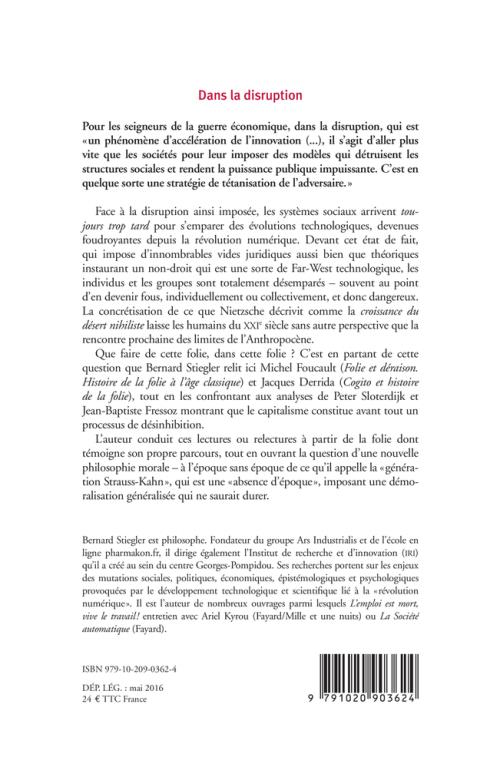
One might translate this as: “In Disruption – How do we not go mad?”

Here’s the front and back covers, and I offer a quick translation of the back cover blurb…


For the lords of economic war disruption is “a phenomenon of the acceleration of innovation (…) which is going to happen more quickly in societies that allow them to impose programmes that destroy social structures and render public power impotent. This is a kind of strategy of tetanising one’s adversary”.

Facing the disruption thus imposed, social systems always arrive too late to seize technological evolution, now thundering ahead in the digital revolution. Faced with this state of affairs, which requires countless legal and theoretical loopholes establishing a lawlessness which is a kind of techonlogical Wild-West, individuals and groups are totally lost, often to the point of going mad, individually or collectively, and therefore becoming dangerous. The concretisation of what Nietzsche described as a growing desert of nihilism leaves 21st Century humans with no other perspective than facing the next of the limits of the Anthropocene.

What can be done with such madness, in such madness? It is by starting with this question, that Bernard Stiegler rereads Michel Foucault (Madness and civilisation: A history of insanity in the Age of Reason) and Jacques Derrida (Cogito and the History of Madness) while confronting Peter Sloterdijk and Jean-Baptise Fressoz’s analyses of capitalism as above all a process of disinhibition.

The author conducts these readings or re-readings starting from the forms of madness which reflects his own course, opening out the question of a new moral philosophy – in an age without age [l’époque sans époque], which he calls the “Strauss-Kahn generation”, that is a “lack of age” [“absence d’époque”], which imposes a general demoralisation that cannot last.

Projecting a genuine future for the living? On Latour & Stiegler comments after the Paris attacks

I was quite surprised at how quickly the translation of the short interview with Bernard Stiegler in le Monde spread on twitter, which is not usual for my posts…

Anyway, I have been struck by a similarity in ethos between the comments made by Bernard Stiegler in his interview and the commentary provided by Bruno Latour in an op-ed (translated by Jane Kuntz) for Reporterre, entitled “The Other State of Urgency” [via Installing (Social) Order].

It is an ethos of calling for the casting-off of a short-termism or ‘death-wish’ (pace Latour) focussed on (inadequately mitigating) destruction–destruction of states, of peoples and of our planet–towards affirming what Stiegler calls a ‘genuine’ future and what Latour sees as a taking of fate into our our hands. One might see it as a loosely vitalist ethos: an affirmation of life and its pluri-potency.

It seems to me significant that both Latour and Stiegler frame the issue in relation to the anthropocene and the COP21 talks being held in Paris. For both of them, the affirmation of a ‘genuine’ future entails combining stances towards ecological, economic, political and scientific atmospheres. Such an affirmation of a sustainable path towards a future of the living is set in contra-distinction to a rhetoric of war, which both thinkers reject in their own ways. To submit to war, in the manner of the French government, is to submit to a short-term imperative to (re)act, but to act for whom and to what ends is a question both Latour and Stiegler find troubling. It is analogous to government via catastrophism – such forms of reaction are already presumed in the mode of ‘normal’ operation: the ‘everywhere war’ and ‘state of exception’ is the new ‘normal’.

Who could argue against an affirmation of hope? I certainly would not. Yet, while there is plenty of diagnosis of the ‘state of urgency’, we are left to ponder: what is to be done?

I don’t think I buy Stiegler’s eurocentric call for policy, it is too easy to see how–even with the best of intentions–this would slip into the kind of technocratic malaise that has buggered up the Mediterranean EU countries. Yet, at least Stiegler attempts to offer strategies – and I think the wider outlining of a political-economics of contribution and of a kind of ‘neganthropy‘, while somewhat grandiloquent, remain inspiring. I would be very curious to see what Latour would suggest in order to “invent demonstrations more innovative than yet another march from Place de la République to Place de la Nation.”

It is, of course, excruciatingly hard to offer strategies for action – as Zizek likes to quip: we can see why it has been suggested that it is easier to imagine the end of the world than an end to the ideological milieu of capitalism. Working for a ‘genuine’ future hurts, but as both Latour and Stiegler demonstrate: it remains the task at hand.

Power, powerlessness, entropy and dissent. A manifesto by de Lagasnerie and Louis & response by Stiegler

Over on the LA Review of Books site there is a really interesting sort of ‘call and response‘ debate, in which Geoffrey de Lagasanerie (Prof. of Philosophy at ÉNS) and Edouard Louis (author) offer a manifesto for counter-acting a perceived capturing of politics by a kind of right-wing intellectualism (this was originally published in Le Monde, and translated for LARB), to which Bernard Stiegler (philosopher & activist) offers a forthright response (translated for LARB).

de Lagasanerie and Louis observe:

Against this massive political-intellectual dynamic [populism, Islamophobia, misogyny, xenophobia, homophobia, antisemitism], a general mood is established. It would not be an exaggeration to say that there are many today who make their living off of this disarray and sadness. To experience politics, for most of us now, is to experience powerlessness.

and offer a kind of manifesto, or set of principles, in response: to refuse to recognise particular ideologues; to recognise refugees and racists alike as what they are rather than bow to a perceived deception; to ‘redistribute shame’ by making those on the far-right understand that their remarks are worthy of nothing but contempt; and finally: to intervene, wherever possible. They argue that:

…we cannot just lament the situation without questioning the means of creating new structures. In fact, all hope is not lost: the Zemmours and Houellebecqs are bent on denying what they really are, and lying. The left continues to dominate symbolically. In France, “intellectual right” remains an oxymoron, better still: an impossibility. We must at least rejoice in that.

In response, Bernard Stiegler opposes the sweeping generalisation of the identification of any kind of ‘intellectual’ which for him validates a kind of proleterianisation (after Marx) that is (in fact) a loss of knowledge (regardless of class position):

In the first place, for any thinking that claims to think powerlessness (and “to say things other than what is already agreed”), the common noun “intellectual” (“an intellectual,” “intellectuals”) must not only be the subject of critique, but should be scrupulously avoided. […] The figure of “the intellectual” is an unfortunate invention that unquestioningly internalizes the opposition between “manual workers” and “intellectuals,” […] Behind all this lies proletarianization, which today affects all forms of knowledge, and firstly as a destruction of knowledge – of how to live, do, and conceptualize.

Stiegler moves on to discuss how the issue of powerlessness not only stems from the issues that de Lagasnerie & Louis diagnose but are, further, entrenched and tied up with these forms of proletarianisation (losses of knowledge), in which even those apparently radical thinkers on the left are somewhat complicit (with a particular withering for Badiou). It is worth quoting at length here:

Geoffroy de Lagasnerie and Edouard Louis deplore the absence of intellectual debate. For my part I deplore that, like Manuel Valls, they have apparently never heard either of Pharmacologie du Front National or of States of Shock – in which I argue that so-called “post-structuralism” has significantly contributed, in France and elsewhere, to the legitimation first of neoliberal discourse and then libertarian discourse, the libertarians being those who are the practitioners of disruption.

This is occurring not only because “intellectuals” yield to the drive-based ideology of the extreme right as it continues to gain ground. It is because there is no thought of the present age worthy of the name – and here, where I am resolutely “on the left,” I would never say that such a thought “worthy of the name” would necessarily be on the left.

The “intellectuals,” whether of the “left” or the “right,” are stuck in an antiquated opposition between “intellectual” and “manual” that refers in a more profound way to the opposition between logos and tekhne against which Marx fought, and which he posited as the basis of the ideology that was then called “bourgeois.” This has largely been forgotten, in particular by the heirs of Althusser and firstly by Alain Badiou. For the consequence lies in the fact that, contrary to what Badiou’s hero, Plato, wants to prove, knowledge is always constituted by technics, which in so doing always constitutes a social relation.

In this forgetting of the technological composition (in all of the meanings of that word) of society and humanity we fail to recognise the context of what is variously (by politicians and technologists alike) referred to as ‘disruption’. Stiegler argues (somewhat) in passing here, and in greater detail elsewhere, that this is precisely what is stake in coming to know/understand the ‘anthropocene’. He discusses how this relates to contemporary feelings of powerlessness through the trope of entropy/negentropy – which he has been working with across various books (some of which have recently been translated and some which are still to be translated):

Entropy is becoming, devenir. Negentropy is what inscribes within it a future, avenir. Becoming and future have until today been confused. It is this confusion that makes us powerless, and it is what the impasse of the Anthropocene reveals. Such a perspective is also an immense building site for intellectual construction – open to all those who still have the ability to think for themselves, rather than vainly repeat received ideas.

These two articles are well worth a read, they offer an interesting counter-poise to anglophone debates about the multiple ‘crises’ in Europe (of refugees, of the rise of the far-right, of the capitulation of democracy to technocracy etc. etc.). Plus they’re good fun to read 🙂

Manifesto for an Intellectual and Political Counteroffensive by Geoffroy de Lagasnerie & Edouard Louis, translated by Adam Briscoe.

Power, Powerlessness, Thinking, and Future by Bernard Stiegler, translated by Daniel Ross.

‘Escaping the Anthropocene’, Stiegler on the Anthropocene

Following on from the various discussions and reflections on geography’s disciplinary mobilisation of the idea/concept of ‘the anthropocene’ I thought I’d just link to a bunch of things Bernard Stiegler has written about/in response to the concept.

I cannot pretend to be totally on top of this work. Likewise, I am not totally sure I can buy into the argument Stiegler presents in these works but it is relatively interesting nonetheless…

These are all translated and made available by the inimitable Daniel Ross:

“The Anthropocene and Neganthropology“, lecture by Bernard Stiegler at Canterbury, 2014.

“Escaping the Anthropocene“, lecture by Bernard Stiegler at the University of Durham, January 2015.

“Automatic Society 1: The Future of Work – Introduction“, the Introduction to Stiegler’s latest(?) book Automatic Society 1: The Future of Work (another series apparently!). This has been published in the new journal La Deleuziana.


Reblog> Klimahaus ~ the world interior of climate (by Martin Mahoney)

Martin Mahoney has written a nice piece reading his visit to the ‘climate museum’ Klimahaus in Bremerhaven through Sloterdijk’s World Interior of Capital.

Here’s some excerpts and then a link to the full post below, it’s worth a read:

The two main strands of Sloterdijk’s argument in the World Interior neatly map onto the two main sections of the Klimahaus. In the first, we follow an ‘explorer’ boldly setting out to discover spaces which do not belong to his own lifeworld. Suitcase in hand, he embodies contemporary residues of the ‘Geography Militant‘ culture which Felix Driver argues can be detected in diverse discourses and media, a long time hence from its Victorian apogee. The presentation of other cultures as situated timelessly within particular spaces and climates, displaying ahistorical ‘customs and traditions’, recalls much earlier modes of knowing and representing the anthropological Other.

…

The ‘Climate Protection’ section offers climate not as an exterior space to be explored, but as part of a modern interior which must be carefully calculated and managed. The symbolic media of this calculation are many and varied: the ice core, the computer model, the ‘personal climate account’. But amid these calculative rationalities uncertainties proliferate, which are domesticated through personal stories from the future offered by characters we met on our first voyage

Klimahaus Bremerhaven: in the world interior of climate

I recently visited the Klimahaus in Bremerhaven, northern Germany along with cultural anthropologist Werner Krauss. Klimahaus is a unique museum dedicated to humanity’s relationship to climate. The main body of the museum leads visitors on a journey along the line of 8-degrees Longitude, following a modern-day explorer as he heads south from Bremerhaven to Switzerland, through Italy and the Sahara, into Cameroon, across the south Atlantic and over Antarctica. From there visitors head across the Pacific, calling in on Samoa and Alaska, before looping back to northern Germany at Hallig Langeness. At each stop, visitors enter an exhibition dedicated to the climate of the location, exploring its role in shaping human life and culture. In a rather old-fashioned anthropological tradition, we are introduced to the ‘customs and traditions’ of the locals, while immersed in the heat or cold, humidity or aridity of their climate.

Read the full blogpost on Topograh blog.