Andrew Barry’s new book: Material Politics

Stuart Elden has highlighted on his blog that a new book by Andrew Barry entitled ‘Material politics: disputes along the pipeline‘ is forthcoming in the RGS-IBG book series, its currently set for release in September.

Andrew Barry is a thoughtful commentator on the politics intimately concerned with technology and, one might say, technics. His book ‘Political Machines’ was of significant help to me during my PhD work for thinking through how we can conceptualise the sorts of politics that emerge within institutions or networks focused on ‘innovation’ in technology.

Perhaps more importantly, Barry is also one of a still-limited number of social scientists engaging with the work of the philosopher Isabelle Stengers. In fact, his talk at the recent ‘Politics and Matter‘ event held by the University of Bristol’s geography department offered an excellent and rigorous exegesis of Stengers’ project of ‘cosmopolitics’, which, as he suggested, is not easy.

This new book clearly draws upon some of the thinking that Barry has been engaged in around these themes, as the blurb on the book’s web page demonstrates:

In Material Politics, author Andrew Barry reveals that as we are beginning to attend to the importance of materials in political life, materials has become increasingly bound up with the production of information about their performance, origins, and impact.
* Presents an original theoretical approach to political geography by revealing the paradoxical relationship between materials and politics
* Explores how political disputes have come to revolve not around objects in isolation, but objects that are entangled in ever growing quantities of information about their performance, origins, and impact
* Studies the example of the Baku-Tbilisi-Ceyhan oil pipeline – a fascinating experiment in transparency and corporate social responsibility – and its wide-spread negative political impact
* Capitalizes on the growing interdisciplinary interest, especially within geography and social theory, about the critical role of material artifacts in political life

ESRC benchmarking review places UK Human Geography at the top

Over on his blog Pop Theory, Clive Barnett points out that the ESRC have completed an international benchmarking exercise that argues strongly that British Human Geography is world-leading. As Clive says: ‘say it loud, say it proud’, heh. This news has also featured heavily in my twitter stream this morning…

Clive suggests this is the take-home paragraph:

“Our unanimous conclusion from the evidence presented to us is that human geography in the UK is innovative, vibrant, and in most sub-fields is the world leader. Its students and staff are gifted and committed, its research outputs are disproportionately influential, read and referenced throughout the English-reading world – and, in translation, beyond. It is radically interdisciplinary and with the spatial turn in the humanities and social sciences has become an exporter of ideas and faculty to other disciplines. In the 1960s and 1970s the overseas export of geographers was substantial, and though slower today and more likely to be two-way, this trade in academic knowledge continues. UK geographers have an art not only for innovation but also for synthesis and a large number of the seminal publications (books as well as articles) continue to have a UK origin. So too among the major disciplinary journals – the UK publishes more than its share. Bibliometric indicators reveal that both in volume and in citation impact UK human geography exceeds the scores of other countries and almost all UK comparator social sciences. Cumulatively, this evidence supports the conclusion that human geography as a whole in the UK ranks first in the world.”

Review of Mitchell’s Me++ 10 years on

A few months ago David Beer, reviews editor at Information, Communication & Society, invited me to submit a review of William J Mitchell’s Me++: The cyborg self and the networked city as part of a review symposium marking the 10th anniversary of the book’s publication. The review is now available in the ‘online first’ section of the journal’s website.

David has blogged about the review on his own website:

The third review of William Mitchell’s Me++ has now been published on the online first section at Information, Communication & Society. It’s a really lively review by Sam Kinsley. This is a new section I’ve developed that provides reviews of important books during significant anniversaries. The idea was to provide a space for reflections on older books to complement the usual book review focus on newness. In this case it is 10 years since Me++ was published. I’m hoping to do a revisiting the classics symposium every year (if anyone has an idea for a book to revisit in 2014 just let me know). The Me++ section will be published in issue 16.9 around October this year. The review by Sam Kinsley will be accompanied by reviews from Roger Burrows and Mark Johnson.

I enjoyed contributing to this review section, it is interesting to return to Mitchell’s work – not least to reflect on how much my own ideas have changed since being an undergraduate!

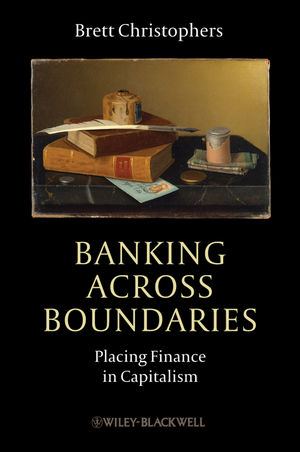
Brett Christophers – Banking Across Boundaries

Over on his blog Progressive Geographies, Stuart Elden highlights that Brett Christophers’ book Banking Across Boundaries has been published:
Banking across boundaries, book by Brett Christophers

Brett Christophers’s new book Banking Across Boundaries: Placing Finance in Capitalism has just been published. It’s part of the Antipode Book Series, and comes with glowing endorsements from David Harvey, Mary Poovey and Leonard Seabrooke.

There are excerpts available to read on the Wiley-Blackwell page for the book.

The concept of an ordinary ethics – Laruelle

The Univocal Press blog features a translation of an essay by the philosopher François Laruelle entitled ‘The concept of an ordinary ethics or ethics founded in man‘, translated by Taylor Adkins. The essay concerns, following an apparently recurring theme in Laruelle’s work, the critique and countering of the imposition of particular ontological arguments, in the name of ‘philosophy’, with a ‘non-‘ ethics/ philosophy. As Laruelle states in the first paragraph:

“Philosophical ethics has always already decided what an ethics of everyday, common, vulgar or gregarious man would be, i.e. an ethics of mores; the philosophical is the disjunction of the common and the philosophical. The ordinary is something different, another thought which is not directly philosophical but does not deny philosophy: here it designates the point of identity and reality that renders the articulation of the philosophical and the common possible, a de jure identity prior to their disjunction and thus prior to their synthesis and presupposed by both. No reconciliation of the mores of philosophical ethics is attempted here because the latter is always already this reconciliation fulfilled or thought in its de jure possibility. The identity of the ordinary–this must be said of everything that follows–is not philosophically acquired, i.e. by a decision or scission, and it does not found a philosophy, i.e. a becoming and a reconciliation. If the ordinary is not a simple predicate that can be mastered philosophically, then it is an absolute experience of thought which only arises from itself, from its internal, immanent or transcendental nature, and for which an identifiable name is still lacking…”

The ‘ordinary’ here is the form of thought not performed especially but perhaps arising through everyday forms of life, which does not deny or necessarily oppose philosophy, but does not spring from the enactment of a peculiar identity of the ‘philosopher’. Laruelle, in my all-too-brief reading, appears to suggest that philosophical ethics always undermines, if not destroys, any negotiated forms of (ethical) value and/or morality by the insistence of the a priori preliminary recognition of the authority of the ‘philosophical’ position. Ethics is what ‘every philosophy seeks to isolate and describe’, and thus render special in some way, distancing the ethical from the ‘ordinary’ – the manifold possible forms of life that exist before the individuation of this life, now. So, Laruelle poses the question of an ordinary ethics not in terms of a specific authority (a history, a world, a state) in order to question that authority –such an authority is simply taken as a given, but instead suggests that ‘ordinary ethics’ interrogates the pragmatic reality of negotiating an ethics of the present:

“Ordinary ethics does not explain how and why we obey laws or not, an obedience which is an inheritance and an archaism: but that which we should and can make of ethics. The claim to explain the reason behind our obedience only comes from the domain of philosophy. This obedience and its difficulties are for ordinary ethics instead a given–but nothing more–that it needs as simple material. Ordinary ethics does not interrogate its possibility, it interrogates its reality and formulates rules of usage and transformation of this supposed given.”

For Laruelle, then, there is no transcendent authority of philosophy that presupposes and affords a judgement of ethics, in the form of something like a ‘meta-ethics’. Instead, ethics is not founded in ontological distinctions, offered by Jewish or Greek (his examples), or any other, essential laws of Being, but, rather, ‘ordinary’ ethics is emerges from the immanence, the potentiality, of the world realised in our own becoming as humans. Ordinary ethics, therefore, is resolutely human (as opposed to transcendent, divine, or ontological).  This form of ethics does not take its authority from outside, but only from inside our understanding of ourselves – it does not come from ‘Earth’ or ‘Heaven’, in Laruelle’s terms, but from (the) ‘[hu]man’. And not the reasoned, philosophical, human that abstracts itself from the world, but the imbricated messy human bound up in the interstices of becoming:

“Ethics can only become pure if it reduces the form of the Law itself, Reason; but it can only be real, rather than another quasi-religious empiricism of the Other, if it is founded in the essence of man. Not between Heaven and Earth: ordinary ethics is neither of Heaven or Earth, but of man who is not their difference but instead takes his essence from himself. Only the greatest immanence, purely internal immanence with neither transcendence nor internal relation, can found the reality and validity of prescriptions in a non ethical way or outside moral authority.” (Final Para.)

To think about this from the point of view of my own theoretical interests, in Stieglerian terms, I would suggest that such an ethics consists (like the law it con-sists it does not ex-ist), and is composed in processes of transindividuation – rendering ethics metastable without being necessarily permanent.

Letterpress Theory – Univocal Press

The publishers Univocal Press are publishing some interesting work, in the form of lovely books, from a number of philosophers that are becoming increasingly of interest, and dare-I-say important, to those of a theoretical bent across the humanities and social sciences. I only recently stumbled across their blog, which seems to be worth following. The video below, for example, was posted – which features an interesting documentation of the savour-faire still perhaps necessary to make books. Plus, its a lovely video.

Joanna Zylinska on Facebook and the ‘ethics of mediation’

I am really happy that the DCRC have been able to invite Professor Joanna Zylinska to visit the Pervasive Media Studio to give a talk, on the 19th of March 2013. As well as being a great editor at Culture Machine, Prof. Zylinska has written significantly about ethics in relation to processes of mediation and how we might rethink where agency lies in the increasingly complicated human-technical relations of our everyday lives.

Prof. Zylinska will talk about how our understandings of what counts as ‘human’ are being changed by the capacities of new media technologies that extend our abilities beyond our bodies. Drawing on material from her recent book Life After New Media: Mediation as a Vital Process (MIT Press, 2012, co-written with Sarah Kember) Zylinska will explain what she is calling an ‘ethics of mediation’, which she argues is an increasingly important part of our ethical understanding of contemporary everyday life. She will ask: what happens when we understand physical things as intimately interconnected by networks of energy and information?  What systems of morality are made possible or necessary when more and more of our lives are mediated by social networking systems such as Facebook?

To learn more about Prof. Zylinska’s work and to listen to this fascinating talk please join us at the Pervasive Media Studio on the 19th of March.


Clive Barnett on varieties of ‘the political’

In a recent post over on his blog, Pop Theory, Clive Barnett has written an excellent critical reflection upon the meanings and uses of ‘the political’ in social scientific discussion and political philosophy, as well as the various ways in which politics and the political are characterised, frequently dyadically. The post is set in the context of reflecting upon the growth in the supposition of the ‘post-political’ and Barnett’s healthy skepticism about it. I particularly like this passage:

Methodologically, the analysis of our post-political condition depends on a weird slippage – when one finds an example of partisan political action making use of consensual rhetoric, or of a political action culminating in a decision being made in the favour of some interests rather than others, or at the expense of others, then what you have found, it turns out, is not politics being done at all, but the end of politics, the closing down of the properly political. One would have thought that it’s not that difficult to recognise that politics is a game that turns on different ways of relating the partisan and the common, the partial and the universal, the specific and the general, at the level of rhetoric and action; dare one say it, even the consensual and the a(nta)gonistic (that’s what compromise, bargaining, deal-making are after all). One might also think that the literature on the politics/the political distinction has some interesting ways of understanding the dynamics of those relations. One would have thought, too, that the fact that some people end up being better at politics than others – that it’s a game of winners and losers – could be understood as an important part of the game, worthy of some analytical attention, and not just interpreted as being an effort to end of the game.

I found the three varieties of discussion of the political that Barnett characterises a useful analytic for reflecting upon my own work and how I’d situate it, not least in terms of Barnett’s critique of the trend towards studies of “the politics of–”, of which I am certainly guilty. Its also interesting to reflect on what it might mean to talk about politics on the context of research given the increasing pressure to make knowledge ‘exchangeable’ and ‘transferable’…

Steigler resources

I have been posting translations and links to resources about the work of Bernard Stiegler for a while now and so I have now collected these posts under one section of this website, which you will see linked in the main menu as “Stiegler“. I have also created a permanent page for the Bibliography of Stiegler’s work in English, to make it more easily accessible.

This is of interest to me but I hope that these things are of interest to more people too!

The Wager of Sublimation (translation), Petit on Stiegler

[Co-posted at technophilia]

In the book of interviews “The hypermaterial economy and psychopower” [Économie de l’hypermatériel et pyschopouvoir], Bernard Stiegler (with Philip Petit and Vincent Bontems) works through and explicates a range of the political-economic and socio-technical issues he feels are most pressing in the contemporary milieu. In the interviews Stiegler ties together his more ontological arguments concerning the co-constitution of the human/technology with his wide-ranging critique of political economy. At the heart of these arguments are the related issues of sublimation in a libidinal economy (the translation of libidinal energy into social objects) and the hypermaterial nature of our material supports (technology, taken in the broadest sense). Stiegler argues for a revitalisation of the economy by better translating our desires into more fulfilling outcomes, rather than submitting to mindless consumption. This is more an evolutionary rather than a revolutionary imperative, as can also be seen by the manifesto of the campaigning organisation Stiegler co-founded, Ars Industrialis.

At the beginning of the book, one of the interviewers in the book, the philosopher Philip Petit, has written an introduction to Stiegler’s project and to the areas of discussion covered in the three interviews. Petit’s short introductory essay, ‘the Wager of sublimation’ (Le Pari de la sublimation), is a useful, if playful, introduction to the life and work of Stiegler. I offer here a translation of Petit’s introductory essay: The Wager of Sublimation [PDF], I hope it is of interest and perhaps of use. I would like to particularly thank Patrick Crogan for his significant and invaluable help in honing the translation of this piece. Continue reading “The Wager of Sublimation (translation), Petit on Stiegler”