Interesting discussion in this post about the uses of systems to automate particular kinds of management task. Originally written & a hared by Phoebe V Moore.
N.B. This is a hastily written and maybe not well-thought-through post. Perhaps that’s a mistake, I don’t know, but I have realised that if I try to write at a more rigorous level I am not going to write much on this blog, so here goes…
Crunch points in the academic year bring some things into the foreground, from the background. While many of us in universities are (desperately) clinging to a sense of solidarity and ‘we’re all in this together’, that is a very fragile arrangement (if it actually exists). So here’s a few vignettes by way of example…
Many departments rely on and assume a certain number of people working on fixed-term contracts. In some, more senior academics’, minds this is a sort of ‘right of passage’ part of the career. While that may once have been true, in a time of more (perceived) abundance in universities, there are now so many people who variously eek out a piecemeal ‘career’ on fixed-term work, moving between institutions, or relying on a particular university. Many people who have just received their PhDs try to stick with the same department, stick with the familiar. In most cases that is impossible and can lead to some dashed hopes, sadly. Today, there are fewer jobs, and only ever more people applying for them. Massively over-qualified people in universities facing redundancies are applying for junior roles. The situation is deeply fraught. And yet, for those in (relatively) comfortable and ‘secure’ positions it can be all-too-easy to ignore the depth of feelings, of turmoil, this brings for those in such uncertainty. As we come near to the end of teaching for this academic year in many places (in the global North) the uncertainty of temporary contracts, of applying for jobs for next year, of not knowing if you can actually mark the dissertations of students you cajoled through the year, comes to a head. We all have our worries. We can all get lost in our own concerns. And ‘the job’ can be all encompassing for quite a few of us. I wonder whether that makes some of the already febrile atmospheres in university departments feel worse. A lack of time to be able to talk with colleagues, to understand their positions, to get a sense of what it feels like for them, I think leads to an unintended undermining of solidarity.
The ‘big conference’ for each discipline, or area of research, tends to happen at particular times of year. In human geography two of the biggest Anglophone conferences in the Global North are the American Association of Geographers annual ‘meeting’ and the RGS-IBG annual conference, which occur around Easter and the last week of August respectively. Who can afford to go, which groups you rein, associated with – whether colleagues, former PhD friends, sub-disciplinary block etc. – which session you get accepted into, whether you are working on the ‘next big thing’, all matter to your experience of a conference. Fear you are missing out, somehow, often overhangs conferences. It can be bewildering to navigate these things, especially in a relatively small discipline. It can also be a bit too easy to see yourself in competition with others in these situations, which, while it may be true on very specific occasions, is generally not a helpful way to see things (at least, I think so – in terms of mental health). All of this can also be overlaid with the feelings of precarity, discussed above, and a sense that ‘I have it worse’ when we hear about, or see on social media, the ‘successful’ people who have landed yet another big grant, are on study leave etc etc. What is rarely, or never, visible is the things those ‘successful’ people may or may not be contending with, and sacrificing, for that success. I am sure there are a few people with ‘charmed’ situations, but I don’t think the treadmill of ambition and over-achieving that is required to get to Professorship (at least in the UK) is easily navigated without some fairly major concessions in the rest of life.
The role of an academic can be privileged, in comparison to many other forms of work in society, but it is not without its own difficulties and consequences. Like many contexts of work, it can feel like a very insular world, with all sorts of wider gender- and class-based assumptions (in the UK) that are not especially visible to those unaffected. If you have to struggle with childcare, if you cannot or will not work at weekends, if you have a poorly paid partner, if you cannot travel, if you don’t have a (emotional, family, childcare, disability) support network, then you likely find it much harder than those with some, or all, of those things to actually ‘succeed’ in the terms recognised by universities as employers and by your peers. For all of the initiatives, for all of the positive gains made for equality and diversity in universities, I am inclined to think it is still the case that the model academic is a White, late-30s, early-40s and upper-middle class man who doesn’t have to think about childcare, has a bit of personal wealth, has some social capital (‘knows’ the ‘right’ people, can navigate the ‘right’ social contexts) and has the single-minded self determination to focus on ‘the job’. Of course, there are many examples of people who have overcome these difficulties, and we should reward those people, but in many ways they have succeeded despite the academic system, rather than because of it.
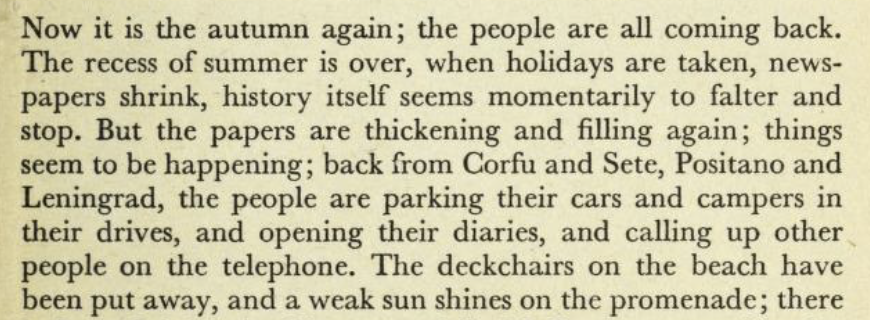
In more recent years there is also a clashing of socio-economic assumptions/expectations and reality. I am a fan of Malcolm Bradbury’s novels. In the opening pages of his, perhaps best known, work ‘The History Man’ he references the kinds of life academics are assumed to lead:
International holidays – indeed having a holiday at all, having the time to ease your way back into work after resting, having more than one car, or a camper van. This is a sort of middle class life perhaps many still assume is lived by academics. And yet, the same people on temporary contracts, discussed above, are sometimes using food banks. Amongst my colleagues who are on permanent contracts and therefore ‘better off’, at least those who are Senior Lecturers, struggle to find the money for family holidays, they are not going to Corfu or the stereotypical 1990s middle-class destination of the Dordogne in France. Academics below the professorial level, and maybe some who are professors (I confess, I don’t know), are not immune to the cost of living crisis felt so keenly by so many in society. Yet, we are all operating in a context where we cannot let on that actually, many of us just cannot afford to do most of the things people used to take for granted in a supposedly well resourced profession. I am reminded of the argument of Yurchak’s argument (adapted by Adam Curtis in Hypernormalisation) about the end of the Soviet Union (seriously though, I am not comparing universities to the USSR!) that people are so wedded to the ‘norm’ they cannot imagine an alternative. We collectively imagine academic life as the David Lodge campus novel-like comfortable middle class ideal (ideal if you’re White & male, of course) and seem to collectively struggle to imagine it differently.
Negotiating these clashing contexts, especially for those who keenly feel the precarity of temporary contracts, is exhausting. I wish I had some helpful suggestions, but I am not sure I honestly do. I feel in a pretty weird position – I am ‘secure’ in a ‘permanent’ position in a ‘good’ department within a university whose management keep telling us there will not be redundancies, yet we have colleagues on temporary contracts, we are told to reduce costs, we are ‘rationalising’ contact time, and we are told to be ambitious – to apply for prestigious funding, to do the research, to publish, publish, publish, and yet there feels like less time, fewer resources and more isolation. My partner is not an academic, they work in the public sector, which is in a much worse state, so I still see my relative privilege but the difference is far less stark than it was only two years ago.
This isn’t the most coherent post, but I wanted to try and capture something of the sense of clashing contexts that working in academia feels like, at least for me. I am curious how others see things. Differently, no doubt. Get in touch if you’d like to talk about any of this. And, regardless of its shortcomings, for those academics in the UK – please consider joining UCU, we are stronger together.
“Where do you want to go today?” –Microsoft advertisement campaign, 1994.
There has, for a long time, been a sort of silence on the ‘digital studies’ JiscMail list – so I thought it was probably worth trying to do something with it.
Several years ago, a few people met for a semi-regular reading group in Bristol (in the UK) to work through a variety of ideas relating to ‘the digital’, whatever that may be. I somewhat flippantly named the associated email list: ‘digital studies’. In part because I was, and continue to be, greatly influenced by the late philosopher Bernard Stiegler, who, amongst many other things, wrote a call for ‘Digital Studies’ in 2012 (here’s a blogpost by me around the same time).
What would a ‘digital studies’ list and maybe an online reading group(?) mean today, in 2025?
I would argue that in the intervening years, between 2012 and today, there has only grown a greater urgency for studying the things named ‘digital’ and the sorts of work ascribed to them, abstractly and materially, for good and bad. So, in this follow on, and more modest, call for a digital studies (pluralised, provisional and no capital letters) I want to offer an invitation to grasp that urgency to interrogate ‘the digital’.
“Now come, fire!” – The Ister, Hölderlin
Digital technologies, in Stiegler’s terms, are the latest form of writing and access to writings, they are the means by which an industrialisation of knowledge has been taking place. There is, for Stiegler, an accelerating industrial and largely automated form of writing shaped, edited, broadcast and read with the help of forms of automation that take place at speeds tending towards the speed of light. The digital technologies are ‘intellectual technology’, following the work of Jack Goody, in which an automation, industrialisation and performance of speed radically transforms the conditions of the ‘life of the mind’, our collective capacities for creativity and critique – including and across the arts, culture, economy, geopolitics, science.
Writing, in any form, is an ensemble of traces, and rules of combination of those traces. For Stiegler, following the likes of Andre Leroi-Gourhan and Bertrand Gille, all human societies can be described as regimes of traces: the inscription, exteriorisation, and interiorisation of traces are what constitutes the material culture of the human ‘spirit’ and the ‘life of the mind’ (la vie de l‘esprit). The processes of ongoing digitalisation raise, for Stiegler and I argue for us, questions concerning the future of human cerebral organisation, what kinds of lives of the mind (and their material and social supports) we want to flourish.
It is essential to all disciplines in all their dimensions to question the status given to technics in our ongoing becoming as humans, and in the becoming of knowledge by which we come to know ourselves and our world/s. The questions imposed by digitalisation – what kinds of life we (collectively) want to live, according to Stiegler, is posed well before that of digitalisation itself, as if the radical experience of the upheavals provoked by digitalisation renders these questions apparently unavoidable.
What is to be done?
I propose a monthly online meet-up to read and discuss work we feel might be relevant to this broad questioning of ‘the digital’. I cannot run this alone, so It will need, from the outset, people to volunteer time and ideas, but this email list can act as the initial vehicle for organising. People may come and go, of course, and I wouldn’t wish this to be a burden, but rather an opportunity. For many, these may be worrying times, but there is solidarity in coming together to affirm creative and critical reflection.
[D]igital studies should not be limited to the study of digital technologies: their general object would be the study of technics and intellectual technologies in general from the angle of their effects on all knowledge in general. In this sense, rather than digital studies, it would be without a doubt better to talk of knowledge studies (“studies” in plural form denoting a specific relation regarding epistemology which, other than studying scientific knowledge (savoir) and understanding (connaissance), is conceived from the outset as a discourse unified by a pure logos of all technicity).
Hence knowledge studies would propose in principle – and as their common position – that the study of knowledge is not soluble to that of cognition, as all knowledge and understanding supposes, at the same time, being able to transmit and transform a technical artifactuality is essential to what Georges Canguilhem described as the form of technical life.
Now, some of these terms and their phrasing may seem grandiose. Even so, the ethos of a digital studies as an interdisciplinary endeavour with the goal of interrogating the contemporary conditions of our ongoing negotiations of creativity, critical reflection and culture, remain worthy goals to which we might aspire. Albeit, perhaps, in more modest terms. In 2012, for those involved in Stiegler’s circle (The Insitute de Recherche et d’Innovation at the Pompidou Centre and the Ars Industrialis collective) this was located in a conference that led to a website [digital-studies.org]. I would argue it is possible for a modest goal of forming a community of practice to read and explore work, our own and others, by acquiring fairly easily and inexpensively various means and consuming little time, allowing the maintenance of an online forum, beginning with this email list.
I can offer some suggestions for readings, I think a great place to start, though, is with you – what do you want to think about? What do you want to discuss with likeminded peers?
Please contribute ideas and suggestions! Open the conversation. Everyone is welcome.
I have a new journal article out, as part of a theme issue in Environment and Planning D: Society & Space. This forms the first peer-reviewed publication that stems from work I began around 2016 concerning automation (this is one of the earliest posts on this blog about it, with a talk I did at the SW Futures meet-up group). This took an impetus from the work of Bernard Stiegler around automation and my initial thinking with and through his ideas was influenced by many conversations around that time with my friend and former colleague Patrick Crogan, who has also written on automation (more than me!), e.g. here.
What the does ‘automative’ mean? You might be asking yourself. Well, I coined a neologism because I couldn’t find a word that fit what I wanted to say. In the paper I put it this way:
The ‘automative imagination’, in the context of this article, is a heuristic that enables two things: (i) a critique of the spatial politics scale pregnant within debates around the opportunities and threats brought by automation; (ii) an interrogation of the normative character of different habits of considering and discussing automation. I am not using the neologism ‘automative’ to assert any kind of authority but rather as a pragmatic tool. Other words do not quite fit—to speak of an ‘automated’ or ‘automatic’ imagination does not describe the characteristics of automation but suggests the imagining is itself automated, which is not the argument I am seeking to make. My aim is not to validate/invalidate particular narratives of automation. A ‘technologically determinist’ reading of the automative imagination might see what is imagined as goals towards which companies are specifically working, largely driven by economic imperative.
In the final sentence of the article I argue:
Using the automative imagination as a lens for inquiry asks for what kinds of ‘problem’ automation is situated as a ‘solution’, by whom and how they do so; and thereby how they are or may be contested.
For lots of personal reasons, this work has taken a long time to make it into print. Even so, I think the argument I make in the paper is at least interesting and has something to contribute in the current maelstrom of debate/s around automation. You can read the article for free, it is open access, courtesy of ESRC/UKRI funding. Here’s the abstract:
This article argues that the ways automation is imagined illustrate a wider problematisation of labour. The concept of an ‘automative imagination’ is proposed to articulate these different habits of considering and discussing automation. In these forms of imagination, I argue labour is discursively reconfigured as a logistical infrastructure. The concrete value of labour, the labouring body and the place of work as such are abstracted into an opaque logistical infrastructure in the narratives of an automative imagination. The impetus for this analysis comes from press releases and reports concerning automation and COVID-19 focused on the UK economy, creating a vanguard of abstracting ‘labour’ into infrastructure. The work of automation can usefully be understood as a relation, both in its implementation and in its imagining—a relation that geographers can, and should, interrogate. The automative imagination powerfully articulates the normative force of the performative abstraction and devaluation of work.
I wanted to explicitly post here an update about Clive Barnett’s website, pop theory.org
This is difficult. Talking about Clive in a non-academic way is hard. I’m not going to pretend I had a closer friendship with him than anyone else, I didn’t. But I was working with him when he very sadly passed away and, of the many people that expressed a care for Clive and his legacy, I remain working at Exeter, which was the university he was working at too.
As many have noticed, Clive’s website – poptheory.org – is not currently live. The domain name has lapsed and we don’t currently have access to the ‘back end’. A couple of us managed to pay for an extension to Clive’s site so that WordPress kept it live. We had asked for this to be maintained but the payments failed and there was no reminder sent to an email to which anyone in my department had access. While this is not my responsibility per se, I do want to issue a public apology.
I am sorry that Clive’s website was not better cared for.
Where does this leave things now?
A number of people have asked me what is going on, so this is one way I can provide an answer. The University of Exeter Geography department, led by our Head of Department, is working with Clive’s family to secure a permanent solution to maintaining Clive’s website as an archived website, and hopefully re-secure the domain name. This may take a little while but I am hopeful that we can make this happen. If you have any concerns or questions, please feel free to get in touch with me and I can do my best to answer them, or put you in touch with someone who can, and keep you updated.
This is hard. I miss Clive greatly. I will try to write something one day soon but I don’t think I can just yet.