
A great video instalment of “Anywhere but Westminster” with John Harris looking at the united independents movement – especially in Frome (Somerset) and an interesting foray into “Take Back the City“. Recommended viewing for the politically inclined…
In Disruption – new book by Bernard Stiegler
 Yet another new book by Bernard Stiegler has been published in French recently: Dans la Disruption – Comment ne pas devenir fou?
One might translate this as: “In Disruption – How do we not go mad?”
Here’s the front and back covers, and I offer a quick translation of the back cover blurb…

For the lords of economic war disruption is “a phenomenon of the acceleration of innovation (…) which is going to happen more quickly in societies that allow them to impose programmes that destroy social structures and render public power impotent. This is a kind of strategy of tetanising one’s adversary”.
Facing the disruption thus imposed, social systems always arrive too late to seize technological evolution, now thundering ahead in the digital revolution. Faced with this state of affairs, which requires countless legal and theoretical loopholes establishing a lawlessness which is a kind of techonlogical Wild-West, individuals and groups are totally lost, often to the point of going mad, individually or collectively, and therefore becoming dangerous. The concretisation of what Nietzsche described as a growing desert of nihilism leaves 21st Century humans with no other perspective than facing the next of the limits of the Anthropocene.
What can be done with such madness, in such madness? It is by starting with this question, that Bernard Stiegler rereads Michel Foucault (Madness and civilisation: A history of insanity in the Age of Reason) and Jacques Derrida (Cogito and the History of Madness) while confronting Peter Sloterdijk and Jean-Baptise Fressoz’s analyses of capitalism as above all a process of disinhibition.
The author conducts these readings or re-readings starting from the forms of madness which reflects his own course, opening out the question of a new moral philosophy – in an age without age [l’époque sans époque], which he calls the “Strauss-Kahn generation”, that is a “lack of age” [“absence d’époque”], which imposes a general demoralisation that cannot last.
Books in my bag today – Bardin, Derrida, Stiegler
Following from the last post, here’s the books in my bag today – informing the latest drafting of the “algorithmic imaginary” talk…

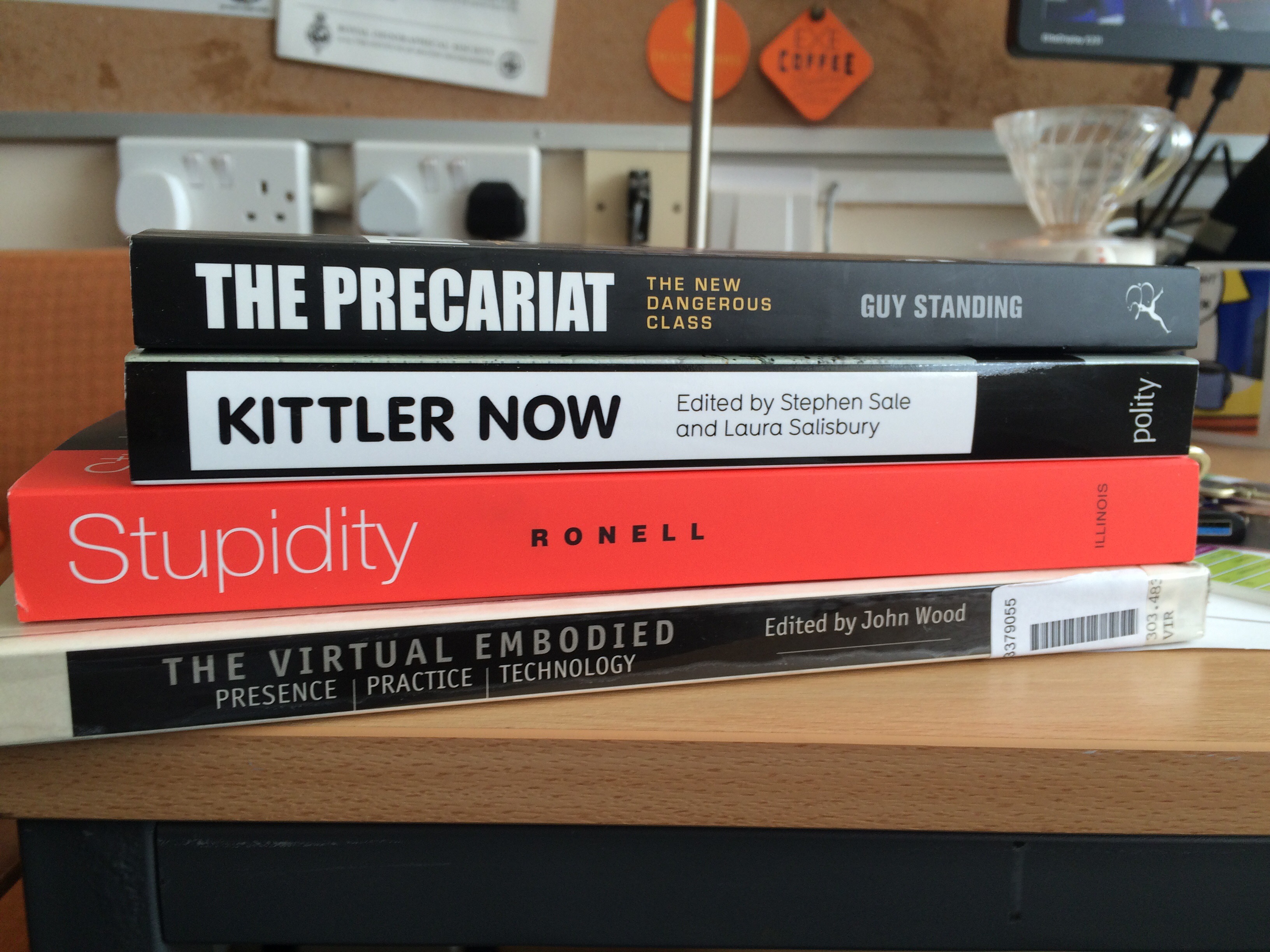
Books in my pigeonhole – Kittler, Ronell, Standing, Wood
Some books, older & newer I’ve splashed out on recently… Struck me, after the fact, as a peculiar mix, heh…
Upcoming talks: ‘an algorithmic imaginary’
I’ll be giving two talks in the next week that both address the ways claims are made about ‘algorithms’, in terms of what they are and what they can do. I frame this in terms of an ‘algorithmic imaginary‘.
The first talk is titled “Prosethetic stupidity, or world-ing by numbers” (more accurately, following Derrida, this should be ‘prothétatique‘, but that’s far too enigmatic!), and is short. I’ll be taking part in the launch event for the University of Bristol’s MSc Society & Space blog, and discussing how the sociotechnical assemblages we name as algorithms perform a kind of world-ing, rather than reflect a world, which, of course, has significant implications in the growth of ‘big data’–driven computational social science.
The second talk, entitled “An algorithmic imaginary: anticipation and stupidity”, is longer. This is an invited seminar, and a part of the University of Oxford Institute for Science, Innovation and Society’s “Anthropological Approaches to Technics” seminar series.
In both talks I’m playing around with co-opting the idea of an ‘imaginary‘ (in the vein of ‘geographical’ or ‘sociological’ imaginaries) to offer a critical reading of how particular stories about automation and agency are taking hold. I acknowledge others have already employed the term (e.g. Bucher, Mager), but I think I’m offering a novel definition of my own here… In the talks I frame this in two ways: in terms of ‘anticipation’ and in terms of ‘stupidity’ (there is more detail in the written piece I’m developing on the back of the talks).
Firstly, the phenomena labelled ‘algorithms’ are suggested to anticipate the activities of people, organisations and (other) mechanisms. This is one of the substantive claims of ‘big data’ analytics in relation to any form of ‘social’ data, for example. It is certainly true that, building on ever-larger datastores, software (with its programmers, users etc. etc.) have a capacity to make certain kinds of prediction. Nevertheless, and as many have pointed out, these are predictions based upon a model (derived from data) that I argue constitutes a world (it does not reflect the world – these predictions are ontogenetic, calling entities/relations into being, rather than descriptive).
Further, precisely because these anticipatory mechanisms are often a part of systems that use their outputs in order to select what may be seen, or not, and thus what may be acted upon, or not, they are arguably a form of self–fullfiling prophecy. The anticipation is ‘proven’ accurate precisely because it functions within a context where the data and its structures (the model) are geared towards their efficient calculation by the ‘algorithm’. Thus, we might choose to be more cautious about the claims of large social media experiments that are focused on a single platform, precisely because they are self-validating. A social media platform is a world unto itself, not a reflection of ‘reality’ (and whatever we choose that to mean). Indeed, it has been highlighted by others (Mackenzie 2005, Kitchin 2014) that the outcomes of ‘algorithms’ can be unexpected in terms of their work in world-ing.
Yet, the supposition of such an anticipation is, itself, a form of anticipation – a kind of imagining of agency. The capacity to ‘predict’ is suggested to have effects, and those effects produce particular kinds of experience, or spaces. Visions of a world are conjured with what we imagine ‘algorithms’ can do. Thus it is a double-bind of anticipation: to write anticipatory programmes, a programmer must imagine what kinds of things the programme can/should anticipate. There is accordingly a geographical imaginary of anticipatory systems. Furthermore, that imaginary is becoming normative – in two senses: normative or prescriptive in the sense of the double-bind just mentioned; and normative, in the Wittgensteinian sense, such that such an imaginary becomes the criteria by which we judge each other as to whether how and what we say about something (e.g. ‘algorithms’) is appropriate, or not, to the context of discussion.
Secondly, ‘Algorithms’, as socio-technical apparatuses, can, if we allow, act as a mirror in which we might reflect upon the generation and use of sets of rules, and how they are followed[1]. In order for contingencies to be made, the anticipatory ‘world-ing’ of the programmer must be complex (and a form of catastrophism – always planning for the potential error or breakdown). Such a reflection upon ‘algorithms’ is, in effect, a reflection upon reason and stupidity. For the purposes of this post, I identify two elements to this reflection: the reification of the apparatus we call ‘algorithms’; and the idiomaticity and untranslatability of language in terms of the conventions of programming ‘code’.
Much of the recent discourse of ‘algorithms’ invites, or even assumes, a belief in the validity and sovereignty of the black-boxed system named an ‘algorithm’. The ‘algorithm’ is reportedly capable of extraordinary and perhaps fear-inducing feats. We are often directed to focus upon the apparent agencies of the code as such, perhaps ignoring the context of practices in which the ‘algorithm’ is situated: practices of ‘coding’, ‘compiling’ (perhaps), ‘designing’, ‘managing’, ‘running’ and may others that involve the negotiation of different rationales for how and why the ‘algorithm’ can and should function. There is nothing in-and-of-itself “bad” about the apparently hidden agencies of an ‘algorithm’ – although, of course, sometimes questionable activities are enabled by such secrecy – and focusing upon that hidden-ness elides those contexts of practice[2].
By ‘reifying’ (following Adorno and Horkheimer 2002; Stiegler 2015) the black-boxed ‘algorithm’ we submit to a form of stupidity. We allow those practitioners that enable the development and functioning of the ‘algorithm’, and ourselves as critical observers, to “vanish[…] before the apparatus” (Adorno and Horkheimer 2002, xvii). This is inherently an act of positioning ourselves in some kind of peculiarly subordinate relation to the apparatus, it is a debasement of our theoretical knowledge (because, of course, we understand the context of practices, we understand the kinds of ‘world-ing’ discussed above), and of our critical ‘know-how’. Such a ‘stupidity’ is a tendency towards an incapacity; an incapability to meet the future–deferring instead to the calculative capacities of the apparatus, and its (arguably) impoverished world-ing.
A suitable humorous example of this is, of course, David Walliams’ character Carol Beer who, in the sketch comedy programme Little Britain, has a blithe and unbending deference to the computer – which simply “says no”. The whole premise of the joke Walliams presents with that catchphrase is that, of course, there should be room for interpretation and yet we are presented with a blind adherence to the results of the programme – which is patently stupid. Nevertheless, in many moments of everyday life we are faced with such forms of adherence to nonsensical outputs from software – we may even feel compelled to be complicit. Following Stiegler (2015), we might recognise that a part of what makes this funny is that a moment of stupidity (i.e. its recognition) is also a moment of shame: if we value reason and independent thought, Walliams’ character should feel ashamed of her ‘stupidity’ – as Stiegler (2015, 46) says: “a stupidity such that I perceive my own being stupid”. This is not (normatively) a “bad” thing: how else can one become the person we desire to be (or ‘individuate’) than by recognising our own ‘stupidity'[3]? In this light, stupidity cannot be opposed to knowledge, neither is this a ‘stupidity’ that is necessarily forced upon us. Reflecting upon stupidity is always a reflection upon my own stupidity, it is a means of thinking the passage to knowledge. Crucially, we realise it only in retrospect. If we are to take such a critical understanding of stupidity seriously, we are therefore called to urgently attend to the ‘reification’ of what we name ‘algorithms’ and the knowledge claims that are made on the back of the suppositions we accordingly make about their operation.
It is possible to be convinced that the reductive forms of language, formulated through formal logic, that constitute a ‘programming language’ cannot be idiomatic or open to difficult forms of interpretation. Yet (of course), they are – and this is an issue of translation. A programme must be (however minimally) written and read, with the rules of such activities agreed upon (an architypically ‘normative’ operation). Yet the range and scope of contexts in which such reading and writing must function are very broad. There is always some ambiguity in the interpretive function of ‘reading’, or more accurately ‘translation’ (translation as the execution of the code, the way it is ‘compiled’ [into binary] or ‘interpreted’ by another layer of software, or its transposition into another codebase, for example through an API). Indeed, as Kitchin (2014) points out, there is an issue of translating a problem (in the mathematical sense) into a structured formula and thence into some form of software programme. Likewise, in software systems the software itself makes no sense without some kind of translation of data, either in formats or units of data, a prime example of this might be the ‘stupidity’ that led to the failure of NASA’s Mars Climate Orbiter, or expected forms of data, with a good example being the ‘stupid’ assumptions about what kinds of interaction and thus kinds of data the Microsoft “Tay” Twitter bot would end up ‘learning’ from (a form of stupidity on the part of the Microsoft programmers who failed to recognise and negotiate normative contextual issues).
An ‘algorithmic imaginary’, as briefly outlined here, has become normalised in our discussions of how computation and software play an increasingly significant part in various aspects and processes in our lives, which always take place within systems (sociotechnical assemblages). The challenge of such an algorithmic imaginary is that it is, sadly, couched in either dystopian and defeatist or blandly a-political terms: we are either doomed to ‘welcome our new algorithmic overlords’ (to paraphrase Kent Brockman) or invited to sink into the stupor of a standardised shiny surface of our lives being made progressively ‘easier’ by apps, gadgets and so on. We need not ‘believe’ in the world-ings of ‘algorithms’ or reify the precarious achievements of software. Even when intentions are noble, what is done as ‘social science’ under the umbrellas of ‘big data’ is in danger of eliding more than it apparently reveals . We can and should instead look to our critical toolbox and examine the contexts of practice of ‘algorithms’ and the systems of which they are a part, and here we already have some excellent resources (see: Gillespie, Kitchin, Mackenzie, Miller, Seaver). We must forge alternate, diverse and resolutely political sociotechnical imaginaries, and hone our capacities to intervene – even at the level of code; for one of the most important things we can do “in this life that must constantly be critiqued in order for it to be, in fact, worth living – is the struggle against stupidity” (Stiegler 2013, 132).
Notes
- Even if we are considering complex forms of ‘machine learning’ there are always foundational rules set within the software platform or the hardware systems, and indeed the choice of ‘training data’ that reflect particular forms of decision-making.
- One might think of this through the lens of the ‘pharmakon’: what we call ‘algorithms’ are both a support to structures that increase our capacities (to support forms of individuation) but also carry the potential (sometimes actualised) to harm our capacities (leading to disindividuation, and thus to ‘baseness’ [bêtise]) – “That which is pharmacological is always dedicated to uncertainty and ambiguity, and thus the prosethetic being is both ludic and melancholy” (Stiegler 2013, 25)
- Both Jacques Derrida (2009) and Bernard Stiegler (2013, 2015) identify, following Deleuze (1994), the question of how ‘stupidity’ is possible as one that is transcendental:“If we are stupid it is because individuals individuate themselves only on the basis of preindividual funds (or grounds) from which they can never break free; from out of which they can individuate themselves, but within which they can also get stuck, bogged down, that is, disindividuate themselves” (Stiegler 2015, 46).For Derrida, again following Deleuze, such a ‘ground’ is a ‘groundless ground’ [fond sans fond] (Derrida 2009) insofar as
“Stupidity is neither the ground nor the individual, but rather this relation in which individuation brings the ground to the surface without being able to give it form” (Deleuze 1994, 151).This ‘groundless ground’, or baseness, can be forged from knowledge that has become ‘well known’ (akin to the Wittgensteinian normative) yet remains ‘susceptible to regression’ (Stiegler 2015, 47). Indeed, it is this (‘pharmacological’) negotiation of tendencies that fuels Stiegler’s use of ‘entropy’ as a trope.
Some references
Adorno, T and Horkheimer, M 2002 The Dialectic of Enlightenment, Stanford University Press, Stanford.
Deleuze, G. 1994 Difference and Repetition, trans. Patton, P. Columbia University Press, New York.
Derrida, J. 2009 The Beast and the Sovereign: Volume I, trans. Bennington et al., University of Chicago Press, Chicago.
Kitchin, R. 2014 “Thinking critically about and researching algorithms”, The Programmable City Working Paper 5, pp. 1-29.
Mackenzie, A. 2005 “The performativity of code: software and cultures of circulation”, Theory, Culture and Society 22(1): pp. 71-92.
Miller, D. 2015 Social Media in an English Village, (Why We Post Series), UCL Press, London.
Stiegler, B. 2013 What makes life worth living: On pharmacology, trans. Ross, D., Polity, Cambridge.
Stiegler, B. 2015 States of Shock. Stupidity and Knowledge in the 21st Century, trans. Ross, D., Polity, Cambridge.
Reblog> Launch Event: Researching Alternative Worlds: New political orientations in Geography
I’m taking part in the launch event of the Bristol Geography MSc Society & Space blog alongside some excellent and distinguished alumni of the course. It promises to be an interesting event!
Launch Event: Researching Alternative Worlds: New political orientations in Geography
The Official Launch of the Society and Space MSc Blog
4.00pm, Hepple Lecture Theatre, School of Geographical Science, University of Bristol
Register here

On Wednesday 27th April, we will be officially launching the Society and Space MSc blog with a panel discussion event bringing together Society and Space alumni to discuss a common concern to all of their work – the role of academia in creating alternative social worlds. The Society and Space MSc Course is the principle Human Geography research training Master’s programme within the School of Geographical Sciences at the University of Bristol. As a Master’s degree that emphasises social and political theory, the programme trains students to think about social and cultural geographies from a critical perspective while also interrogating the political and ethical components inherent to these geographies. The programme has produced a range of alumni who have, in the course of their research, continue to contemplate and develop the issues, theories and debates they first encountered on the Master’s programme.
To officially launch the Society and Space blog, we have invited back Society and Space alumni – including James Ash, Emma Roe, Sam Kinsley, Nathan Eisenstadt, Owain Jones and Julian Brigstocke – to take part in a panel discussion centred upon pressing questions concerning our role as researchers in mapping alternative social worlds. What is the role of academic research in investigating, creating and sustaining alternative social worlds? When is academia useful and effective? What are we doing wrong, and what should we be doing more of?
Although a Master’s programme in Cultural Geography, the Society and Space MSc attracts students from a range of backgrounds and a variety of disciplines, such as journalism, English literature, philosophy, fine art and cultural studies. Due to the wide spectrum of backgrounds and interests of those who enrol in the course, as well as the dynamic nature of Human Geography as a subject, the contents covered in the Society and Space programme stimulate a range of conversations about the nature of sociality, the world we live in, and potential futures that may lie ahead of us. We expect that this diversity and broad outlook will be reflected in the work our speakers will present and the discussions that ensue. In addition to being a highly theoretical course, there is a strong, grounded political and ethical focus to the Master’s programme. Consequently, the issues debated, discussed and encountered throughout the Society and Space course are in direct conversation with ‘real’ issues – today’s hot topics and current political and ethical debates. In a context of austerity and the neoliberalisation of academia, the role of academia in researching and co-creating an alternative future is surely one such topic.

For a taste of the themes that the panel discussion will traverse, please have a look at abstracts provided by some of our panellists:
Dr James Ash, University of Newcastle
In this short reflection I offer one way of thinking about how we frame social science research questions. In doing so I want to caution against approaches which, however well meaning, centre on ‘big’ problems, framed in a general sense in relation to the concept of world. While issues such as climate change, poverty, homelessness and debt, amongst myriad others are undoubtedly real, there is an issue when assuming that a set of general problems are experienced within a shared horizon of meaning that is implied in the use of the term world. Rather than framing social problems in terms of big or small, or general or particular, I want to argue that such problems can be more productively framed in terms of what Simondon terms the abstract and the concrete. Drawing upon vignettes from the research design of an ESRC project on debt and digital interfaces, I demonstrate how Simondon’s work can be applied to specific societal problems.
Dr Nathan Eisenstadt, University of Bristol
In this brief intervention I reflect on my doctoral work exploring paradoxes of freedom enacted in contemporary anarchist spaces. I propose that while performed inconsistently and in contradictory ways, the liberatory and egalitarian character of these practices lies in their capacity for an undoing of oneself with the help of compassionate others. Wonderful as this may sound – it has its edges. In closing I call attention to the failure of self-reflection and attempts to make spaces ‘safer’ when collectively established norms are radically transgressed.
Dr Sam Kinsley, University of Exeter
Computation is being used, within and without academia, to make ever grander and more detailed claims about our world. Yet, the (many) ‘worlds’ that emerge from what are generically referred to as ‘algorithms’ can be seen to fall foul of well-known fallacies of empiricism, in relation to their supposed lack of theoretical basis and apparent exhaustive reach. So, in light of grand claims made on behalf of ‘big data’ research and a contemporary predilection for the study of ‘algorithms’, I argue for a critical interrogation of the forms of world-ing propounded by such an ‘algorithmic imaginary’. In so doing, I suggest we reflect on what can be called a dialectic of ‘stupidity’ and ‘knowledge’, following Bernard Stiegler (2015), that undergirds our contemplation of such world-ings. My aim here is to tackle the inherent politics of this logic of worlds and how critical social scientists might engage.
Professor Owain Jones, Bath Spa University
My short presentation will reflect upon my experience of being in the first (very small) cohort of the MSc and then also devising and teaching the Nature and Society module from 2003-2006. I did not do an academic degree but an arts practice based degree so the MSc really marked my ‘conversion’ to academia and to geography. I can say without any exaggeration that doing the course was a life transforming and enhancing experience (as university (PG) education should be). The very possibility of imagining and enacting alternative worlds was very much part of that. My subsequent academic and professional life stands upon the very strong foundations put in place by the MSc and I think this is the case for many others too. I will offer some reflections upon why the course was so effective in this way. In part this was simply about being in a centre of excellence where there was a powerful intellectual momentum in which the conceptual and imaginative tools for questioning the trajectories of modernity were set out . But it was also about openness, spirit and collegiality with the staff and PG cohorts.
In addition to the panel discussion – which will be followed by time for audience questions – there will be a brief introduction by the Society and Space Blog Editors, before our very own Dr JD Dewsbury will recount his experience as first a student and then a lecturer on the MSc and map out how the course has changed and developed over the years.
The event will take place at 4.00pm, in the Hepple Lecture Theatre, School of Geographical Science, University of Bristol (see map). The discussion will be followed by a drinks reception. If you intend to attend (and we hope you do!), please confirm your attendance here.
We look forward to meeting you on 27th April.
The Editors
Artefacts for generations growing up with robots
I’ve had this open in one of my tabs for ages with the intention of writing something about it here but I’ve sort of run out of time on that, so…
Here’s an interesting student project (I’d be delighted to have students like this!!) It’s a sort of deliberately controversial speculative design/ prototyping exercise to provoke thought and conversation about what it might mean to live with actually existing robots (not sci-fi androids).
The creators are: Stephan Bogner, Phillipp Schmitt and Jonas Voigt.
It’s worth a look…
RAISING ROBOTIC NATIVES

Artefacts for generations growing up with robots
Why do future visions of robotics incite discomfort in our generation? Could robots truly render us obsolete or is it our fear of losing control? And are these fears conditioned or instinctive?
Raising Robotic Natives explores interactions between children and robots that could raise them as the first generation of robotic natives.
Just like digital natives grow up in the digital world, robotic natives are born into an environment that is adapting to robots. As a result of unbiased, childlike enthusiasm, they are socialized with the technology early on. Through constant robotic interactions and formalized education, robotic natives get to think differently about robots than we do. It will be their responsibility to shape the future of robotics, not ours–besides we’re robotic immigrants, after all.
See the full details of the project here.
Daniel Miller – The Internet: Provocation
There’s an entertaining and incisive piece on the Cultural Anthropology website by Prof. Daniel Miller (UCL) on (ethnographic) research concerning the internet/’online’…
I have felt that perhaps my primary qualification for engaging in the anthropology of this domain is simply that I have never, ever actually believed in “The Internet.” My provocation is that this disbelief is what distinguishes anthropologists from other scholars of online activity. My approach has always been ethnographic, what I call holistic contextualization. I study populations whose online activities are a growing element of who they are and what they do. Yet no one lives just online.
If you teach under the auspices of Internet studies or similar, it is pretty hard not to fetishize the Internet. But I cut my teeth on trying to develop something called material culture studies as a systematic defetishizing of objects (and of society). Instead, we examine the place of materiality within the anthropology of relationships. I see online as just one place in which we now live and conduct relationships with others. After overhearing a two-hour telephone conversation between your husband and his mother, for example, you would not remark, “Oh, that sounded bad, but what is your relationship like in the real world?”
Read the whole thing here.
Video> Massey on public space
Great video interview with the inimitable Doreen Massey, which was posted by Sarah Koopman on Twitter not long after the sad news of her passing away broke.
PUBLIC SPACE // Espais compartits amb … Doreen Massey (VO En) from CCCB on Vimeo.
showing this short video of Doreen Massey on public space in class today. Rest in Power. https://t.co/M5RcPMPwBW pic.twitter.com/fAQ9L5Qtb2
– Sara Koopman (@spaceforpeace) March 16, 2016
Stiegler: Stop the uberisation of society!
Posted below is a translation of a piece co-authored by Bernard Stiegler with Ariel Kyrou (journo), Yann Moulier-Boutang (writer) and Bruno Teboul (Director of innovation at Keyrus) and published in Libération on the 10th April.
I suppose it doesn’t really propose anything especially novel, if you’re familiar with others involved in debates around “postcapitalism”, automation, worklessness and universal income (e.g. Srnicek and Williams, or Mason). What is perhaps novel is an application of the ideas in a distinctly European flavour, with examples in France and in the context of a much more robust unionised response to Uber (and the task/gig economy).
Anyway, it’s an interesting read I think…
The piece is rather conversational in tone and uses idioms I have only been able to infer (not being a fluent and native speaker) so it was quite difficult to translate, and so I’m pretty sure there are errors. As usual clarifications or original French are in [square brackets].
Stop the uberisation of society!
Libération, 10th April
The war by taxi companies against an Uber society cannot be reduced to the storyline of a film depicting an ancient evil battling benevolent forces of modernity. If on the one hand the participatory economy threatens our social structures, it can also, on the other, make possible a society with greater solidarity.
Since the first moves towards the draft Thévenoud law in June 2014[1], the urban transport soap opera has generated multiple variations on the theme of the standard storyline. On one side are the taxi federations, which have been labelled a horde of grumpy medieval malthusians by Uber, who in the opening of the second act of the performance of the trial of the 11th February demanded a whopping €100m in damages from Uber, on the other the ‘white knight’ of the new economic order, the high-tech Robin Hood of its pleb users whose UberPop service enables simple fellows in search of employment the opportunity to offer at cut-price their talents for automotive locomotion, between February 2014 and July 2015. This tale of jokers against modernisers is more attractive than the G7, queen of opaque rentier sorcery, who could not turn themselves with the wave of a magic wand into the cinderella of Parisian Transport.
Except that the movie script of the ancient evil against the benevolent ‘disruptors’ rings as hollow as any Hollywood blockbuster: seen quickly, soon forgotten. It works in the short-term, like the groan of the indefinite vigil for a taxi at 3 o’clock in the morning in the banlieue, but it hardly takes us any distance towards solving the questions about the future of our society and the search for sustainable solutions to the crisis we are experiencing.
Let’s not misunderstand this scenario: the agonism presented by this contemporary drama [série du moment] is neither the ardent need to pit global start-ups against French corporatism [corporatismes franchouillards] nor its exact opposite, namely the obligation to defend the capitalism of tired old barons against the hyper-capitalism of the rulers of the digital future. No, the issue that should be obvious to everyone with a stake in the debate is the urgent need to think about the society we want, and then act in order to build it.
For why should we anoint an ‘uberisation of the economy’ without interrogating its ideology and long-term deleterious effects? Uber, which declares only a fraction of its profits in France thanks to a complex form of tax evasion through the Netherlands, Bermuda and Delaware, is participating in the liquidation of our social structures. It embodies a short circuit that threatens the fragile economic balance between taxation, social law, transport policy, infrastructure investment at the local level and the pensions system. Worse still: its social and economic logic foreshadows the advent of a futuristic no-man’s land in which the a priori ideal of liberty becomes monetised against an a posteriori generalised casualisation throughout society. Indeed, the rictus predatory behaviour of platforms like Uber, Lyft and others such as Amazon’s Mechanical Turk is founded upon a low intensity of capital, little infrastructure, a minimum of salaried employees with more independent or self-employed workers.
The uberisation process forms the first wave in the tsunami of automation. Its primary consequence will be a net loss of five million jobs in industrialised countries by 2020, according to a report published on the 18th of January by the oracles of the World Economic Forum in Davos, the shameless apostles of the “fourth industrial revolution”. This deeply unappealing assertion has been amplified by several studies in the last three years (by Oxford, MIT, the Breugel Institute and Roland Berger) which predict around 47% fewer people in employment by 2025. This slow but inexorable extinction of of the salaried world effects not only warehouse workers, supermarket cashiers and lorry drivers but also barristers, solicitors, journalists, those working in medicine, and so on. Why should it remain necessary to use human beings for tasks that are reducible to systematic procedures? Which in our data economy robots and algorithms will soon perform much more efficiently. The combination of robotics and ‘big data’, algorithms and network effects, is already transforming us into the involuntary gravediggers for salaried employment. Welcome to a world that is ultimately ‘flexible’, boosted by robotic automation [robotisation] and work on the meter. A world where users and customers constantly account for themselves, where each becomes their own big brother and where most of the activity in every market, like with car insurance, will increasingly play out more in an automated big data-driven fashion than according to laws or to forms of trust that are not based in calculation.
Nevertheless we should beware skewed perspectives: such a world is not inevitable. The digital gives us an opportunity to reconsider work not only in terms of jobs doomed to become ever more precarious, provoking anxiety about self-exploitation, but also as a part of a project for a contributory society in which salaried employment would be one means amongst many, rather than an end in itself. A company like TaskRabbit certainly creates use value through its platform of small on-demand jobs, but it keeps for itself and its shareholders the [accompanying] exchange value in the form of profit. In contrast, Loconomics is a co-operative owned by those who use it to advertise their services. Against the platforms of the so-called sharing economy (which it is in name only) Trebor Scholz endorses a ‘platform cooperativism’ [2] to build a society of commons that operates beyond solely economic and financial dimensions.
This shambles needs to be urgently addressed. Thinking in the long-term, this is political in the principal sense of the word. To buckle down to the future of work equally concerns: expertise in data to use and liberate ourselves from algorithms and a care for people without the need for machines; to classify work in a way that is both protective of our ways of life and much less administrative than today; to examine the establishment of an adequate basic income, structurally justified by massive unemployment due to automation and the coming slow death of employment; to experiment with the extension of the regime of casual work in the context of a true society of contribution, with the acquisition and sharing of knowledge by and between everyone; to study tax reform based upon the principles of a financial transactions tax [la taxe pollen], beginning with the establishment of a European tax on the flows of High Frequency Trading, to finance a universal income.
Rather than the two opposing and yet complimentary nightmares that are the integral uberisation of society and the sovereignist protection of the capitalism of yesteryear we prefer the realisation of a dream: to imagine, to experiment, to build, step by step, a freer society with greater solidarity; preferring disagreement to the brainwashing that has played out, historically, through the carrot and the stick, or, in our high-tech times, through a blind obedience to shiny artificial devices [l’obéissance aveugle à de rutilantes mécaniques artificielles et augmentées].
1. For more information on the Thévenoud law see this article – Sam.
2. See this article on Medium by Scholz.