Critical and Creative Ethnography After Human Exceptionalism. Brilliant new publication from @annegalloway

Amidst the slog of marking a shining jewel-like piece of inspiration appeared in my inbox – one of my academic heroes Anne Galloway shared a draft of what is a fantastic chapter for a brilliant book, which is set to be published later this year (what a great editorial team too!). Anne has posted about this on her lab’s blog, so I am reposting some of that post… however, go and read it on the More-than-human Lab blog!

I’m pleased to announce that The Routledge Companion to Digital Ethnography, edited by Larissa Hjorth, Heather Horst, myself & Genevieve Bell, will be published later this year.

For the companion I also contributed a chapter called “More-Than-Human Lab: Critical and Creative Ethnography After Human Exceptionalism.”

Anne shares the introductory paragraph, which I think wonderfully performs precisely the ethos of praxis she explores in the chapter:

Haere mai. Welcome. This story starts with an introduction so that the reader can know who I am, and how I have come to know what I know. My name is Anne Galloway. My mother’s family is Canadian and my father’s family is British. Born and raised outside both places, for the past seven years I have been tauiwi, or non-Māori, a settler in Aotearoa-New Zealand. I have always lived between cultures and have had to forge my own sense of belonging. Today I am in my home, on a small rural block in the Akatarawa Valley of the Tararua ranges, at the headwaters of the Waikanae River, on the ancestral lands of MuaÅ«poko (Ngāi Tara) & Ngāti Toa, with my partner, a cat, seven ducks, five sheep–four of whom I hope are pregnant–and a multitude of extraordinary wildlife. The only way I know how to understand myself is in relation to others, and my academic career has been dedicated to understanding vital relationships between things in the world. Most recently, I founded and lead the More-Than-Human Lab, an experimental research initiative at Victoria University of Wellington. Everything I have done has led me to this point, but for the purposes of this chapter I want to pull on a single thread. This is a love story for an injured world, and it begins with broken bones”¦

Anne offers more excerpts and explanation in her blogpost and her full reference list (so please do read it!).

I did however want to share a brief snippet of one of the many bits I love from the chapter:

As more technological devices connect people to things in the world, and as more data are collected about people and things, digital ethnography stands to make an important contribution to our understanding of constantly shifting relations. When combined with speculative design that translates realist narratives into fantastic stories, I also believe we can inject hope into spaces, times and relations where it seems most unlikely.

For me,  Anne’s reading of a feminist ethics of care: for knowledge for our ‘selves’ and for our decentred place in the vital soup of our (transindividuated) becoming, as a part of contemporary ethnographic praxis is really valuable and we would all do well to involve ourselves in the conversation which Anne invites.

The image at the top comes from Anne’s twitter feed, it’s one of her own sheep:

Contested Cities conference ~ July 2016, Madrid

Saw this via Gillian Rose on Twitter, looks interesting!

As part of our upcoming Conference in Madrid (July 4-7, 2016), the Contested Cities network and its partners invites contributions for a radical mixed- and multi-media exploration of contestation and cities. Our goal is simple – to challenge people everywhere to see cities and the struggle for their past, present and future in a new light, and to do so by gathering an international set of creative projects in one place. We think we can do that in part by using all of the new audio and visual tools at our disposal. We have some ideas ourselves, but are looking globally for those who want to join in.
We encourage and actively seek contributions from amateurs and professionals alike – expert videographers who may be amateur urbanists, expert urbanists who are amateur photographers, people who wear multiple hats comfortably, data visualization nerds, map geeks, audioheads, visual artists and everyone in between. If you are someone new to both thinking about cities and visualizing them, and simply had a moment of inspiration and now have a provocative project they want to show someone, send us your project! 
Accepted projects will be shown via slideshow at the Congress, and we hope to invite some of the best submissions for an international book project. We may also build a web version, but will ask permission before posting your work.
All “authors” will be invited to attend, but alas we cannot cover registration fees. There is no fee for submission.

Reblog> Bite Size Theory [on the presence/absence of mobile phones]

via Pop Theory:

“The presence/absence of mobile phones in one’s fictional worlds is going to be, I suspect, no trivial matter. Because so much of the mechanics of novel writing, past and present, is taken up with making information available to characters or keeping it from them, with getting people together in the same room or holding them apart. If, all of a sudden, everyone has access to more or less everyone else – electronic access, that is – what becomes of all that plotting?”John Coetzee, in Paul Auster and J.M. Coetzee, 2013, Here and Now: Letters 2008-2011.

Checkout @TOPOSExeter for some great art & events

TOPOS Exeter show: art-articles

This is post is really an invite, from the cultural geographers at Exeter, to an exhibition & associated events that are taking please this week at TOPOS on St. Sidwell’s street – with input and support from Prof John Wylie (Head of Geography at Exeter), and from Ian Cook et al. and Paula Cutchlow’s magnificent Museum of Contemporary Commodities.

TOPOS is a distinctive space for artistic installation/ exhibition/ discussion in Exeter, hosted and run by Volkhardt Mueller and is well worth a visit. So, please do!

This week’s new exhibition, Art-Articles, by Berlin artist Konstantin Bayer, offers a set of installations and objects which comment upon, and invite direct exploration of, contemporary encounters with commodification, originality, materiality and nature. See the link below for details of Bayer’s distinctive approach and products:

There will be a private viewing at TOPOS on Wed May 11th 17.30 – 18.30, and the exhibition will have regular opening hours in the days following (details here). There will also be a conversation/discussion event at TOPOS, on the themes of Landscape, Art & Commodity, Friday May 13th, 18.00 – 21.00

Please visit the TOPOS website for details of how to find it. And consider following them on Twitter for more information.

And here is a link to book a place at the discussion event on Friday: https://www.eventbrite.co.uk/e/topos-conversation-art-landscape-commodity-tickets-25235555225

Sprung haiku 

Flickering birch leaves
froth against skies of skim’d milk,
Ensign of high Spring.

Motorway bass line
‘neath windblown birdsong descant.
Prelude to summer.

The Museum of Contemporary Commodities in EXETER

The Museum of Contemporary Commodities

Just a quick note to let you know that the brilliant Paula Crutchlow has brought “The Museum of Contemporary Commodities” (MoCC) to Exeter for the majority of May.

There’s lots going on, much of it creative and interesting – so if you’re in Exeter or nearby: come and visit!

Two immediate things this week:

RIGHT NOW!: help re-create the internet in paper with Artist Louise Ashcroft from 11 -2 in the Exeter University Forum.

TOMORROW: sign up to do a data walkshop with Alison Powell from the LSE on Saturday from 10-1. Places have to be booked, and the Eventbrite page is here https://www.eventbrite.com/e/mocc-data-walkshop-tickets-24464719635

Please do visit the MoCC website for lots more events and activities taking place this month and visit the shop:

87 Fore St,
Exeter
EX46RT

Open 10:00-18:00pm Weds-Sat, 4th-21st May.

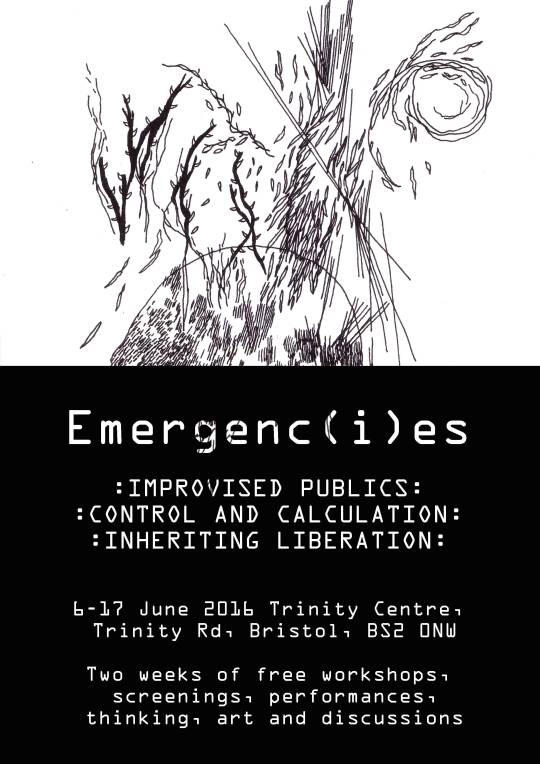
Reblog> Improvised Publics :: Control and Calculation :: Inheriting Liberation :: 6-17 June 2016

This event looks really interesting, check out the website for more information…

Emergenc(i)es – an event in Bristol between 6th and 17th June

Emergenc(i)es is an invitation to consider the emergency of the current historical moment.

The exhibition will dwell in the question of emergence within emergency.

Performance, education activities, visual art, screenings, installations, workshops and a library-cum-pharmacy will create time and space to diagnose, explore and understand the world we live in.

Enter – Relate – Improvise – Diagnose – Inherit – Public – Liberate – Gather

All activities are free to attend, thanks to generous funding from Awards for All.

Feminism, Digital Culture and the Politics of Transmission – Deborah Withers

I don’t really know why I haven’t seen this before today(?!) but just wanted to flag this really interesting book by Deborah Withers, which I will be ordering ASAP…

Feminism, Digital Culture and the Politics of Transmission argues that despite the prevalence of generational narratives within feminism, the technical processes through which knowledge is transmitted across generations remain unexplored. Taking Bernard Stiegler’s concept of the already-there as its starting point the book considers how the politics of transmission operates within digital culture. It argues that it is necessary to re-orient feminism’s political project within what is already-there so that it may respond to an emergent feminist tradition.Grounded in the author’s work collecting and interpreting the music-making heritage of the UK Women’s Liberation Movement, it explores how digital technologies have enabled empassioned amateurs to make ‘archives’ within the first decade of the 21st century. The book reflects on what is technically and politically at stake in the organization and transmission of digital artifacts, and explores what happens to feminist cultural heritage when circuits shut down, stall or become diverted.

And here’s some praise from Patrick Crogan, whose opinion I trust:

A substantial, judicious, and highly effective mobilisation of key tenets of Stiegler’s work pertaining to memory, technology, and cultural transmission. Withers develops a cogent political reformulation of questions of memory, heritage, and archival matters of preservation and access in the digital age in this book project. Her use of Stiegler is central to this, and indeed represents an important introduction to his philosophical critique of the digital mediated world to an area where his ideas have particular relevance but are under-represented.

Patrick Crogan, Associate Professor of Digital Cultures, University of the West of England

“Ways of Being in a Digital Age”, one of five @ESRC priorities for research 2016-2020

I’ve only just seen this but wanted to post this here as a reminder and to point it out to others with similar interests…

In the recently published ESRC Delivery Plan 2016-2020 one of the five priority areas for research is “Ways of Being in a Digital Age”, here’s their one paragraph explanation (p. 4):

Ways of Being in a Digital Age – digital technology is present in all aspects of our lives, whether we actively engage with it or not. It affects the way we communicate, and the ways we receive, consume and process information. It influences routine behaviours – the way we travel, shop and work. The presence of digital technology mediates our perceptions, behaviours and practices across these different domains and thereby influences our ways of living. This raises a number of fundamental questions about our ways of being in a digital age, the risks and opportunities associated with digital living, and our understanding of the individual, community, and society.

Compositional thinking, or ‘deconstruction as composition’

I’ve been re-reading Dan Ross’ excellent chapter in the edited collection Stiegler and Technics entitled “Pharmacology and Critique after Deconstruction” and wanted to post an excerpt because it seems to me one of the clearest interpretations of one of the foundations of Bernard Stiegler’s thought: “composition”. This is a brief excerpt but I thoroughly recommend reading Dan’s chapter, and indeed the whole book – which is really good!


Stiegler inherits more from Derrida than from any other thinker: ‘deconstructive’ thinking is translated in Stieglerian terms into ‘compositional’ thinking:

Deconstruction is a thinking of composition in the sense that composition is ‘older’ than opposition (what Simondon would have called a ‘transductive relation’: that is, a relation that constitutes its terms, the terms not existing outside the relation). It is a relation that is the vehicle of a process (that of différance), one very close, I would argue, to what Simondon elaborates in terms of a ‘process of individuation’ (Stiegler 2001: 249-250).

Deconstruction, pursuing the complex genesis of oppositional pairs, amounts to the elaboration of s process of becoming. It is therefore more consistent than first appearances might indicate with the theories of Gilbert Simondon, for whom the key was not to begin with terms or individuals and then think their ‘relation’; rather, it is the process itself that ‘has the status of being’ (Simondon 1992: 306).

[…]

To this relation of differance to individuation should be added the influence of Nitetzsche, for whom existence must be understood as a play of forces, or, better, of tendencies. The formation of oppositions from prior compositions is an expression of this play of tendencies…

And it may turn out that where compositional thought is superior to deconstructive thought is in making it possible to think de-composition […] Deconstruction thus tends, perhaps, to perceive less clearly the pharmacological dangers of the deconstruction of ‘oppositions’, and the possibility that distinctions may on occasion be precisely what need to be preserved, that is, saved.

Ross, D 2015 “Pharmacology and Critiques after Deconstruction”, in  Howells, C and Moore, G eds. Stiegler and Technics, Edinburgh University Press, Edinburgh, pp. 245-246.

Other references:

Simondon, G. 1992 [1964] “The genesis of the individual”, in Crary, J. and Kwinter, S. Eds. Incorporations, Zone, New York.

Stiegler, B. 2001 “Deconstruction and technology: Fidelity at the limits of deconstruction and the prosthesis of faith”, trans. Beardsworth, R,, in Cohen, T. Ed. Jacques Derrida and the Humanities: A Critical Reader, Cambridge University Press, Cambridge.