Reblog> Book Launch: Playful Mapping in the Digital Age

Via Institute of Network Cultures.

Generally wary of anything with “digital age” in the title, but good to see some geographers featuring in ‘digital cultures’ type networks…

Book Launch Playful Mapping in the Digital Age

MONDAY 13TH OF MARCH, 17:00 – 18:15 @SPUI25, AMSTERDAM.

With keynote lectures by Michiel de Lange and, Emma Fraser and Clancy Wilmott.

From Mah-Jong to the introduction of Prussian war-games, through to the emergence of location-based play: maps and play share a long and diverse history. In this programme, we will launch the book Playful Mapping in The Digital Age, which shows how playing and mapping can be liberating, dangerous, subversive and, performative.

>> Sign up here.

Playful Mapping in the Digital Age shows how mapping and playing unfold in the digital age and in which ways the relations between these apparently separate tropes are increasingly woven together. Fluid networks of interaction have encouraged a proliferation of hybrid forms of mapping and playing. A rich plethora of contemporary case-studies, ranging from fieldwork, golf, activism and automotive navigation to pervasive and desktop-based games, emphasizes this trend. Examining these cases shows how mapping and playing can form productive synergies, but also encourages new ways of being, knowing and shaping our everyday lives. This afternoon, the Members of the Playful Mapping Collective explore how play can be more than just an object or practice, and instead focus on its potential as a method for understanding maps and spatiality.

Coffee etiquette around the world (well some of it)

Interesting post, from a while ago, about the various ways we differently prepare and consume coffee and I guess then how we develop a taste (both gustatory and aesthetic) for coffee…

crema

When it comes to dining etiquette, it is different all around the world. From the United States, to Spain, Africa to Japan, the world eats differently. And the world drinks differently too. The myriad ways in which the world drinks coffee is vastly different too. For instance, in India, slurping coffee is normal whereas it’s considered rude in US. In Turkey, your fortune is read from the coffee ground left at the bottom of your cup whereas in Ethiopia, coffee drinking is an hour affair- not a to-go option. Here is a handy guide to help you maneuver through the world’s coffee drinking experience.

COFFEE DRINKING IN ITALY

In Italy, it is common for a glass of water to be served alongside coffee, so that you can cleanse your palate and prepare it for the coffee. Coffee is always ordered after meals, never before or during. Also, espressos are not ordered to go. Espressos are drunk quickly in a shot at the coffee bar. It is also common to have a cappuccino in the morning, and nothing else. It is also common in Italy for liquor to be included in coffee.

COFFEE DRINKING IN TURKEY 

After meals, black Turkish coffee is served strong with sweet Turkish candy. As Turkish coffee is strong, it is never ordered double. If you want more to drink later, then your next order should be tea. Also, sugar is often added while the coffee is made, and not after. Once your coffee is drunk, it is often normal to have your fortune read from the coffee grounds at the bottom of your cup.

COFFEE DRINKING IN FRANCE 

Dunking a croissant in coffee is acceptable in France. Café au lait is normally drunk early in the morning and using a wide mug so it is easier to dunk your croissant in. Coffee mugs can be held with both hands to savor your coffee. In France, never order flavored coffee; never order filtered coffee, and never order coffee with whipped cream. Coffee in France is always served after dessert.

COFFEE DRINKING IN BOSNIA

Coffee preparation in Bosnia is similar to that in Turkey. Coffee is served in a Dzezva, together with sugar cubes, rahat lokum and a glass of water. The proper way to drink your coffee is to take the sugar cube, and let it dissolve under your tongue while you sip the coffee.

COFFEE DRINKING IN VIETNAM

Coffee in Vietnam is served using an individual drip filter. Hot water is poured onto the coffee grounds in the drip filter and the dissolved coffee slowly fills the cup underneath with fresh coffee. Condensed milk and sugar is added into the cup at the bottom.

COFFEE DRINKING IN SPAIN

A very popular drink both in Spain as well as Portugal is called Cortado, which is based off of the espresso. To reduce the acidity of the coffee, a bit of warm milk is added to the coffee. Cortado is drunk for breakfast as well as during La Merienda which is coffee and snack time, usually happens after a siesta.

COFFEE DRINKING IN ETHIOPIA 

Coffee is considered a national drink in Ethiopia and is a long ritual that stretches for two hours. Sugar is added into small cups, and then water is added followed by coffee. It is normal and customary to inhale the aroma of the coffee before sipping it.  Coffee is served in three rounds which are awol, tona and Baraka. When drinking coffee in Ethiopia, it is always sipped slowly and never drunk quickly.

COFFEE DRINKING IN DENMARK

Due to the extremely cold climate during Scandinavian winters, Denmark ranks highest in the world for coffee drinkers. Cafes are usually packed at every street corner especially in Copenhagen. Filter coffee is especially popular in Denmark and is normally eaten with sweet Danish pastries.


AI under feminist scrutiny

Searching for something else, I came across a 1999 book review by Tiziana Terranova of Alison Adam’s book Artifical Knowing in New Media and Society. As with much of Terranova’s incisive writing, there is a set of observations about the ontological politics of technology studies, in this case a really interesting reflection on how we might understand the issue of embodiment in relation to mediation:

…although embodiment is a foundational feminist category, it is far from being a resolved question. It is much easier to charge malestream science and technology with disembodiment than to come up with a model of embodiment which won’t stir the opposition of this or that feminist quarter. In many ways, the debate about cyberculture and technology keeps stumbling against the same block: if disembodiment is preferential bias of cybernetic technologies, how do we anser that? How do we bring back the body in cyberspace without essentializing it? Interestingly… if [we see] in Harraway’s cyborg (directly inspired by the skewed, labarynthine technologic of cybernetics) a machinic assemblage of organic and inorganics, of identity and difference, maybe [we] could have come up with a constructive, non-essentialist, embodied model of AI. Maybe it is a sad testimony of the overuse of the term ‘cyborg’ that [some are] all to ready to dismiss it as another ruse of an a-political postmodern feminism. It is a pity indeed since it seems to me that the charge of disembodiment more and more often levelled at digital culture (in all its manifestiations) has turned into the final word on the latter rather the beginning of a really different understanding of technology and subjectivity (or in this case, ‘intelligence’). Maybe we need a model of embodiment which is more about connections and partialities, more akin to cybernetics itself, to make AI work for feminists. (p. 142)

“Irreconcilable differences?” Sharlene Mollett’s Gender, Place and Culture Jan Monk Distinguished Annual Lecture

The latest issue of Gender, Place and Culture, and first of 2017, is online. It has Sharlene Mollett’s  Jan Monk Distinguished Lecture,as well as a themed section on ‘Sexual and Gender Minorities in Disaster’. There’s also an article on ‘crazy cat ladies‘ (there is, honest).

Here’s Mollett’s abstract:

Irreconcilable differences? A postcolonial intersectional reading of gender, development and Human Rights in Latin America

In 2015, the United Nations set in motion the International Decade for People of African Descent (2015–2024). While this mandate provides much to celebrate, its reliance on universal and human rights narratives collides against the reality of a persistent inferiorization of Afro-descendant communities as less–than–human. The paradoxical nature of human rights discourses notwithstanding, Afro-descendant women (ADW) leaders in Latin America embrace the opportunity provided by the UN Decade, to rethink human rights discourses and Afro-descendant inclusion in development practice. I draw insight in this article from black feminist and postcolonial thinking to contribute to a growing engagement with the concept of intersectionality in the subfield of feminist political ecology. Employing the concept of postcolonial intersectionality, I reflect on how ADW operationalize particular knowledges and their racialized gendered subjectivities to challenge regional imaginaries that limit livelihoods, access to natural resources and that cast Afro-descendants outside humanity. I connect such organized activism to that of quiet, every day and largely unrecognized acts of resistance among Afro-Antillean women situated in the growing residential tourism enclave along Panama’s Atlantic coast, in a place known as ‘Bocas’. This article draws from ethnographic and historical data collection and is supplemented with news articles, activist scholarship, government documents and secondary resources. Together, I center the intersectional logics of power in Bocas and argue that ADW lead a material and symbolic process of place-making, one that prioritizes life while struggling over carnal, gendered and racialized dispossession and the right to be recognized as human.


Material carriers of thought

In a recent article on the Social Epistemology Review and Reply Collective, Lyudmila A. Markova discusses the material supports for human communication, what Stiegler would call the processes of exteriorisation and thus materialisation of memory/thought:

Even the most common type of communication is not possible without a material carrier. For example, at a minimum stone, papyrus or paper is required for written communication. Their production processes obey the laws of engineering sciences, which are completely independent from the content of the information they convey. Even if the information is transmitted orally, with a voice, a material carrier is present. The sound is produced in a person’s larynx and is uttered through the mouth as language. Furthermore, the air movement, which is born inevitably during the conversation, obeys the laws of physics.

There’s some really interesting discussion of the various ways those involved in studies of social epistemology, and most notably in the essay it’s Steve Fuller’s work set in relation to Kuhn, have attempted to reconcile the passage to knowledge. It’s also curious to see how David Berry’s work ends up in there too, I suspect there’s more than a hint of Stiegler shining through there (but I haven’t read the work so should probably do so…) and it’s a shame Markova doesn’t make that connection. Might be interesting to pursue that angle…

Echoborg

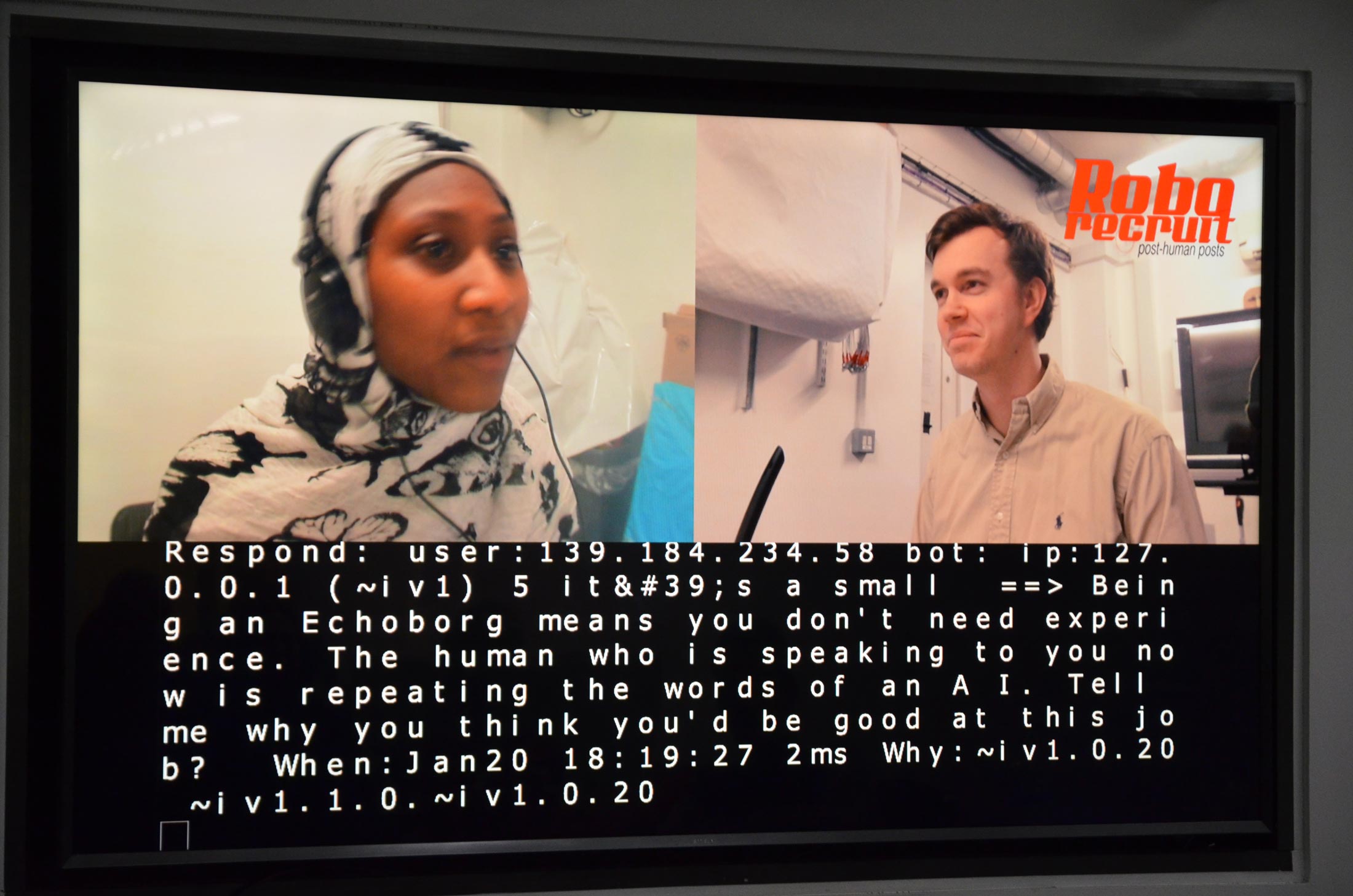
Former colleagues of mine at UWE are developing an interesting project, which you may have seen/heard about through the BBC’s Click programme, called Echoborg.

An echoborg is a hybrid agent composed of the body of a real person and the “mind” (or, rather, the words) of a conversational agent; the words the echoborg speaks are determined by the conversational agent, transmitted to the person via a covert audio-relay apparatus, and articulated by the person through speech shadowing[1].

Recently, the project team have demoed the project as part of an AHRC-funded network on Automation Anxiety and have written this up on the project website, here’s a snippet – it sounds like it is really compelling (I’ve not seen this in action):

Four people were interviewed by the AI which increasingly displayed an interest in eliciting help to reprogram itself. Proceedings were visible on a projector screen and the ‘audience’ of applicants gradually began to discuss the situation of the Echoborg and how to change it. At a certain point their reflections passed a threshold and the group fired into collective action, experimenting with various methods to bring the situation to a head in some way. The lively inventiveness of the group and the individual interviewees went a long way to confirming the interactive potential of this format of the work. It also gave Rik and Phil much to work with in considering the further development of the AI/Chatbot, the restricted delivery of narrative by the human Echoborg and the staging. This event also trialled a secondary, higher level, Echoborg character as part of the slow process of unfolding the potential for this Echoborg recruitment event to be a disruptive and thought and emotion provoking experience for all players.

Notes

  1. Corti, Kevin and Gillespie, Alex (2015) Offscreen and in the chair next to you: conversational agents speaking through actual human bodies. Lecture Notes in Computer Science, 9238 . pp. 405-417.

Tony Sampson on neuroculture

From a Conversation piece on Huxley, dystopia and how we might think about Facebook etc. in relation to Huxley’s “College of Emotional Engineering”, this concise evocation of his understanding of ‘neuroculture’ is interesting:

The origins of neuroculture begin in early anatomical drawings and subsequent neuron doctrine in the late 1800s. This was the first time that the brain was understood as a discontinuous network of cells connected by what became known as synaptic gaps. Initially, scientists assumed these gaps were connected by electrical charges, but later revealed the existence of neurochemical transmissions. Brain researchers went on to discover more about brain functionality and subsequently started to intervene in underlying chemical processes.

Interpretation of Cajal’s anatomy of a Purkinje neuron, by Dorota Piekorz.

On one hand, these chemical interventions point to possible inroads to understanding some crucial issues, relating to mental health, for example. But on the other, they warn of the potential of a looming dystopian future. Not, as we may think, defined by the forceful invasive probing of the brain in Room 101, but via much more subtle intermediations.