The downloaders of Yaoundé

Glitched image of 'Downloaders' in the informal economy of Yaoundé, Cameroon

Via the UCL Why We Post series, I saw this post by Patrick Awondo from the project Anthropology of Smart Phones and Smart Ageing. Really interesting… read the full post here. Some quotes:

Among the material elements that mark the smartphone economy in Yaoundé, there are shops and sales counters that resale low-cost phones, predominantly from Asia. There are also houses and buildings in the same stlye and colours of the operators of local phone companies ; yellow for  South African MTN, Orange for French Orange, red for Korean Nextel, and blue for Cameroonian Camtel. There are also more discreet kiosks. Sometimes these are mobile, but mostly they are  sedentary. They often contain simple tables, where a laptop is installed and speakers are held by a young man between the age of 20-30 . At these kiosks, you find working persons known as ‘downloaders’, whose job it is to assist with people with their digital queries and technical needs for a fee.

Once called ‘engravers’, downloaders are not a new body of tradesmen in Yaoundé. They appeared in the urban landscape with the invention of the compact disk (CD) in the 90s. At that time, young working men here established the act of burning CDs for people (actually a large majority of the urban population), who had no computers to copy music and other films and data via digital media. they They also recorded music onto cassette tapes. The CD gave way to downloading and streaming, and  uses of USB sticks, and eventually smartphones. Downloading has since become a central business in Cameroon in the informal labour economy.

As an informal presence occupying the street, downloaders’s status within the  urban / labour community appears ambivalent, sometimes falling within, and sometimes outside of official protocols. Since the 2000s, public life has become increasingly disciplinary. Assisted by policemen, agents of the municipal brigade carry out daily observations of the streets, and where they deem necessary, do not hesitate to use violence against  young people  occupying parts of urban space and engaging in a variety of commercial activities (Ottou, Forthcoming).

CFP> International Labour Process Conference STREAM Artifical Intelligence, Technology and Work

Industrial factory robot arms

Via Phoebe Moore.

ILPC STREAM Artifical Intelligence, Technology and Work

INTERNATIONAL LABOUR PROCESS CONFERENCE

Artifical Intelligence, Technology and Work 

ILPC 2019 Special Stream No. 5

Please submit abstracts via the International Labour Process Conference website (ilpc.org.uk) by the deadline of 26 October 2018.

Of all the social changes occurring over the past six or seven decades, perhaps most fascinating is the integration of computers and machines into the fabric of our lives and organizations. Machines are rapidly becoming direct competitors with humans for intelligence and decision-making powers. This is important for research in international labour process because artificial intelligence (AI) brings about challenges and questions for how organizations, globally, are designed and established with respective human resources planning and execution and industrial relations negotiations. We start with John McCarthy’s term, who both invented and defined AI as processes that are ‘making a machine behave in ways that would be called intelligent if humans were so behaving’ in 1955. At the origin of the term, AI aligned humans directly with machines, expecting machines to behave symbolically like humans. Over time, programmers working on neural networks and machine learning have emphasised the cognitive rather than symbolic. Now, AI is seen to have comparable capabilities to humans in both routine and non-routine ways, leading to new possibilities for automation. This draws on huge amounts of data often produced originally by humans. In fact, every time we enter a search term on a computer we add to and train machinic ‘intelligence.’ Every day, billions of actions are captured as part of this process, contributing to the development of AI. In doing so, people provide under-recognised cognitive and immaterial labour.
Therefore, this streams looks at the conditions and circumstances whereby machines begin to have the capacity to influence and become integrated in to humans’ ways of thinking, decision-making, working. It also considers the possibilities of AI in resistance against neoliberal and even authoritarian capitalism in the global north and south. AI is a broad term that identifies the pinnacle of machine capabilities that have recently become possible based on the amount of a) extensive big data that has become available in organisations, b) data analytical tools where programmers can identify what to track based on this data and what algorithms will allow one to gain the insights of interest, c) machine learning, where patterns across data sets can be identified and d) AI, where the final frontier has become the ability of pattern recognition across myriad data sets that have already identified their own patterns. When applied to work and work design, the primary goals are efficiency, market capture, and control over workers.
The rise of autonomous machines leads to philosophical questions that Marx engaged with in theories of objectification and alienation. Later, critical theorists have dealt with these questions in labour process research, where technologies and digitalization have created unprecedented concerns for how workplaces and work design are structured and control and resistance are pursued. In particular, the gig economy has become the frontline of these new changes. Workers here are now facing automation of the management function, supervised and even fired (or “deactivated”) without human intervention nor interaction. This is creating intensified and precarious working conditions, leading to fragmentation over digital platforms and platform management methods (Moore and Joyce 2018), as well as new forms of resistance and solidarities. These are all happening while their own work is under the threat of digitalization, where control and resistance have taken new forms and humans are in danger of becoming resources for tools (see Moore 2018a, 2018b; Woodcock, 2017; Waters and Woodcock, 2017).
Ultimately, across the economy, technology and its integration may be leading to organisations that take on a life of their own. Human resource decisions are increasingly taken by algorithms, where new human resources techniques integrate machine learning to achieve a new technique called ‘people analytics’ where data patterns are used to make workplace decisions for hiring/firing/talent predictions, creating significant threats to the possibilities of workplace organising and social justice. Sometimes, AI-based decisions lead to automating aspects of the workplace, for example, in the case of wearable devices in factories that allow human resource calculations based on AI and location-management by GPS and RFID systems. In these ways and others, AI processes inform a number of decision-making processes and digitalized management methods that have led to significant changes to workplaces and working conditions. If machines can deal with ethically based questions and begin to mimic the nuances of experiences and human judgement, will they become participants in humans’ already manifest ‘learned helplessness’? While currently, humans train AI with the use of big data, could machines begin to train humans to be helpless?

This call builds upon the ‘Artificial Intelligence. A service revolution?’ stream that featured at the 36th ILPC conference in Buenos Aires. This year’s stream is intended as a forum to bring together researchers engaged with the topics of labour process, political economy, technology, and AI to discuss this topic. We invite submissions on the following topics (not limited to, but also considering the need not to overlap with other streams):
-The effect of AI on the labour process where control and resistance rub against debates about exploitation Vs empowerment
-The implication of algorithmic management and control on the labour process, work replacement, and/or intensification from the factory to the office
-The “black box” of AI and related practices, algorithmic decision support, people analytics, performance management
-The impact of AI on the Global South: geographies and variegation of AI implementation, direct and indirect impact on jobs and differential effects of diverse socio-political setups
-Resistance and organising against/with AI and social media

Special Issue: We are also considering a submission for a journal special issue (though contributions may be requested before the conference). Please email Phoebe Moore pm358@leicester.ac.uk immediately if this is of interest.

Stream Organisers:

  • Juan Grigera (CONICET, Universidad de Quilmes, Buenos Aires, Argentina),
  • Lydia Hughes (Ruskin College, Oxford, UK),
  • Phoebe Moore (University of Leicester, School of Business, UK),
  • Jamie Woodcock (Oxford Internet Institute, University of Oxford, UK)

Please feel free to contact the stream organisers with any informal inquiries.

For information on the ILPC 2019 and the Calls for Papers for the General Conference and the other Special Streams please go to https://www.ilpc.org.uk/

References
Moore, P. (2018a): The Quantified Self in Precarity: Work, Technology and What Counts, Advances in Sociology series (Abingdon, Oxon: Routledge).
Moore, P. (2018b): ‘The Threat of Physical and Psychosocial Violence and Harassment in Digitalized Work’ International Labour Organization, ACTRAV, Geneva: Switzerland.
Woodcock, J. (2017): Working the Phones: Control and Resistance in Call Centres, London: Pluto.
Waters, F. and Woodcock, J. (2017): ‘Far From Seamless: a Workers’ Inquiry at Deliveroo’, Viewpoint Magazine.

Unformed thoughts on doing ‘work’ – 1 August

I was sitting in my office, which I actually really like (for reasons which may be explained in a bit), when I began writing this post – thinking about the tendency at present for sitting alone in an office to be the sort of ‘everyday’ norm. I suspect this is a common experience for many academics. I also recognise that it is actually a privilege to have my own office, something I really do value, but that’s not the focus of this post. I am also near certain that others have written much the same thing before in different guises. What I want to do is argue for the keeping or reinstating of ‘common rooms’, not for nostalgic reasons but for pragmatic ones.

Summer working in a building that is mostly empty, and so sitting alone quite a bit of the time, makes me think about the nature of my job at present. It also prompts me to remember what it was like five years ago when I started the job I currently have. It makes me think of the stripping away of things that some might think of as quaint, old fashioned, out-of-date and superfluous but I tend to think might actually be really important to the efficient functioning of academic institutions.

We used to have a “Senior Common Room” at the end of my corridor. It was just the one, shared, PGR/staff ‘common room’ for a very large building (the Amory building, in Exeter, is a warren and is home to about seven departments) but it had a little café, the people that worked there were nice – you knew them by name, and it meant that colleagues would gravitate there.

This was a space colleagues would choose to go to. Where possible, patterns I had become used to in other institutions were sort of observed – people would go for coffee around 10:45, some still do, and often arrange to be there for lunch too. This was a room in which you would feel comfortable to take a visiting academic, you may well bump into colleagues. You could learn what others are working on, maybe share tips about mundane teaching issues (the speakers in that seminar room still don’t work etc). Some years ago I doorstepped a colleague at a London university whilst killing time in advance of an event and was taken to a nice, if well-worn, common room and we bumped into colleagues and I learned things I do not think I otherwise would have.

Now, this post is not merely the yearnings of a privileged white male academic pining for a time that only really existed, and was sent up, in campus novels by Bradbury and Lodge. Neither do I want to rehearse that peculiar line about how academic life is special and different. I think many of the issues here are relatable to other kinds of work. Nevertheless, I do think that the kinds of work we do are made better, work better, if we are able to talk and share ideas in ways that are conducive to that communcation taking place. While I think they help – I do not think that a social media channel or email list is sufficient. I guess, this post is also prompted by an anecdote that I’d like to relate, something I observed a while ago but that has stayed with me.

I was looking for our relocated administrators, now no longer ‘geography’ but paired back and blitzed together into a ‘hub’ for the whole building (yes, all seven departments). I was dithering along an unfamiliar corridor on another floor of my building, following room numbers, when I happened across a group of academics talking. Mugs in hand they were stood speaking in semi-hushed tones, somewhat conspiratorially. As I came closer and overheard their conversation it was the usual sort of mix of teaching and research chat. I passed on, in search of the elusive administrators. Having completed my task and returned down the corridor I again passed the group of colleagues stood in the same place talking. Around 15 minutes later I needed to return to the admin office and so strode more confidently back down the same corridor to find the group of colleagues had been augmented by a couple and an impromptu, semi-casual, research meeting was taking place.

I suppose the reason this brief, fairly unremarkable, episode has stuck with me is that this is the reality of working in my building. You talk in corridors, there is nowhere else to go. The ‘common room’ is still sort of there. It has shrunk to accommodate further offices and has been redecorated in the soulless corporate style you will recognise if you work in a university. There are no facilities – so you need to find one of the small kitchens to make your own tea or coffee in advance. We can book seminar rooms for meetings, but that requires notice and you’re told off if you are caught taking in your coffee. Of course teaching rooms are not necessarily conducive to certain kinds of discussion either, with rows of tables and so on.

In the meantime, the building is subject to wall-shaking redevelopment to accommodate the new student ‘hub’, taking the place of our departmental offices. There will be a café and social space for the students. So, many of us drink coffee and eat lunch at our desks and will continue to do so. Some go to the cafés on campus, but I find them rather expensive and it wastes a lot of time with crossing campus and queuing. It is also tacitly clear that these facilities are not intended for staff, they are really for students.

Quite a lot of colleagues work from home when they do not ‘have to’ be on campus. This is difficult for me. We no longer have a ‘spare’ room and so I sit at a desk in the corner of the kitchen. I have no space to store work-related things and so when working from home I have to remember to bring books etc. back and forth in my bag. It is by no means terrible but I find it hard to work from home. I like having an office – all of the things it enables. I would like to bump into colleagues more too. Sitting alone in an office is helpful for concentration and ‘getting things done’ but it is not helpful if it’s the only thing you do. It can be isolating. I value those times when colleagues take the initiative and knock on the door to chat but it can also be an inconvenient moment, with a crying student etc.

Space to meet is, I think, important for a happy and effective working environment in a university department. It also requires a commitment from us, the ‘workers’ to perform the function of commonality – we need to make the time. A common refrain is that there is no time, and I suspect that really is true for many, but even if it’s just once a week, or every so often, I’d like to think that taking the time to be with colleagues and to learn about what they’re doing is an uncontroversially positive thing to do. If we also argue for a little more time to enable this, then all sorts of positive research collaborations, teaching innovations and so on might actually arise – not because of top-down pressure from a person with “chancellor” in their job title but because we actually like to do our jobs.

I am not arguing for the reinstatement of some sort of peculiar system in which a particular class of academic staff can remain aloof in their “Senior Common Room”. I am arguing that, given the kinds of work we do, providing a space to talk, to connect – actually makes us more healthy and more productive. I would also argue that, as lovely as they can be, sometimes you just need to do this away from the students.

For all we might (perhaps rightly) castigate and deride companies like Google, they do understand and take seriously that people work better when there are common spaces and facilities to support less-formal ways of being together. It leads to more productive workers, I am confident that they wouldn’t be doing it otherwise – however ‘cool’ it might look.

So, a modest plea – fight for your common room and use it. I don’t think I’ve taken that seriously enough, so I’ll try too. We don’t know what we’ve got til it’s gone.


40 years of automation anxiety in the UK through BBC clips [video]

Industrial factory robot arms

I’ve just done a rough edit of some snippets from BBC programmes that I think shows an interesting pattern to the ways that automation has been discussed by the UK national broadcaster over the last 40 years. In each case, automation is a significant issue – it needs to be urgently addressed, but that hasn’t yet happened.

Out of the three programmes, the first two are fairly significant in their onward influence.

The first, the 1978 “Now the Chips Are Down” Horizon episode was reportedly a significant influence for the BBC’s own Computer Literacy Project, which spawned the BBC Micro Computer.

The second, the 1980 (middle of three) episode(s) of “The Silicon Factor” was a part of the Computer Literacy Project. Alongside the three-part series, the producers created a report (for the BBC Continuing Education Department): “Microelectronics“, which was commissioned by the outgoing late-1970s Labour government’s Department for Education and the Manpower Services Commission. I thoroughly recommend watching the programmes and looking at the report if you’re interested in the histories of computing and automation in the UK.

The third, as far as I know – less significant in it’s onward influence, is a 2015 episode of Panorama: “Could a Robot Do My Job?” Interesting here because the rhetoric is nearly identical to that of “The Silicon Factor” – we need to take advantage of the revolution.

I’ve got more to say about this and I need to do a bit more thinking but wanted to share, because I think it’s interesting! This video (or a revised version) will form a part of my paper for a double session on ‘New Geographies of Automation(?)‘ at the RGS-IBG conference in August 2018 concerning the ways that we imagine automation.

“How will you manage fallout from [robot] displaced labor?” KPMG

Gigolo Jane and Gigolo Joe robots in the film A.I.

From KPMG’s Strategic Visions on the Sourcing Market 2016, p. 32. Via Jamie Peck’s excellent Offshore.

How will you manage fallout from displaced labor?

The automation of human jobs may cause some unrest, so prepare to have honest, open discussions with your organization. Resistance may come not only from the workers in automatable roles but also from directors who may fear erosion in their span of control, as they potentially go from managing employees to managing bots.


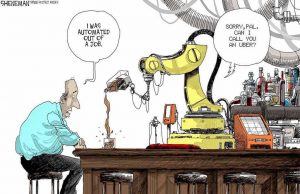
Cartoon about automation by Drew Sheneman

Call for applications >Environmental Impact of Data-Driven Technologies Workshop

Strip mining for rare earth minerals

Via Data & Society.

Call for Applications: Environmental Impact of Data-Driven Technologies Workshop

Deadline for applications: August 16, 2018
Submit your application: http://datasociety.net/EnvironmentTechWorkshop


On November 2, 2018, Data & Society will host a workshop in NYC on the environmental impact of data-driven technologies. The purpose of the Data & Society Workshop series is to enable deep dives with a broad community of interdisciplinary researchers into topics at the core of Data & Society’s concerns.

The structure of the Data & Society Workshop is designed to maximize scholarly thinking about the evolving and societally important issues surrounding data-driven technologies.  Participants will be asked to read three full papers in advance of the event and prepare comments for intensive discussion. Some participants will be asked to be discussants of papers, where they will lead the conversation and engage the room. Authors will not present their work, but rather participate in critical discussion with the assembled group about the paper, with explicit intent of making the work stronger and more interdisciplinary.

Participation in this event is limited. Those who are interested in participating should apply by AUGUST 16.

Environmental Impact of Data-Driven Technologies

By the end of 2018, Bitcoin will consume .05% of the world’s energy per year. This is equivalent to the energy consumption of Denmark. Major tech companies are working hard to make cloud services more energy efficient, but server farms still require tremendous power and water to function. Additionally, other parts of the “stack” (e.g., software development, usage patterns) do not take environmental impact into consideration. Likewise, financiers obsessed with blockchain and 5G are often ignoring the environmental impact of the proliferation of these new technologies. While some IoT chipmakers are competing on energy efficiency, cheap production still dominates that conversation at a moment in which data-oriented tech is being introduced into everything.

[…]

Much work is still needed to understand the environmental cost of technology. The purpose of this workshop is to bring together researchers who are examining these issues from different disciplinary and analytic perspectives. Relevant topics for this workshop might include:

  • What is the environmental cost of blockchain, 5G, AI, and other hyped technologies?
  • How do design concerns at different parts of the “stack” affect the environmental impact of whole systems?
  • What would an environmental audit of artificial intelligence look like?
  • How do/might software engineers or other practitioners integrate climate concerns into their practice?
  • What is the relationship between privacy and energy-sensitive code?
  • How do data centers affect water policies in different countries?
  • How can decentralized engineering practices be made more environmentally responsible?

Read the full Call for Applications.

CFP The Body Productive

Gilbreth motion studies light painting

Saw this via Twitter. Looks good.

Call for Papers

How are bodies produced under capitalism?

How, in turn, does capitalism make bodies productive?

How is the body (and knowledge of the body) shaped by demands of production, consumption and exchange, and how can these logics be resisted, challenged and overcome?

These are the questions at the heart of François Guéry and Didier Deleule’s Productive Body. First published in French in 1972, The Productive Body asks how the human body and its labour have been expropriated and re-engineered through successive stages of capitalism. The Productive Body challenges us to rethink the relationships between the biological and the social; the body and the mind; power and knowledge; discipline and control. Finally, it invites us to think about the body as a site of resistance and revolutionary potential.

corpsbody

At this one-day, interdisciplinary conference, we invite scholars and activists to assess the contribution of The Productive Body, and to address its relevance as a theoretical tool for understanding and challenging contemporary ideologies of bodily health, efficiency and productivity.

We invite submissions from scholars, activists and artists for 20-minute papers, or 10-minute provocations on the relationships – past and present – between capitalism, work and the body. Collaborative papers are welcome, and proposals for longer workshops and panel discussions will also be considered. Please contact the organisers if you are unsure. Proposals that explore or are inspired by any of the following areas are welcome:

  • Critical responses to Guéry and Deleule – the biological, the social, and the productive
  • Materialist vs. discursive approaches to the history of the body
  • Conceptualising discipline in Marx and Foucault
  • The body as an object of discipline vs. the body as a site of dissent
  • The psychology and corporeality of activism, organising and resistance
  • Hierarchies of gender and race in the division of labour
  • (Re)productive bodies; intimate and emotional labour, sex work, body work
  • How are ideas of health and disability shaped by the demands of wage labour?
  • How do queer bodies disrupt or challenge logics of productivity? How are queer bodies in turn, commodified or appropriated by capital?
  • How do the demands of productivity complicate/interact with the body as a site of intimacy?
  • Biopolitics and neoliberalism
  • Body-machines – technology and automation; robotics, cybernetics and transhumanism; digital surveillance, ‘lifelogging’ and the ‘quantified self’
  • Counterproductive bodies: pre-capitalist, non-capitalist, and post-capitalist bodies

Please send abstracts of no more than 300 words to thebodyproductive@gmail.com by 24th August 2018. Submissions are especially encouraged from graduate students, early-career researchers, and groups typically underrepresented in the academy.

Doreen Massey – Critical Dialogues and Reader

Professor Doreen Massey

Doreen Massey Critical Dialogues book the Doreen Massey Reader


Jamie Peck shared on Twitter that Agenda Publishing have two books coming out simultaneously – Doreen Massey. Critical Dialogues and The Doreen Massey Reader. It is a testament, surely, to the mark of Doreen Massey’s influence on geography and the ways many of us try and make sense of the world that several books and theme issues for Massey have been written and edited (not least in the RGS-IBG book series). As the first sentence of the blurb for the Reader asserts: “Doreen Massey changed geography”. These two new books demonstrate both the quality and range of Massey’s own ideas and work and the ways that has inspired and spurred on many others.