Ubiquitous Computing video circa. 1991

“Coined by the Xerox Palo Alto Research Center’s (PARC) Computer Science Laboratory (CSL), [Ubiquitous Computing] describes a vision of the future. Just as electric motors have disappeared into the background of everyday life, PARC scientists envision a future where mobile computational devices will be similarly transparent. Potentially numbering the 100s per person these devices are nothing like those you use today. They are mobile. They know their location, and they communicate with their environment.”

I have no idea if I’m allowed to put this up but it seems a desperate shame that this video isn’t held in one complete file, easily accessible to the public and to researchers, given the historical significance of the work conducted on ubicomp at PARC by Mark Weiser et al. during hte late 80s early 90s. Please see the original files here: http://www.ubiq.com/hypertext/weiser/UbiMovies.html and read more about Mark Weiser by sticking his name in Google.

Please note that I had to edit out 2 minutes of the more technical stuff to get the video down to under 10mins.

Motorola’s “2000 A.D”

In 1990 Motorola produced a video depicting a Ubicomp type vision that was a little more conservative than some other ‘vision videos’ being produced around the same time but has many of the usual constituent elements. What is striking is that the use of mobile phones must have been ‘futuristic’ then but one can’t help considering it banal now…

I am indebted to Paleo-future for these videos, it seems to be a gold mine of an archive!!

Oblong Industries’ “g-speak” and “diegetic prototypes”

One of the examples of ubicomp like technology that was referred to the most in my interviews in California last year was the diegetic prototype [see slide 29] gestural interface in the film Minority Report. This was predominantly the brainchild of a chap called John Underkoffler who was the “scientific advisor” on the film, and has since been an advisor on several other films including Iron Man. According to a paper by David Kirby, currently in-press, Underkoffler’s work at the Media Lab was noticed by the production designer and prop master for Minority Report and was brought in as primary science consultant. For Kirby, Underkoffler’s interface is a prime example of a diegetic prototype, a prototype realised in fictional narrative and image to persuade audiences of a technological need, as Kirby suggests of the gestural interface in the film:

These technologies not only appear normal while on screen but they also fit seemlessly into the entire diegetic world. In these cases audiences will accept as true that characters still use these technologies even when they are off-screen… To achieve the sense of an extraordinary techonlogy appearing as ordinary within the diegetic space Underkoffler established the gestural interface as a “self-consistent technological entity” that adhered not only to the rules of hte diegetic world but also to its own internal logic and the constraints of real-world computer technologies.

And, indeed, that diegetic prototype has become a “real-world computer technology”, as demonstrated below.

Oblong Industries’ “g-speak”


g-speak overview 1828121108 from john underkoffler on Vimeo.

NTT Docomo’s ‘vision of the future’ (2010)

NTT Docomo have created a few vision videos (but this one is easily accessible via YouTube), many seemed to target the end of this decade. The video below uses yet another schmultzy storyline full of pathos in which to situate (and thus ‘humanise’) apparently futuristic everyday technologies. NTT Docomo depict a rather unsettlingly monolithic future of technology, in which everyone and everything is connected together and monitored. A prime example of the apparently easy trade-off between privacy and seamless integration of systems without any consideration of political repercussions…

Visions as Polaris (or – a guiding star)

“[T]o successfully navigate the many uncertainties facing us in the future, businesses need to have a North Star. Even during tough times, you need to know where you’re going, and how you’re going to pull through this.”¦ I believe one of the best ways to articulate this vision is to immerse ourselves in an inspirational view of what the world could look like five, 10, 15 years from now”

– Stephen Elop, President of Microsoft Business Division,
Wharton Business School, 27th February 2009

Over the last week I’ve been working on a new chapter for my thesis, which I hope may also be a journal article, on the production of what I’ve come to call (in shorthand) ‘vision videos’. A key case study is Microsoft’s recent ‘Future Vision of 2019‘, not least because the President of the aforementioned company’s Business Division recently spoke at length about how what is represented in the associated video(s) also represents the guiding values and goals for current and near-future research. Two interesting points might be made about this particular example as a ‘future of the present’, following Mike Michael’s analysis.

First, at ten years in ‘the’ future, what is depicted is framed as sufficiently close to the present for Elop to claim the vision represents what’s do-able: ‘Every single thing here is something that could be real’, and sufficiently distant from the present to absolve the company from having to specify the ‘what’ and ‘when’ of delivery.

Second, the production of such visions is rendered trivial by explaining away how they aren’t far-fetched nor particularly unique, and yet this trivialisation is political – it lends legitimacy. To produce such (video) visions requires quite a bit of imagination, and significant resources. The aesthetics have a political agency, the specificity of the appearance of the world depicted, how the devices and systems will look and how they will be used, attempts to foreclose possibility. The inference is – this is the Microsoft future and this will be how the future looks.

<a href="http://video.msn.com/?playlist=videoByUuids:uuids:eacbe40c-48cb-4a76-a83a-767c9783636e&#038;showPlaylist=true" target="_new" title=".">Microsoft Office Labs&#8217; Productivity Future Vision</a>

Mr Elop introduced the above vision video as follows:

“Everything in this video is based on research and technology explorations from across Microsoft, and throughout the industry. This is not science fiction, nor is it Hollywood imagineering”¦ Watch carefully because in every frame there’s something new and advancing in terms of how technology will enable the improvement of productivity for businesses and individuals.”

Again, to borrow from Mike Michael’s analytic frame, if we think about these vision videos as ‘textualisations’, the connotation of material form, they perform in and on the present. These videos are not representations of ‘future presents’, but rather they are performances of ‘present futures’. In moving, on screen and in-mind, they ‘take time’ in the present and are therefore afforded an agency to act upon the present.

What makes vision videos interesting to me then is not that they are shiny, beautifully produced images of a future to which we can (or must! – according to some) aspire, but rather that they do something in the present, which I’d argue is under-researched. Stay tuned for more…

Edit: I had linked to the wrong video above, Mr Elop showed the ‘Future Vision of Productivity‘ not the shorter montage.

MIT Media Labs’ “Sixth Sense” vision

A clever chap at MIT’s Media Lab Pranav Mistry has created what he calls “a wearable gestural interface that augments the physical world around us with digital information and lets us use natural hand gestures to interact with that information”. This has been picked up by quite a number of people, from Wired to The Sun, Mistry also spoke at TED, and has been touted as a vision of the future. So, it’s not as polished as the MS stuff but here’s another ‘future vision’ video:

Mistry has more information and more videos on his web page about sixth sense.

Chuggers go mobile

Spread out chuggers - Walt Jabsco

Short of actual physical assault there is little more obnoxious when idling along a public thoroughfare than being chugged. Now the assailants have further automated their pseudo-worthy diabolical guilt assaults with smart phones to more efficiently process your banking details, if not instantly shackle you into a direct debit agreement.

Twice during my walk into work this week I have seen chuggers sans clipboards and kitted out with innocuous blackberry-esque handsets. Some outcomes of the pervasion of ICTs are less welcome than others. I wonder if the use of a mobile technology as the data collection mechanism has any effect on attitudes towards giving? Is it off-putting or does having a relatively expensive technology (rather than a clipboard & pen) somewhat authenticate or render greater authority for the chugger? I have no answer, but it’d be interesting to find out (and whether it is a decision calculated on more than efficiency). Either way, such activities are ethically questionable and perhaps antithetical to the admirable aims of charitable organisations.

Productive reductive computing

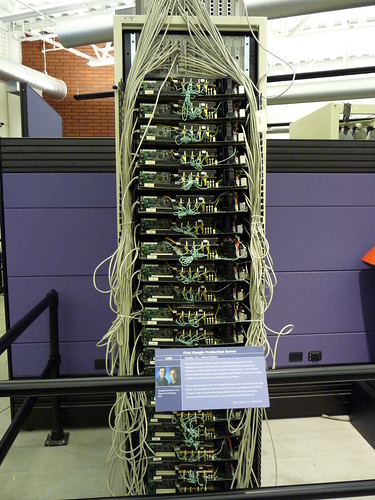
Google's first production server

Towards the end of a recent meeting with my supervisors I was asked a question that went something along the lines of: “do you buy the argument that if something is computational, that it is then necessarily reductive?” An excellent question I think. I suggested at the time, and still believe, there are two answers to this question that go together. First, by virtue of what computing ‘is’, as a machine-enabled set of processes that rely by and large on languages based in a formal logic, we must answer ‘yes’. Second, ‘computing’ as an activity and ‘computers’ as devices do not exist in a vacuum they are a part of our lives. I am writing a blog post using my laptop, connected to a network of other computers, run and maintained by people, allowing me to ‘publish’ my thoughts on a web site held on yet another computer, and hopefully some other people are reading this! Therefore, computing is definitely a part of the ‘politics of things‘, as suggested by Latour, with and by which we and others socialise.

My two answers are not mutually exclusive, “either/or”, they go together such that, I argue, we must increasingly see ‘computing’ as a connective capacity. Computing connects people with other people, people with ideas, information with things, etc etc. In this way, I have some sympathy for those, like Adam Greenfield, that suggest that “ubiquitous computing”, or something like it, was somewhat inevitable. However, I think hindsight definitely smoothes out the errors and stumblings along the way. If we think about ubiquitous computing as “the application of computational tools to human activity regardless of the shape and form of those tools”, following Scott Carter (whom I interviewed this summer), I think we can see computing as an ‘affordance’, the capacity to enable possible actions, which is innately connective. Here we might start looking to Gregory Bateson or Deleuze and Guattari to theorise such a connective capacity.

Why do I blog this? It is useful to keep probing concepts central to, and perhaps assumed, in one’s arguments, and I don’t want to lose sight of the fact that the idea of ‘computing’ is not neccesarily fixed.

Image: Google’s first server, held in the Computer History Museum, CA, taken by me.

Intel’s “Optimism”

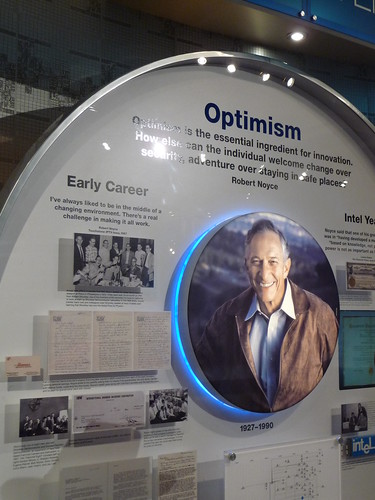
Exhibit about Bob Noyce at the Intel museum, San Jose

The central quote, by Robert Noyce, from this exhibit at the Intel museum is: “Optimism is the central ingredient for innovation. How else can the individual welcome change over security, adventure over staying in safe places”.