New book: Digital Humanities and Digital Media: Conversations on Politics, Culture, Aesthetics and Literacy

Saw this via Twitter:

Looks interesting, includes chapters from Johanna Drucker, Katherine Hayles and  Bernard Stiegler…

Blurb:

Digital Humanities and Digital Media: Conversations on Politics, Culture, Aesthetics and Literacy

edited by Roberto Simanowski

digital-humanities-and-digital-media_cover_200x300.jpg

There is no doubt that we live in exciting times: Ours is the age of many ‘silent revolutions’ triggered by startups and research labs of big IT companies; revolutions that quietly and profoundly alter the world we live in. Another ten or five years, and self-tracking will be as normal and inevitable as having a Facebook account or a mobile phone. Our bodies, hooked to wearable devices sitting directly at or beneath the skin, will constantly transmit data to the big aggregation in the cloud. Permanent recording and automatic sharing will provide unabridged memory, both shareable and analyzable. The digitization of everything will allow for comprehensive quantification; predictive analytics and algorithmic regulation will prove themselves effective and indispensable ways to govern modern mass society. Given such prospects, it is neither too early to speculate on the possible futures of digital media nor too soon to remember how we expected it to develop ten, or twenty years ago.

The observations shared in this book take the form of conversations about digital media and culture centered around four distinct thematic fields: politics and government, algorithm and censorship, art and aesthetics, as well as media literacy and education. Among the keywords discussed are: data mining, algorithmic regulation, sharing culture, filter bubble, distant reading, power browsing, deep attention, transparent reader, interactive art, participatory culture. The interviewees (mostly from the US, but also from France, Brazil, and Denmark) were given a set of common questions as well specific inquiries tailored to their individual areas of interest and expertise. As a result, the book both identifies different takes on the same issues and enables a diversity of perspectives when it comes to the interviewees’ particular concerns.

Among the questions offered to everybody were: What is your favored neologism of digital media culture? If you could go back in history of new media and digital culture in order to prevent something from happening or somebody from doing something, what or who would it be? If you were a minister of education, what would you do about media literacy? What is the economic and political force of personalization and transparency in digital media and what is its personal and cultural cost? Other recurrent questions address the relationship between cyberspace and government, the Googlization, quantification and customization of everything, and the culture of sharing and transparency. The section on art and aesthetics evaluates the former hopes for hypertext and hyperfiction, the political facet of digital art, the transition from the “passive” to “active” and from “social” to “transparent reading”; the section on media literacy discusses the loss of deep reading, the prospect of “distant reading” and “algorithmic criticism” as well as the response of the university to the upheaval of new media and the expectations or misgivings towards the rise of the Digital Humanities.

Contents

Roberto Simanowski Introduction

Johanna Drucker At the intersection of computational methods and the traditional humanities

John Cayley Of Capta, vectoralists, reading and the Googlization of universities

Erick Felinto Mediascape, antropotechnics, culture of presence, and the flight from God

David Golumbia Computerization always promotes centralization even as it promotes decentralization

Ulrik Ekman Network Societies 2.0: The extension of computing into the social and human environment

Mihai Nadin Enslaved by digital technology

Nick Montfort Self-monitoring and corporate interests

Rodney Jones The age of print literacy and ‘deep critical attention’ is filled with war, genocide and environmental devastation

Diane Favro, Kathleen Komar, Todd Presner, Willeke Wendrich Surfing the web, algorithmic criticism and Digital Humanities

N. Katherine Hayles Opening the depths, not sliding on surfaces

Jay David Bolter From writing space to designing mirrors

Bernard Stiegler Digital knowledge, obsessive computing, short-termism and need for a negentropic Web

Bernard Stiegler: “The time saved through automation must be granted to the people” [translation]

The interview with Bernard Stiegler translated below comes from the l’Humanité.fr website. This follows nicely from the other interview about ‘how to survive disruption’ I recently translated. It’s interesting for a number of reasons, but I think principally because he offers a little more detail on how one might go about creating an ‘economy of contribution’ by discussing the experiments with Plaine Commune and what he means by “contributory income” and how that differs from a ‘universal basic income”. For those interested in Stiegler’s work, beyond the philosophical texts, this is quite an enlightening read (I think).

As usual, clarifications and original French are in square brackets. In this case, all of the footnotes are by me. I hope some others find this of interest… I did.

Bernard Stiegler: “The time saved through automation must be granted to the people”

In the face of the upheavals created by digital data, the philosopher [Bernard Stiegler], developing his research in concert with the think tank Ars Industrialis and the Institute of Research and Innovation [of the Pompidou Centre], invites us to comprehensively [de fond en comble] rethink work. He advocates the establishment of an economy of contribution based on a new type of value production and social justice.

We are entering the era of big data. Does the quantitative explosion of digital data signal a new industrial revolution?

Bernard Stiegler Yes and it is already upon us. A study for the board of Roland Berger [a global strategy consultancy] suggests that three million jobs will be destroyed in the next ten years. But, other studies predict that 47% of jobs in the US, 50% in Belgium and France, will be automated in the course of the next twenty years. We are entering the third historical wave of automation. In the 19th century machine tools enabled capitalism to achieve enormous gains in productivity, while distributing the resulting profits only amongst the bourgeoisie. The second wave was created through Taylorism and the assembly line, which in part benefited the working classes because the workers consumed the goods they played a part in producing, creating mass markets. The third wave is not solely constituted by robots but also by the data we all generate, notably with our smart phones. All of these data that we deliver to platforms, such as Google, banks or shopping websites, are processed in every country and in an immediate manner by algorithms. Their exploitation allows, for example, a company like Amazon to predict what it may sell and to encourage us to buy in an extremely efficient manner, all with the minimum staff. Further, automation is allowing the company’s founder, Jeff Bezos, to design very simple robots, capable of placing and retrieving stock incredibly quickly, without human interaction, controlled by software.

Does this means that in the near term a company like Amazon will be able to do without employees to pick, pack and send out packages?

Bernard Stiegler Warehouse workers will be replaced by robots. The “robolution” [1] is becoming increasingly possible for a large number of companies. The humanoids that are reaching market now are much less expensive and more advanced than the large automata already in use. Even SMEs can invest in them.

In the medium term then, such automation concerns everyone?

Bernard Stiegler Driverless lorries are already on the roads of Nevada and soon will be in Germany. Artificial intelligence will be able to replace lawyers who put their legal studies on file. All analytical jobs will be effected. Even medics. A high performance robot is able to conduct prostate surgery… In his Foundations of a Critique of Political Economy [the Grundrisse], Karl Marx formulated the hypothesis: what if everything  is automated? If nothing changes, in particular regions, 80 to 90 percent of the under 25s will soon have no other perspective. The markets will collapse, because there will be no more purchasing power, and with them will go the social security system that relies on workers’ contributions. A new society is being formed and it is not very compatible with that of today. We urgently need to rethink everything, to develop trade based on a new type of value production and social justice. I strongly believe in experimentation, which is why we have launched a project related to Plaine Commune [2] in the urban community of Seine-Saint-Denis. Beginning with a 10-year pilot programme, the aim is to create a district of learning [territoire apprenant] whose inhabitants are not only consumers of but also providers [prescripteurs] of digital services.

We imagine that this area was not chosen at random. Plaine Commune is both rich in diversity, it’s network of associations but also home to a disadvantaged population, facing mass unemployment… 

Bernard Stiegler When I started talking about this project with Patrick Braouezec, president of Plaine Commune, 38% of young people under 25 were unemployed in Seine-Saint-Denis. That figure is now 50% and if we follow the projections, the rate could reach between 80 and 90% in ten years. This endemic problem of unemployment will affect all developed countries unless they invent something new: that’s what we want to do in Plaine Commune. The idea is to develop an economy of contribution in a completely different model to Uber. The time gained through automation must be made available to people, otherwise the economy will collapse. The Indian economist Amartya Sen has shown, through a study comparing the residents of Bangladesh and Harlem [New York], that life expectancy is better and we live in a better society when the sharing of expertise strengthens social ties. He discusses a Human Development Index. Plaine Commune is a bit like Bangladesh: the people there are exercising a remarkable energy. [Various] actors, businesses and residents are aware of the urgent need to invent something radically new, which is to use the mechanisms of contribution to develop a commons in a project that promotes the development, exchange, and transmission of practical knowledge [savoir-faire], life skills [savoir-vivre] and theoretical knowledge [savoir théoretiques] among the younger generations, associations, businesses, public services of the area, and doctoral students from around the world. Researchers will have the mission to facilitate and work alongside these changes.

So this project proposes to put people at the centre of an increasingly automated society [une société de plus en plus robotisée]?

Bernard Stiegler Standardisation, the elimination of diversity, and the destruction of knowledge produce high-dose entropy, characterised by the state of “disorder” of a system. Here was must engage in a little theory. In the nineteenth century, physicists established that, in the theory of a universe in expansion since a big bang, energy irreversibly dissipates. The law of becoming is entropy [La loi du devenir est l’entropie]. Erwin Schrödinger, a great theorist of quantum mechanics (which is the theoretical basis of nanotechnology), however, showed that life is characterised by its ability to produce negative entropy, which is also called negentropy. This delays disorder, that is to say death, which is a decomposition of living matter. Social organisations have a similar function. Automation, which is a hyper-standardisation, produces entropy. Google’s algorithms, which can translate the languages of the world through English, which acts a pivot language, causes an immense linguistic entropy. The impoverishment of vocabulary and dysorthography regresses individual and collective intelligence through a submission to the law of averages. Conversely, life produces, through exceptions, mutations that are impossible to anticipate but which are the very conditions of evolution. Poets and writers have shaped languages through their exceptional use of language. Algorithms erase all exceptions: they only work by calculating probabilities based upon averages. Crude automation produces a generalised (mental as well as environmental) disorder, which ruins the economy. In the economy of tomorrow, automation can instead be placed at the service of the production of negative entropy. It must allow for the valorisation of exceptions by developing the collective empowerment of everyone to make the commons [la valorisation des exceptions en développant la capacitation collective de chacun pour en faire du commun].

The upheaval that you describe considerably changes the concept of work. Are we facing the erasure of the organisation of employment around the notion of salaried work?

Bernard Stiegler In employment [l’emploi] today, the worker [travailleur] is deprived of their expertise [savoir-faire]. They must follow a process and rely upon software – until one day, the task has become automated and the employee [l’employé] is dismissed. Work [Le travail], by contrast, is an activity during which the worker enriches the task by exercising their knowledge [savoir] through its differentiation [en le différenciant], and continually bringing something new to society. This kind of work produces negentropy, that is to say, also, value, and it cannot be automated because it consists, on the contrary, in de-automating [désautomatiser] routines. Ongoing automation must redistribute some of the productivity gains in order to fund some time for everyone to build capacities [un temps de capacitation de tout un chacun] within an economy of contribution that enables everyone to enhance their knowledge. This is why we advocate the adoption of a contributory income, which is not the same as a universal income.

Precisely, the idea has even more trouble finding its way because it overlaps very different definitions … 

Bernard Stiegler Such an income, also called “basic” [income], is a safety net. A contributory income is at the intersection of the models of temporary work in the performing arts [intermittents du spectacle] and the practices of [creating] free software. It covers various levels of compensation that depend upon the periods of employment and the level of salary. The work of tomorrow will be discontinuous [intermittent]. Periods of employment will alternate with periods of acquiring, developing and sharing knowledge. The right to the contributory income will be “rechargeable”, based upon the number of hours of employment. In case of problems, the system will be accompanied by a minimum living wage [revenu minimum d’existence] – as a social protection system accompanying the scheme. The trial we have led with Plaine Commune includes testing a contributory income to benefit those who are younger, for whom the amounts could increase with age and where the contribution allowance [allocation contributif] outside of the employed period would represent a percentage akin to the model of paying unemployment benefit to those working in the performing arts [les intermittents]. The beneficiaries would be invited to “invest in themselves” [«s’encapaciter»], that is to say, to increase their knowledge through studies as well as professional experience. They would be invited to share their knowledge [savoirs] with their neighbouring community [communauté territoriale]. All of this calls for a new collective intelligence, capable of mobilising formal and advanced theoretical knowledge, which is why, with doctoral students, the aim is to develop a contributory research involving the young and local residents. The aim is to develop an economy of contribution founded on the production of negentropy. [3]

So, periods of paid employment remain in your system – what is the difference between contributory work [travail contributif] and precarious part-time job [petit job précaire]?

Bernard Stiegler The switchboard operator job at TF1 paid in the vein of someone working in the performing arts [comme intermittents du spectacle] is only made precarious [précarisée] at the expense of Assedic [4]. Contributory work must be defined by precise criteria. However, such a question cannot be answered a priori, except through the formal principal I have already stated, which is the production of negentropy, that is to say: practical know-how [savoir-faire], life skills [savoir-vivre] and formal knowledge [savoirs formels]. The PhD theses of our doctoral students are intended to inform these issues in close collaboration with the work carried out in Villetaneuse by Benjamin Corriat’s team on the economy of the commons. We will build on the experience of the architect Patrick Bouchain, who has shown how to put urban renewal projects in the service of a political economy of collaboration – where the residents, who are directly involved in the renovation, may be paid in shares of the development [l’habitat]. There are possibilities for developing the economy of contribution through associations, cooperatives, the social economy and solidarity, public services, as well as through industry, where new production methods will create new professions, which will be intermittent.

Have you any idea of how to fund this radical transformation to systems of production?

Bernard Stiegler A share of the gains in productivity must be redistributed. Taxes raised on trillions of euros passing through purely speculative markets might actually be invested in profitable, just and sustainable projects, without forgetting the fight against tax evasion. Vocational training credits [Les crédits de la formation professionnelle] – 38 billion Euros per year – should be involved in funding the economy of contribution, as should many of the exemptions from social charges or tax that could be diverted for this purpose. They represent 80 billion Euros. There really is enough there for this to be funded.

Notes [by me]

1. “Robolution” is a literal translation of the neologism used by Stiegler, i.e. a portmanteau of robot & revolution.

2. The project with Plaine Commune is specified in outline [in French] on the France Strategie 2017-2027 website, and is supported by the Fondation de France.

3.As in previous written work and interviews, Stiegler uses the idea of the “intermittents” or “intermittents du spectacle” to signify the idea of work that is subsidised through some form of state administered allowance, such as unemployment benefit. In France people working in the performing arts are entitled to claim for social security benefits designed for people without regular employment [as per the definition provided by Larousse online.]

4. Assédic or ASSEDIC is the partial acronym of “Association pour l’emploi dans l’industrie et le commerce” (Association for Employment in Industry and Trade).

Reblog> Yuk Hui @digital_objects at Birkbeck on ‘For a Realism of Relations: The Case of Digital Objects’

via Scott Rodgers –

Yuk Hui – For a Realism of Relations: The Case of Digital ObjectsThe Vasari Research Centre for Art and Technology at Birkbeck is pleased to welcome Yuk Hui on 17 June, 2016 (3pm to 4pm in the Birkbeck Cinema)

In this talk, Yuk Hui will discuss his recent book On the Existence of Digital Objects, which is an investigation of digital objects in light of the proliferation of computational ontologies, and situates this phenomenon within both the history of philosophy and computation. This central thesis of the book is to develop a theory of relations in order to understand objects and to politicize the existence of digital objects, by drawing from Simondon, Heidegger and Husserl.

The talk will be followed by a response from Vasari Research Centre director Joel McKim and a Q&A with the audience.

Yuk Hui is currently research associate at the Institute of Culture and Aesthetics of Digital Media of Leuphana University Lüneburg; previous to that, he was postdoctoral researcher at the Institute for Research and Innovation of the Centre Pompidou in Paris. He is editor (with Andreas Broeckmann) of 30 Years after Les Immatériaux: Art, Science and Theory (2015), and author of On the Existence of Digital Objects (prefaced by Bernard Stiegler, University of Minnesota Press, 2016).

Registration: https://www.eventbrite.co.uk/e/yuk-hui-for-a-realism-of-relations-the-case-of-digital-objects-tickets-25647236575

Further reflections on ‘being in a digital age’: remember the “Virtual Society?”

Virtual Society? ESRC programme

I was trying to think about the lineage of an ESRC programme on ‘digital’ stuff and was prompted to remember the Oxford-led (by Steve Woolgar) ESRC programme: “The Virtual Society?” and accompanying publications.

It is probably worth revisiting, however out-of-date it might feel, because I suspect there are some questions posed there to follow-up. Or at least modes of framing issues that maybe of interest…

Some good people were involved in that programme, including Christine Hine, Sonia Livingstone, Celia Lury and Sally Wyatt (amongst others). I hope that the interest in qualitative work within the ESRC’s scoping call will take into account good work like theirs, and Daniel Miller’s.


Scoping review @ESRC : Ways of being in a digital age ~ anyone applying?

A kind colleague sent this to me just now and it made me both sit up in interest and slightly slump in my chair… I would love to be involved in this but just can’t see how…

This looks like a really interesting opportunity for an interdisciplinary team to provide a valuable and incisive push to the ESRC to think about what an earth “ways of being in a digital age” might mean. I do hope someone cam drive this forward in a positive way, the boosterism of “big data” etc. or the dystopian malaise of “algorithmic governance” are simply not sufficient for this task1.

Invitation to submit Expressions of Interest

We are delighted to invite Expressions of Interest (EoI) for a scoping review to inform a future ESRC initiative on ‘Ways of being in a digital age’.This is an exciting opportunity to inform ESRC’s possible future strategic investment and provide a more holistic view of how digital technology mediates our lives, and the way technological and social change co-evolve and impact each other.

This is a broad and much researched area, so the purpose of the scoping review is to undertake a systematic literature review and synthesis; to identify gaps in current research and determine where the ESRC should focus any initiative to add most value. Through this process the aim of the scoping review is also to build new networks and extend existing ones across the academic community, amongst other stakeholders and potential funding partners.

The scoping review is for a maximum duration of eight months and must commence no later than 1 August 2016. The maximum budget for the scoping review is £300,000 at 100 per cent in full economic costs. In accordance with RCUK policy, the ESRC will contribute up to 80 per cent of the full economic costs.

The call makes a brilliant plea for qualitative work (bottom of p. 3), which is very much needed. I hope this is something we can all build upon.

The initial questions offered in the invitation are interesting, but really need to be pushed a bit further For example, talking about “impacts” on society and forms of community that emerge “as a result” of technology are far too technologically determinist, and there isn’t “the digital” as some kind of amorphous separate domain,  where’s the conceptual nuance here?!

  • How we define and authenticate ourselves in a digital age

  • How do we construct the digital to be open to all, sustainable and secure

  • How digital technology impacts on our autonomy, agency and privacy – illustrated by the paradox of emancipation and control

  • What are the challenges of ethics, trust and consent in the digital age

  • How we live with and trust the algorithms and data analysis used to shape key features of our lives

  • How our relationships are being shaped and sustained in and between various domains, including family and work

  • What new forms of communities and work emerge as a result of digital technologies – for example new forms of coordination including large scale and remote collaboration Whether and how our understanding of citizenship is evolving in the digital age – for example whether technology helps or hinders us in participating at individual and community levels

  • How we define responsibility and accountability in the digital age Whether technology makes us healthier, better educated and more productive.

None of the disciplinary silos is sufficient in addressing this. It would be really, really depressing to see just a “digital sociology”, “digital geography”, or “digital anthropology” type review made here.

I hope someone is bold and imaginative and really pushes at the questions we should be asking. I would welcome conversations about how I could contribute in some small way…

Note
1. I am not seeking to denigrate those who work on such things, merely pointing out that no fashionable trope is sufficient. Just as those that led the “Virtual Society?” theme for the ESRC back in didn’t bang on about “cyberspace”, although the use of the term “virtual” is/was possibly problematic…

Critical and Creative Ethnography After Human Exceptionalism. Brilliant new publication from @annegalloway

Amidst the slog of marking a shining jewel-like piece of inspiration appeared in my inbox – one of my academic heroes Anne Galloway shared a draft of what is a fantastic chapter for a brilliant book, which is set to be published later this year (what a great editorial team too!). Anne has posted about this on her lab’s blog, so I am reposting some of that post… however, go and read it on the More-than-human Lab blog!

I’m pleased to announce that The Routledge Companion to Digital Ethnography, edited by Larissa Hjorth, Heather Horst, myself & Genevieve Bell, will be published later this year.

For the companion I also contributed a chapter called “More-Than-Human Lab: Critical and Creative Ethnography After Human Exceptionalism.”

Anne shares the introductory paragraph, which I think wonderfully performs precisely the ethos of praxis she explores in the chapter:

Haere mai. Welcome. This story starts with an introduction so that the reader can know who I am, and how I have come to know what I know. My name is Anne Galloway. My mother’s family is Canadian and my father’s family is British. Born and raised outside both places, for the past seven years I have been tauiwi, or non-Māori, a settler in Aotearoa-New Zealand. I have always lived between cultures and have had to forge my own sense of belonging. Today I am in my home, on a small rural block in the Akatarawa Valley of the Tararua ranges, at the headwaters of the Waikanae River, on the ancestral lands of MuaÅ«poko (Ngāi Tara) & Ngāti Toa, with my partner, a cat, seven ducks, five sheep–four of whom I hope are pregnant–and a multitude of extraordinary wildlife. The only way I know how to understand myself is in relation to others, and my academic career has been dedicated to understanding vital relationships between things in the world. Most recently, I founded and lead the More-Than-Human Lab, an experimental research initiative at Victoria University of Wellington. Everything I have done has led me to this point, but for the purposes of this chapter I want to pull on a single thread. This is a love story for an injured world, and it begins with broken bones”¦

Anne offers more excerpts and explanation in her blogpost and her full reference list (so please do read it!).

I did however want to share a brief snippet of one of the many bits I love from the chapter:

As more technological devices connect people to things in the world, and as more data are collected about people and things, digital ethnography stands to make an important contribution to our understanding of constantly shifting relations. When combined with speculative design that translates realist narratives into fantastic stories, I also believe we can inject hope into spaces, times and relations where it seems most unlikely.

For me,  Anne’s reading of a feminist ethics of care: for knowledge for our ‘selves’ and for our decentred place in the vital soup of our (transindividuated) becoming, as a part of contemporary ethnographic praxis is really valuable and we would all do well to involve ourselves in the conversation which Anne invites.

The image at the top comes from Anne’s twitter feed, it’s one of her own sheep:

Contested Cities conference ~ July 2016, Madrid

Saw this via Gillian Rose on Twitter, looks interesting!

As part of our upcoming Conference in Madrid (July 4-7, 2016), the Contested Cities network and its partners invites contributions for a radical mixed- and multi-media exploration of contestation and cities. Our goal is simple – to challenge people everywhere to see cities and the struggle for their past, present and future in a new light, and to do so by gathering an international set of creative projects in one place. We think we can do that in part by using all of the new audio and visual tools at our disposal. We have some ideas ourselves, but are looking globally for those who want to join in.
We encourage and actively seek contributions from amateurs and professionals alike – expert videographers who may be amateur urbanists, expert urbanists who are amateur photographers, people who wear multiple hats comfortably, data visualization nerds, map geeks, audioheads, visual artists and everyone in between. If you are someone new to both thinking about cities and visualizing them, and simply had a moment of inspiration and now have a provocative project they want to show someone, send us your project! 
Accepted projects will be shown via slideshow at the Congress, and we hope to invite some of the best submissions for an international book project. We may also build a web version, but will ask permission before posting your work.
All “authors” will be invited to attend, but alas we cannot cover registration fees. There is no fee for submission.

Reblog> Bite Size Theory [on the presence/absence of mobile phones]

via Pop Theory:

“The presence/absence of mobile phones in one’s fictional worlds is going to be, I suspect, no trivial matter. Because so much of the mechanics of novel writing, past and present, is taken up with making information available to characters or keeping it from them, with getting people together in the same room or holding them apart. If, all of a sudden, everyone has access to more or less everyone else – electronic access, that is – what becomes of all that plotting?”John Coetzee, in Paul Auster and J.M. Coetzee, 2013, Here and Now: Letters 2008-2011.

The Museum of Contemporary Commodities in EXETER

The Museum of Contemporary Commodities

Just a quick note to let you know that the brilliant Paula Crutchlow has brought “The Museum of Contemporary Commodities” (MoCC) to Exeter for the majority of May.

There’s lots going on, much of it creative and interesting – so if you’re in Exeter or nearby: come and visit!

Two immediate things this week:

RIGHT NOW!: help re-create the internet in paper with Artist Louise Ashcroft from 11 -2 in the Exeter University Forum.

TOMORROW: sign up to do a data walkshop with Alison Powell from the LSE on Saturday from 10-1. Places have to be booked, and the Eventbrite page is here https://www.eventbrite.com/e/mocc-data-walkshop-tickets-24464719635

Please do visit the MoCC website for lots more events and activities taking place this month and visit the shop:

87 Fore St,
Exeter
EX46RT

Open 10:00-18:00pm Weds-Sat, 4th-21st May.

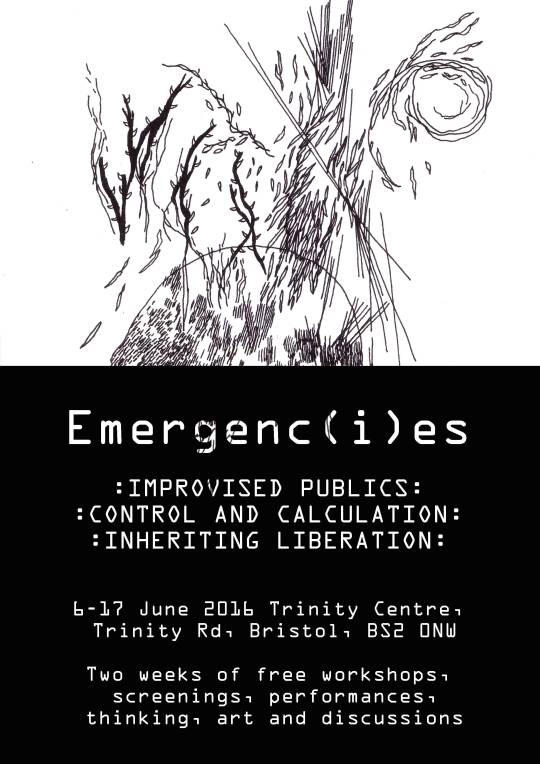
Reblog> Improvised Publics :: Control and Calculation :: Inheriting Liberation :: 6-17 June 2016

This event looks really interesting, check out the website for more information…

Emergenc(i)es – an event in Bristol between 6th and 17th June

Emergenc(i)es is an invitation to consider the emergency of the current historical moment.

The exhibition will dwell in the question of emergence within emergency.

Performance, education activities, visual art, screenings, installations, workshops and a library-cum-pharmacy will create time and space to diagnose, explore and understand the world we live in.

Enter – Relate – Improvise – Diagnose – Inherit – Public – Liberate – Gather

All activities are free to attend, thanks to generous funding from Awards for All.