Repost> Our new European Commission DG EMPL report: Algorithmic management trends and the world of work

We are happy to announce that our report, prepared for the Employment, Social Affairs and Inclusion (DG EMPL) of the European Commission, has …

Our new European Commission DG EMPL report: Algorithmic management trends and the world of work

Interesting discussion in this post about the uses of systems to automate particular kinds of management task. Originally written & a hared by Phoebe V Moore.

For a ‘digital studies’

 “Where do you want to go today?” –Microsoft advertisement campaign, 1994.

There has, for a long time, been a sort of silence on the ‘digital studies’ JiscMail list – so I thought it was probably worth trying to do something with it.

Several years ago, a few people met for a semi-regular reading group in Bristol (in the UK) to work through a variety of ideas relating to ‘the digital’, whatever that may be. I somewhat flippantly named the associated email list: ‘digital studies’. In part because I was, and continue to be, greatly influenced by the late philosopher Bernard Stiegler, who, amongst many other things, wrote a call for ‘Digital Studies’ in 2012 (here’s a blogpost by me around the same time).

What would a ‘digital studies’ list and maybe an online reading group(?) mean today, in 2025?

I would argue that in the intervening years, between 2012 and today, there has only grown a greater urgency for studying the things named ‘digital’ and the sorts of work ascribed to them, abstractly and materially, for good and bad. So, in this follow on, and more modest, call for a digital studies (pluralised, provisional and no capital letters) I want to offer an invitation to grasp that urgency to interrogate ‘the digital’.

“Now come, fire!” – The Ister, Hölderlin

Digital technologies, in Stiegler’s terms, are the latest form of writing and access to writings, they are the means by which an industrialisation of knowledge has been taking place. There is, for Stiegler, an accelerating industrial and largely automated form of writing shaped, edited, broadcast and read with the help of forms of automation that take place at speeds tending towards the speed of light. The digital technologies are ‘intellectual technology’, following the work of Jack Goody, in which an automation, industrialisation and performance of speed radically transforms the conditions of the ‘life of the mind’, our collective capacities for creativity and critique – including and across the arts, culture, economy, geopolitics, science.

Writing, in any form, is an ensemble of traces, and rules of combination of those traces. For Stiegler, following the likes of Andre Leroi-Gourhan and Bertrand Gille, all human societies can be described as regimes of traces: the inscription, exteriorisation, and interiorisation of traces are what constitutes the material culture of the human ‘spirit’ and the ‘life of the mind’ (la vie de l‘esprit). The processes of ongoing digitalisation raise, for Stiegler and I argue for us, questions concerning the future of human cerebral organisation, what kinds of lives of the mind (and their material and social supports) we want to flourish.

It is essential to all disciplines in all their dimensions to question the status given to technics in our ongoing becoming as humans, and in the becoming of knowledge by which we come to know ourselves and our world/s. The questions imposed by digitalisation – what kinds of life we (collectively) want to live, according to Stiegler, is posed well before that of digitalisation itself, as if the radical experience of the upheavals provoked by digitalisation renders these questions apparently unavoidable.

What is to be done? 

I propose a monthly online meet-up to read and discuss work we feel might be relevant to this broad questioning of ‘the digital’. I cannot run this alone, so It will need, from the outset, people to volunteer time and ideas, but this email list can act as the initial vehicle for organising. People may come and go, of course, and I wouldn’t wish this to be a burden, but rather an opportunity. For many, these may be worrying times, but there is solidarity in coming together to affirm creative and critical reflection.

In his 2012 call, Stiegler argues that:

[D]igital studies should not be limited to the study of digital technologies: their general object would be the study of technics and intellectual technologies in general from the angle of their effects on all knowledge in general. In this sense, rather than digital studies, it would be without a doubt better to talk of knowledge studies (“studies” in plural form denoting a specific relation regarding epistemology which, other than studying scientific knowledge (savoir) and understanding (connaissance), is conceived from the outset as a discourse unified by a pure logos of all technicity).

Hence knowledge studies would propose in principle – and as their common position – that the study of knowledge is not soluble to that of cognition, as all knowledge and understanding supposes, at the same time, being able to transmit and transform a technical artifactuality is essential to what Georges Canguilhem described as the form of technical life.

Now, some of these terms and their phrasing may seem grandiose. Even so, the ethos of a digital studies as an interdisciplinary endeavour with the goal of interrogating the contemporary conditions of our ongoing negotiations of creativity, critical reflection and culture, remain worthy goals to which we might aspire. Albeit, perhaps, in more modest terms. In 2012, for those involved in Stiegler’s circle (The Insitute de Recherche et d’Innovation  at the Pompidou Centre and the Ars Industrialis collective) this was located in a conference that led to a website [digital-studies.org]. I would argue it is possible for a modest goal of forming a community of practice to read and explore work, our own and others, by acquiring fairly easily and inexpensively various means and consuming little time, allowing the maintenance of an online forum, beginning with this email list. 

I can offer some suggestions for readings, I think a great place to start, though, is with you – what do you want to think about? What do you want to discuss with likeminded peers?

Please contribute ideas and suggestions! Open the conversation. Everyone is welcome.

Join the list here

Narratives of labour as infrastructure and the automative imagination

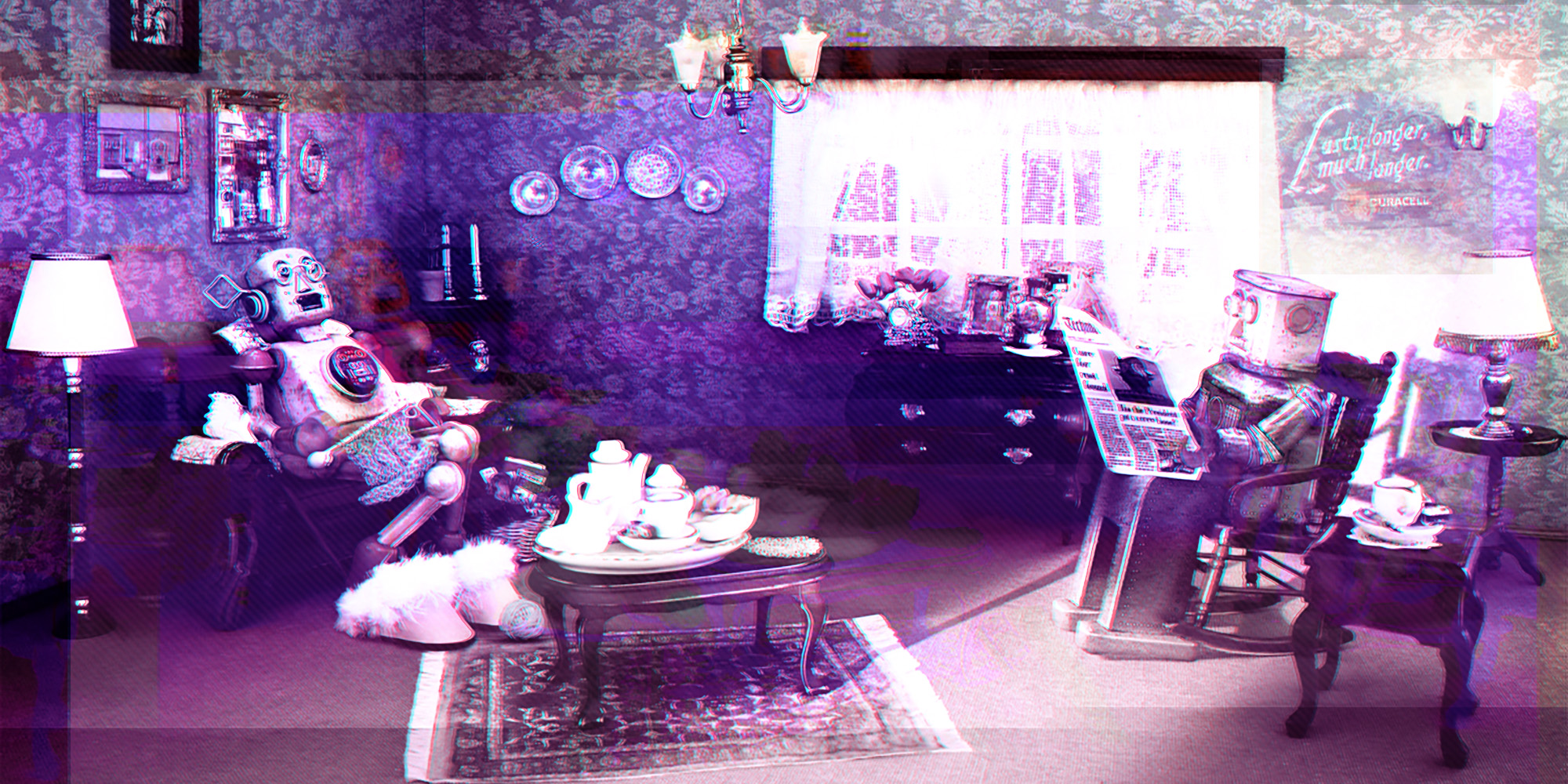
Glitched representation of 1980s Duracell robots in a domestic setting

I have a new journal article out, as part of a theme issue in Environment and Planning D: Society & Space. This forms the first peer-reviewed publication that stems from work I began around 2016 concerning automation (this is one of the earliest posts on this blog about it, with a talk I did at the SW Futures meet-up group). This took an impetus from the work of Bernard Stiegler around automation and my initial thinking with and through his ideas was influenced by many conversations around that time with my friend and former colleague Patrick Crogan, who has also written on automation (more than me!), e.g. here.

What the does ‘automative’ mean? You might be asking yourself. Well, I coined a neologism because I couldn’t find a word that fit what I wanted to say. In the paper I put it this way:

The ‘automative imagination’, in the context of this article, is a heuristic that enables two things: (i) a critique of the spatial politics scale pregnant within debates around the opportunities and threats brought by automation; (ii) an interrogation of the normative character of different habits of considering and discussing automation. I am not using the neologism ‘automative’ to assert any kind of authority but rather as a pragmatic tool. Other words do not quite fit—to speak of an ‘automated’ or ‘automatic’ imagination does not describe the characteristics of automation but suggests the imagining is itself automated, which is not the argument I am seeking to make. My aim is not to validate/invalidate particular narratives of automation. A ‘technologically determinist’ reading of the automative imagination might see what is imagined as goals towards which companies are specifically working, largely driven by economic imperative.

In the final sentence of the article I argue:

Using the automative imagination as a lens for inquiry asks for what kinds of ‘problem’ automation is situated as a ‘solution’, by whom and how they do so; and thereby how they are or may be contested.

For lots of personal reasons, this work has taken a long time to make it into print. Even so, I think the argument I make in the paper is at least interesting and has something to contribute in the current maelstrom of debate/s around automation. You can read the article for free, it is open access, courtesy of ESRC/UKRI funding. Here’s the abstract:

This article argues that the ways automation is imagined illustrate a wider problematisation of labour. The concept of an ‘automative imagination’ is proposed to articulate these different habits of considering and discussing automation. In these forms of imagination, I argue labour is discursively reconfigured as a logistical infrastructure. The concrete value of labour, the labouring body and the place of work as such are abstracted into an opaque logistical infrastructure in the narratives of an automative imagination. The impetus for this analysis comes from press releases and reports concerning automation and COVID-19 focused on the UK economy, creating a vanguard of abstracting ‘labour’ into infrastructure. The work of automation can usefully be understood as a relation, both in its implementation and in its imagining—a relation that geographers can, and should, interrogate. The automative imagination powerfully articulates the normative force of the performative abstraction and devaluation of work.

I hope you find it of interest.

Algorithms in politics after Brexit

dystopian city

As Clive recently shared – Kuba Jablonowski, Clive and myself have been very fortunate to successfully apply for a grant in the ESRC’s ‘Governance after Brexit’ scheme. The project, which begins in January ’21, focuses on  ‘Algorithmic politics and administrative justice in the EU Settlement Scheme’ (The EUSS is the UK government scheme designed to determine the post-Brexit UK immigration status of EU citizens and their families who are currently living in the UK under EU free movement law).

The project will run from the start of 2021 through to the end of 2023. Here’s a quick summary from the application: 

“The research aims to analyse the process of administrative reform associated with Brexit, and the intersection of this process with the digitalisation of administration and governance in the UK. It takes the evolution of the EU Settlement Scheme (EUSS) as its empirical entry-point. By investigating how grievances and claims of injustice emerge from the operation of the EUSS and are monitored and challenged in the public sphere, the research will seek to understand how practices of administrative justice are reconfigured by the interaction of automated algorithmic systems with rights-based practices of monitoring, advocacy and litigation.”

I’m sure we’ll post further information as the project gets underway on our websites.

Funded PhD: British Telegraphic work and spaces

A glitched image of a telegraph worker up a telegraph pole

My colleague Richard Noakes, Anne Archer and James Elder at BT Archives and I have a funded PhD position that will commence in September. Please see all of the relevant information below. Please also circulate widely and feel free to get in touch.

http://www.exeter.ac.uk/pg-research/money/award/?id=3894

The duration of this studentship is 45 months (or part time equivalent) plus additional 3 months for professional development opportunities

Closing Date for applications is Monday 1st June 2020.

Applications are invited for a PhD studentship on British telegraphic work and spaces, 1846-1950 at the University of Exeter in partnership with BT Archives (London).  The studentship is awarded by the Science Museums and Archives Consortium under the AHRC’s Collaborative Doctoral Partnership scheme.  The project will commence in September 2020 and will be supervised by Prof Richard Noakes and Dr Sam Kinsley at Exeter and Ms Anne Archer and Mr James Elder at BT Archives, with further support from the Science Museum.

This project is a revisionist study of the largely forgotten operators of Britain’s inland telegraph network from the foundation of the first private telegraph companies in 1846, through nationalisation of the service in 1870, to 1950 when the service was in sharp decline owing to competition from telephony.  It plugs a considerable gap in the historiography of British telecommunications – the need for a systematic and detailed understanding of telegraphic work and the spaces within which it was pursued. The project will yield new insights into such key developments as the entry of women into telegraphy and the foundation of telegraphic workers’ unions.  The project involves the study of a wealth of largely unexplored primary source material, the bulk of which is held in BT Archives.  The systematic study of these materials will enable the CDA student to make a highly original contribution to historical scholarship and to help BT Archives in several important ways, including significantly enhancing the detail in its catalogue, producing website content and curating physical exhibitions.  The CDA’s research will also help enhance the Science Museum’s catalogue of telegraphic instruments.

A preliminary survey of BT Archives catalogue reveals an immense amount of material that can support this research.  It holds complete runs of periodicals dedicated to telegraphy and a wealth of unpublished documents relating to such issues as station organisation, employee recruitment, training, health and working conditions, and the experiences of female and male telegraphists. It is possible that the project will also uncover materials revealing the experiences of BAME and other under-represented telegraphists. The richness of the archival material that the student will be exploring means that there is much flexibility within the project for them to build on their own intellectual strengths and follow their own interests.

In addition to the 36 months spent on research, the CDA student will also spend a minimum of 3-6 months on professional development opportunities at BT Archives. How and when this time is used will depend on the student’s interests and goals and this will be agreed with them early in the project.  The time will be used to develop the student’s professional archiving and cataloguing skills.

Further information about the funding scheme and the institutions involved in this project can be found at the following links:

AHRC Collaborative Doctoral Partnership Scheme
https://www.ahrc-cdp.org/

BT Archives
https://www.btplc.com/thegroup/btshistory/btgrouparchives/

Postgraduate Research at the University of Exeter
https://www.exeter.ac.uk/pg-research/

Science Museum Group Collaborative Doctoral Awards
https://www.sciencemuseumgroup.org.uk/our-work/research-public-history/collaborative-doctoral-awards/

UKRI research training
https:/www.ukri.org/skills/funding-for-research-training

For more information about the project and informal enquiries, please contact the primary supervisor, Professor Richard Noakes. r.j.noakes@exeter.ac.uk

UK/EU tuition fees and an annual maintenance allowance at current Research Council rate of £15,285 per year.  Award holders will also receive a Collaborative Doctoral Partnership maintenance of £600 per year and a partial London weighting of £1000 per year.  The partner institution, BT Archvies, will also provide the award holder with up to £1000 per year to support travel and other research expenses.

AI Now’s Data Genesis programme – job opportunity

Facial tracking system, showing gaze direction, emotion scores and demographic profiling

The excellent AI Now institute have announced a fantastic new project titled ‘Data Genesis’ – I’ve copied some details below. Importantly – there are jobs, so – if you think you might fit the bill then apply!

 AI Now Institute has been developing new approaches to study and understand the role of training data in the machine learning field. Key research questions include: What type of information is used as training data? Who generates and collects it and for what purpose? What segments of society does it reflect? Who and what does it exclude? And how does that affect the functioning of AI systems themselves?

The Data Genesis program’s goal is to answer and demystify these questions through three core components:

  • Archiving and analyzing the origin and construction of key datasets that serves as foundations for today’s AI systems;
  • Producing visualizations, maps, and other designs to help crystallize and contextualize what this data is and what it means to communities, practitioners, companies, and policymakers; and
  • Convening experts from across disciplines to help build a field around this topic.

The rapid proliferation of AI into various social and political contexts demands a thorough understanding of the data that these systems are trained on, including the biases and flaws this data may encode. Our Data Genesis program will investigate the complex foundation on which AI is built and will call into question the perception of AI as a magical force that is superior to human judgement.

Check out the jobs associated with the project here.

Absence makes… blogging harder

A glitched image of a typewriter

I haven’t written here for some time. It is not because I am short of ideas, but rather – I am short of time. I am convening three modules this year at work and had to write one (from scratch) and modify two. Coupled with the strike action, becoming a new ‘Co-Editor-in-Chief‘ and various things going on outside of work – I have been stretched!

I really do want to return to posting here though. I am unsure how often and in what way… I hope to return to the ‘work notes‘ in particular, I find these quite helpful, personally. So, I hope people are still reading things that get posted here, I also hope that, if you like things I have written in the past, you might like to get in touch and talk about them – I would welcome it 🙂

As Adam Greenfield used to regularly say in his own blogposts: be kind to yourselves and those around you.