Reblog> The work lives of uber drivers

Uber surge pricing in LA

Over on Working-Class Perspectives there’s an interesting post byKatie Wells, Kafui Attoh, and Declan Cullen about the working lives of Uber drivers. I’ve copied a few bits below. Read the whole post here.

The Work Lives of Uber Drivers: Worse Than You Think

To be an Uber driver is to work when you want. Or so Uber likes to say in recruitment materials, advertisements, and sponsored research papers: “Be your own boss.” “Earn money on your schedule.” “With Uber, you’re in charge.” The language of freedom, flexibility, and autonomy abounds, and can seem like a win for workers.

But the reality of our research shows something very different. The price of flexibility in the gig economy is substantial. Last year we conducted 40 in-person interviews and online surveys with Uber drivers in the Washington, D.C. metro area. Our project—which creates one of the first independent, qualitative datasets about the rideshare industry—found that the economic realities of precarious work are a far cry from the rosy promises of the gig economy. In exchange for flexible schedules, Uber retains near total control over what really matters for drivers, namely the compensation and costs of work.

…

The problem isn’t just uncertainty about what drivers can earn. Some also end out in deeper financial trouble by leasing cars from Uber’s Xchange program. One driver, Joan, got caught in this trap after she hit a pothole and damaged her car’s suspension system. She spent nearly all the money she had to get the car fixed. Then, when efforts to repair the vehicle failed, she spent more to lease a car from Uber. While Xchange offers lower credit barriers than traditional lenders, the payments which Uber automatically deducts from drivers’ paychecks, are high. Joan pays $138, more than the national lease average of $100 per week. Another driver we interviewed pays $290 per week and, at the end of her 3-year lease, she will have paid two or three times her car’s value. Think company town, or as one of our other drivers said, “indentured servitude.” The costs of these subprime leases are exorbitant, but, according to the Federal Trade Commission, Uber has actively deceived drivers about those costs. A Massachusetts Attorney General also found that Uber’s former lender charged higher-than-allowed interest rates to drivers in low-income communities.

…

Workers do not know how much they earn largely because of the fluctuating algorithms on which pay is based and the numerous expenses they must deduct. Of the 40 drivers we interviewed and surveyed, only a handful knew what percentage of their fares Uber takes. The majority did not know how Uber determined how much drivers take home on a single ride (whether, for instance, the booking fee is removed before or after Uber takes its commission), whether they are required to buy commercial insurance, or how tax filing works at the end of the year.

…

What can be done about the working conditions of Uber drivers? The biggest fix, though the least likely at the moment, would be for regulators to require Uber to treat its drivers as employees, which would mean the company would provide worker protections in line with national labor laws. An easier inroad would be for federal legislators and prosecutors to confront the subprime auto-lending practices that proliferate in the Uber world. Until these two steps are taken, cities should be wary of partnering with Uber for any kind of public transit provision, workers should be wary of driving for Uber, and rideshare users should patronize worker co-operative taxi fleets, or barring that, should tip their drivers — a lot.

Katie Wells is a Visiting Scholar and Declan Cullen is an Adjunct Professor in the Department of Geography at George Washington University. Kafui Attoh is an Assistant Professor of Urban Studies in the Murphy Institute for Labor Studies at the City University of New York. This research was funded by the Ewing Marion Kauffman Foundation. The contents of this publication are solely the responsibility of the authors. For more information on forthcoming pieces about driver strategies and the rise of Uber in D.C., contact Katie Wells.

Read the whole post.

Getting in ‘the zone’: Luxury & Paranoia, Access & Exclusion – Capital and Public Space

Uber surge pricing in LA

Another interesting ‘long form’ essay on the Institute of Network Cultures site. This piece by Anastasia Kubrak and Sander Manse directly addresses some contemporary themes in geographyland – access, ‘digital’-ness, exclusion, ‘rights to the city’, technology & urbanism and ‘verticality’. The piece turns around an exploration of the idea of a ‘zone’ – ‘urban zoning’, ‘special economic zones’, ‘export processing zones’, ‘free economic/enterprise zones’, ‘no-go zones’. Some of this, of course, covers familiar ground for geographers but its interesting to see the argument play out. It seems to resonate, for example, with Matt Wilson’s book New Lines…

Here’s some blockquoted bits (all links are in the original).

Luxury & Paranoia, Access & Exclusion On Capital and Public Space

We get into an Uber car, and the driver passes by the Kremlin walls, guided by GPS. At the end of the ride, the bill turns out to be three times as expensive than usual. What is the matter? We check the route, and the screen shows that we travelled to an airport outside of Moscow. Impossible. We look again: the moment we approached the Kremlin, our location automatically jumped to Vnukovo. As we learned later, this was caused by a GPS fence set up to confuse and disorient aerial sensors, preventing unwanted drone flyovers.

…

How can we benefit as citizens from the increase in sensing technologies, remote data-crunching algorithms, leaching geolocation trackers and parasite mapping interfaces? Can the imposed verticality of platform capitalism by some means enrich the surface of the city, and not just exploit it? Maybe our cities deserve a truly augmented reality – reality in which value generated within urban space actually benefits its inhabitants, and is therefore ‘augmented’ in the sense of increased or made greater. Is it possible to consider the extension of zoning not only as an issue, but also as a solution, a way to create room for fairer, more social alternatives? Can we imagine the sprawling of augmented zones today, still of accidental nature, being utilized or artificially designed for purposes other than serving capital?

…

Gated urban enclaves also proliferate within our ‘normal’ cities, perforating through the existing social fabric. Privatization of urban landscape affects our spatial rights, such as simply the right of passage: luxury stores and guarded residential areas already deny access to the poor and marginalized. But how do these acts of exclusion happen in cities dominated by the logic of platform capitalism? What happens when more tools become available to scan, analyze and reject citizens on the basis of their citizenship or credit score? Accurate user profiles come in handy when security is automated in urban space: surveillance induced by smart technologies, from electronic checkpoints to geofencing, can amplify more exclusion.

This tendency becomes clearly visible with Facebook being able to allow for indirect urban discrimination through targeted advertising. This is triggered by Facebook’s ability to exclude entire social groups from seeing certain ads based on their user profile, so that upscale housing-related ads might be hidden from them, making it harder for them to leave poorer neighborhoods. Meanwhile Uber is charging customers based on the prediction of their wealth, varying prices for rides between richer and poorer areas. This speculation on value enabled by the aggregation of massive amounts of data crystallizes new forms of information inequality in which platforms observe users through a one-way mirror.

…

If platform economies take the city as a hostage, governmental bodies of the city can seek how to counter privatization on material grounds. The notorious Kremlin’s GPS spoofing fence sends false coordinates to any navigational app within the city center, thereby also disrupting the operation of Uber and Google Maps. Such gaps on the map, blank spaces are usually precoded in spatial software by platforms, and can expel certain technologies from a geographical site, leaving no room for negotiation. Following the example of Free Economic Zones, democratic bodies could gain control over the city again by artificially constructing such spaces of exception. Imagine rigorous cases of hard-line zoning such as geofenced Uber-free Zones, concealed neighborhoods on Airbnb, areas secured from data-mining or user-profile-extraction.

…

Vertical zoning can alter the very way in which capital manifests itself. The‘Bristol pound’ is an example of city-scale local currency, created specifically to keep added value in circulation within one city. It is accepted by an impressive number of local businesses and for paying monthly wages and taxes. Though the Bristol Pound still circulates in paper, today we can witness a global sprawl of blockchain based community currencies, landing within big cities or even limited to neighborhoods. Remarkably, Colu Local Digital Wallet can be used in Liverpool, the East London area, Tel Aviv and Haifa – areas with a booming tech landscape or strong sense of community.

Gilbreth’s motion studies films

Gilbreth motion studies light painting

Via Motion Pictures in the Human Sciences.
Parts of the lineage of some aspects of automation can be traced through this work:

“The Original Films of Frank Gilbreth”

The “industrial efficiency” expert Frank Gilbreth (1868-1924) conducted his motion studies, both in the United States and abroad, in factories, offices, hospitals and other workplaces between about 1910 and 1924. Gilbreth made his films with a 35 mm hand crank camera. The films below, despite their claim to be “original,” were actually compiled by James Perkins and Lillian Gilbreth after Gilbreth’s death in 1924. The original films are presumed lost. The above versions are silent and are from the Internet Archive; the Archives Center at the National Museum of American History has another, slightly different version, narrated by Lillian Gilbreth.

Reblog> Addiction, excess and artists: strategies of resistance

A still from the Black Mirror episode "the entire history of you"

Via Tony Sampson. Looks like a great event from Furtherfield >>

Addiction, excess and artists: strategies of resistance

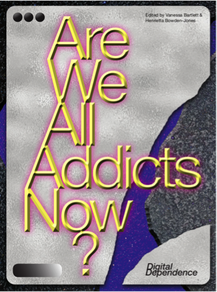
Are We All Addicts Now? Symposium and Book Launch.

Are we all addicts now?Date: Tuesday 7th November, 6.30 – 9pm

Venue: Central St Martins, University of the Arts London, 1 Granary Square, London, N1C 4AA

Tickets for the event are now available so please feel free to share this info.

http://www.furtherfield.org/programmes/event/are-we-all-addicts-now-symposium-and-book-launch

Here’s the blurb for the panel I’ll be talking on

Addiction, excess and artists: strategies of resistance

Techniques such as neuro-marketing are used online to keep users on device, driving endless circulation and drawing profits from every click. While many artists have celebrated overstimulation and digital excess, others incorporate strategies of resistance into their practice. In a hyper digital world, what are the possibilities for defying techniques such as neuro-marketing, nudging and gamification and what role can artists play in these acts of resistance? 

Reader in Digital Culture Tony D. Sampson explores neuro-marketing and digital addiction 

Artists Katriona Beales and Fiona MacDonald : Feral Practice discuss strategies of resistance from the AWAAN exhibition

Artist and writer Emily Rosamond on reputation addiction and how to resist it 

Reblog> Martin Dodge and Rob Kitchin, Mapping Cyberspace (free book download)

Via Stuart Elden.

Mapping Cyberspace was a formative introduction to ‘geography’ for me as an undergraduate digital arts student. It certainly influenced my (all-too-naive) BSc dissertation ideas… It’s great this is available, it documents so many things that seemed so vital at the time and that now appear almost like peculiar mirages.

Martin Dodge and Rob Kitchin, Mapping Cyberspace (free book download)

Mapping Cyberspace – Martin Dodge & Rob KitchinMartin Dodge and Rob Kitchin’s 2001 book Mapping Cyberspace is now available as a free download. There is also a website about the book here.

Mapping Cyberspace is a ground-breaking geographic exploration and critical reading of cyberspace, and information and communication technologies. The book:

  • * provides an understanding of what cyberspace looks like and the social interactions that occur there
  • * explores the impacts of cyberspace, and information and communication technologies, on cultural, political and economic relations
  • * charts the spatial forms of virtual spaces
  • * details empirical research and examines a wide variety of maps and spatialisations of cyberspace and the information society

has a related website at http://www.MappingCyberspace.com.

This book will be a valuable addition to the growing body of literature on cyberspace and what it means for the future.

AI Now post-doc positions

Holly from the UK TV programme Red Dwarf

This looks like a great opportunity for someone interested in the sorts of things the “AI Now” Institute (NYU) does. Link.

AI Now is looking for two to three postdoctoral researchers whose work resonates with the Institute’s mission. This position is an ideal opportunity for scholars who are interested in understanding the growing role of AI and related technologies within social and political institutions, and who are excited by the idea of shaping a new and far-ranging research field.

ABOUT THE AI NOW INSTITUTE

The AI Now Institute at New York University is an interdisciplinary community researching the social and economic implications of artificial intelligence and related algorithmic systems. We focus on producing foundational research illuminating the social contexts as automated decision-making moves deeper into core institutions like health, education, and criminal justice.

Founded in 2017 by Kate Crawford and Meredith Whittaker, AI Now is housed at NYU, where it fosters vibrant interdisciplinary engagement across the University and beyond. AI Now’s current partners at NYU include: the Tandon School of Engineering, the Steinhardt School of Culture, Education, and Human Development, the Law School, the Stern School of Business, and the Center for Data Science.

AI NOW POSTDOCTORAL FELLOWSHIPS

As an interdisciplinary institute at NYU, AI Now will provide postdocs with the opportunity to develop their scholarship at a top academic institution with an explicit remit to collaborate with researchers and practitioners across different fields, whether in NYU, at partner institutions, or within relevant industry and civil society organizations. AI Now has a strong network across these sectors, and will make this network available to postdocs where relevant and useful.

Postdocs will devote time to their own research and collaborative projects and will contribute to AI Now programs and events related to their research portfolio. Teaching is not expected, but may be an option, depending on a candidate’s availability and interest.

AI Now is committed to mentorship and support and to accommodating and resourcing research agendas that fit within its core mission. Postdocs will become a core part of a growing research community that includes reading groups, expert workshops, international conferences, regular salons, and site-specific travel. Fellows will also have the opportunity to help shape the annual AI Now Symposium.

RESOURCES AND BENEFITS

  • Competitive salary and benefits
  • Access to an exceptional network of mentors and established researchers spanning NYU and beyond, including civil society and industry practitioners
  • A generous research stipend for conferences (including international), fieldwork, and research materials, available as needed
  • Relocation assistance available as needed

See the full text of the call here.

‘Robotism’ and the agency of ‘automated’ workers

Charlie Chaplin in Modern Times

Following on from my post about the ways we might think about and research ideas of agency in relation to ‘automation’, it so happens that an accessible and interesting comment piece in the Grauniad by Brett Frischmann and Evan Selinger was published last week (not being on Twitter means I miss more of these sorts of things perhaps). Here’s a few of relevant lines (all links are from the original):

Most of the headlines about technology in the workplace relate to robots rendering people unemployed. But what if this threat is distracting us from another of the distorting effects of automation? To what extent are we being turned into workers that resemble robots?

…

Fears about humans becoming like machines go back longer than you might think. The sort of algorithmic management we see in the modern gig economy … has its roots in a management theory developed by Frederick Taylor in the early 20th century.

…

Technological innovations have made it increasingly easy for managers to quickly and cheaply collect, process, evaluate and act upon massive amounts of information. In our age of big data, Taylorism has spread far beyond the factory floor. The algorithmic management of the gig economy is like time cards on steroids.

…

It’s not just the intensity of the monitoring that is different. Surveillance is increasingly hidden. In Taylor’s analogue era, workers were acutely aware when they were being observed by management with stopwatches and notebooks. Today management tools are much less visible.

…

Taylorism starts from the assumption that employees are innate shirkers. While there will always be some who want to game the system and put in as little effort as possible, there are plenty who don’t. When the guiding assumption of management is that employees won’t be productive unless forced to be by constant observation, it engineers low morale and pushes people to act like resources that need to be micromanaged. Too often, we become what we’re expected to be.

Read the full comment.

Our vascilating accounts of the agency of automated things

Rachael in the film Blade Runner

“There’s no hiding behind algorithms anymore. The problems cannot be minimized. The machines have shown they are not up to the task of dealing with rare, breaking news events, and it is unlikely that they will be in the near future. More humans must be added to the decision-making process, and the sooner the better.”

Alexis Madrigal

I wonder whether we have if not an increasing then certainly a more visible problem with addressing the agency of automated processes. In particular automation that functions predominantly through software, i.e. stuff we refer to as ‘algorithms’ and ‘algorithmic’, possibly ‘intelligent’ or ‘smart’ and perhaps even ‘AI’, ‘machine learning’ and so on.  I read three things this morning that seemed to come together to concretise this thought: Alexis Madrigal’s article in The Atlantic – “Google and Facebook have failed us“, James Somers’ article in The Atlantic – “The coming software apocalypse” and LM Sacacas’ blogpost “Machines for the evasion of moral responsibility“.

In Madrigal’s article we can see how the apparent autonomy of the ‘algorithm’ becomes the fulcrum around which machinations around ‘fake news’, in this case regarding the 2nd October 2017 mass shooting in Las Vegas. The apparent incapacity of an automated software system to perform the kinds of reasoning attributable to a ‘human’ editor is diagnosed on the one hand, and on the other the speed at which such breaking news events taking place and the volume of data being processed by ‘the algorithm’ led to Google admitting that their software was “briefly surfacing an inaccurate 4chan website in our Search results for a small number of queries”. Madrigal asserts:

It’s no longer good enough to shrug off (“briefly,” “for a small number of queries”) the problems in the system simply because it has computers in the decision loop.

In Somers’ article we can see how decisions made by programmers writing software that processed call sorting and volume for the emergency services in Washington State led to the 911 phone system being inaccessible to callers for six hours one night in 2014. As Somers describes:

The 911 outage… was traced to software running on a server in Englewood, Colorado. Operated by a systems provider named Intrado, the server kept a running counter of how many calls it had routed to 911 dispatchers around the country. Intrado programmers had set a threshold for how high the counter could go. They picked a number in the millions.

Shortly before midnight on April 10, the counter exceeded that number, resulting in chaos. Because the counter was used to generating a unique identifier for each call, new calls were rejected. And because the programmers hadn’t anticipated the problem, they hadn’t created alarms to call attention to it. Nobody knew what was happening. Dispatch centers in Washington, California, Florida, the Carolinas, and Minnesota, serving 11 million Americans, struggled to make sense of reports that callers were getting busy signals. It took until morning to realize that Intrado’s software in Englewood was responsible, and that the fix was to change a single number.

Quoting an MIT Professor of aeronautics (of course) Nancy Leveson, Somers observes: “The problem,” Leveson wrote in a book, “is that we are attempting to build systems that are beyond our ability to intellectually manage.”

Michael Sacasas in his blogpost refers to Madrigal’s article and draws out arguments that the complex processes of software development, maintenance and the large and complicated organisations such as Facebook are open to those working there to work in a ‘thoughtless’ manner:

“following Arendt’s analysis, we can see more clearly how a certain inability to think (not merely calculate or problem solve) and consequently to assume moral responsibility for one’s actions, takes hold and yields a troubling and pernicious species of ethical and moral failures. …It would seem that whatever else we may say about algorithms as technical entities, they also function as the symbolic base of an ideology that abets thoughtlessness and facilitates the evasion of responsibility.”

The simplest version of what I’m getting at is this: on the one hand we attribute significant agency to automated software processes, this usually involves talking about ‘algorithms’ as quasi- or pretty much autonomous, which tends to infer that whatever it is we’re talking about, e.g. “Facebook’s algorithm”, is ‘other’ to us, ‘other’ to what might conventionally be characterised as ‘human’. On the other hand we talk about how automated processes can encode the assumptions and prejudices of the creators of those techniques and technologies, such as the ‘racist soap dispenser‘.

There’s a few things we can perhaps note about these related but potentially contradictory narratives.

First, they perhaps infer that the moment of authoring, creating, making, manufacturing is a one-off event – the things are made, the software is written and it becomes set, a bit like baking a sponge cake – you can’t take the flour, sugar, butter and eggs out again. Or, in a more nuanced version of this point – there is a sense that once set in train these things are really, really hard to change, which may, of course, be true in particular cases but also may not be a general rule. A soap dispenser’s sensor may be ‘hard coded’ to particular tolerances, whereas what gets called ‘Facebook’s algorithm’, while complicated, is probably readily editable (albeit with testing, version control and so on). This kind of narrative freights a form of determinism – there is an implied direction of travel to the technology.

Second, the kinds of automated processes I’m referring to here, ‘algorithms’ and so on, get ‘black boxed’. This is not only on the part of those who create, operate and benefit from those processes—like those frequently referred to Google, Facebook, Amazon and so on—but also in part by those who seek to highlight the black boxing. As Sacasas articulates: “The black box metaphor tries to get at the opacity of algorithmic processes”. He offers a quote from a series of posts by Kevin Hamilton which illustrates something of this:

Let’s imagine a Facebook user who is not yet aware of the algorithm at work in her social media platform. The process by which her content appears in others’ feeds, or by which others’ material appears in her own, is opaque to her. Approaching that process as a black box, might well situate our naive user as akin to the Taylorist laborer of the pre-computer, pre-war era. Prior to awareness, she blindly accepts input and provides output in the manufacture of Facebook’s product. Upon learning of the algorithm, she experiences the platform’s process as newly mediated. Like the post-war user, she now imagines herself outside the system, or strives to be so. She tweaks settings, probes to see what she has missed, alters activity to test effectiveness. She grasps at a newly-found potential to stand outside this system, to command it. We have a tendency to declare this a discovery of agency—a revelation even.

In a similar manner to the imagined participant in Searle’s “Chinese Room” thought experiment, the Facebook user can only guess at the efficacy of their relation to the black boxed process. ‘Tweaking our settings’ and responses might, as Hamilton suggest, “become a new form of labor, one that might then inevitably find description by some as its own black box, and one to escape.” A further step here is that even those of us diagnosing and analysing the ‘black boxes’ are perhaps complicit in keeping them in some way obscure. As Evan Selinger and Woodrow Hartzog argue: things that are obscure can be seen as ‘safe’, which is the principle of cryptography. Obscurity, for Selinger & Hartzog, “is a protective state that can further a number of goals, such as autonomy, self-fulfillment, socialization, and relative freedom from the abuse of power”. Nevertheless, obscurity can also be an excuse – the black box is impenetrable, not open to analysis and so we settle on other analytic strategies or simply focus on other things. A well-worn strategy seems to be to retreat to the ontological, to which I’ll return shortly.

Third, following from above, perhaps the ways in which we identify ‘black boxes‘ or the forms of black boxing we do ourselves over-simplifies or elides complexity. This is a difficult balancing act. A good concept becomes a short-hand that freights meaning in useful ways. However, there is always potential that it can hide as much as it reveals. In the case of the phenomena outlined in the two articles above, we perhaps focus on the ends, what we think ‘the algorithm’ does – the kinds of ‘effects’ we see, such as ‘fake news’ and the breakdown of an emergency telephone system, or even a ‘racist soap dispenser’. It is then very tempting to perform what Sally Wyatt calls a ‘justifactory’ technological determinism – not only is there a ’cause and effect’ but these things were bound to happen because of the kinds of technological processes involved. By fixing ‘algorithms’ as one kind of thing, we perhaps elide the ways in which they can be otherwise and, perhaps more seriously, elide the parts of the process of the development, resources, use and reception of those technologies and their integration into wider sociotechnical systems and society. These things don’t miraculously appear from nowhere – they are the result of lots of actions and decisions, some banal, some ‘strategic’, some with good intentions and some perhaps morally-questionable. By black boxing ‘the algorithm’, attributing ‘it’ with agency and making it ‘other’ to human activities we ignore or obscure the organisational processes that make it possible at all. I argue we cannot see these things as completely one thing or the other: the black boxed entity or the messy sociotechnical system, but rather as both and need to accommodate that sort of duality in our approaches to explanation.

Fourth, normative judgements are attached to the apparent agency of an automated system when it is perceived as core to the purpose of the business. Just like any other complicated organisation whose business becomes seen as a ‘public good’ (energy companies might be another example), competing, perhaps contradictory, narratives take hold. The purpose of the business may be to make money–in the case of Google and Facebook this is of course primarily through advertising, requiring attractive content to which to attach adverts–but the users perhaps consider their experience, which is ‘free’, more important. It seems to have become received wisdom that the very activities that drive the profits of the company, by boosting content that drives traffic and therefore serves more advertising and I assume therefore resulting in more revenue, run counter to accepted social and moral norms. This exemplifies the competing understandings of what companies like Google and Facebook do – in other words, what their ‘algorithms’ are for. This has a bearing on the kinds of stories we then tell about the perceived, or experienced, agency of the automated system.

Finally (for now), there is a tendency for academic social scientific studies of automated software systems to resort to ontological registers of analysis. There may be all sorts of reasons used as justification for this, such as specific detail of a given system is not accessible, or (quite often) only accessible through journalists, or the funding isn’t available to do the research. However, it also pays dividends to do ‘hard’ theory. In the part of academia I knock about in, geography-land and it’s neighbours, technology has been packaged up into the ‘non-human’ whereby the implication is that particular kinds of technology are entirely separate from us, humans, and can be seen to have ‘effects’ upon us and our societies. This is trendy cos one can draw upon philosophy that has long words and hard ideas in it, in particular: ‘object oriented ontology‘ (to a much lesser extent the ‘bromethean‘ accellerationists). The generalisable nature of ‘big’ theory is beguiling, it seems to permit us to make general, perhaps global, claims and often results in a healthy return in the academic currency of citations. Now, I too am guilty of resorting to theory, which is more or less abstract, through the work of Bernard Stiegler in particular, but I’d like to think I haven’t disappeared down the almost theological rabbit hole of trying to think objects in themselves through abstract language such as ‘units‘ or ‘allopoetic objects‘ and ‘perturbations’ of non-human ‘atmospheres’.

It seems to me that while geographers and others have been rightly critical of simplistic binaries of human/technical, there remains a common habit of referring to a technical system that has been written by and is maintained by ‘humans’ as other to whatever that ‘human’ apparently is, and to refer to technologically mediated activities as somehow extra-spatial, as virtual, in contra-distinction to a ‘real’. This is plainly a contradiction. On the one hand this positions the technology in question (‘algorithms’ and so on) as totally distinct from us, imbued with an ability to act without us and so potentially powerful. On the other hand if that technology is ‘virtual’ and not ‘real’ it implies it doesn’t count in some way. While in the late 90s and early 00s the ‘virtual’ technologies we discussed were often seen as somewhat inconsequential, the more contemporary concerns about ‘fake news’, malware and encoded prejudices (such as racism) have made automated software systems part of the news cycle. I don’t think it is a coincidence that we’ve moved from metaphors of liberty and community online to metaphors of ‘killer robots’, like the Terminator (of course there is a real prospect of autonomous weapons systems, as discussed elsewhere).

In the theoretical zeal of ‘decentering the human subject’ and focusing on the apparent alterity of technology, as abstract ‘objects’, we are at risk of failing to address the very concerns which are expressed in the articles by Madrigal and Somers. In a post entitled ‘Resisting the habits of the algorithmic mind‘, Sacasas suggests that automated software systems (‘algorithms’) are something like an outsourcing of problems solving ‘that ordinarily require cognitive labor–thought, decision making, judgement. It is these very activities–thinking, willing, and judging–that structure Arendt’s work in The Life of the Mind.’ The prosthetic capacity of technologies like software to in some way automate some of these processes might be liberating but they are also, as Sacasas suggests, morally and politically consequential. To ‘outsource the life of the mind’ for Sacasas means to risk being ‘habituated into conceiving of the life of the mind on the model of the problem-solving algorithm’. A corollary to this supposition I would argue is that there is a risk in the very diagnosis of this problem that we habituate ourselves to a determinism as well. As argued in the third point, above, we risk obscuring the organisational processes that make such sociotechnical systems possible at all. In the repetition of arguments that autonomous, ‘non-human’, ‘algorithms’ are already apparently doing all of these problematic things we will these circumstances upon ourselves. There is, therefore, an ethics to thinking about and analysing automation too.

Where does this leave us? I think it leaves us with some critical tools and tasks. We perhaps need not to shy away from the complexity of the systems we discuss – the ideas and words we use can do work for us, ‘algorithm’ for example freights some meaning, but we perhaps need to be careful we don’t obscure as much as we reveal. We perhaps need to use more, not fewer, metaphors. We definitely need more studies that get at the specificity of particular forms, processes and work of automation/automated systems. All of us, journalists and academics alike, need to perhaps use our words more carefully, or use more words to get at the issues.

Simply hailing the ‘rise of the robots’ is not enough. I think this reproduces an imagination of automation that is troubling and ought to be questioned (what I’ve called an ‘automative imaginary’ elsewhere, but maybe that’s too prosaic). For people like me in geography-land to retreat into ‘high’ theory and to only discuss abstract ontological/ metaphysical attributes of technology seems to me to be problematic and is a retreat from that part of the ‘life of the mind’ we claim to advance. I’m not arguing we need not retreat from theory we simply need to find a balance. A crucial issue for social science researchers of ‘algorithms’ and so on is that this sort of work is probably not the work of a lone wolf scholar, I increasingly suspect that it needs multi-disciplinary teams. It also needs to, at least in part, produce publicly accessible work (in all senses of ‘accessible’). In this sense work like the report on ‘Media manipulation and disinformation online‘ by Data & Society seems like necessary (but by no means the only) sorts of contribution. Prefixing your discipline with ‘digital’ and reproducing the same old theory but applied to ‘digital’ things won’t, I think, cut it.

Scaring you into ‘digital safety’

I’ve been thinking about the adverts from Barclays about ‘digital safety’ in relation to some of the themes of the module about technology that I run. In particular, about the sense of risk and threat that sometimes gets articulated about digital media and how this maybe carries with it other kinds of narrative about technology, like versions of determinism for instance. The topics of the videos are, of course, grounded in things that do happen – people do get scammed and it can be horrendous. Nevertheless, from an ‘academic’ standpoint, it’s interesting to ‘read’ these videos as particular articulations of perceived norms around safety/risk and responsibility, for whom, and why in relation to ‘digital’ media… I could write more but I’ll just post a few of the videos for now…

Chinese bitcoin mining in pictures

From ChinaFile – photos from Photographer Liu Xingzhe documenting Bitcoin ‘mines’ in China.

Employees use their phones at the Bitcoin mine, September 26, 2016. The mine has 550 “mining machines” running continuously. They solve complicated mathematical problems for which they are rewarded with Bitcoins. Seven employees work in shifts monitoring the machines to keep the mine running 24 hours a day.

Photographer Liu Xingzhe traveled to Sichuan’s Ngawa (Aba) Tibetan and Qiang Autonomous Prefecture, some 175 miles from the provincial capital of Chengdu, to explore not only the operations of these [Bitcoin] mines, but also the lives of the “miners” who spend their days tending to whirring legions of machines. He also traveled to Shenzhen to see the factories where the world’s finest Bitcoin mining machinery is engineered and produced.

See all of Lio Xingzhe’s photos.