Talk: ‘imagining automation’, part of ‘Human centred design in the age of automation’

I’m doing a talk on 25th October for the ‘SW Futurists’ meet-up. The event is called “Human centred design in the age of automation” and I’ll be talking about how ‘automation’ gets imagined and what kinds of power or agency those imaginings might have.

There are two speakers, the other is Lucas Godfrey a design researcher at Edinburgh – who had a hand in inviting me to speak. 

There’s web page for the event on meetup.com with descriptions of both talks.

The blurb for my talk is here:

Imagining automation 
We are told that we face the widespread automation of jobs, that we are increasingly subject to ever more complex and intrusive ‘algorithmic’ surveillance and that complex computational systems, such as Google’s search, know us better than we know ourselves. What are the bases of such claims? How much do they say about the world we live in? and do such claims say more about the stories we tell about digital technologies? By talking through some examples, ranging from ill-fated chatbots to production lines and missions to Mars I invite you to consider with me some possible answers to these questions. In doing so, I hope we can reflect a little more on the power of the stories we tell about technology and how such power gets exercised.

“At play on the field of ghosts” – James Bridle on code/spaces of competitive sport

Reflecting upon the increasing instrumentation of the sporting field off play, for spectating, e.g. the ‘Hanwha chickens‘, and for the judgement of rules, e.g. ‘HawkEye’, James Bridle has written a nice piece on Medium about how the idea/ideal of ‘sport’ may be getting translated into something else…

This distinction between the actuality of the event and the fidelity of its recreation is narrow and could easily be dismissed as just another conjuration of spectacular TV coverage, were its remit limited to mere representation. But in the hyper-competitive domain of sports, lubricated with broadcasting and gambling dollars, recreation turns into prediction, and representation into judgement. The distinction between what is seen and what occurs becomes crucial.

More and more, the practice of human adjudication in sports is being crowded out by the supposed superiority of machine perception; a perception which is based on the recreation and prediction of real events, rather than their explicit witnessing. Since 2001, the Hawk-Eye computer system has become increasingly ubiquitous in major sporting competitions, combining machine vision with motion analysis to not only declare where precisely a ball touched or crossed a line, but where the ball would have gone if it were not rudely interrupted.

Provocations for Cultural Geography Today

The latest issue of Social and Cultural Geography is now published and live online and it contains the theme issue that stems from the 5th Annual Doreen Massey event in which I participated.

My contribution is entitled: Vulgar geographies? Popular cultural geographies and technology.

There is a fantastic and diverse range of papers in the issue and I heartily recommend exploring it. Not least the editorial by Nadia Bartolini, Parvati Raghuram & George Revill.  I would like to thank them, again, for inviting me to be part of such a rich conversation.

Of course, all of these provocations follow in the wake of the departure of one of, if not, the most provocative and vital influencers of geographical thought – Doreen Massey, for whom the annual event these papers stem from is named. I am confident that all of the author’s in this theme issue took inspiration from Doreen’s work. fitting then that in the same issue is Rob Kitchin’s excellent obituary.

A few articles from the theme issue that stand out for me are:

Patricia Noxolo’s Provocations beyond one’s own presence: towards cultural geographies of development?

Isla Forsyth’s More-than-human warfare

The Museum of Contemporary Commodities in EXETER

The Museum of Contemporary Commodities

Just a quick note to let you know that the brilliant Paula Crutchlow has brought “The Museum of Contemporary Commodities” (MoCC) to Exeter for the majority of May.

There’s lots going on, much of it creative and interesting – so if you’re in Exeter or nearby: come and visit!

Two immediate things this week:

RIGHT NOW!: help re-create the internet in paper with Artist Louise Ashcroft from 11 -2 in the Exeter University Forum.

TOMORROW: sign up to do a data walkshop with Alison Powell from the LSE on Saturday from 10-1. Places have to be booked, and the Eventbrite page is here https://www.eventbrite.com/e/mocc-data-walkshop-tickets-24464719635

Please do visit the MoCC website for lots more events and activities taking place this month and visit the shop:

87 Fore St,
Exeter
EX46RT

Open 10:00-18:00pm Weds-Sat, 4th-21st May.

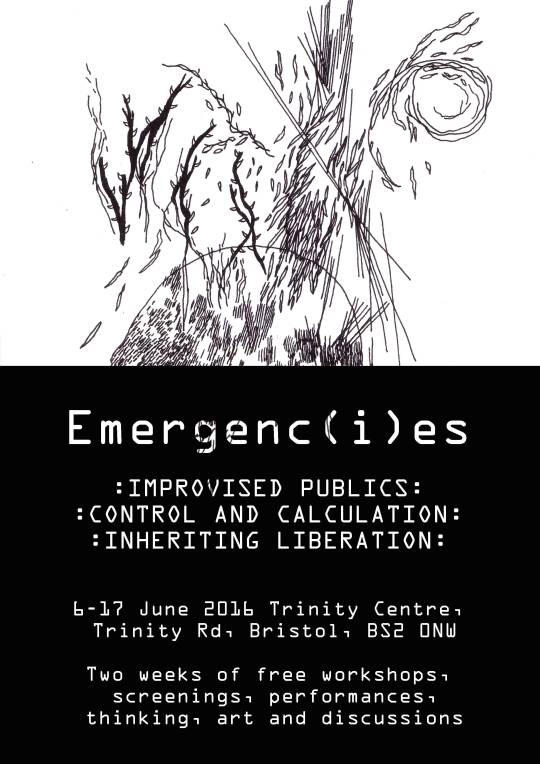
Reblog> Improvised Publics :: Control and Calculation :: Inheriting Liberation :: 6-17 June 2016

This event looks really interesting, check out the website for more information…

Emergenc(i)es – an event in Bristol between 6th and 17th June

Emergenc(i)es is an invitation to consider the emergency of the current historical moment.

The exhibition will dwell in the question of emergence within emergency.

Performance, education activities, visual art, screenings, installations, workshops and a library-cum-pharmacy will create time and space to diagnose, explore and understand the world we live in.

Enter – Relate – Improvise – Diagnose – Inherit – Public – Liberate – Gather

All activities are free to attend, thanks to generous funding from Awards for All.

Daniel Miller – The Internet: Provocation

There’s an entertaining and incisive piece on the Cultural Anthropology website by Prof. Daniel Miller (UCL) on (ethnographic) research concerning the internet/’online’…

I have felt that perhaps my primary qualification for engaging in the anthropology of this domain is simply that I have never, ever actually believed in “The Internet.” My provocation is that this disbelief is what distinguishes anthropologists from other scholars of online activity. My approach has always been ethnographic, what I call holistic contextualization. I study populations whose online activities are a growing element of who they are and what they do. Yet no one lives just online.

If you teach under the auspices of Internet studies or similar, it is pretty hard not to fetishize the Internet. But I cut my teeth on trying to develop something called material culture studies as a systematic defetishizing of objects (and of society). Instead, we examine the place of materiality within the anthropology of relationships. I see online as just one place in which we now live and conduct relationships with others. After overhearing a two-hour telephone conversation between your husband and his mother, for example, you would not remark, “Oh, that sounded bad, but what is your relationship like in the real world?”

Read the whole thing here.

Yik Yak on campus and the tensions of public anonymity

This piece in The Seattle Times offers a fairly succinct view on the tensions being performed through students’ use of YikYak, the ‘public’ location-based messaging system in which one posts to a location’s public conversation through an app.

Since the growth in population of social media there has also been a growth in the ‘back channel’ at events such as conferences, a ‘second screen’ conversation around ‘appointment TV’ (at least according to the BBC), and from Facebook onwards, there has been a mediated conversation in the background of university lectures.

The students, especially, first years, take some delight in offering observations about the lecture material, the lecturer and so on – amongst the wider hubbub of conversation about pets, hangovers and the relative qualities and number of attractive people on campus.

However, this can spillover into insult. As noted in the BBC local news coverage of one brave lecturer’s response to insults on YikYak at Bristol.

The Seattle Times piece illustrates how, just as in other kinds of social media, a perception of anonymity and the opportunity to perform ourselves otherwise allows some of us to grant ourselves permission to say some appalling things.

I’ve used the example of Yik Yak, in relation to the performance of identity, in a first year lecture… it may have made some of them think… (or maybe not)

yCklGKOW