Reblog> 12 Critical Theory books that came out this month, September

Lots to explore here!

12 Critical Theory books that came out this month, September

Starve and Immolate

By Banu Bargu
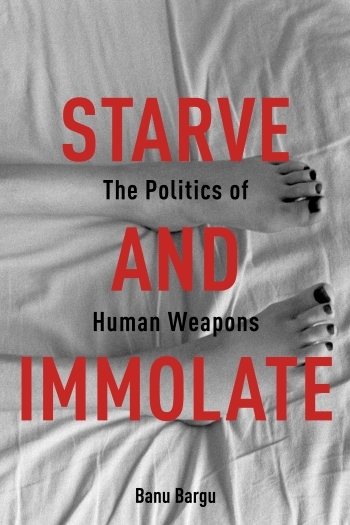
starve and immolate

“Starve and Immolate tells the story of leftist political prisoners in Turkey who waged a deadly struggle against the introduction of high security prisons by forging their lives into weapons. Weaving together contemporary and critical political theory with political ethnography, Banu Bargu analyzes the death fast struggle as an exemplary though not exceptional instance of self-destructive practices that are a consequence of, retort to, and refusal of the increasingly biopolitical forms of sovereign power deployed around the globe.

Bargu chronicles the experiences, rituals, values, beliefs, ideological self-representations, and contentions of the protestors who fought cellular confinement against the background of the history of Turkish democracy and the treatment of dissent in a country where prisons have become sites of political confrontation. A critical response to Michel Foucault’s Discipline and Punish, Starve and Immolate centers on new forms of struggle that arise from the asymmetric antagonism between the state and its contestants in the contemporary prison. Bargu ultimately positions the weaponization of life as a bleak, violent, and ambivalent form of insurgent politics that seeks to wrench the power of life and death away from the modern state on corporeal grounds and in increasingly theologized forms. Drawing attention to the existential commitment, sacrificial morality, and militant martyrdom that transforms these struggles into a complex amalgam of resistance, Bargu explores the global ramifications of human weapons’ practices of resistance, their possibilities and limitations.”

See the other eleven here…

Reblog> How We Write – the open access collection reviewed and highlighted

Stuart Elden on the book “How We Write”, which is a really interesting insight into different ways in which writing is practised…

How We Write – the open access collection reviewed and highlighted

How-We-Write-cover-E-216x346How We Write – the open access collection edited by Suzanne Conklin Akbari, which includes thirteen short pieces on academic writing – has been getting  a bit of attention already. It was chosen as a highlighted title on open access site Unglue.it and has been reviewed in French at Ludite! Jeffrey Jerome Cohen also talks about his piece here.

As I said when I announced the book’s publication, while free to download, it was not free to produce. It is also available to buy in paperback, or you can leave a donationwhen you download the book. This is a book that does not seek to give advice, but to show how a range of people do things in a number of different ways. Please share widely”¦

Reblog> New Book Series – Cultural Geographies: Rewriting the Earth

I missed this somehow… Looks like an interesting new book series – which will, of course, now be part of the Informa (Routledge, Taylor & Francis stable). The academic editors (Kingsbury & Saldhana) have also posted this to Crit-Geog-Forum and invited people to contact them…

New Series – Cultural Geographies: Rewriting the Earth

Ashgate is delighted to announce the launch of a new series, Cultural Geographies: Rewriting the Earth, with series editors Paul Kingsbury (Simon Fraser University, Canada) and Arun Saldanha (University of Minnesota, USA).

Social and Cultural Geography series postcard

Cultural geography has witnessed profound changes in recent years on three interrelated levels: theoretical, methodological, and socio-political. In terms of theory, new conceptions of culture have emerged which examine social and geographical differentiation as involving objects, affect, nonhumans, mobility, emotion, queerness, assemblage, materiality, the unconscious, biopolitics, relationality, and intersectionality. At the level of methodology, experiments with fieldwork and writing practices demonstrate the extent to which cultural geography has learnt from and contributes to many areas of policy, science, therapy, ethics, aesthetics, and activism. Finally, in terms of the socio-political and engagements with the world outside of academia, cultural geographers are exploring the multiple crises of energy, climate change, nationalism, (sub)urban expansion, loss of biodiversity, inequality, and fragmentation of life under the spell of digital technologies and consumerism.

Contemporary cultural geography cannot be defined simply as a distinctive sub-field within geography (“earth writing”), but rather as an efflorescence of many strands of research exploring cultural phenomena with the shared commitment to spatiality. This new series offers a dedicated space for high-quality and innovative research monographs and edited collections in cultural geography which address the new hopes, dangers, and intensities that are rewriting the earth.

For further information about the series, including details of how to submit a book proposal, please email Senior Commissioning Editor Katy Crossan.

Why so few translations of Simondon?

The politics of a scholar’s work after (or even before!) their death and how one interprets their wishes (often unclearly expressed) is difficult. Likewise, there are plenty of people with ‘vested interests’  in how that work is communicated. This is a particularly thorny issue in translation.

I do not pretend to have any special insight but the following excerpt from an excellent interview conducted by Andrew Iliadis (whose work is very much worth exploring) with Jean-Hughes Barthélémy perhaps offers some clue about why we have seen so little of Simondon’s work translated into English:

Iliadis: You are the editor of Cahiers Simondon. Who else is involved in that project, and do you see it growing? Where is it heading?

Barthélémy: I created the Cahiers Simondon in 2009, thanks to the Maison des Sciences de l’homme de Paris-Nord and the editor Jean-Louis Déotte. My friend and collaborator Vincent Bontems and I decided to establish each year a selection of papers, among them those that were presented at the Atelier Simondon, derived by Vincent at the École Normale Supérieure. But some papers come from proposals that are external to the Atelier Simondon. Sometimes, I have to translate – or at least to correct –the papers in the French version. My criterium for the selection is only the seriousness of the work of exegesis, and that’s why it is difficult, each year to have enough papers. Interest in Simondon is really growing in the world, but the seriousness of Simondon’s studies is still a dream. Young researchers that are not French get an excuse: there is no English translation of Simondon’s books, and some partial translations are quite wrong. I must add that when I worked with Arne De Boever, I corrected the American translation of L’individuation psychique et collective–I spent many hours on this passionate and voluntary work. But Nathalie Simondon asked the editor to publish the entire text of L’individuation à la lumière des notions de forme et d’information. Therefore, I have no news concerning the translation of L’individu et sa genèse physico- biologique. I just know that this part of the main thesis is the most difficult: its translation into English needs one or two philosophers of science that are also specialists on Simondon! Now, about the current translation of Du mode d’existence des objets techniques: here again, the information we have had does not make us optimistic.

It is tempting to see a kind of intellectual policing going on here, but I simply do not know the institutional and legal contexts of what Barthélémy is saying… Nevertheless it is tremendously sad (and rather frustrating) that it appears likely that Anglophone scholars will have to wait some time before they have access to an ‘approved’/ published translation of Simondon’s major work(s): L’individuation à la lumière des notions de forme et d’information.

I am given to understand that The Mode of Existence of Technical Objects (Du mode d’existence des objets techniques) will be published by Univocial, which is associated with University of Minnesota Press, at some time in the latter part of 2015. I have also heard that another of Simondon’s lecture courses will be translated and published by Univocal, I do not know the likely time-frame.

I welcome any clarifications or comments from those ‘in the know’…

Reblog> CounterText: call for papers

Interesting CFP via Edinburgh Press blog...

CounterText
Call for Papers
Special Issue: Explorations in Electronic Literature
Edited by Mario Aquilina and Ivan Callus

An entire epoch of so-called literature, if not all of it cannot survive a certain technological regime of telecommunications.
– Jacques Derrida, The Post Card

Is literature surviving? Is it not still electrifying? Might electronic literature be one form of its survival? Does electronic literature mark another stage in the evolution of literature or does it open a new, unprecedented paradigm for the concept of the ‘literary’? This special issue investigates electronic literature’s challenges to established conceptions of literature and literariness. The following will be irrepressible questions. How should authorship, creation and originality be rethought? Can we still speak of ‘literature’ when the letter becomes only one element in works which are characterised by kinetic, visual, ludic, and sensory dynamics? Can we think of the electronic (post-)literary also as an electronic post-letter? And how might this be countertextual?

The apocalyptic threat to literature implied in Derrida’s comment on ‘a certain technological regime of telecommunications’ has not come to pass, nor might we be expecting it to. There can be no doubt, however, that computing technologies and code (the digital affordances enabling electronic literature) can prompt fevered speculation on literature’s evolving futures and platforms. As a result literary criticism, too, changes. Long traditions of aesthetic, thematic and formal discussions of literature are brought into question by electronic literature, as is the meaning of reading more generally (never mind close reading).

However, discussions of electronic literature countenancing technological determinism risk ignoring genealogies of electronic literature founded in long traditions of combinatorics and generative (not quite algorithmic) rules. Is electronic literature, then, a manifestation of a potential always already within the literary rather than simply a technology-determined transformation in the literary? And if it is so, how do we conceive the temporal relation and notional continuities between electronic literature and print literature, for example? Do we speak of supplementation, supplantation, renovation, complementarity, convergence? All these terms seem unsatisfying – but why?

The editors of this special issue of CounterText welcome articles with a focus related to these and related points that explore the connections between electronic literature and the concepts of ‘literature’ and ‘literariness’. The following list indicates some other possible points of discussion:

  • E-lit and new understandings of literary ‘value’.
  • The humanist affinities of e-lit.
  • E-lit and communal understanding of the literary.
  • E-Lit and the expectation of originality.
  • E-lit as a literature of the fragment.
  • E-lit and the problem of the total work.
  • Precursors of the electronic post-literary.
  • The space of e-lit: where does e-lit happen?
  • E-lit and literary criticism and theory.
  • E-lit as literary criticism and theory.
  • The role of the letter in e-lit.
  • Code and literariness.
  • Literariness and digital affordances.
  • E-lit as a space where literature meets other art forms.

Potential contributors to the special issue may email the Guest editor, Mario Aquilina (mario.aquilina@um.edu.mt), or Ivan Callus (ivan.callus@um.edu.mt) for further information. They may also wish to refer to the journal’s site for information about CounterText‘s style sheet (http://www.euppublishing.com/journal/count).

Submissions are to be sent as an email attachment to countertext@um.edu.mt by 14thDecember 2015. Notice of acceptance/refusal will be given by February 2016. Final manuscripts incorporating editorial suggestions and changes will then have to be submitted by 28th March 2016.

New journal: “Digital Literacy Studies”

David Cooper tweeted a link to an interesting new open access journal called “Digital Literacy Studies“, published through Penn State University Libraries. Here’s the info from their page:

Digital Literary Studies

Digital Literary Studies is an international peer-reviewed interdisciplinary publication with a focus on those aspects of Digital Humanities primarily concerned with literary studies.

Digital Literary Studies publishes scholarly articles on research concerned with computational approaches to literary analysis/criticism, or critical/literary approaches to electronic literature, digital media, and textual resources.

In addition to longer, more traditionally-formed articles, this journal publishes positional papers and articles with a shorter experimental focus, as well as reviews of books and electronic literature. Contributors may also submit curated electronic texts for peer-review, as well as thoroughly-documented hermeneutical methods and tools. Any digital project with a literary focus, whether that be a digital edition, tool, or otherwise, may be considered for peer-review.

I’ve highlighted a bit above to point out that they welcome experimental shorter contributions too.

New Books in Critical Theory

I’ve just come across the New Books in Critical Theory podcast, thanks to David Beer, on Twitter – who linked to the latest interview with Christian Fuchs, talking about his book Culture and Economy in the Age of Social Media.

It’s a pleasure to find that there are also recent interviews with Robin James on her book about resistance, pop music and feminism, as well as fellow geographers Deborah Cowen on her book The Deadly Life of Logistics and Amanda Rogers talking about her book Performing Asian Transnationalisms: Theatre, Identity and the Geographies of Performance. Trawling the archives one can find Bradley Garrett talking about Explore Everything and, of course, David Beer talking about his book Popular Culture and New Media.

Apparently there are other New Books in… podcast series, with one for Geography and another for Digital Culture (various series clearly cross-post), which is interesting. Worth exploring…

Running towards publication – Jonathan Sterne on the pace of publishing

Over on the group blog Culture Digitally, Jonathan Sterne has written about the competing paces of publication, audiences and the lifespan of our examples:

The recent Culture Digitally posts by Jeff Pooley and C.W. Anderson suggest that one of the main broken areas of new media scholarship has to do with publication and speed. Our examples are out of date before our articles appear in the journals to which we submitted them. Our books suffer even worse fates. Both authors suggest the problem is the speed with which our objects of study–digital media–change. Both also point to the dilemmas faced by academic authors and presses as the world of academic publishing changes. . . slowly. And both suggest that iterated versions and new digital platforms would be one set of solutions to this problem.

Sterne makes the point that the texts to which we continue to return, and with which we teach, are those that do not solely rely on the examples. While examples are ‘examples of themselves’ (see Dewsbury et al. 2002), they are also (hopefully) illustrative of a broader theory about the world:

Scholars have developed a number of strategies for dealing with the different temporalities of scholarship and life, and that in fact is important for our students to learn about. Take four canonical examples that still frequently appear on media studies syllabi (do a search for these and “media studies syllabus” if you don’t believe me): Stuart Hall’s “Encoding/Decoding,” Raymond Williams’ Television; Dick Hebdige’s Subculture: The Meaning of Style; and Pierre Bourdieu’s Distinction. All of these were originally published in the 1970s and reference social worlds vastly different from the ones our student inhabit. Two of them refer to the UK, one to the US, and one to France, which means students everywhere else need to make some adjustments. Why are these texts still being taught if they are so out of date? The answer is simple: the ideas in them transcend the examples, and even where the conclusions no longer obtain, the questions they ask might be useful for students to ask today. To be sure, treating them as timeless social science theories would be a disservice: Hall’s Encoding/Decoding model is tied to the inaccessibility of television production in the 1970s; an account of the same politics around news today would have to think very differently about production.

…

Dated examples in readings are not a problem. They are unavoidable when the reference is popular culture, current events or new media. They can be used to teach students about the specificity of their (and our) own moment; and they provide an opportunity to teach students that intellectual work is an ongoing process and conversation of which our students can be a part.

Sterne goes on to make a plea against ‘keeping up’ with the acceleration, against ‘keeping [old work] up-to-date’ and that

we must also let scholars walk away from their projects. More than that, we should encourage it. Abandoning work has probably done more to advance scholarly conversation than any other single act by academic writers.

It’s worth reading the whole thing. I would briefly note that it is possible to argue that there is a healthy academic tradition of ‘abandonment’. In philosophy, there have been a number of writers/thinkers that have unapologetically changed their minds or simply shifted the terms of their projects – for example Francois Laruelle has made it a feature of his work as such, and one might argue that Foucault did so too.

Likewise, there have been arguments made for a more contemplative pace of work. For example, Bernard Stiegler has argued that we need to (re)constitute what the Romans called Otium the techniques of the self, of our care for ourselves and for knowledge, such that we allow space and time for attentive thought.

The Matter of Virtual Geographies – Progress in Human Geography Paper Prize

I am really pleased to be able to share that my article “The matter of ‘virtual’ geographies”, published in Progress in Human Geography last year, has been jointly awarded the Progress in Human Geography Best Paper Prize 2015.

One of the great things about this prize being awarded is that the article is now free to read! So, you can read it on the journal website.

If you find the article interesting, you might also like another I’ve written: ‘Memory Programmes’, published in Cultural Geographies, which you can read here (on ResearchGate). I’m also very happy to discuss my work, so please do feel free to get in touch.