States of precarity in UK Higher Education Geography – report

I am late to highlighting the publication of the important RGS-IBG report States of precarity in UK Higher Education geography. I encourage anyone in academia but especially those of us in geography as a discipline to read and think about this work. There is a summary at the RGS-IBG website (a snippet of this is copied below), where there are also links to the report, plans, posters and other resources.

Precarious working conditions are increasingly common throughout academia – from the proliferation of fixed term contracts (FTCs) to widespread restructuring and redundancies. The States of Precarity Report provides a snapshot of the immediate and long-term effects of precarity within UK HE Geography across career stages.

Importantly, as well as engaging with key and pressing issues, the report provides a series of recommendations and best practice resources to support more equitable and caring departmental working cultures.

The States of Precarity in UK Higher Education Geography report was funded by the Antipode Foundation and the Royal Geographical Society (with IBG). The team included Rachael Squire, James Esson, Johanne Bruun, Rachel Colls, Peter Forman, Anna Jackman, Jasmine Joanes.

Narratives of labour as infrastructure and the automative imagination

Glitched representation of 1980s Duracell robots in a domestic setting

I have a new journal article out, as part of a theme issue in Environment and Planning D: Society & Space. This forms the first peer-reviewed publication that stems from work I began around 2016 concerning automation (this is one of the earliest posts on this blog about it, with a talk I did at the SW Futures meet-up group). This took an impetus from the work of Bernard Stiegler around automation and my initial thinking with and through his ideas was influenced by many conversations around that time with my friend and former colleague Patrick Crogan, who has also written on automation (more than me!), e.g. here.

What the does ‘automative’ mean? You might be asking yourself. Well, I coined a neologism because I couldn’t find a word that fit what I wanted to say. In the paper I put it this way:

The ‘automative imagination’, in the context of this article, is a heuristic that enables two things: (i) a critique of the spatial politics scale pregnant within debates around the opportunities and threats brought by automation; (ii) an interrogation of the normative character of different habits of considering and discussing automation. I am not using the neologism ‘automative’ to assert any kind of authority but rather as a pragmatic tool. Other words do not quite fit—to speak of an ‘automated’ or ‘automatic’ imagination does not describe the characteristics of automation but suggests the imagining is itself automated, which is not the argument I am seeking to make. My aim is not to validate/invalidate particular narratives of automation. A ‘technologically determinist’ reading of the automative imagination might see what is imagined as goals towards which companies are specifically working, largely driven by economic imperative.

In the final sentence of the article I argue:

Using the automative imagination as a lens for inquiry asks for what kinds of ‘problem’ automation is situated as a ‘solution’, by whom and how they do so; and thereby how they are or may be contested.

For lots of personal reasons, this work has taken a long time to make it into print. Even so, I think the argument I make in the paper is at least interesting and has something to contribute in the current maelstrom of debate/s around automation. You can read the article for free, it is open access, courtesy of ESRC/UKRI funding. Here’s the abstract:

This article argues that the ways automation is imagined illustrate a wider problematisation of labour. The concept of an ‘automative imagination’ is proposed to articulate these different habits of considering and discussing automation. In these forms of imagination, I argue labour is discursively reconfigured as a logistical infrastructure. The concrete value of labour, the labouring body and the place of work as such are abstracted into an opaque logistical infrastructure in the narratives of an automative imagination. The impetus for this analysis comes from press releases and reports concerning automation and COVID-19 focused on the UK economy, creating a vanguard of abstracting ‘labour’ into infrastructure. The work of automation can usefully be understood as a relation, both in its implementation and in its imagining—a relation that geographers can, and should, interrogate. The automative imagination powerfully articulates the normative force of the performative abstraction and devaluation of work.

I hope you find it of interest.

‘Post-work’ and shifting from “the” future of work to futures of work

Warehouse robots moving packages

As part of my project on automation I’ve begun to engage with the wealth of literature about ‘the future of work’ and in particular the sorts of imaginings of a ‘post-work’ society that have emerged in popular discourse, not least in relation to idea(l)s of using automation to liberate workers. Many will be familiar with the sorts of arguments presented in books like “Fully automated luxury communism“, “Inventing the Future” and “PostCapitalism“, often receiving coverage in the left(ish)-leaning press (e.g.). These are often fairly muscular, advocations of using the machinery of capitalism itself to bring about its own demise through the liberation of the workforce.

One of the most interesting and helpful resources I have encountered in making sense of these sorts of arguments and where there may be opportunities to engage is the Futures of Work blog/journal led by Katie Bales, Harry Pitts and Huw Thomas and published by University of Bristol Press. I highly recommend browsing through but in particular the video and the articles linked below I think are really interesting and helpful ways of engaging with these ideas without getting lost (or, in my case, overly cross!)

Bernard Stiegler on disruption & stupidity in education & politics – podcast

Bernard Stiegler being interviewed

Via Museu d’Art Conptemporani de Barcelona.

On the Ràdio Web Macba website there is a podcast interview with philosopher Bernard Stiegler as part of a series to ‘Reimagine Europe’. It covers many of the major themes that have preoccupied Stiegler for the last ten years (if not longer). You can download the pod as an mp3 for free. Please find the blurb below and a link.

In his books and lectures, Stiegler presents a broad philosophical approach in which technology becomes the starting point for thinking about living together and individual fulfilment. All technology has the power to increase entropy in the world, and also to reduce it: it is potentially a poison or cure, depending on our ability to distil beneficial, non-toxic effects through its use. Based on this premise, Stiegler proposes a new model of knowledge and a large-scale contributive economy to coordinate an alliance between social agents such as academia, politics, business, and banks. The goal, he says, is to create a collective intelligence capable of reversing the planet’s self-destructive course, and to develop a plan – within an urgent ten-year time-frame – with solutions to the challenges of the Anthropocene, robotics, and the increasing quantification of life.

In this podcast Bernard Stiegler talks about education and smartphones, translations and linguists, about economic war, climate change, and political stupidity. We also chat about pharmacology and organology, about the erosion of biodiversity, the vital importance of error, and the Neganthropocene as a desirable goal to work towards, ready to be constructed.

Timeline
00:00 Contributory economy: work vs proletarianization
05:21 Our main organs are outside of our body
07:45 Reading and writing compose the republic
12:49 Refounding Knowledge 
15:03 Digital pharmakon 
18:28 Contributory research. Neganthropy, biodiversity and diversification
24:02 The need of an economic peace
27:24 The limits of micropolitics
29:32 Macroeconomics and Neganthropic bifurcation
36:55 Libido is fidelity
42:33 A pharmacological critique of acceleration
46:35 Degrowth is the wrong question

Bernard Stiegler on the on the notion of information and its limits

Bernard Stiegler being interviewed

I have only just seen this via the De Montfort Media and Communications Research Centre Twitter feed. The above video is Bernard Stiegler’s ‘key note’ (can’t have been a big conference?) at the University of Kent Centre for Critical Though conference on the politics of Simondon’s Modes of Existence of Technical Objects. 

In engaging with Simondon’s theory (or in his terms ‘notion’) of information, Stiegler reiterates some of the key elements of his Technics and Time in relation to exosomatisation and tertiary retention being the principal tendency of an originary technics that, in turn, has the character of a pharmakon, that, in more recent work, Stiegler articulates in relation to the contemporary epoch (the anthoropocene) as the (thermodynamic style) tension between entropy and negentropy. Stiegler’s argument is, I think, that Simondon misses this pharmacological character of information. In arguing this out, Stiegler riffs on some of the more recent elements of his project (the trilogy of ‘As’) – the anthropocene, attention and automation – which characterise the contemporary tendency towards proletarianisation, a loss of knowledge and capacities to remake the world.

It is interesting to see this weaving together of various elements of his project over the last twenty(+) years both: in relation to his engagement with Simondon’s work (a current minor trend in ‘big’ theory), and: in relation to what seems to me to be a moral philosophical character to Stiegler’s project, in terms of his diagnosis of the anthropocene and a call for a ‘neganthropocene’.

“How will you manage fallout from [robot] displaced labor?” KPMG

Gigolo Jane and Gigolo Joe robots in the film A.I.

From KPMG’s Strategic Visions on the Sourcing Market 2016, p. 32. Via Jamie Peck’s excellent Offshore.

How will you manage fallout from displaced labor?

The automation of human jobs may cause some unrest, so prepare to have honest, open discussions with your organization. Resistance may come not only from the workers in automatable roles but also from directors who may fear erosion in their span of control, as they potentially go from managing employees to managing bots.


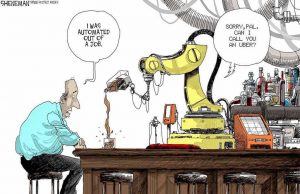
Cartoon about automation by Drew Sheneman

CFP The Body Productive

Gilbreth motion studies light painting

Saw this via Twitter. Looks good.

Call for Papers

How are bodies produced under capitalism?

How, in turn, does capitalism make bodies productive?

How is the body (and knowledge of the body) shaped by demands of production, consumption and exchange, and how can these logics be resisted, challenged and overcome?

These are the questions at the heart of François Guéry and Didier Deleule’s Productive Body. First published in French in 1972, The Productive Body asks how the human body and its labour have been expropriated and re-engineered through successive stages of capitalism. The Productive Body challenges us to rethink the relationships between the biological and the social; the body and the mind; power and knowledge; discipline and control. Finally, it invites us to think about the body as a site of resistance and revolutionary potential.

corpsbody

At this one-day, interdisciplinary conference, we invite scholars and activists to assess the contribution of The Productive Body, and to address its relevance as a theoretical tool for understanding and challenging contemporary ideologies of bodily health, efficiency and productivity.

We invite submissions from scholars, activists and artists for 20-minute papers, or 10-minute provocations on the relationships – past and present – between capitalism, work and the body. Collaborative papers are welcome, and proposals for longer workshops and panel discussions will also be considered. Please contact the organisers if you are unsure. Proposals that explore or are inspired by any of the following areas are welcome:

  • Critical responses to Guéry and Deleule – the biological, the social, and the productive
  • Materialist vs. discursive approaches to the history of the body
  • Conceptualising discipline in Marx and Foucault
  • The body as an object of discipline vs. the body as a site of dissent
  • The psychology and corporeality of activism, organising and resistance
  • Hierarchies of gender and race in the division of labour
  • (Re)productive bodies; intimate and emotional labour, sex work, body work
  • How are ideas of health and disability shaped by the demands of wage labour?
  • How do queer bodies disrupt or challenge logics of productivity? How are queer bodies in turn, commodified or appropriated by capital?
  • How do the demands of productivity complicate/interact with the body as a site of intimacy?
  • Biopolitics and neoliberalism
  • Body-machines – technology and automation; robotics, cybernetics and transhumanism; digital surveillance, ‘lifelogging’ and the ‘quantified self’
  • Counterproductive bodies: pre-capitalist, non-capitalist, and post-capitalist bodies

Please send abstracts of no more than 300 words to thebodyproductive@gmail.com by 24th August 2018. Submissions are especially encouraged from graduate students, early-career researchers, and groups typically underrepresented in the academy.

“The Rise of the Robot Reserve Army” – interesting working paper

Charlie Chaplin in Modern Times

Saw this via Twitter somehow…

The Rise of the Robot Reserve Army: Automation and the Future of Economic Development, Work, and Wages in Developing Countries – Working Paper 487

Lukas Schlogl and Andy Sumner

Employment generation is crucial to spreading the benefits of economic growth broadly and to reducing global poverty. And yet, emerging economies face a contemporary challenge to traditional pathways to employment generation: automation, digitalization, and labor-saving technologies. 1.8 billion jobs—or two-thirds of the current labor force of developing countries—are estimated to be susceptible to automation from today’s technological standpoint. Cumulative advances in industrial automation and labor-saving technologies could further exacerbate this trend. Or will they? In this paper we: (i) discuss the literature on automation; and in doing so (ii) discuss definitions and determinants of automation in the context of theories of economic development; (iii) assess the empirical estimates of employment-related impacts of automation; (iv) characterize the potential public policy responses to automation; and (v) highlight areas for further exploration in terms of employment and economic development strategies in developing countries. In an adaption of the Lewis model of economic development, the paper uses a simple framework in which the potential for automation creates “unlimited supplies of artificial labor” particularly in the agricultural and industrial sectors due to technological feasibility. This is likely to create a push force for labor to move into the service sector, leading to a bloating of service-sector employment and wage stagnation but not to mass unemployment, at least in the short-to-medium term.

Reblog> Internet Addiction watch “Are We All Addicts Now? Video

Twitter

Via Tony Sampson. Looks interesting >

This topic has been getting a lot of TV/Press coverage here in the UK.Here’s a video of a symposium discussing artistic resistance, critical theory strategies to ‘internet addiction’ and the book Are We All Addicts Now? Convened at Central St Martins, London on 7th Nov 2017. Introduced by Ruth Catlow with talks by Katriona Beales, Feral Practice, Emily Rosamond and myself…

@KatrionaBeales @FeralPractice @TonyDSpamson @EmilyRosamond & @furtherfield