
Here’s Bradley Garrett, Leo Hollis and Anna Minton talking at the Festival of the Future City, in Bristol – found through Deterritorial Investigations Unit
Interesting new paper: Performing the sharing economy – Lizzie Richardson
This new article in Geoforum [paywall] by Lizzie Richardson (@LizzieCIRich) looks really good – I’ve only skim read it so far but looking forward digging in 🙂
Performing the sharing economy
Here’s the abstract:
The sharing economy converges around activities facilitated through digital platforms that enable peer-to-peer access to goods and services. It constitutes an apparent paradox, framed as both part of the capitalist economy and as an alternative. This duplicity necessitates focusing on the performances of the sharing economy: how it simultaneously constructs diverse economic activities whilst also inviting the deconstruction of ongoing practices of dominance. Such performances hold open the question of what the (sharing) economy is, suspending it as a space for both opportunity and critique. Drawing on participant observation at a sharing economy ‘festival’ and analysis of the vocabularies of online platforms, the paper outlines three performances of sharing through community, access and collaboration. It argues through these performances that the sharing economy is contingent and complexly articulated. It has the potential to both shake up and further entrench ‘business-as-usual’ through the ongoing reconfiguration of a divergent range of (economic) activities. Whilst offering an antidote to the narrative of economy as engendering isolation and separation, the sharing economy simultaneously masks new forms of inequality and polarisations of ownership. Nonetheless, the paper concludes in suggesting that by pointing to wider questions concerning participation in, access to and production of resources, the sharing economy should not be dismissed. Instead, it should serve as prompt to engage with ‘digital’ transformations of economy in the spirit of affirmative critique that might enact the promise of doing economy differently.
Reblog> New HTTP error code 451 to signal censorship
Interesting… (love the Bradbury reference too!) via Steve @Bowbrick
New HTTP error code 451 to signal censorship
Will help catalogue attempts to limit information
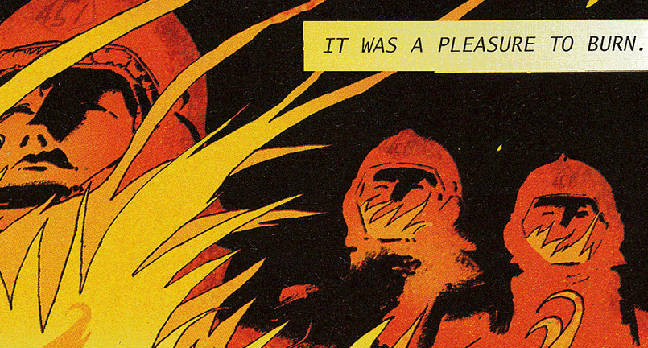
After a three-year campaign, the IETF has cleared the way for a new HTTP status code to reflect online censorship.
The new code – 451 – is in honor of Ray Bradbury’s classic novel Fahrenheit 451 in which books are banned and any found are burned (451 degrees Fahrenheit being the auto-ignition temperature for paper).
The idea is that rather than a web server, proxy or some other system returning a 403 code to a browser when information is blocked – i.e. you are not authorized to see it – the 451 status code will mean “unavailable for legal reasons.” Specifically, according to a draft RFC:
This status code indicates that the server is denying access to the resource as a consequence of a legal demand.
The server in question might not be an origin server. This type of legal demand typically most directly affects the operations of ISPs and search engines.
The IETF published the proposal late last week; this should encourage some people to start using it early. There will be a few more steps before it becomes official. It was first proposed back in June 2012 when British ISPs started being forced to block The Pirate Bay.
Reblog> Raising the Bar: The Metric Tide that Sinks All Boats

This post by Liz Morrish is an excellent if dismal reflection upon the kinds of performance management we labour under in universities. The expectations for the ‘exeter academic’ are not dissimilar to those discussed in the post. Saw this via Julie Cupples.
Raising the Bar: The Metric Tide that Sinks All Boats
Liz Morrish writes: A longer post than usual, but very relevant if your working life in academia is governed by the insanity of metrics – grant income, PhD students, impact, REf 4* ‘outputs’. You know it is insanity, so read on”¦..
James Wilsdon may as well not have inveighed against the ‘metric tide’, and Jo Johnson could have saved printers’ ink asking vice-chancellors not to waste academics’ time, and students’ fee money by operating multiple ‘mock’ REFs (BIS Green Paper November 2015 Chapter 2, para 7).
It is time for a critical conversation to take place about the use and abuse of metrics. In July 2015, Hefce published The Metric Tide, the report of a review body chaired by James Wilsdon, professor of science and democracy at the University of Sussex.
Despite the report’s chilling preface, announcing a “new barbarity” in our universities, we continue to witness the misuse of metrics as a tool of management in UK higher education. “Metrics hold real power: they are constitutive of values, identities and livelihoods”, wrote Wilsdon. Universities should proceed with caution, then, lest metrics should spread like a digital Himalayan Balsam and undermine the ethical architecture of universities.
It is ironic, but perhaps fortunate, that students find universities a very different experience than the academic staff who labour in them. For students, the intrusive scrutiny of metrics can at least claim to betoken a therapeutic and supportive institution. Generally speaking, the student ‘dashboard’ does not harbour the disciplinary function of its academic equivalent.
Imogen Heap on inventing new [blockchain] contracts for publishing/selling music digitally
This interview/article in Forbes with Imogen Heap offers an interesting insight into what some artists are beginning to think about in relation to how on earth one creates a ‘fair’ mechanism of reward/recognition of work as an artist in a world where one’s work is subject to near infinite digital reproducibility.
This, to me (in my naivety), seems to represent one of the more compelling and believable implementations of what the blockchain can enable. It’s worth checking out Heap’s articulation of Mycelia (the blockchain powered music publishing system she hopes to help create).
For years I’ve been so frustrated with the deep opacity of the music industry stopping me from really making the most out of my career and connecting the dots. The ‘black boxes,’ the NDAs, the endless contracts and statements. In the last few years, auditing labels and publishers seems to have become the norm, as it’s apparent how consistently the books don’t match up. You can pretty much guarantee you’ll find something, but it’s not always intentional; it’s just the deals, trigger points, and percentages are so complex – even more when mergers and acquisitions occur – that it’s hard to get it right every time, if you’re human!
[Mycelia…]
Its success will come from the adoption of millions of music lovers. A grand scale ongoing, collective project like no-other. To document, protect and share that which we love and build a place for it to grow, enabling future generations of artists to blossom as well as honouring those of the past.
Open source, a living, breathing, smart, decentralised, transparent, adaptable, useful, shining home for our love of music. A home which allows creativity to flow, connect and facilitate collaboration on so many levels, many of which just haven’t been possible. With this grand library of all music forming the basis upon which all music businesses from digital radio to tour bookings can then grow and thrive from. Empowering the artists, turning and landing the industry finally on its feet.
Inspired by the largest living organisms on earth, ancient, unseen, core to life itself, Mycelium (plural Mycelia) can stretch for miles, beneath the surface.
Each artist acting like its own Mycelium, in full animated dialogue with others on the global network.
Mycelia is huge, as it holds all music related information ever recorded anywhere ever ever ever but this organism stretches across our planet between hundreds of thousands of personal computers. It is the world’s greatest and most treasured library and it belongs to the two collective parties who solely make music complete. The music makers and their audience.
Reblog> New Book – Smart Urbanism: Utopian Vision or False Dawn
Interesting new book highlighted by Colin McFarlane, including contributions by Rob Kitchin (and team) and Jennifer Gabrys…
New Book – Smart Urbanism: Utopian Vision or False Dawn
Andrés Luque-Ayala, Simon Marvin and myself have just published a new edited book on the ‘smart city’ debate. The book, Smart Urbanism: Utopian Vision or False Dawn? (Routledge), is a critical examination of the claims, drivers, imaginaries and consequences of smart city discourses.
As we all know, there is an incredible amount of hype and noise made about smart cities, much of it by multinational corporations like IBM and Cisco in their effort to sell expensive ‘urban solutions’. In this book, we sought to take this debate on by bringing together a group of critical, international and interdisciplinary researchers.
The book examines how smart city initiatives are being rolled out, and makes a series of arguments that seeks to advance a critical research agenda. It finds, for example, that the discourse is often in reality a justification for the latest round of neoliberal development and displacement. It finds a common tendency to place far too much faith in technology, with far too little attention to the actual urban context. It also finds that most of the time, and despite high profile cases such as Rio’s control room, the smart city discourse is little more than discourse, bolstered by pervasive imagery that globally circulates and effectively constitutes a powerful form of marketing.
But the book also finds openings in the smart city discourse, including in the actions of social movements, civil society groups, and critical researchers to use or promote digital technologies in more socially and ecologically relevant ways. In these efforts, it is urbanism and social justice that inform whether or not digital technologies are useful, as opposed to the positivist view that technology can be added to cities awaiting ‘enhancement’ through sensors, dashboards and real-time data management. But as the book shows, it would be far too simple to argue that there is an ‘alternative’ smart city discourse that opposes a ‘mainstream’ discourse, partly because the various overlaps between what may initially appear mainstream and alternative, and partly because many critical initiatives with digital technology reject the entire smart city discourse altogether while others seeks to reframe it.
Here’s the list of contributors and chapter titles:
- IntroductionAndrés Luque-Ayala, Colin McFarlane and Simon Marvin
- Smart cities and the politics of urban dataRob Kitchin, Tracey Lauriault and Gavin McArdle
- IBM and the visual formation of smart citiesDonald McNeill
- The smart entrepreneurial city: Dholera and a 100 other utopias in IndiaAyona Datta
- Getting smart about smart cities in Cape Town: Beyond the rhetoricNancy Odendaal
- Programming environments: Environmentality and citizen sensing in the smart cityJennifer Gabrys
- Smart-city initiatives and the Foucauldian logics of governing through codeFrancisco Klauser and Ola Söderström
- Geographies of smart urban powerGareth Powells, Harriet Bulkeley and Anthony McLean
- Test-Bed as urban epistemologyNerea Calvillo, Orit Halpern, Jesse LeCavalier and Wolfgang Pietsch
- Beyond the corporate smart city?: Glimpses of other possibilities of smartnessRobert G. Hollands
- ConclusionsColin McFarlane Andrés Luque-Ayala and Simon Marvin
Reblog> Space, Power and the Commons: new book in Place, Space and Politics series
Clive Barnett on a new book out edited by Samuel Kirwan, Leila Dawney & Julian Brigstocke… all smart people so well worth a look!
Space, Power and the Commons: new book in Place, Space and Politics series
 The latest book in the Routledge Research in Place, Space and Politics series is now published (technically it is a 2016 book) – Space, Power and the Commons: The struggle for alternative futures is edited by Sam Kirwan, Leila Dawney and Julian Brigstocke, and is associated with the Authority Research Network. It’s an important addition to the literature on the theme of ‘the commons’, not least because it draws together discussions of high theory on this topic (Hardt, Nancy, Ranciere, etc) with empirical analyses of practices of ‘commoning’.
This is the second title to appear in the Place, Space and Politics series, after the collection on Urban Refugees. There are more titles in the pipeline. More details on the series, including guidelines for submitting proposals, can be found here and here.
*.exe ~ Executions: conversations on code, power & death (version 0.1)
This event in Aarhus, this week, with Wendy Chun and Geoff Cox as ‘keynotes’ looks really good!
Executions: conversations on code, power & death (version 0.1)
Keynote presenters: Wendy Chun and Geoff Cox
Venue: Aarhus Institute of Advanced Studies (AIAS) | Høegh-Guldbergs Gade 6b, bygning 1630, Aarhus
When: December 3rd and 4th, 2015
This event investigates the cultural, material and political implications of execution. Software permeates our environment. We co-exist in an increasingly datafied present in which algorithms and abstract coded processes execute across different scales, materialising and operating at the micro and macro levels of our actions.
The aim of this event is to open up the concept of execution, both from a particular perspective of code and its execution, and more generally towards a wider discussion in relation to datafied culture and everyday life. How can we understand the affective, embodied, performative, programmed processes of execution in the world today? By gathering together researchers working with diverse artistic practices, we hope to encourage a critical curiosity and engagement with the theme of execution.
Topics will include:
execution as power / execution as decision / execution as performed instruction set / execution as enunciation / execution as critique / execution as temporal performance / execution as participation / execution as cruelty / indigestion/incorporation as execution / tuning as execution
In autumn 2015 and spring 2016, two-day events will take place (in Aarhus, Denmark and Malmö, Sweden respectively) that include keynote talks by Wendy Chun (Brown University) and Geoff Cox (Aarhus University), as well as workshops on the theme of execution.
These events are instantiations of an on-going discussion by the critical software thing group, a collection of researchers with a common interest in exploring, reflecting on and working with code.
Projecting a genuine future for the living? On Latour & Stiegler comments after the Paris attacks
I was quite surprised at how quickly the translation of the short interview with Bernard Stiegler in le Monde spread on twitter, which is not usual for my posts…
Anyway, I have been struck by a similarity in ethos between the comments made by Bernard Stiegler in his interview and the commentary provided by Bruno Latour in an op-ed (translated by Jane Kuntz) for Reporterre, entitled “The Other State of Urgency” [via Installing (Social) Order].
It is an ethos of calling for the casting-off of a short-termism or ‘death-wish’ (pace Latour) focussed on (inadequately mitigating) destruction–destruction of states, of peoples and of our planet–towards affirming what Stiegler calls a ‘genuine’ future and what Latour sees as a taking of fate into our our hands. One might see it as a loosely vitalist ethos: an affirmation of life and its pluri-potency.
It seems to me significant that both Latour and Stiegler frame the issue in relation to the anthropocene and the COP21 talks being held in Paris. For both of them, the affirmation of a ‘genuine’ future entails combining stances towards ecological, economic, political and scientific atmospheres. Such an affirmation of a sustainable path towards a future of the living is set in contra-distinction to a rhetoric of war, which both thinkers reject in their own ways. To submit to war, in the manner of the French government, is to submit to a short-term imperative to (re)act, but to act for whom and to what ends is a question both Latour and Stiegler find troubling. It is analogous to government via catastrophism – such forms of reaction are already presumed in the mode of ‘normal’ operation: the ‘everywhere war’ and ‘state of exception’ is the new ‘normal’.
Who could argue against an affirmation of hope? I certainly would not. Yet, while there is plenty of diagnosis of the ‘state of urgency’, we are left to ponder: what is to be done?
I don’t think I buy Stiegler’s eurocentric call for policy, it is too easy to see how–even with the best of intentions–this would slip into the kind of technocratic malaise that has buggered up the Mediterranean EU countries. Yet, at least Stiegler attempts to offer strategies – and I think the wider outlining of a political-economics of contribution and of a kind of ‘neganthropy‘, while somewhat grandiloquent, remain inspiring. I would be very curious to see what Latour would suggest in order to “invent demonstrations more innovative than yet another march from Place de la République to Place de la Nation.”
It is, of course, excruciatingly hard to offer strategies for action – as Zizek likes to quip: we can see why it has been suggested that it is easier to imagine the end of the world than an end to the ideological milieu of capitalism. Working for a ‘genuine’ future hurts, but as both Latour and Stiegler demonstrate: it remains the task at hand.
Stiegler on Daesh and ‘the age of disruption”
I offer a here a quick translation of an interview for Le Monde published past week with Bernard Stiegler, following the attacks in Paris in which he addresses Daesh/ISIS within the context of his conceptualisation of ‘disruption’, which is the context of his forthcoming book [Dans la Dusruption ~ “In the Age of Disruption”].
Only by planning a genuine future can we fight Daesh
The philosopher Bernard Stiegler develops this thesis in his forthcoming book: “In the Age of Disruption”.
Interview by Margherita Nasi.
For the philosopher Bernard Stiegler “war is economic”. The collapose of employment egenders a dispair that in turn leads to violence. “There is no future without a fundamental reversal of economic value”, he explains.
Since the attacks of the 13th of November the President of the Republic insists” “We are at war”, do you recognise yourself in such a war?
No. What is this “we”? They are at war, not me. War is economic, it is theirs and it creates casualties, including me, who cannot sleep at night, not because of terrorists but because of a lack of future for my children. This is not a war against Daesh, as they suggest, but a global economic war, which takes us into civil war if we do not combat it.
Employment will collapse, especially amongst young people, and dispair breeds violence. We no longer produce reasons for hope today. The attacks of the 13th of November were suicide attacks, which is not insignificant – suicide is developing around the world, especially amongst those young people who know they will not work for a long time.
Both Sarkozy and Hollande failed to provide any kind of prospects for these young people. It is against this stupidity, this madness, that I am at war. A war within myself as well: we are all subject to this tendency to find scapegoats, not to think and not to care. This is barbarism, and that is exactly what Daesh wants: to create civil war. There will be more attacks if we do not change our politics. This is the context of my next book ” In the Age of Disruption”.
What do you mean by disruption?
Disruption is a phenomenon of accelerating inovation which is the foundation of a strategy developed in Silicon Valley: it is a drive to go faster than societies in order to impose upon them models for the destruction of social structures, rendering public powers powerless It is a strategy that tetanises the opponent. In my book, I analyse a text signed by Abu Bakr Al-Naji, as summarised by Ignance Leverrier [former diplomat and journalist], that defines a collective, including former officers of Saddam Hussein that became Islamists. It is a sort of Daesh manual, in the image of corporate bibles that detail the rules to set up a franchise. This book explains how Daesh actors should seize power. One must create chaos and thus exploit the need for some kind of authority.
I compare this strategy with that of the website “Les Barbares attaquent” [The barbarians are coming], founded by Nicolas Colin, a former tax inspector known for his report on the tax system and the digital economy, in which hie highlighted the inadequacy of the tax system for dealing with digital companies, which he describes as the ‘four horsemen of the apocalypse’, in this case GAFA [acronym for: Google, Amazon, Facebook and Apple]. He has since moved to the other side, from public service into the economy which he described as so damaging, to create an investment fund that raises money to practice disruption on the French. Yet, repeating the strategy of GAFA, he can only extend their ecosystem and intensify the colonisation of Europe, wrecking transport, housing, education–all sectors–through new models such as Uber. However, such disruptive practices destroy the social balance, what [German Philosopher] Theodor W. Adorno anticipated by speaking in 1944 of a “new form of barbarism” in relation to the cultural industries.
It is not by declaring war on Daesh that this takes place. This declaration is one way of absolving oneself of one’s own responsibilities by scapegoating people that have become extremely dangerous and who we have co-produced with Daesh.
This radicalisation is thus built on the ruins of ultraliberalism?
Yes. We turn radicalism into a question of religion, and this is outrageous, Most recruits of radical Islam have no religious culture. It is not religion in question but despair. Richard Dur, the murderer of eight members of the Nanterre Council in March 2002, prefigures his actions by speaking about his feelings not existing: he wanted to become somebody by these actions.
In 2012 you launched a call for a global economic peace treaty, is this still a possible contemporary solution for eradicating barbarism?
We need to open out a debate in Europe, take things head-on, since the birth of the web we have all been losing. Exploited by the kinds of disruption practised by GAFA, digital technologies have accentuated the environmental toxicity that has been growing since the beginning of the anthropocene – an era in which humans have become the major geological factor – in terms of the climate, the atmosphere and in mental terms.
There is no future without a fundamental reversal of economic value: only the transition to an economy producing sustainable forms of value will overcome the challenges that are the subject of the COP21 next week.
We must launch a new European policy rather than aligning ourselves with the American model that is disruptive and suicidal/ We must invent a new Web in the service of viable marcoeconomic model, rather than developing a completely ruinous economy of data. These are the themes of the “Conversations about a new industrial world”, orgainsed at the Pompidou Centre on the 14th and 15th of December. Only by planning [projetant] a genuine [véritable] future for the planet can we combat Daesh, in other words to combat despair.