I was delighted to have Dr Jess McLean from Macquarie visit us in Exeter this week. Jess gave a great talk in our department around themes from a new book, about to be published by Palgrave. It promises to be a really interesting contribution to the renewed interest in ‘digital’ in geographyland and especially at the intersections with political ecology and work concerning the anthropocene.
This book examines the changing digital geographies of the Anthropocene. It analyses how technologies are providing new opportunities for communication and connection, while simultaneously deepening existing problems associated with isolation, global inequity and environmental harm. By offering a reading of digital technologies as ‘more-than-real’, the author argues that the productive and destructive possibilities of digital geographies are changing important aspects of human and non-human worlds. Like the more-than-human notion and how it emphasises interconnections of humans and non-humans in the world, the more-than-real inverts the diminishing that accompanies use of the terms ‘virtual’ and ‘immaterial’ as applied to digital spaces. Digital geographies are fluid, amorphous spaces made of contradictory possibilities in this Anthropocene moment. By sharing experiences of people involved in trying to improve digital geographies, this book offers stories of hope and possibility alongside stories of grief and despair. The more-than-real concept can help us understand such work – by feminists, digital rights activists, disability rights activists, environmentalists and more. Drawing on case studies from around the world, this book will appeal to academics, university students, and activists who are keen to learn from other people’s efforts to change digital geographies, and who also seek to remake digital geographies.
My piece applied some of my previous conceptual work around the politics of anticipation to my current interests in the stories that are told about automation. I argue that automation exists as much in the imaginations as in practice. This means that a lot of how automation is articulated is in terms of what is to come, not what is present. Nevertheless, particular imaginaries of possible worlds are lent credibility through particular ways of addressing a future as the future. This, I suggest, is the distinction in address between “present futures” and “future presents” (following Adam and Groves 2007).
“Future presents” are efforts to bring a ‘future’ into ‘the present’ to make it happen. “Present futures” are a way to hold a future at a distance in order to form the idea of a threatening risk or an attractive utopian goal.
I work through a quick example about how the ‘fact’ of a particular future state of affairs becomes concrete, through reiteration and reworking. I trace a story from a Guardian news article back through several layers of sources.
The formulation of a future as the future, as argued in the first editorial of Futures of Work, does political work – it enables certain forms of powerful rhetoric, for example around a fourth industrial revolution. Rhetorically constructed as the “present future”, it possesses a discursive power over what is considered ‘common sense’ and elides the persistent contradictions of capitalism. Meanwhile, it allows management consultancies and others to propose the proximity of a “future present” as a problem for which there is a solution to be sold, as Sturdy and Morgan argue.
All too often arguments around automation and futures of work accept narratives of displacement or replacement of jobs as their premise. This renders them common sense, rather than calling them into question. How we construct and receive ‘truths’ about possible futures of work is political and demands political action. We must pay attention to how particular futures become ‘facts’ and how well those ‘facts’ travel and take on a life of their own.
In this first full episode of Antipod we turn our attention to Black Geographies, the theme of our first season. Hosts Brian Williams and Akira Drake Rodriguez walk listeners through a series of clips from a panel on Clyde Woods’s posthomously published work Development Drowned and Reborn: The Blues and Bourbon Restorations of Post-Katrina New Orleans, edited by Jordan T. Camp and Laura Pulido (University of Georgia Press, 2017). Brian and Akira comment on the use of Woods’s “blues epistemology” framework to contextualize the ongoing making and re-making of Black geographies in New Orleans. Covering themes from dispossession to displacement to the fallacy of “natural” disasters, this episode challenges traditional notions of urban planning and privileges what Woods’s calls “the visions of the dispossessed.” Clips from this episode are from an “Author Meets Critics” panel at the Community Book Center in New Orleans’s Seventh Ward, a space of continuity for pre- and post-Katrina New Orleans residents. The participants in the discussion were: former Woods student and activist-poet Sunni Patterson; Khalil Shahyd, Senior Policy Advocate at the National Resource Defense Council; Anna Brand, Asst. Prof at the University of California at Berkeley; Shana Griffin from Jane’s Place, New Orleans’ first community land trust; Sue Mobley, who, at the time of the panel, was the Public Programs Manager for the Albert and Tina Small Center for Collaborative Design at Tulane University; and Jordan T. Camp (editor) who at the time of the panel was at Barnard College, and is now the Director of Research at the People’s Forum in New York.
We have a 6 month 0.5FTE research associate post available in the 3S research group at the University of East Anglia, UK, on the Just Public Algorithms project. The successful candidate will work with me and Professor Jason Chilvers of the 3S research group, as well as the participation NGO Involve UK. The project is funded as part of the EPSRC Not Equal network+.
In between doing other things I am trying to maintain a little progress with work on The Automative Imagination. Recently I’ve been looking at (largely Anglophone and/or global North/West) representations of robots or automatons in cinema. There’s some funny examples (I posted a few music video representations some time ago) and it is interesting how humour, and I suppose forms of satire, and artistic representations are an enduring way of getting to grips with whatever we think ‘robots’ might be.
So, for your consideration – I have posted below two interesting pieces I have found recently (to me). I’ll try to write more on this in the near future.
This ‘deepfake’ video of lots of current and former world leaders and other famous people is interesting and provokes all sorts of questions. Some suggest legislation against them, which is what the US seems to be pursuing, but that of course asks further questions about how to ‘police’ them and who has agency. There are, perhaps, some interesting resonances with the increasing use of performance holograms to re-animate dead performers – but there, of course, the legal issues are different. Nevertheless, all sorts of ideas, aesthetic, ethical and otherwise, about ‘authenticity’ crop up (e.g. this from New Scientist, or this on trust in ‘evidence’ re ‘deepfakes’), which we will increasingly be provoked into discussing.
It is interesting, I think, that while those of us in what we call ‘critical’ social sciences or humanities have been developing fairly nuanced articulations of identity and subjectivity, arguing they are not necessarily essential and acknowledging how they are performed (for example), contemporary digital/ social media, and our uses of them, have forged new norms of ‘authenticity’ in relation to identity. Facebook wants ‘true’ names, for instance. “Finsta” (‘f’ denoting ‘fake’), the phenomenon of setting up hidden, often pseudonymous, Instagram accounts – only for selected friends (as opposed to your curated “rinsta” account (‘r’ denoting ‘real’)) shows how these two understandings of the performative nature of identity and the construction of a normative insistence on ‘authenticity’ collide. We might reasonably ask, for instance, why the ‘finsta’/’rinsta’ labels don’t actually mean the reverse if the more public of the two accounts is heavily curated and the ‘secret’ one is in some senses then more ‘authentic’.
‘Deepfakes’ are, amongst other things, a sensory ‘trick’, an attempt to somehow fool the conscious and sub-conscious habitual discernment of what feels whatever it is we mean by ‘authentic’, ‘genuine’ or ‘real’. In some senses, ‘deepfakes’ reveal back to us the extent to which digital media may have shifted how we pay attention and how we feel (about ourselves, others and the world around us) with and through them. Digital media cultivate attention in different ways, many of them perhaps oriented towards a capitalist imperative, also, perhaps, with them we cultivate forms of paying attention. If this is the case then, as was argued in terms of the potency of TV advertising, we may begin to ‘see through’ the ‘tricks’ precisely because we are bombarded with them (for example, the Putin bits in the video above are not very convincing to my eye). Or, to be pessimistic, we may simply begin to assume nothing can be trusted, that all media is created in bad faith, which of course prompts discussions of a crisis of democracy because how can a population make informed decisions without ‘trustworthy’ sources.
On the Ràdio Web Macbawebsite there is a podcast interview with philosopher Bernard Stiegler as part of a series to ‘Reimagine Europe’. It covers many of the major themes that have preoccupied Stiegler for the last ten years (if not longer). You can download the pod as an mp3 for free. Please find the blurb below and a link.
In his books and lectures, Stiegler presents a broad philosophical approach in which technology becomes the starting point for thinking about living together and individual fulfilment. All technology has the power to increase entropy in the world, and also to reduce it: it is potentially a poison or cure, depending on our ability to distil beneficial, non-toxic effects through its use. Based on this premise, Stiegler proposes a new model of knowledge and a large-scale contributive economy to coordinate an alliance between social agents such as academia, politics, business, and banks. The goal, he says, is to create a collective intelligence capable of reversing the planet’s self-destructive course, and to develop a plan – within an urgent ten-year time-frame – with solutions to the challenges of the Anthropocene, robotics, and the increasing quantification of life.
In this podcast Bernard Stiegler talks about education and smartphones, translations and linguists, about economic war, climate change, and political stupidity. We also chat about pharmacology and organology, about the erosion of biodiversity, the vital importance of error, and the Neganthropocene as a desirable goal to work towards, ready to be constructed.
Timeline 00:00 Contributory economy: work vs proletarianization 05:21 Our main organs are outside of our body 07:45 Reading and writing compose the republic 12:49 Refounding Knowledge 15:03 Digital pharmakon 18:28 Contributory research. Neganthropy, biodiversity and diversification 24:02 The need of an economic peace 27:24 The limits of micropolitics 29:32 Macroeconomics and Neganthropic bifurcation 36:55 Libido is fidelity 42:33 A pharmacological critique of acceleration 46:35 Degrowth is the wrong question
For the last couple of years I have given a lecture that takes the “Virtual/Real” distinction and deconstructs it using various bits of geographical theory. I also talk about the enduring trope of the sort of eschatological narrative of VR, tying it back to a little bit of history, mainly focusing on how this has been propagated in pop culture. This year, for fun, I have decided to be a little bit more creative than resorting to my usual trick of showing the trailer for Lawnmower Man or Ready Player One – I’ve made a quick mashup of the two, which I think show quite nicely how the underlying narratives of the ‘virtual’ somehow counterposed to the ‘real’ but also in some way ‘crossing over’ is an enduring theme.
The other enduring theme here is that the forms of gameplay drawn upon are characterised as highly masculine (and normatively heterosexual – no queering of the digital here, sadly), which is something I will try to also blog about sometime…
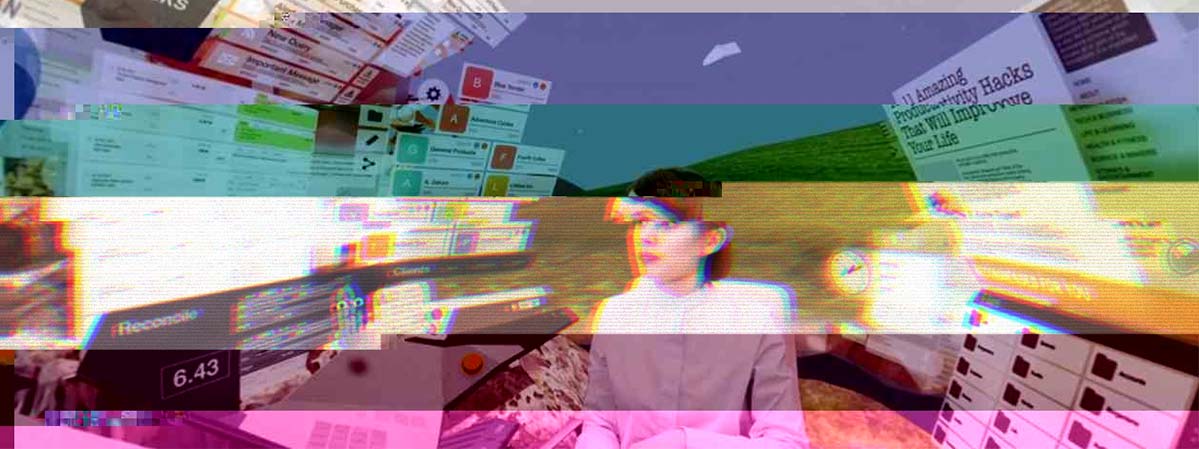
“With automation disrupting centuries-old industries, the professional must reshape and expand their service to add value. Failure is a mindset. It is those who empower themselves with technology who will thrive. “Merger is a new film about the future of work, from cult director/designer Keiichi Matsuda (HYPER-REALITY). Set against the backdrop of AI-run corporations, a tele-operator finds herself caught between virtual and physical reality, human and machine. As she fights for her economic survival, she finds herself immersed in the cult of productivity, in search of the ultimate interface. This short film documents her last 4 minutes on earth.”
I came across the most recent film by Keichii Matsuda which concerns a possible future of work, with the protagonist embedded in an (aesthetically Microsoft-style) augmented reality of screen-surfaces, and in which the narrative denouement is a sort of trans-human ‘uploading’ moment.
I like Matsuda’s work. i think he skilfully and playfully provokes particular sorts of conversations, mostly about what we used to call ‘immersion’ and the nature of mediation. This has, predictably happened in terms of human vs. AI vs. eschatology (etc etc.) sorts of narratives in various outlets (e.g. the Verge). The first time I encountered his work was at a Passenger Films event at which Rob Kitchin talked about theorisations of mediation in relation to both Matsuda’s work and the (original) Disney film ‘Tron‘.
What is perhaps (briefly) interesting here are two things:
The narrative is a provocative short story that asks us to reflect upon how our world of work and technological development get us from now (the status quo) to an apparent future state of affairs, which carries with it certain kinds of ethical, normative and political contentions. So, this is a story that piggybacks the growing narrative of ‘post-work’ or widespread automation of work by apparently ‘inhuman’ technologies (i.e. A.I) that provokes debate about the roles of ‘technology’ and ‘work’ and what it means to be ‘human’. Interestingly, this (arguably) places “Merger” in the genre of ‘fantasy’ rather than ‘science fiction’ – it is, after all, an eschatological story (I don’t see this final point as a negative). I suppose it could also be seen as a fictional suicide note but I’d rather not dwell on that…
The depiction of the interface and the interaction with the technology-world of the protagonist– and indeed the depiction of these within a 360-degree video –are as important as the story to what the video is signifying. By which I mean – like the videos I called ‘vision videos’ back in 2009/10 (and (in some cases) might be called ‘design fiction’ or ‘diagetic prototypes’) – this video is also trying to show you and perhaps sell you the idea of a technology (Matsuda recently worked for Leap Motion). As I and others have argued – the more familiar audiences are with prospective/speculative technologies the more likely we are (perhaps) to sympathise with their funding/ production/ marketing and ultimately to adopt them.
People publish lists at this time of year. So, here’s another. I’m not going to pretend I am someone I’m not though… so here’s two lists, really, one is books I enjoyed reading, the other is books I wish I’d read (for want of time) and hope to in 2019.
Read
Automating Inequality – Virginia Eubanks : A superbly detailed, very readable account of the ways in which automated systems carry assumptions from the policy makers and developers within them, even when they consciously try to avoid this, and how to think about studying such things. This really is a wonderful book. If you are interested in ‘algorithms’, AI’ and automation, especially in relation to bias and ethics you really ought to read this book. Likewise, if you are interested in studying welfare provision.
The Problem with Work – Kathi Weeks : A thoughtful, mostly conceptual (in a good way), engagement with what counts as work (or ‘waged labour’) and the ways in which it has become a given and removed it from critique. In concluding the book, Weeks stages a well-argued counter to the ‘work ethic’ (in the vein of Weber) as a ‘post-work politics’ – a mandate to ‘get a life’. This is wonderful piece of scholarship.
Working Bodies – Linda McDowell : I am slightly ashamed that I’d not read this before but McDowell’s book on ‘interactive service work’, ‘body work’ and emotional labour is a forceful, really engaging and superbly argued book about how work continues to be gendered in relation to idea(l)s around ‘care’. This is also a fantastic teaching resource, which I’ve made good use of in teaching a portion of second year module on geographies of ‘work’.
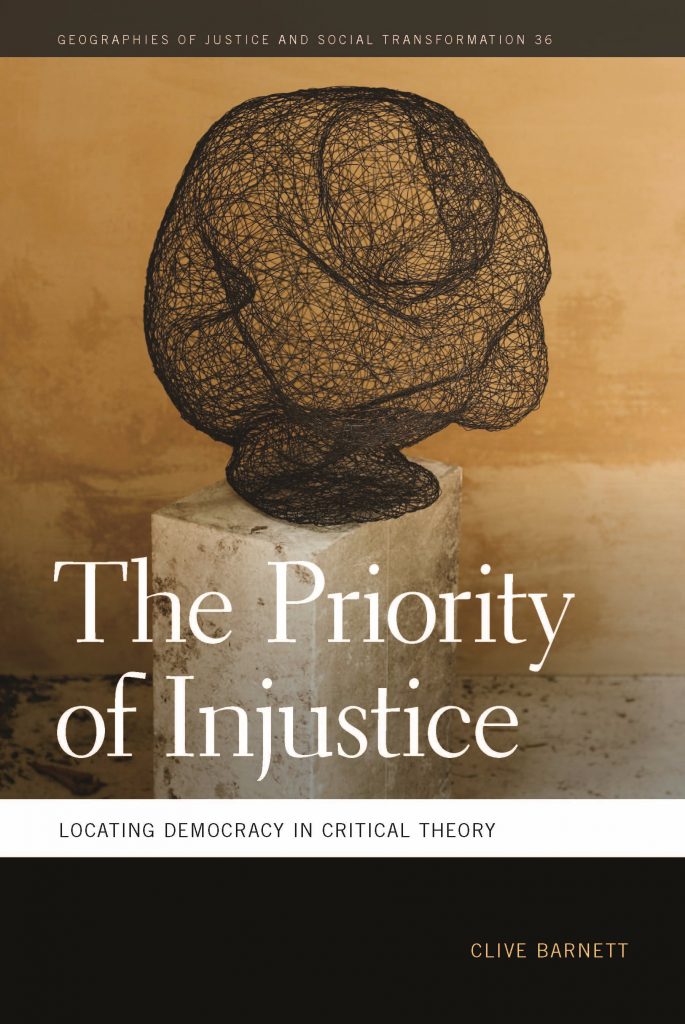
The Priority of Injustice – Clive Barnett : The subtitle –’Locating democracy in critical theory– captures the ambition of the book, which I think is fulfilled. This is a consummate and substantial theoretical (try to think of that word in a positive way here) investigation of the ways people in geographyland and the wider landscape of social theory conceptualise ‘democracy’ (often in relation to something called ‘justice’, which Clive rethinks). However, above and beyond this, what this book did for me is to further provoke a conscious rethinking of what it can mean to ‘do theory’ and to solidify a shift in my theoretical antennae. (Full disclosure: I work with Clive and I chaired an “author meets…” panel on this book at the 2018 RGS-IBG conference in Cardiff)
To Read
Programmed Inequality – Mar Hicks : A book tracing the crumbling of the British computing industry on the back of disastrous decisions made about the work-force involved, not least the pushing out of highly skilled women – what Hicks calls a ‘gendered technocracy’. I’ve read a few excerpts and related publications by Hicks on this topic, not least the excellent article in the ‘Fail’ issue of Logic, and the work is uniformly excellent. I am really looking forward to reading this.
Artificial Knowing – Alison Adam : Related to the above, this book by Adam looks fascinating – tackling ideas of a ‘knowing subject’ in relation to gender biases in AI work in the 1990s. The research is explicitly situated in relation to Haraway’s and Turkle’s feminist epistemologies. This seems like a really valuable book in getting to grips with some of the contemporary fascinations with AI.
Technology and the Virtues – Shannon Vallor : An examination of how to think about ethics/ morality in relation to technology design, use and regulation with a really substantial and well-argued engagement with virtue ethics. I came to this via John Danaher’s podcast conversation with Vallor – who was fantastic (listen here). This book looks really really interesting.
The New Enclosure – Brett Christophers : An examination of one of the most fundamental aspects of the Thatcherite programme of privatisation – the privatisation of land in the UK. This book looks like essential reading for geographers, especially those of us in the UK. I came to this via an excellent, two-part, podcast interview with Christophers on the brilliant City Road Podcast.