Brilliant new paper: Mortal Questions, by @PepeRomanillos

There some good articles (with some interesting contributions to debates on urban geographies) in the latest issue of Progress in Human Geography, including a brilliant article by my colleague Pepe Romanillos, I heartily recommend reading this:

Mortal questions
Geographies on the other side of life

Drawing upon resources from philosophy, sociology, history, and anthropology, this paper explores the possibilities of attending to geographies on the other side of life. After an introductory review of work on deathscapes and extant geographical reflections on absence and loss, the paper turns to consider three horizons in which geographers might extend their interrogations of different mortal conditions: mourning, the spatial politics of the dead, and corporeality. The paper concludes by reflecting on the disciplinary possibilities of responding to these empirical concerns at a time when we are often asked to cultivate all manner of lively geographies.

Drone Culture – new issue of Culture Machine

Hitting a contemporary ‘hot topic’, especially amongst social scientists and, in particular, geographers, the current issue of Culture Machine  is themed as “Drone Culture“.

There’s some interesting looking contributions, ranging from a media archaeology of the control room to a critique of the cybernetic utopianism that underlies the logic of drone use for governmental ends.

Lots to get your teeth into – and all open access.

Character assassinations? There’s an app for that…

Interesting article on the Washington Post  site, tweeted by David Murakami Wood (above), that talks about a service/app called “Peeple” that seeks to be a “Yelp for people” – to enable us to ‘rate’ and ‘review’ one another… A market-driven death-knell for treating one another like ‘people’ (rendering the name rather ironic) and another attempt to pull a further aspect of ‘ordinary’ life into the attention economy. This is an attempted renegotiation of the ‘normative’, what Daniel Miller and Sophie Woodward, in their book Blue Jeans, describe as the sense in which “the expectation that actions within a social field are likely to be judged as right or wrong, appropriate or inappropriate, proper or transgressive”. What if reviewing one another became ‘normal’..?(!!) *sigh*

Reblog> 12 Critical Theory books that came out this month, September

Lots to explore here!

12 Critical Theory books that came out this month, September

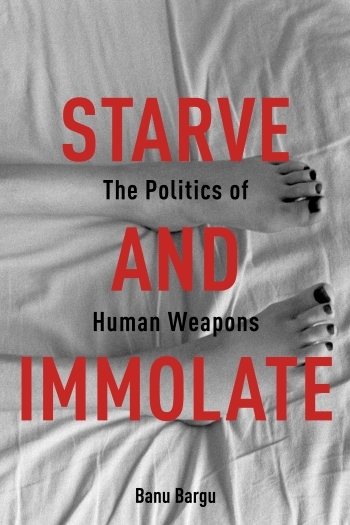
Starve and Immolate

By Banu Bargu

starve and immolate

“Starve and Immolate tells the story of leftist political prisoners in Turkey who waged a deadly struggle against the introduction of high security prisons by forging their lives into weapons. Weaving together contemporary and critical political theory with political ethnography, Banu Bargu analyzes the death fast struggle as an exemplary though not exceptional instance of self-destructive practices that are a consequence of, retort to, and refusal of the increasingly biopolitical forms of sovereign power deployed around the globe.

Bargu chronicles the experiences, rituals, values, beliefs, ideological self-representations, and contentions of the protestors who fought cellular confinement against the background of the history of Turkish democracy and the treatment of dissent in a country where prisons have become sites of political confrontation. A critical response to Michel Foucault’s Discipline and Punish, Starve and Immolate centers on new forms of struggle that arise from the asymmetric antagonism between the state and its contestants in the contemporary prison. Bargu ultimately positions the weaponization of life as a bleak, violent, and ambivalent form of insurgent politics that seeks to wrench the power of life and death away from the modern state on corporeal grounds and in increasingly theologized forms. Drawing attention to the existential commitment, sacrificial morality, and militant martyrdom that transforms these struggles into a complex amalgam of resistance, Bargu explores the global ramifications of human weapons’ practices of resistance, their possibilities and limitations.”

See the other eleven here…

Reblog> Here’s why visions of ubiquitous connectivity aren’t going to be realised any time soon

Interesting post from Mark Graham on his blog…

Here’s why visions of ubiquitous connectivity aren’t going to be realised any time soon

The last few months have seen a wealth of stories about visions to connect the world. Facebook, Google, large international organisations, states, and even Bono, dream of a world in the near future in which we are all hooked into the network.

In the midst of all of this, I found a comment made by Jimmy Wales particularly interesting.

This hope of the inevitability of ubiquitous connectivity is one that is widely reproduced by other policy makers, technologists, and thought leaders.

However, it is a hope that needs to be unpacked. There are two ways in which this hypothetical future in which everyone is connected could be brought into being.
The first one of these futures is a world where everyone can afford access. But as we demonstrated in our research about the global affordability of broadband, dropping prices is unlikely to be a sufficient strategy. There will remain billions of people making a subsistence living, for whom even extremely cheap access is unaffordable.  The average Mozambican worker, for instance, would need over one and a half year’s salary to pay for one year’s worth of broadband access.

In other words, Jimmy Wales’ prediction won’t happen simply by lowering prices.
Broadband_Affordability-1024x723
The second future is the one promoted by the likes of Mark Zuckerberg. One in which large corporations sponsor free (and importantly, limited) access for billions of people in return for attention monopolies. This brings a very different sort of Internet into being: one in which winners and losers, centres and peripheries, are already pre-selected by those who control your access.

What this all ultimately means is that it seems unlikely that any sort of open Web will be ubiquitously available in the near future. Simply lowering the cost of access will continue to leave out the very poorest; and handing over the project of connecting the disconnected to large technology firms will leave us with a very different (and far less desirable) sort of Internet.


To read a bit more about visions of connectivity, here are two of my recent papers:

Two theme issues to explore: ‘Culture Digitally’ and ‘Digital Labour’

Just a quick post to flag two very interesting theme issues of journals that have been shared on Twitter recently:

So, in the above order:

As Nancy Baym highlights, the journal Social Media + Society has a theme issue edited, or as they suggest: curated, by Tarleton Gillespie and Hector Postigo on the theme of ‘Culture Digitally’, which is also the title of the group blog to which they both contribute.

As Aphra Kerr highlights, the journal Critical Studies in Media and Communication has a theme section on Digital Labour.

Between them, both have lots of contributions that look really interesting and worth exploring!

Interesting paper: Towards a relational materialism by @digital_objects

Yuk Hui (Leuphana), one of the rising stars in the Ars Industrialis / Digital Studies milieu, has an interesting new paper out in the journal Digital Culture & Society. Unfortunately, my university doesn’t offer access but I trust that a version will appear on academia.edu / ResearchGate sometime soon…

Towards a Relational Materialism

Abstract:

This article takes off from what Lyotard calls ‘the immaterial’, demonstrated in the exhibition Les Immatériaux that he curated at the Centre Pompidou in 1985. It aims at outlining a concept of ‘relational materiality’. According to Lyotard, ‘the immaterial’ is not contrary to material: instead, it is a new industrial material brought about by telecommunication technologies, exemplified by Minitel computers, and serves as basis to describe the postmodern condition. Today this materiality is often referred to as ‘the digital’. In order to enter into a dialogue with Lytoard, and to render his notion of ‘immaterial materials’ contemporary, this article contrasts the concept of relational materiality with some current discourses on digital physics (Edward Fredkin, Gregory Chaitin) and digital textuality (Matthew Kirschenbaum). Against the conventional conception that relations are immaterial (neither being a res nor even having a real esse), and also contrary to a substantialist analysis of materiality, this article suggests that a relational materiality is made visible and explicit under digital conditions. It suggests a reconsideration of the ‘relational turn’ in the early 20th century and the concept of concretisation proposed by Gilbert Simondon. The article concludes by returning to Lyotard’s notion of materialism and his vision of a new metaphysics coming out of this ‘immaterial material’, and offers ‘relational materialism’ as a contemporary response.

In relation to this see also the book 30 Years after Les Immatériaux – Art, Science and Theory (Meson Press) – edited by Yuk Hui, with some great chapters on similar themes…

Reblog> Danse macabre

Derek Gregory points to this really lovely video from Opéra National de Paris and Julien Prévieux inspired by Gregoire Chamayou’s work on ‘schematic bodies and patterns of life’.

I love how the ideas have been translated into performance in such a provocative yet beautiful way – this really gets you thinking about, as Stiegler would put it, the grammatisation of gesture (see, in particular: For a New Critique of Political Economy, pp. 8-13): the sense in which the capture and retention of our movements feeds back into the ways in which institutions and apparatuses address us both as individuals (‘subjects’) and populations (and/or ‘markets’)…

Danse macabre

Grégoire Chamayou writes to say that after our conversations in Irvine last year he has worked with an artist friend, Julien Prévieux (who won the Prix Marcel Duchamp in 2014) and the Opéra national de Paris to turn his ideas about schematic bodies and patterns of life into a short film: Patterns of Life.

I’ve embedded it below, but if the link doesn’t work you can watch it here or on YouTube here. You will soon see why Anne Buttimer once described Torsten HÃ¥gerstrand‘s time-geography diagrams as a danse macabre.  The subtitles are in French but the commentary is in English.

I find the combination of intellectual imagination and performance work absolutely compelling – see my comments on ‘Bodies on the line’ here, for example.

Reblog> How to deal with thew ‘track changes hellstorm’

Some good advice from Alistair Fraser over on the NUIM Geography department blog…

HOW TO DEAL WITH THE ‘TRACK CHANGES HELLSTORM’

Anyone who has shared their written work recently will probably have received back a document with comments and edits inserted using the ‘track changes’ function embedded in word processors. This can be hell on earth. A hellstorm. The first time I saw it was in 2005 when I returned from doing fieldwork in South Africa. I sent a draft of a paper to my adviser and promptly got back a document with hundreds of changes and comments. I’d never seen it before, had no idea what to do with it, and basically nearly had a heart attack.

Today, my heart still skips a few beats when I open a document and see everything leaping out at me. I suspect most academics feel the same. And for students who are new to this whole thing I’m sure it can be difficult to know what to do. So here are five tips to think about it. They work for me. If you have further suggestions, let me know in the comments.

  1. Step away from the computer. Go do something else. Let your heart beat return to normal.
  2. Go back to the computer. Scroll through the whole document and get a general sense for what’s going on.
  3. Accept or reject the editorial changes. A lot of times this will be about agreeing to corrections of grammar or typos. I suspect that, with time, you will see fewer and fewer of these. But even experienced writers make stupid mistakes or write passively when they should probably write in active tense; and so on. We tend to think faster than we type and so it’s normal to miss out a word or get the grammar wrong in some way. Don’t feel bad. But do make yourself (and the person who’s reading your work) a promise. Say: “I won’t make that mistake again.” And don’t. If there’s one thing I know from commenting on other people’s work, it’s incredibly – and I mean, like, totally unbelievably – annoying if mistakes are repeated time and time again.
  4. Read all of the comments, which are usually located on the right margin. Don’t delete any. But take a piece of paper and note which comments are going to be the easiest to deal with. Then work your way through them. One by one. Next, make a start on the harder ones. A lot of times this means doing a ton of extra work. That’s life. But if you’ve cleaned the document of typos, and if you’ve worked your way through the easier comments, you should find that your brain will find the energy and the ideas to sort out the bigger issues. Yes, in many instances this is going to mean you need to completely re-think. Sometimes it can mean the document will need to be entirely re-written. Tough. But writing is about precisely this iterative process – back and forth, changing, reflecting, adjusting, improving – and the point of having someone else read your work is to enrol them in this activity. I’ve been fortunate to know two academics who consistently make excellent, thoughtful comments on my written work. You also need to find good readers and editors. Working with, and gaining from the experience of using, track changes can pay off big time. Keep the faith.
  5. Go get a drink.

Alistair Fraser

Some interesting papers: mothering with social media, archaeologies of e-waste, and performing tasks with wifi

Just wanted to flag some more interesting papers that have recently come out.

First, Robyn Longhurst‘s fantastic work on mothering with Skype and other social media has been really productive of some great papers and the latest in Social & Cultural Geographies is no exception. There’s some really lovely empirical work here and some interesting discussion of method too. I will be giving this paper to some of my students precisely because of this methods discussion. Good stuff!

Mothering, digital media and emotional geographies in Hamilton, Aotearoa New Zealand

This article traces a line between two literatures that can usefully be drawn into deeper conversation: geographies of digital media, and geographies of emotion. Its broad theoretical aim is to ascertain what insights might be gleaned by increasingly bringing together these two literatures. The more specific and primary aim, however, is an empirical one and that is to offer a materially grounded example of 35 mothers who live in Hamilton, Aotearoa New Zealand who use digital media to communicate with their children. Particular attention is paid to the capacities of different digital media, both individually and combined, to help facilitate, but certainly not guarantee, different emotions. The research is informed by a feminist geographical reading of theories of digital media and emotion. Findings illustrate that increasingly mothers are making use of digital media, both singularly and collectively, to increase the chances of a particular desired emotional outcome with their child or children. This article concludes that bodies, devices, screens, sounds and images comingle to mediate emotions over time and space.

Second, Sy Taffel has written another interesting article (following on from the paper he contributed to our theme issue of Culture Machine in 2012) concerning the desirable and undesirable materialities of electronic devices, not least when they are discarded and thrown away. This paper is part of an interesting forum convened by Angela Piccini. (You’ll find Sy’s piece between pp. 78-85):

Archaeologies of Electronic Waste

The toxicity and volume of electrical waste (commonly referred to as e-waste) forms one material legacy of contemporary digital culture which emphasizes the importance of paying attention to the deleterious material impacts of technological assemblages upon human and ecological systems, and asks serious questions about the sustainability and ethical orientation of current technocultural systems. Globally, around 50 million tonnes of e-waste are generated each year, and this waste is considered to be toxic due to the presence of a “witch’s brew” of substances which are highly hazardous to humans and other biotic systems. Whilst there exist inter-, supra-, and national laws and conventions mandating that most OECD nations (the US being a notable exemption) cannot legally export hazardous wastes to non-OECD nations, there exists a vibrant illegal market in exporting e-waste which is systematically mislabelled as working second-hand electronics goods for sale in emerging markets, with an estimated 50–100 shipping containers of illegally exported e-waste arriving daily in Hong Kong. This short essay seeks to sketch several ways that media archaeology and archaeologies of media provide productive apertures through which to consider issues surrounding e-waste, whilst contextualizing how media archaeology fits within the broader field of materialist media studies.

Thirdly, and by no means least, Sung-Yueh Perng has written a really thoughtful and interesting article on how the apparently ‘immaterial’ infrastructure of wi-fi is enrolled in ‘human-signal assemblages’ through which are performed the intricacies of everyday life. Again, some really lovely empirical work here and a nuanced synthesis of empirics and theory – with an interesting reading together of Adrian Mackenzie’s work on wireless communications, Ingold’s refrain of the ‘taskscape’ and the technocultural spatial imaginaries that have emerged in Taipei around these technologies.

Performing Tasks With Wi-Fi Signals in Taipei

This article examines the process of constructing, repairing, and improvising “human–signal assemblages” by drawing on in-depth interviews and virtual ethnography regarding the engineering of Wi-Fi connectivity in Taipei, Taiwan. It is demonstrated that spatial, temporal, infrastructural, and embodied orchestrations of Wi-Fi signals both reinforce and challenge prescribed ways of conducting daily tasks. Continuity and change, enacted by attempts to incorporate Wi-Fi signals into daily urban life, are explored by discussing a wide range of practices performed by government entities, local companies and initiatives, and users themselves. Particular attention is paid to the ways in which machines, the city landscape, discourses, maps, and signs grow and multiply, as well as intersect and intervene with each other at various levels, locales, and stages of establishing Wi-Fi connections. The article thus argues for the importance of “machine juggling” as a skillful performance that mends, maintains, and improvises Wi-Fi-enabled urban everyday rhythms.