The Museum of Contemporary Commodities in EXETER

The Museum of Contemporary Commodities

Just a quick note to let you know that the brilliant Paula Crutchlow has brought “The Museum of Contemporary Commodities” (MoCC) to Exeter for the majority of May.

There’s lots going on, much of it creative and interesting – so if you’re in Exeter or nearby: come and visit!

Two immediate things this week:

RIGHT NOW!: help re-create the internet in paper with Artist Louise Ashcroft from 11 -2 in the Exeter University Forum.

TOMORROW: sign up to do a data walkshop with Alison Powell from the LSE on Saturday from 10-1. Places have to be booked, and the Eventbrite page is here https://www.eventbrite.com/e/mocc-data-walkshop-tickets-24464719635

Please do visit the MoCC website for lots more events and activities taking place this month and visit the shop:

87 Fore St,
Exeter
EX46RT

Open 10:00-18:00pm Weds-Sat, 4th-21st May.

“Ways of Being in a Digital Age”, one of five @ESRC priorities for research 2016-2020

I’ve only just seen this but wanted to post this here as a reminder and to point it out to others with similar interests…

In the recently published ESRC Delivery Plan 2016-2020 one of the five priority areas for research is “Ways of Being in a Digital Age”, here’s their one paragraph explanation (p. 4):

Ways of Being in a Digital Age – digital technology is present in all aspects of our lives, whether we actively engage with it or not. It affects the way we communicate, and the ways we receive, consume and process information. It influences routine behaviours – the way we travel, shop and work. The presence of digital technology mediates our perceptions, behaviours and practices across these different domains and thereby influences our ways of living. This raises a number of fundamental questions about our ways of being in a digital age, the risks and opportunities associated with digital living, and our understanding of the individual, community, and society.

In Disruption – new book by Bernard Stiegler

Yet another new book by Bernard Stiegler has been published in French recently: Dans la Disruption – Comment ne pas devenir fou?

One might translate this as: “In Disruption – How do we not go mad?”

Here’s the front and back covers, and I offer a quick translation of the back cover blurb…


For the lords of economic war disruption is “a phenomenon of the acceleration of innovation (…) which is going to happen more quickly in societies that allow them to impose programmes that destroy social structures and render public power impotent. This is a kind of strategy of tetanising one’s adversary”.

Facing the disruption thus imposed, social systems always arrive too late to seize technological evolution, now thundering ahead in the digital revolution. Faced with this state of affairs, which requires countless legal and theoretical loopholes establishing a lawlessness which is a kind of techonlogical Wild-West, individuals and groups are totally lost, often to the point of going mad, individually or collectively, and therefore becoming dangerous. The concretisation of what Nietzsche described as a growing desert of nihilism leaves 21st Century humans with no other perspective than facing the next of the limits of the Anthropocene.

What can be done with such madness, in such madness? It is by starting with this question, that Bernard Stiegler rereads Michel Foucault (Madness and civilisation: A history of insanity in the Age of Reason) and Jacques Derrida (Cogito and the History of Madness) while confronting Peter Sloterdijk and Jean-Baptise Fressoz’s analyses of capitalism as above all a process of disinhibition.

The author conducts these readings or re-readings starting from the forms of madness which reflects his own course, opening out the question of a new moral philosophy – in an age without age [l’époque sans époque], which he calls the “Strauss-Kahn generation”, that is a “lack of age” [“absence d’époque”], which imposes a general demoralisation that cannot last.

Upcoming talks: ‘an algorithmic imaginary’

I’ll be giving two talks in the next week that both address the ways claims are made about ‘algorithms’, in terms of what they are and what they can do. I frame this in terms of an ‘algorithmic imaginary‘.

The first talk is titled “Prosethetic stupidity, or world-ing by numbers” (more accurately, following Derrida, this should be ‘prothétatique‘, but that’s far too enigmatic!), and is short. I’ll be taking part in the launch event for the University of Bristol’s MSc Society & Space blog, and discussing how the sociotechnical assemblages we name as algorithms perform a kind of world-ing, rather than reflect a world, which, of course, has significant implications in the growth of ‘big data’–driven computational social science.

The second talk, entitled “An algorithmic imaginary: anticipation and stupidity”, is longer. This is an invited seminar, and a part of the University of Oxford Institute for Science, Innovation and Society’s “Anthropological Approaches to Technics” seminar series.

In both talks I’m playing around with co-opting the idea of an ‘imaginary‘ (in the vein of ‘geographical’ or ‘sociological’ imaginaries) to offer a critical reading of how particular stories about automation and agency are taking hold. I acknowledge others have already employed the term (e.g. Bucher, Mager), but I think I’m offering a novel definition of my own here… In the talks I frame this in two ways: in terms of ‘anticipation’ and in terms of ‘stupidity’ (there is more detail in the written piece I’m developing on the back of the talks).

Firstly, the phenomena labelled ‘algorithms’ are suggested to anticipate the activities of people, organisations and (other) mechanisms. This is one of the substantive claims of ‘big data’ analytics in relation to any form of ‘social’ data, for example. It is certainly true that, building on ever-larger datastores, software (with its programmers, users etc. etc.) have a capacity to make certain kinds of prediction. Nevertheless, and as many have pointed out, these are predictions based upon a model (derived from data) that I argue constitutes a world (it does not reflect the world –  these predictions are ontogenetic, calling entities/relations into being, rather than descriptive).

Further, precisely because these anticipatory mechanisms are often a part of systems that use their outputs in order to select what may be seen, or not, and thus what may be acted upon, or not, they are arguably a form of self–fullfiling prophecy. The anticipation is ‘proven’ accurate precisely because it functions within a context where the data and its structures (the model) are geared towards their efficient calculation by the ‘algorithm’. Thus, we might choose to be more cautious about the claims of large social media experiments that are focused on a single platform, precisely because they are self-validating. A social media platform is a world unto itself, not a reflection of ‘reality’ (and whatever we choose that to mean). Indeed, it has been highlighted by others (Mackenzie 2005, Kitchin 2014) that the outcomes of ‘algorithms’ can be unexpected in terms of their work in world-ing.

Yet, the supposition of such an anticipation is, itself, a form of anticipation – a kind of imagining of agency. The capacity to ‘predict’ is suggested to have effects, and those effects produce particular kinds of experience, or spaces. Visions of a world are conjured with what we imagine ‘algorithms’ can do. Thus it is a double-bind of anticipation: to write anticipatory programmes, a programmer must imagine what kinds of things the programme can/should anticipate. There is accordingly a geographical imaginary of anticipatory systems. Furthermore, that imaginary is becoming normative – in two senses: normative or prescriptive in the sense of the double-bind just mentioned; and normative, in the Wittgensteinian sense, such that such an imaginary becomes the criteria by which we judge each other as to whether how and what we say about something (e.g. ‘algorithms’) is appropriate, or not, to the context of discussion.

Secondly, ‘Algorithms’, as socio-technical apparatuses, can, if we allow, act as a mirror in which we might reflect upon the generation and use of sets of rules, and how they are followed[1]. In order for contingencies to be made, the anticipatory ‘world-ing’ of the programmer must be complex (and a form of catastrophism – always planning for the potential error or breakdown). Such a reflection upon ‘algorithms’ is, in effect, a reflection upon reason and stupidity. For the purposes of this post, I identify two elements to this reflection: the reification of the apparatus we call ‘algorithms’; and the idiomaticity and untranslatability of language in terms of the conventions of programming ‘code’.

Much of the recent discourse of ‘algorithms’ invites, or even assumes, a belief in the validity and sovereignty of the black-boxed system named an ‘algorithm’. The ‘algorithm’ is reportedly capable of extraordinary and perhaps fear-inducing feats. We are often directed to focus upon the apparent agencies of the code as such, perhaps ignoring the context of practices in which the ‘algorithm’ is situated: practices of ‘coding’, ‘compiling’ (perhaps), ‘designing’, ‘managing’, ‘running’ and may others that involve the negotiation of different rationales for how and why the ‘algorithm’ can and should function. There is nothing in-and-of-itself “bad” about the apparently hidden agencies of an ‘algorithm’ – although, of course, sometimes questionable activities are enabled by such secrecy – and focusing upon that hidden-ness elides those contexts of practice[2].

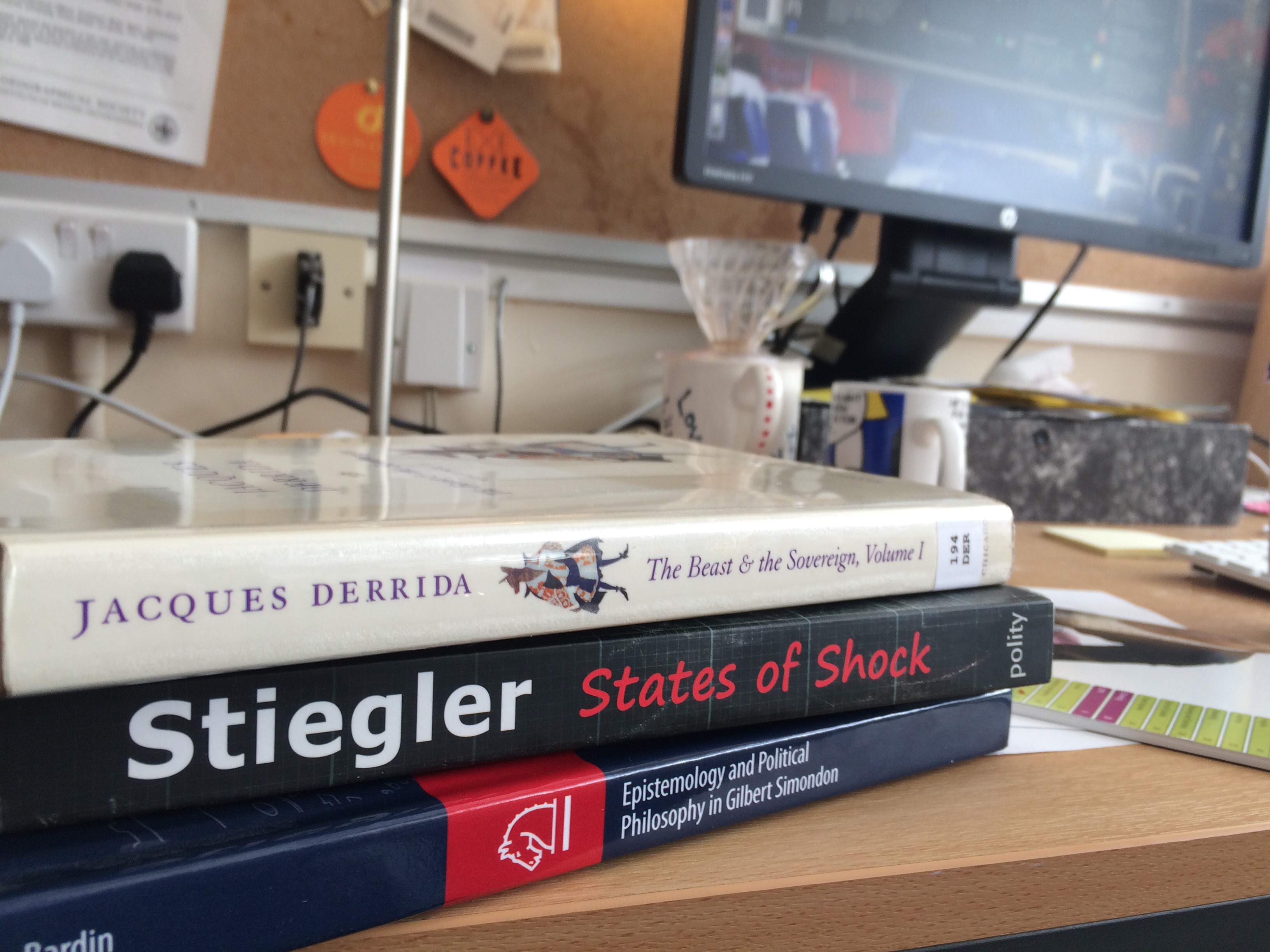
By ‘reifying’ (following Adorno and Horkheimer 2002; Stiegler 2015) the black-boxed ‘algorithm’ we submit to a form of stupidity. We allow those practitioners that enable the development and functioning of the ‘algorithm’, and ourselves as critical observers, to “vanish[…] before the apparatus” (Adorno and Horkheimer 2002, xvii). This is inherently an act of positioning ourselves in some kind of peculiarly subordinate relation to the apparatus, it is a debasement of our theoretical knowledge (because, of course, we understand the context of practices, we understand the kinds of ‘world-ing’ discussed above), and of our critical ‘know-how’. Such a ‘stupidity’ is a tendency towards an incapacity; an incapability to meet the future–deferring instead to the calculative capacities of the apparatus, and its (arguably) impoverished world-ing.

A suitable humorous example of this is, of course, David Walliams’ character Carol Beer who, in the sketch comedy programme Little Britain, has a blithe and unbending deference to the computer – which simply “says no”. The whole premise of the joke Walliams presents with that catchphrase is that, of course, there should be room for interpretation and yet we are presented with a blind adherence to the results of the programme – which is patently stupid. Nevertheless, in many moments of everyday life we are  faced with such forms of adherence to nonsensical outputs from software – we may even feel compelled to be complicit. Following Stiegler (2015), we might recognise that a part of what makes this funny is that a moment of stupidity (i.e. its recognition) is also a moment of shame: if we value reason and independent thought, Walliams’ character should feel ashamed of her ‘stupidity’ – as Stiegler (2015, 46) says: “a stupidity such that I perceive my own being stupid”. This is not (normatively) a “bad” thing: how else can one become the person we desire to be (or ‘individuate’) than by recognising our own ‘stupidity'[3]? In this light, stupidity cannot be opposed to knowledge, neither is this a ‘stupidity’ that is necessarily forced upon us. Reflecting upon stupidity is always a reflection upon my own stupidity, it is a means of thinking the passage to knowledge. Crucially, we realise it only in retrospect. If we are to take such a critical understanding of stupidity seriously, we are therefore called to urgently attend to the ‘reification’ of what we name ‘algorithms’ and the knowledge claims that are made on the back of the suppositions we accordingly make about their operation.

It is possible to be convinced that the reductive forms of language, formulated through formal logic, that constitute a ‘programming language’ cannot be idiomatic or open to difficult forms of interpretation. Yet (of course), they are – and this is an issue of translation. A programme must be (however minimally) written and read, with the rules of such activities agreed upon (an architypically ‘normative’ operation). Yet the range and scope of contexts in which such reading and writing must function are very broad. There is always some ambiguity in the interpretive function of ‘reading’, or more accurately ‘translation’ (translation as the execution of the code, the way it is ‘compiled’ [into binary] or ‘interpreted’ by another layer of software, or its transposition into another codebase, for example through an API). Indeed, as Kitchin (2014) points out, there is an issue of translating a problem (in the mathematical sense) into a structured formula and thence into some form of software programme. Likewise, in software systems the software itself makes no sense without some kind of translation of data, either in formats or units of data, a prime example of this might be the ‘stupidity’ that led to the failure of NASA’s Mars Climate Orbiter, or expected forms of data, with a good example being the ‘stupid’ assumptions about what kinds of interaction and thus kinds of data the Microsoft “Tay” Twitter bot would end up ‘learning’ from (a form of stupidity on the part of the Microsoft programmers who failed to recognise and negotiate normative contextual issues).

An ‘algorithmic imaginary’, as briefly outlined here, has become normalised in our discussions of how computation and software play an increasingly significant part in various aspects and processes in our lives, which always take place within systems (sociotechnical assemblages). The challenge of such an algorithmic imaginary is that it is, sadly, couched in either dystopian and defeatist or blandly a-political terms: we are either doomed to ‘welcome our new algorithmic overlords’ (to paraphrase Kent Brockman) or invited to sink into the stupor of a standardised shiny surface of our lives being made progressively ‘easier’ by apps, gadgets and so on. We need not ‘believe’ in the world-ings of ‘algorithms’ or reify the precarious achievements of software. Even when intentions are noble, what is done as ‘social science’ under the umbrellas of ‘big data’ is in danger of eliding more than it apparently reveals . We can and should instead look to our critical toolbox and examine the contexts of practice of ‘algorithms’ and the systems of which they are a part, and here we already have some excellent resources (see: Gillespie, Kitchin, Mackenzie, Miller, Seaver). We must forge alternate, diverse and resolutely political sociotechnical imaginaries, and hone our capacities to intervene – even at the level of code; for one of the most important things we can do “in this life that must constantly be critiqued in order for it to be, in fact, worth living – is the struggle against stupidity” (Stiegler 2013, 132).

Notes

  1.  Even if we are considering complex forms of ‘machine learning’ there are always foundational rules set within the software platform or the hardware systems, and indeed the choice of ‘training data’ that reflect particular forms of decision-making.
  2. One might think of this through the lens of the ‘pharmakon’: what we call ‘algorithms’ are both a support to structures that increase our capacities (to support forms of individuation) but also carry the potential (sometimes actualised) to harm our capacities (leading to disindividuation, and thus to ‘baseness’ [bêtise]) – “That which is pharmacological is always dedicated to uncertainty and ambiguity, and thus the prosethetic being is both ludic and melancholy” (Stiegler 2013, 25)
  3. Both Jacques Derrida (2009) and Bernard Stiegler (2013, 2015) identify, following Deleuze (1994), the question of how ‘stupidity’ is possible as one that is transcendental:“If we are stupid it is because individuals individuate themselves only on the basis of preindividual funds (or grounds) from which they can never break free; from out of which they can individuate themselves, but within which they can also get stuck, bogged down, that is, disindividuate themselves” (Stiegler 2015, 46).For Derrida, again following Deleuze, such a ‘ground’ is a ‘groundless ground’ [fond sans fond] (Derrida 2009) insofar as
    “Stupidity is neither the ground nor the individual, but rather this relation in which individuation brings the ground to the surface without being able to give it form” (Deleuze 1994, 151).This ‘groundless ground’, or baseness, can be forged from knowledge that has become ‘well known’ (akin to the Wittgensteinian normative) yet remains ‘susceptible to regression’ (Stiegler 2015, 47). Indeed, it is this (‘pharmacological’) negotiation of tendencies that fuels Stiegler’s use of ‘entropy’ as a trope.

Some references

Adorno, T and Horkheimer, M 2002 The Dialectic of Enlightenment, Stanford University Press, Stanford.

Deleuze, G. 1994 Difference and Repetition, trans. Patton, P. Columbia University Press, New York.

Derrida, J. 2009 The Beast and the Sovereign: Volume I, trans. Bennington et al., University of Chicago Press, Chicago.

Kitchin, R. 2014 “Thinking critically about and researching algorithms”, The Programmable City Working Paper 5, pp. 1-29.

Mackenzie, A. 2005 “The performativity of code: software and cultures of circulation”, Theory, Culture and Society 22(1): pp. 71-92.

Miller, D. 2015 Social Media in an English Village, (Why We Post Series), UCL Press, London.

Stiegler, B. 2013 What makes life worth living: On pharmacology, trans. Ross, D., Polity, Cambridge.

Stiegler, B. 2015 States of Shock. Stupidity and Knowledge in the 21st Century, trans. Ross, D., Polity, Cambridge.

Reblog> Launch Event: Researching Alternative Worlds: New political orientations in Geography

I’m taking part in the launch event of the Bristol Geography MSc Society & Space blog alongside some excellent and distinguished alumni of the course. It promises to be an interesting event!

The Official Launch of the Society and Space MSc Blog

4.00pm, Hepple Lecture Theatre, School of Geographical Science, University of Bristol

Register here

alternative worlds cover photos-1

On Wednesday 27th April, we will be officially launching the Society and Space MSc blog with a panel discussion event bringing together Society and Space alumni to discuss a common concern to all of their work – the role of academia in creating alternative social worlds. The Society and Space MSc Course is the principle Human Geography research training Master’s programme within the School of Geographical Sciences at the University of Bristol. As a Master’s degree that emphasises social and political theory, the programme trains students to think about social and cultural geographies from a critical perspective while also interrogating the political and ethical components inherent to these geographies. The programme has produced a range of alumni who have, in the course of their research, continue to contemplate and develop the issues, theories and debates they first encountered on the Master’s programme.

To officially launch the Society and Space blog, we have invited back Society and Space alumni – including James Ash, Emma Roe, Sam Kinsley, Nathan Eisenstadt, Owain Jones and Julian Brigstocke – to take part in a panel discussion centred upon pressing questions concerning our role as researchers in mapping alternative social worlds. What is the role of academic research in investigating, creating and sustaining alternative social worlds? When is academia useful and effective? What are we doing wrong, and what should we be doing more of?

Although a Master’s programme in Cultural Geography, the Society and Space MSc attracts students from a range of backgrounds and a variety of disciplines, such as journalism, English literature, philosophy, fine art and cultural studies. Due to the wide spectrum of backgrounds and interests of those who enrol in the course, as well as the dynamic nature of Human Geography as a subject, the contents covered in the Society and Space programme stimulate a range of conversations about the nature of sociality, the world we live in, and potential futures that may lie ahead of us. We expect that this diversity and broad outlook will be reflected in the work our speakers will present and the discussions that ensue. In addition to being a highly theoretical course, there is a strong, grounded political and ethical focus to the Master’s programme. Consequently, the issues debated, discussed and encountered throughout the Society and Space course are in direct conversation with ‘real’ issues – today’s hot topics and current political and ethical debates. In a context of austerity and the neoliberalisation of academia, the role of academia in researching and co-creating an alternative future is surely one such topic.

Alternative Worlds Poster-1

For a taste of the themes that the panel discussion will traverse, please have a look at abstracts provided by some of our panellists:

Dr James Ash, University of Newcastle

In this short reflection I offer one way of thinking about how we frame social science research questions. In doing so I want to caution against approaches which, however well meaning, centre on ‘big’ problems, framed in a general sense in relation to the concept of world. While issues such as climate change, poverty, homelessness and debt, amongst myriad others are undoubtedly real, there is an issue when assuming that a set of general problems are experienced within a shared horizon of meaning that is implied in the use of the term world. Rather than framing social problems in terms of big or small, or general or particular, I want to argue that such problems can be more productively framed in terms of what Simondon terms the abstract and the concrete. Drawing upon vignettes from the research design of an ESRC project on debt and digital interfaces, I demonstrate how Simondon’s work can be applied to specific societal problems.


Dr Nathan Eisenstadt, University of Bristol 

In this brief intervention I reflect on my doctoral work exploring paradoxes of freedom enacted in contemporary anarchist spaces. I propose that while performed inconsistently and in contradictory ways, the liberatory and egalitarian character of these practices lies in their capacity for an undoing of oneself with the help of compassionate others. Wonderful as this may sound – it has its edges. In closing I call attention to the failure of self-reflection and attempts to make spaces ‘safer’ when collectively established norms are radically transgressed.


Dr Sam Kinsley, University of Exeter

Computation is being used, within and without academia, to make ever grander and more detailed claims about our world. Yet, the (many) ‘worlds’ that emerge from what are generically referred to as ‘algorithms’ can be seen to fall foul of well-known fallacies of empiricism, in relation to their supposed lack of theoretical basis and apparent exhaustive reach. So, in light of grand claims made on behalf of ‘big data’ research and a contemporary predilection for the study of ‘algorithms’, I argue for a critical interrogation of the forms of world-ing propounded by such an ‘algorithmic imaginary’. In so doing, I suggest we reflect on what can be called a dialectic of ‘stupidity’ and ‘knowledge’, following Bernard Stiegler (2015), that undergirds our contemplation of such world-ings. My aim here is to tackle the inherent politics of this logic of worlds and how critical social scientists might engage.


Professor Owain Jones, Bath Spa University

My short presentation will reflect upon my experience of being in the first (very small) cohort of the MSc and then also devising and teaching the Nature and Society module from 2003-2006. I did not do an academic degree but an arts practice based degree so the MSc really marked my ‘conversion’ to academia and to geography. I can say without any exaggeration that doing the course was a life transforming and enhancing experience (as university (PG) education should be). The very possibility of imagining and enacting alternative worlds was very much part of that. My subsequent academic and professional life stands upon the very strong foundations put in place by the MSc and I think this is the case for many others too. I will offer some reflections upon why the course was so effective in this way. In part this was simply about being in a centre of excellence where there was a powerful intellectual momentum in which the conceptual and imaginative tools for questioning the trajectories of modernity were set out . But it was also about openness, spirit and collegiality with the staff and PG cohorts.

In addition to the panel discussion – which will be followed by time for audience questions – there will be a brief introduction by the Society and Space Blog Editors, before our very own Dr JD Dewsbury will recount his experience as first a student and then a lecturer on the MSc and map out how the course has changed and developed over the years.

The event will take place at 4.00pm, in the Hepple Lecture Theatre, School of Geographical Science, University of Bristol (see map). The discussion will be followed by a drinks reception. If you intend to attend (and we hope you do!), please confirm your attendance here.

We look forward to meeting you on 27th April.

The Editors

Sam Merrill on “Mapping Maps and Gaps: A Critical Digital Cartography of the ‘Mediterranean Refugee Crisis'”

Over on his blog, a little while ago, Sam Merrill blogged an excellent write-up of his participation in the 2016 Digital Methods Initiative Winter School (something I would’ve liked to do but didn’t know about[!] and anyway didn’t have time/funds to do). There’s a lot to think about from Sam’s blogpost, from the politics of different uses of maps in different phonic communities to the discursive politics of ‘refugee’ and ‘migrant’ and the complex representational politics of different media organisations. Definitely worth a read!

Mapping Maps and Gaps: A Critical Digital Cartography of the ‘Mediterranean Refugee Crisis’

Last month I attended the 2016 Digital Methods Initiative Winter School led by Richard Rogers and his team at the University of Amsterdam. Organised in the format of a data sprint the event saw participants attend a day of keynote talks presented by the likes of, among others, Lilie Chouliaraki, Mathieu Jacomy, Carolin Gerlitz and Rogers himself before turning their attention to a hands-on digital project for the remainder of the week. With the rather clever title of, Otherwise Engaged – Critical Analytics and the New Meanings of Engagement Online the Winter School set out to problematize online engagement and develop new methods by which to measure, visualise and interpret that engagement. The group I joined, which was made up of Natalia Sanchez-Querubin (University of Amsterdam), Rik Smit (University of Groningen), Belal Islim (University of Amsterdam), Quentin Lobbe (Telecom Paris Tech), Gabriele Colombo (Density Design), Suzanne van Geuns (Utrecht University) Jasper Bol (University of Amsterdam), Lars Dellemaan (University of Amsterdam), Hadewieg Beekman (University of Amsterdam) set out to create a digital critical cartography of the so-called ‘Mediterranean Refugee Crisis’ (although this phrase formulation arguable shifts attention from the true location of the crisis in the Middle East) .

Our pilot study compared the maps, images, locations and texts returned by Google searches for the queries ‘refugee routes’ and ‘migrant routes’ in seven languages: Arabic, English, French, Italian, Dutch, German and Spanish. As we expected the result showed the different levels of empathetic distance, dehumanization and solidarity associated with the two terms (refugee and migrants) and reinforced the relevancy of the recent debates in the European press about the responsible use of these terms and the campaign by the UNHCR about the degree to which, in this context particularly, word choice matters. It would take too much space to explain in detail all of the different hybridized digital-human methods that we explored and used over the week not to mention all the multi-leveled findings suggested (but not necessarily confirmed) by our initial interpretive forays. So instead I direct those interested to visit our project wiki, which although still being updated, gives a good idea of what we got up to during the week.

Read the full blogpost.