Containers and global capitalism (podcast)

Via Deterritorial Investigations Unit.

Containers is an 8-part audio documentary about how global trade has transformed the economy and ourselves. Host and correspondent Alexis Madrigal leads you through the world of ships and sailors, technology and tugboats, warehouses and cranes. At a time when Donald Trump is threatening to toss out the global economic order, Containers provides an illuminating, deep, and weird look at how capitalism actually works now.


Reblog> Workshop on Security and the Political Turn in the Philosophy of Technologies

An interesting event blogged by Peter-Paul Verbeek:

Workshop ‘Security and the Political Turn in the Philosophy of Technologies’, University of Twente | DesignLab, March 10 2017. How to understand the political significance of things? And how to deal with the politics of technology in a responsible way? Ever since Langdon Winner claimed in the early 1980s that “artifacts have politics”, these questions have been puzzling philosophers and ethicists of technology. Technologies are not just instruments for humans to do politics but actively shape politics themselves. In this workshop we will explore various dimensions of this political role of technologies, especially with regards to security, citizenship in a technological world, and the role of social media and ‘fake news’ in contemporary democracy.

Speakers include:

  • Babette Babich (Fordham)
  • Robin James (UNCC),
  • Laura Fichtner (TUD)
  • Wolter Pieters (TUD)
  • Melis Bas (UT)
  • Jonne Hoek (UT)
  • Philip Brey (UT)
  • Nolen Gertz (UT)
  • Michael Nagenborg (UT)
  • Peter-Paul Verbeek (UT)

The workshop is sponsored by the 4TU.Ethics working group on “Risk, Safety, and Security.”

Automation in financial services and the ongoing re-imagination of work

From Technology outsmarts the human investor – FT

“It just gets harder and harder and harder,” reflected one money manager this week. His is the predicament of other professionals – anything done by a person that follows a pattern and can be coded into a form that a computer understands will soon get squeezed. Technology also has the advantage identified in 1970: algorithms stay constantly alert.

It does not imply the complete death – or automation – of the investment manager. A professional can still undertake original research on a company or a security that provides insight. As more of the market becomes automated, originality becomes rarer and more valuable: an idiosyncratic investor should achieve higher returns by standing out from the robotic crowd.

Nor can algorithmic efficiency be wholly divorced from human intelligence, as the Oregon study showed – the point was that humans needed to set parameters for computers to follow. Many asset managers use analysts and researchers to build investment models that then trade securities automatically; others blend their active risk-taking with passive elements.

…

But these difficulties demonstrate how automation eats into professions, not by taking away all the jobs in one day but by unbundling them – dividing them between tasks that only humans can perform and those of which an algorithm is quite capable. Then the boundary relentlessly shifts.

The last paragraph is key – there seems to be a growing consensus that automation doesn’t simply ‘destroy’ jobs, it makes particular aspects of or kinds of role redundant and the implementation and development of automated systems requires the remaining workers to fit around those systems in different ways. In many ways, then, automation is a company or institution-specifc organisational or administrative problem as well as a wider political economic problem.


Reblog> Book Launch: Playful Mapping in the Digital Age

Via Institute of Network Cultures.

Generally wary of anything with “digital age” in the title, but good to see some geographers featuring in ‘digital cultures’ type networks…

Book Launch Playful Mapping in the Digital Age

MONDAY 13TH OF MARCH, 17:00 – 18:15 @SPUI25, AMSTERDAM.

With keynote lectures by Michiel de Lange and, Emma Fraser and Clancy Wilmott.

From Mah-Jong to the introduction of Prussian war-games, through to the emergence of location-based play: maps and play share a long and diverse history. In this programme, we will launch the book Playful Mapping in The Digital Age, which shows how playing and mapping can be liberating, dangerous, subversive and, performative.

>> Sign up here.

Playful Mapping in the Digital Age shows how mapping and playing unfold in the digital age and in which ways the relations between these apparently separate tropes are increasingly woven together. Fluid networks of interaction have encouraged a proliferation of hybrid forms of mapping and playing. A rich plethora of contemporary case-studies, ranging from fieldwork, golf, activism and automotive navigation to pervasive and desktop-based games, emphasizes this trend. Examining these cases shows how mapping and playing can form productive synergies, but also encourages new ways of being, knowing and shaping our everyday lives. This afternoon, the Members of the Playful Mapping Collective explore how play can be more than just an object or practice, and instead focus on its potential as a method for understanding maps and spatiality.

Material carriers of thought

In a recent article on the Social Epistemology Review and Reply Collective, Lyudmila A. Markova discusses the material supports for human communication, what Stiegler would call the processes of exteriorisation and thus materialisation of memory/thought:

Even the most common type of communication is not possible without a material carrier. For example, at a minimum stone, papyrus or paper is required for written communication. Their production processes obey the laws of engineering sciences, which are completely independent from the content of the information they convey. Even if the information is transmitted orally, with a voice, a material carrier is present. The sound is produced in a person’s larynx and is uttered through the mouth as language. Furthermore, the air movement, which is born inevitably during the conversation, obeys the laws of physics.

There’s some really interesting discussion of the various ways those involved in studies of social epistemology, and most notably in the essay it’s Steve Fuller’s work set in relation to Kuhn, have attempted to reconcile the passage to knowledge. It’s also curious to see how David Berry’s work ends up in there too, I suspect there’s more than a hint of Stiegler shining through there (but I haven’t read the work so should probably do so…) and it’s a shame Markova doesn’t make that connection. Might be interesting to pursue that angle…

Echoborg

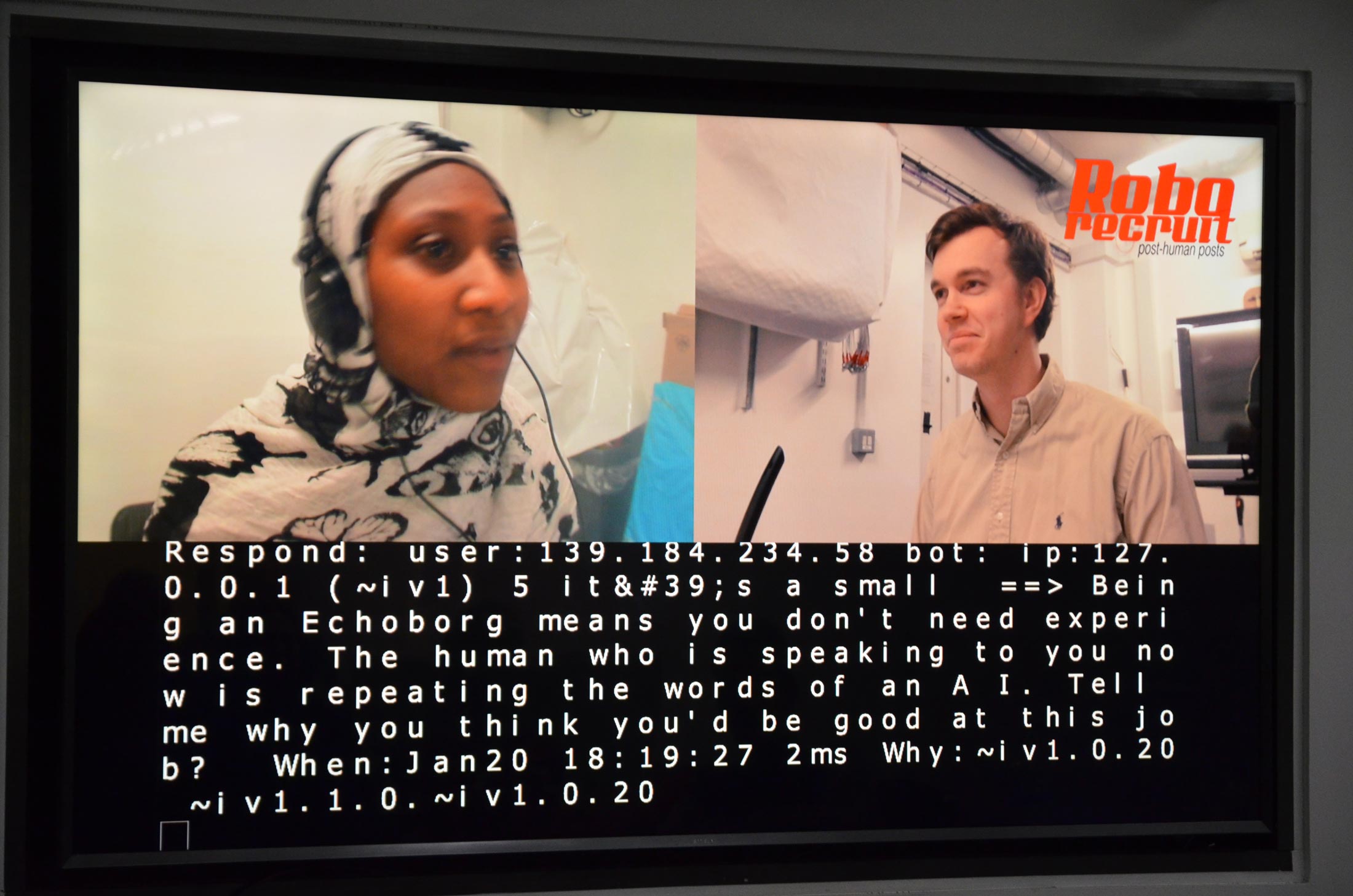
Former colleagues of mine at UWE are developing an interesting project, which you may have seen/heard about through the BBC’s Click programme, called Echoborg.

An echoborg is a hybrid agent composed of the body of a real person and the “mind” (or, rather, the words) of a conversational agent; the words the echoborg speaks are determined by the conversational agent, transmitted to the person via a covert audio-relay apparatus, and articulated by the person through speech shadowing[1].

Recently, the project team have demoed the project as part of an AHRC-funded network on Automation Anxiety and have written this up on the project website, here’s a snippet – it sounds like it is really compelling (I’ve not seen this in action):

Four people were interviewed by the AI which increasingly displayed an interest in eliciting help to reprogram itself. Proceedings were visible on a projector screen and the ‘audience’ of applicants gradually began to discuss the situation of the Echoborg and how to change it. At a certain point their reflections passed a threshold and the group fired into collective action, experimenting with various methods to bring the situation to a head in some way. The lively inventiveness of the group and the individual interviewees went a long way to confirming the interactive potential of this format of the work. It also gave Rik and Phil much to work with in considering the further development of the AI/Chatbot, the restricted delivery of narrative by the human Echoborg and the staging. This event also trialled a secondary, higher level, Echoborg character as part of the slow process of unfolding the potential for this Echoborg recruitment event to be a disruptive and thought and emotion provoking experience for all players.

Notes

  1. Corti, Kevin and Gillespie, Alex (2015) Offscreen and in the chair next to you: conversational agents speaking through actual human bodies. Lecture Notes in Computer Science, 9238 . pp. 405-417.

Tony Sampson on neuroculture

From a Conversation piece on Huxley, dystopia and how we might think about Facebook etc. in relation to Huxley’s “College of Emotional Engineering”, this concise evocation of his understanding of ‘neuroculture’ is interesting:

The origins of neuroculture begin in early anatomical drawings and subsequent neuron doctrine in the late 1800s. This was the first time that the brain was understood as a discontinuous network of cells connected by what became known as synaptic gaps. Initially, scientists assumed these gaps were connected by electrical charges, but later revealed the existence of neurochemical transmissions. Brain researchers went on to discover more about brain functionality and subsequently started to intervene in underlying chemical processes.

Interpretation of Cajal’s anatomy of a Purkinje neuron, by Dorota Piekorz.

On one hand, these chemical interventions point to possible inroads to understanding some crucial issues, relating to mental health, for example. But on the other, they warn of the potential of a looming dystopian future. Not, as we may think, defined by the forceful invasive probing of the brain in Room 101, but via much more subtle intermediations.