Revisiting a 90s future: AHRC/EPSRC Next Generation of Immersive Experiences

glitches image of a 1990s NASA VR experience

Emails have been circulating this week about this so it may already be familiar, but ‘digital’ academics may be interested in this… The below is more or less the text of the emails I’ve seen.

Sources: Teeside / AHRC

The Arts and Humanities Research Council (AHRC) and the Engineering and Physical Sciences Research Council (EPSRC) offer support to interdisciplinary research partnerships with the potential to create new knowledge and address major challenges for the development of the next generation of immersive experiences.Proposals are invited from interdisciplinary research partnerships in the areas of:

– Memory – how can new immersive experiences extend the access, interpretation and reach of memory-based institutions such as museum, galleries, archives and collections?
– Place – what new experiences can be created by the combination of immersive technology and place based services?
– Performance – what new creative practices are enabled by immersive technology, what new experiences can be offered to audiences and how can this transform or extend models of performance?

One of the primary aims of this call is to build interdisciplinary capabilities, collaborations, and partnership which will be well placed to take advantage of future opportunities for research and innovation (both from UKRI and beyond). As such AHRC expect partnerships funded through this call to have a life beyond the end of the funding period.

It is expected that the outputs from the funded projects and the wider cohort will include:

  • Interdisciplinary partnerships including academic researchers and creative economy partners;
  • The potential research questions within this space to have been further developed and refined;
  • Sufficient proof of concept(s) / prototypes / visualisations to have been developed by researchers;
  • Tangible advances in creativity, insights, knowledge and understanding in the area of immersive experiences across one or more of the themes;
  • Working with AHRC, EPSRC, IUK and other funders to understand the complexities of funding research in the immersive experience space and potential barriers to exploitation and scaling up of research outputs.

All outcomes should ensure that the UK creative economy can be a world leader in the conceptualisation, design, production and distribution of commercial and cultural immersive experiences in the future.

This call represents an initial stage of investment in the next generation of immersive experiences. AHRC are currently scoping what form further stages of investment might be, and the outcomes of this call will help to inform these further stages.

The maximum value of applications at 100% FEC is £75,000; the deadline for submissions is 5 October 2017. For further details, see the AHRC website.

The Call Document (PDF, 239KB) provides further information on the context and aims for, and the scope of, the call as well as information on how to submit applications.

The AHRC are running a series of engagement events in early July 2017 to cover this call. Details of these events can be found here
“Digital”, noun

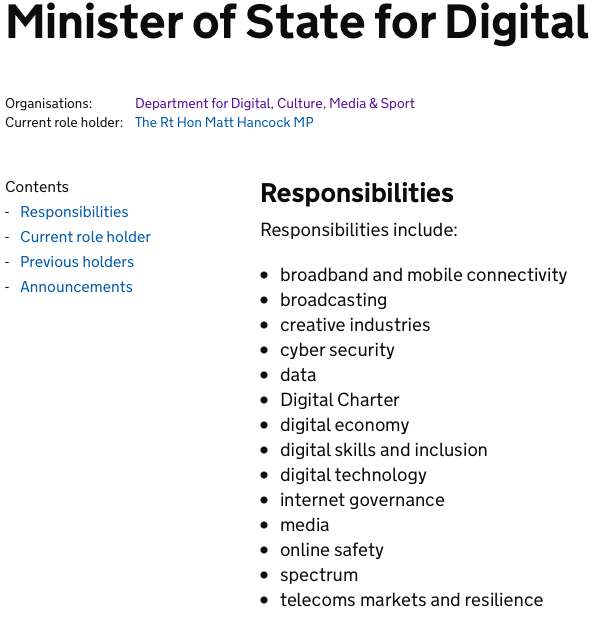
Minister of State for Digital, responsibilities

I tweeted a bit about the name change of the UK government Department for Culture, Media and Sport to Department for Digital, Culture, Media and Sport yesterday. I started off with a throwaway remark about the ongoing transition of the word “digital” to becoming a noun, rather than an adjective.

I think I understand, a little, why this has taken off in some quarters, especially in the civil service and government. It seems, to me, to be about capturing, with one word, the array of, sometimes, loosely related activities undertaken by folks who may have ‘digital’ in their job/unit title and the sorts of things that come under banners such as “digital transformation”.

“Digital” in such contexts might be seen as a managerial or organisational term that describes particular kinds of institutional function/activity. Some of these might have been called something else, previously, but some of the things signified by “digital” are hard to otherwise define, hence the co-opting of an adjective as a noun.

There’s loads more to say about this, but I’m sort of writing this post as a reminder to return to this stuff… maybe…

A communications primer – Eames

Via dmf.

Or “information theory for beginners”, maybe… A heavily stylised interpretation of Shannon’s information theory for IBM, by the Eames’, which may be of interest to those of a cybernetic persuasion.

… it’s a testament to the work of the US mathematician and ‘father of information theory’ Claude Shannon (1916-2001) that his model of communication, laid out in his landmark book A Mathematical Theory of Communication (1949), is still so broadly applicable.

Working from Shannon’s book, in 1953 the iconic husband-and-wife design team Ray and Charles Eames created the short film A Communications Primer for IBM, intending to ‘interpret and present current ideas on communications theory to architects and planners in an understandable way, and encourage their use as tools in planning and design’. Released at the dawn of the personal computer age, the film’s exploration of symbols, signals and ‘noise’ remains thoroughly – almost stunningly – relevant when viewed some 64 years later.

Algorithm 1986

Just cos it’s fun…

From the second edition of The Dictionary of Human Geography, written by Prof. Peter Gould:

A step-by-step procedure, usually supported by a formal mathematical proof, that leads to a desire solution. An example is the Simplex Algorithm in Linear Programming. Heuristic algorithms are not supported by formal proofs, but are highly likely to lead to the optimal solutions. Examples include finding multiple locations within, and the shortest paths through, a network. The word derives from the name Al-Ghorizmeh, a distinguished Arab geographer-mathematician of the sixth century A.D. (See also Districting Algorithm.)   PG

Slightly different from the two-sentence version by Prof. Ron Johnston in the 5th edition (2009).

Responsive media

personal media

It’s interesting to compare competing interpretations of the same ‘vision’ for our near-future everyday media experience. They more or less circle around a series of themes that have been a staple of science fiction for some time: media are in the everyday environment and they respond to us, to varying degrees personally.

On the one-hand some tech enthusiasts/developers present ideas such as “responsive media“, a vision put forward by a former head of ubiquitous computing at Xerox PARC, Bo Begole. On the other hand, sceptics have, for quite some time, presented us with dystopian and/or ‘critical’ reflections on the kinds of ethical and political(economic) ills such ideas might mete out upon us (more often than not from a broadly Marxian perspective), recently expressed in Adam Greenfield’s op-ed for the Graun (publicising his new book “Radical Technologies”).

It’s not like there aren’t plenty of start-ups, and bigger companies (Begole now works for Huawei), trying to more-or-less make the things that science fiction books and films (often derived in some way from Phillip K Dick’s oeuvre) present as insidious and nightmarish. Here I can unfairly pick upon two quick examples: the Channel 4 “world’s first personalised advert” (see the video above) and OfferMoments:

While it may be true that many new inventors are subconsciously inspired by the science fiction of their childhoods, this form of inspiration is hardly seen in the world of outdoor media. Not so for OfferMoments – a company offering facial recognition-powered, programmatically-sold billboard tech directly inspired by the 2002 thriller, Minority Report.

I’ve discussed this in probably too-prosaic terms as a ‘politics of anticipation’, but this, by Audrey Watters (originally about EdTech), seems pretty incisive to me:

if you repeat this fantasy, these predictions often enough, if you repeat it in front of powerful investors, university administrators, politicians, journalists, then the fantasy becomes factualized. (Not factual. Not true. But “truthy,” to borrow from Stephen Colbert’s notion of “truthiness.”) So you repeat the fantasy in order to direct and to control the future. Because this is key: the fantasy then becomes the basis for decision-making.

I have come to think this has produced a kind of orientation towards particular ideas and ideals around automation, which I’ve variously been discussing (in the brief moments in which I manage to do research) as an ‘algorithmic’ and more recently an ‘automative‘ imagination (in the manner in which we, geographers, talk about a ‘geographical imagination’).

AR Super Mario Bros

augmented reality

Via Prosthetic Knowledge.

An AR recreation of the first level of Super Mario Brothers played in first-person with the Microsoft Hololens headset by Abhishek Singh.

Super Mario Bros meets Augmented Reality in this crazy life sized first person experience! I recreated the iconic first level, dressed up as Mario and then played it in Central Park (NYC). Built in Unity3D for the Microsoft Hololens. This video was recorded entirely through the hololens with no post production.

Not quite the AR of William Gibson’s Spook Country, eh?

Jen Jack Gieseking on How to Set Up Your Own Website and Why It’s Worth It

A glitched image of a typewriter

Nice post by Jack Gieseking on why it’s worth setting up a website as an academic. I’d broadly echo many of the points here, albeit from a different standpoint – I’m less prolific and I guess I’m more in curatorial mode on this website at the moment… (I am actually writing again though, so that’s nice)

For Academics: How to Set Up Your Own Website and Why It’s Worth It

Dear Academic Friend,

Over the years, many of you have asked me how to build a website. About eleven years ago, a graduate school friend patiently sat next to me and taught me the ropes using pure HTML. It’s much easier now. If you want a little convincing as to why to do this or want to get firmly rooted on your politics in this, continue reading. If you are already determined to build your own website, click here to skip down. My mantra here: ideas are free; let’s share.

Really, people want to hear about what I do? Let’s begin with the obvious: what you do is important. Wildly important. You may think you are boring, dull, unclear, or talking to your navel, but someone, somewhere needs your work on the lesbian spaces, the history of the lute in 1689, Saharan slavery practices, a rare snail on the coast of the Bahamas, or the relationship of the human-animal of lab scientists studying jellyfish. They truly do. Let’s say you actually choose to believe me for a second and the grip of self-doubt can be put aside for even a few minutes. You know I’m going to encourage you to set up your own website. Now let’s deal with your concerns.

Read the rest of this post on Jack’s website.

(Not) Getting Paid to Do What You Love: Gender, Social Media, and Aspirational Work – Brooke Erin Duffy

Via Culture Digitally.

This looks like an interesting read by Brooke Erin Duffy. Although I know what Duffy calls here “aspirational work” is popular, I have been a bit surprised by how many of our students at Exeter actively do this kind of work – mostly fashion vlogging. I have had at least one dissertation on the topic for each of the last three years and many of the videos produced for my final year option module draw on these themes. Those I’ve spoken to are acutely aware of the nuances of the negotiations of different norms and values – ‘authenticity’ and getting paid don’t always sit well together it seems.

I hope I have the chance to check out this book so I can actually learn more about what I can only vaguely sketch (perhaps wrongly) at the moment, I hope some of those who read this will too…

Book Announcement: (Not) Getting Paid to Do What You Love: Gender, Social Media, and Aspirational Work

Fashion bloggers and Instagrammers seem to enjoy a coveted lifestyle–one replete with international jet-setting, designer-comped fetes, and countless other caption-worthy moments. Yet the attention lavished on these so-called “influencers” draws attention away from a much larger class of social media content creators: those aspiring to “make it” amid a precarious, hyper-competitive creative economy.

I tell their story in my new book (Not) Getting Paid to Do What You Love: Gender, Social Media, and Aspirational Work, and I’m grateful to my publisher Yale University Press for allowing me to share the first chapter with you.

The book focuses on female content creators and draws upon in-depth interviews with bloggers, vloggers, designers, and more. I learned that, often, these young women were motivated by the wider culture’s siren call to “get paid to do what you love.” But their experiences often fell short of the promise: only a few rise above the din to achieve major success. The rest are un(der)- paid, remunerated with deferred promises of “exposure” or “visibility”–even as they work long hours to satisfy brands and project authenticity to observant audiences.

A grueling balancing act is required, one that I explore through the lens of “aspirational labor.” As both a practice and a worker ideology, aspirational labor shifts content creators’ focus from the present to the future, dangling the prospect of a career where labor and leisure coexist.

Despite the book’s emphasis on gendered work, the concept of “aspirational labor” offers a framework for understanding, critiquing, and anticipating larger transformations in the social media economy. Indeed, the book closes by exploring the striking parallels between social media aspirants’ self-branding labor and the work so many of us undertake in contemporary academe.