Ambient literature – new research project

Former colleagues at UWE in the Digital Cultures Research Centre are formally launching their project on what they call ‘ambient literature’ this Friday.

There’s some info on the project copied below, it follows on from a trajectory you can trace through the ‘pervasive media’ canon (with the lovely people from Calvium [many formerly of HP Labs Bristol] instrumental in how this has been technically achieved), from the Mobile Bristol RIOT! 1831 project, Duncan Speakman’s subtle mobs, the fabulous Fortnight project from Proto-type, Curzon Memories, REACT projects like These Pages Fall Like Ash and (my colleague Nicola Thomas’) Dollar Princess – a rich and varied history of work…

Ambient Literature is a two-year collaboration between the University of West England, Bath Spa University, the University of Birmingham, and development partners Calvium, Ltd. established to investigate the locational and technological future of the book. Funded through a grant from the Arts and Humanities Research Council, the project is focused on the study of emergent forms of literature that make use of novel technologies and social practices in order to create robust and evocative experiences for readers.Launched in London, Bristol and online in June 2016, the project draws on the REACT Hub’s experience working with creative industries in order to produce three experimental projects from three different authors. Forming the heart of the project, these commissioned pieces allow researchers to study the processes of innovation and negotiation that become visible as established authors work in the new forms opened up by the idea of Ambient Literature. Combining practice-based, empirical and theoretical research, the project seeks to test out new literary forms and develop a grammar for writing Ambient Literature.

This is an interdisciplinary project focused on understanding how the situation of reading is changing through pervasive and ubiquitous computing. Drawing on literary studies, creative writing, design, human-computer interaction, performance and new media studies, the research being developed looks to engage with the history of the book and see what that history is able to tell us about its future.

The awkwardness of data debates, or how social scientists & policymakers don’t talk

I feel prompted to write something I’ve been puzzling over for a while because of a tweet and post on medium [The commodification of data, by Ade Adewunmi] I saw recently:

It’s a good post, but for some academic social scientists this is now an established argument that’s been developed, been the subject of conferences and books and so on. For a while now, I’ve had a sense of an awkward gap between the conversations about the various concerns for ‘data’ I witness through social media. In particular, I’ve been struck by how different the conversations are between (social sciences) academics from those involved in the development and running of ‘digital’ government services*. I recognise that the following is a bit of a caricature but the quick characterisation serves to assist the wider point I’m interested in exploring.

The fellow academics I follow (mostly in geography but from across the social sciences) have a relatively developed set of political and ethical arguments about the analysis (commercial & governmental–often blurred), big-ness,  collecting/gathering, transformation and so on of digital ‘data’, more often than not with reference to tropes around governance, labour, privacy and surveillance and ‘subjectivity’ (usually in the frame of how we are made individual subjects). So, ‘data’ in this set of debates may signal, for some, negative connotations of commercial or institutional ‘big brother’ and so on. There, of course, plenty of reasons to feel this way.

The digital government services folk, and some of the digital research services people (e.g. from JISC), that I follow often have more diverse and opaque (to me) views. A common foundation for many is the broadly liberal set of arguments for ‘open‘ networked services, somewhere between Stewart Brand’s libertarianism (in the vein of the arguments around “information wants to be free“) and the systematic optimistic liberalism of the W3C: “web for all, web on everything“. Some blog and tweet about the challenges of implementing that ethos and the various systems/techniques developed as a result within the auspices of government. Others write about what is and can be achieved by pursuing the ‘open’ agenda in government. More often that not, there is a positive and ‘progressive’ slant to the debate – developing a ‘common good’ (for want of a better phrase).

The debates do not crossover in my experience. They have their own  pet concepts and specialist terminology, with academics (like me) banging on about ‘dataveillance’, ‘discipline’ and ‘control’, governmentality, and, of course, ‘neoliberalism’; whereas the digital government folk I follow can talk about ‘digital’ and ‘open’ (as nouns), ‘agile‘ and ‘lean‘ (also sometimes nouns) practices. I am not saying any of this is representative, simply pointing out that the kinds of conversation are rather different. Neither of these groupings (as I characterise them) talk about or suggest policy in any detail, which is interesting. Social scientists studying ‘data’ (etc) often discuss methodological technique and diagnose what are perceived to be negative aspects of digital systems, whereas digital government folk are often highlighting progress being made in making ‘public’ data and associated services ‘open’ and more accessible. This may be an issue of ‘methods’. To be (perhaps overly) general – the social scientists I follow do particular kinds of, often, politically inflected research, whereas the digital government folk I follow are attempting to build politically neutral services. So, here, the academics are looking for expressions of power and politics, the digital government folk are attempting to minimise their effects.

We are left with what appears to be an unfortunate gap in a possibly fruitful conversation – there are constructive ways that academic researchers can offer insights into how opaque power structures can operate and, likewise, the digital government folk actually have experience of making complex digital systems for government. At present, in my Twitter stream I see (at best) mutual suspicion and often just totally separate conversations. There are moments though and some academics are clearly engaging albeit ‘critically’, e.g.

I recognise my partiality – that there are more than likely more in-depth conversations going on that I’m missing and I do think there’s some really positive work going on, for example as part of the Programmable City project – for example see the great talk by Sung-Yueh Perng below, that is attempting to look at what it means to build digital public services and the kinds of contributions social scientists (like me – there are lots of other kinds of course!) can make.

I welcome suggestions and comments about this, so please do get in touch.

Sung-Yueh Perng – Creating infrastructures with citizens: An exploration of Beta Projects, Dublin City Council from The Programmable City on Vimeo.

* I am not claiming that those I follow on Twitter and are pigeonholing with this category are representative in any way, this just works for this broad example.

Exciting course for postgraduate researchers: History of Geographical Thought and Philosophy

Here’s a wonderful thing – Christian Abrahamsson, based at U. Oslo,  is convening a course at Oslo for PGRs, with guest appearances from: Trevor Barnes, Innes Keighen, Frederico Ferretti and the inimitable Gunnar Olsson. This is a fantastic opportunity for anyone wanting to engage with geographical thought:

SGO9204 – History of Geographical Thought and Philosophy

Course content

The purpose of this course is to examine the historical and philosophical development of modern geography and geographical knowledge. The course will explore key discourses, debates, and controversies which shaped the modern discipline. A key aim of the course will be to place the development of geographical thought and practice within a broader societal and scientific perspective. The course will also put emphasis on the geographies of the history of geographical thought – i.e. in what ways have, for example, the Nordic welfare states affected geographical thought and practice?

Learning outcome

After the course the students will be able to understand:  On completion of the course, the postgraduate student will be able to describe and analyse their own research projects in relation to broader historical discourses and concepts. The postgraduate student will have acquired knowledge of how different theoretical perspectives and concepts can be brought to bear on their individual projects. They will also have knowledge of how geographers at various times have understood the relation between geographical thought and practice. The course will also give the students an understanding of how geographical scholarship has been related to and informed by larger societal and scientific processes – e.g. the importance of evolutionary theory for 19th century geographical thought. Finally the course will give the students a sense of how and where their own projects fit within the history of the discipline.

Admission

The course is open to applications from all interested Ph.D. students. PhD students at the Department of Sociology and Human Geography at the University of Oslo gain theory-points and register for the course in StudentWeb.

Interested participants outside the department shall fill out this application form.

The deadline for applications is 21st October 2016.

Prerequisites

Formal prerequisite knowledge

No requirements other than that the students have to be enrolled in a doctoral program.

Teaching

Lecturers: 

Dr Christian Abrahamsson, UiO

Professor Trevor Barnes, University of British Columbia, Vancouver

Dr Innes Keighren, Royal Holloway, London

Dr Federico Ferretti, University College, Dublin

Professor Emeritus Gunnar Olsson, Uppsala University


Schedule: 

The course is going to be in room 211, Harriet Holters hus

Monday – Part 1: The History and Geography of Geographical Knowledge 

10.00-12.00: Introduction: Why do we need a history of geographical thought?, (Christian Abrahamsson)

12.00-13.15: Lunch

13.15-15.00: Lecture: The historical geographies of geographical knowledge, (Christian Abrahamsson)

15.15-17.00: Discussion


Tuesday – Part 2: Geography, Enlightenment, Romanticism 

10.15-12.00: Lecture: Kantian and Humboldtian geographies (Federico Ferretti)

12.00-13.15: Lunch

13.15-15.00: Discussion

15.15-17.00: Discussion


Wednesday – Part 3: Science and Explanation 

10.15-12.00: Lecture: Darwinian geography and the rise of geography as a university discipline (Christian Abrahamsson)

12.00-13.15: Lunch

13.15-15.00: Lecture: Environmental determinism and the nation state (Innes Keighren)

15.15-17.00: Discussion


Thursday – Part 4: Contemporary Geography 

10.15-12.00: Lecture: Spatial science and the quantitative revolution (Trevor Barnes)

12.00-13.15: Lunch

13.15-15.00: Lecture: Geography, the cold war, planning, and the welfare state (Trevor Barnes)

15.15-17.00: Discussion


Friday 

10.15-12.00: Discussion

12.00-13.15: Lunch

13.15-15.00: Discussion

15.15-17.00: Discussion


Preliminary reading list

(will be subject to changes according to proposals from the lecturers.):

Geographical Traditions: Rethinking the History of Geography. Transactions of the Institute of British Geographers, New Series, 20(4): 403-422. o

Mayhew “Geography’s Geneaologies”, and Withers “Geography’s Narratives and Intellectual History”, in John Agnew and David N. Livingstone. The SAGE Handbook of Geographical Knowledge, pp. 1-50.

Innes M. Keighren, Christian Abrahamsson and Veronica della Dora, On canonical geographies. Dialogues in Human Geography 2(2012): 296-312

John Agnew and David N. Livingstone. The SAGE Handbook of Geographical Knowledge, pp. 51-136, 149-184, 217-227.

Neil Smith, ‘Geography as museum: private history and conservative idealism in Richard Hartshorne’s The nature of geography’, in Nick Entrikin and Stanley Brunn (eds) Reflections on Richard Hartshorne’s The nature of geography (1989) pp. 91-120.

Stuart Elden. 2008. Reassessing Kant’s geography. Journal of Historical Geography.

Robert B. Louden. Anthropology from a Kantian point of view: toward a cosmopolitan conception of human nature. Studies in History and Philosophy of Science Part A. Volume 39, Issue 4, December 2008, Pages 515-522.

David Livingstone The Geographical Tradition, pp.102-138.

Nicolaas Ropke ‘Alexander von Humboldt and Revolution’, in Livingstone and Withers. Geography and Revolution, pp. 336-350.

Michael Dettlebach, “Humboldtian science,” pp. 287-304 in N. Jardine, J. Secord, E. Spary (eds), Cultures of Natural History (Cambridge: Cambridge University Press, 1996).

Marie Louise Prat. Imperial Eyes selections on Humboldtian Science and transculturation.

Livingston, D. N. (1992) “The Geographical Experiment: Evolution and Founding of a Discipline” The Geographical Tradition. Cambridge, MA: Blackwell. 177-215.

Neil Roberts, “The Idea of Evolution in Geographic Thought”, in John Agnew and David N. Livingstone. The SAGE Handbook of Geographical Knowledge, pp.441-451.

James Moore. “Revolution of the space invaders: Darwin and Wallace on the Geography of Life”, in Livingstone and Withers. Geography and Revolution, pp. 106-132.

D.R. Stoddart, “Darwin’s Impact on Geography,” Annals of the Association of American Geographers, Vol. 56 (Dec., 1966): 683-698.

Janet Browne, “Biogeography and empire,” pp. 305-321 in N. Jardine, J. Secord, E. Spary (eds), Cultures of Natural History (Cambridge: Cambridge University Press, 1996).

Bassin, M.: Imperialism and the Nation State in Friedrich Ratzel’s Political Geography, Prog. Hum. Geog., 11, 473–495, 1987.

Smith,W. D.: Friedrich Ratzel and the Origins of Lebensraum, Ger. Stud. Rev., 3, 51–68, 1980.

David N Livingstone, “Environmental Determinism,” in John Agnew and David N. Livingstone. The SAGE Handbook of Geographical Knowledge, pp.368-380.

Ellen Churchill Semple, Influence of Geographic Environment on the Basis of Ratzel’s System of Anthropo-geography. New York: Russell and Russell, 1911. A reprint is available in Human Geography: An Essential Anthology. Edited by John Agnew, David N. Livingstone, and Alistair Rodgers. Oxford: Blackwell. Pp. 252-267. An online e-reprint from Project Gutenberg can be found at http://infomotions.com/etexts/gutenberg/dirs/1/5/2/9/15293/15293.htm

Peter Kropotkin, selections from “Mutual Aid” in P. Appleman (ed), Darwin: A Norton Critical Edition, pp 399-405 [1902].

Theodore M. Porter, How science became technical. Isis 100 (2009): 292-309

Davis, William M. 1899. The Geographical Cycle. Geographical Journal 14: 481-504.

Nick Spedding, “Landform”, in John Agnew and David N. Livingstone. The SAGE Handbook of Geographical Knowledge, pp. 465-474.

Antony Orme. “The Cycle of Erosion” in John Agnew and David N. Livingstone. The SAGE Handbook of Geographical Knowledge, pp.465-491.

Barbara A. Kennedy. Inventing the Earth: Ideas on Landscape Development Since 1740. Blackwell, 2006,

Neil Smith, “Geography as a museum: Private history and conservative idealism in The Nature of Geography” in Reflections on the Nature of Geography, eds N. Entrikin and S. Brunn (Washington: AAG, 1989), 91-120.

Trevor J. Barnes and Matthew Farish, “Between Regions: Science, Militarism, and American Geography from World War to Cold War,” Annals of the Association of American Geographers, Vol. 96(4) (December 2006): 807-26.

David Harvey, “Owen Lattimore: a memoire” in Harvey, Spaces of Capital: Towards a Critical Geography (New York: Routledge, 2001), pp 90-107. [1983]

Nicholas Entrikin, “Region and regionalism”, in John Agnew and David N. Livingstone. The SAGE Handbook of Geographical Knowledge, pp. 344-356.

Trevor Barnes, “Spatial Analysis”, in John Agnew and David N. Livingstone. The SAGE Handbook of Geographical Knowledge, pp.381-392.

Peter Gould, “Geography 1957-1977: The Augean Period,” Annals of the Association of American Geographers, Vol. 69 (1979): 139-51.

Fred Schaefer, “Exceptionalism in Geography: A Methodological Examination,” Annals of the Association of American Geographers, Vol. 43 (3): (1953): 226-49.

Livingstone, David. 1992. “Statistics Don’t Bleed: Quantification and its Detractors” The Geographical Tradition. Cambridge, MA: Blackwell. pp. 304-311.

Trevor Barnes, ‘Placing ideas: heterotopia, genius loci and geography’s quantitative revolution’, Progress in human geography 28 (2004) pp. 565-95

Stuart Lane, “Making mathematical models perform in geographical space(s)”, in John Agnew and David N. Livingstone. The SAGE Handbook of Geographical Knowledge, pp. 228-245.

Michael J. Watts. 1968 and All That. Prog Hum Geogr June 2001 vol. 25 no. 2, pp.157-188.

William Bunge, “Fitzgerald: Geography of a Revolution” (1971), Selections

Trevor Barnes and Nik Heynen, A classic in human geography: William Bunge’s (1971) Fitzgerald: Geography of a Revolution. Progress in Human Geography. October 2011 35: 712-715.

Nik Heynen, “Marginalia of a revolution: naming popular ethnography through William W. Bunge’s Fitzgerald”, Social & Cultural Geography, 14 (2013): 744-751.

Yves Lacoste, “An Illustration of Geographical Warfare: Bombing the Dikes on the Red River, North Vietnam”, Antipode 5 (1973): 1-13

Gavin P. Bowd and Daniel W. Clayton, “Geographical warfare in the tropics: Yves Lacoste and the Vietnam War”, Annals of the Association of American Geographers 103(2013): 627-646.

 David Harvey, “On the history and present condition of geography: an historical materialist manifesto” in Harvey, Spaces of Capital: Towards a Critical Geography (New York: Routledge, 2001), pp 108-120 [1984].

Doreen Massey, “In what sense a regional problem?” in J. Agnew, D. Livingstone and A. Rogers (eds) Human Geography: an Essential Anthology (Oxford: Blackwell, 1996), pp 398-413 [1979].

Wilbur Zelinsky, “The Strange Case of the Missing Female Geographer.” Professional Geographer, Vol. 25 (1973): 101-05.

Mildred Berman, “On Being a Woman in American Geography: A Personal Perspective,” Antipode, Vol. 6, No. 3 (1984): 61-66.

Linda McDowell and Doreen Massey, “A Woman’s Place?” pp 458-475 in J. Agnew, D. Livingstone and A. Rogers (eds) Human Geography: an Essential Anthology (Oxford: Blackwell, 1996), [1984]

Robinson, J. (1994). White Women Researching/Representing Others: From Anti-apartheid to Postcolonialism? In G. Rose & A. Blunt (eds), Sexual/Textual Colonisations. London: Guildford. 197-226

Gillian Rose, “Feminism and Geography: An Introduction” and “Women and Everyday Spaces,” in Feminism and Geography: The Limits of Geographical Knowledge (Minneapolis: University of Minnesota Press, 1993), 1-40.

Gillian Rose, “Geography as a science of observation: The landscape, the gaze, and masculinity”, in F. Driver and G. Rose (eds), Nature and Science, Historical Geography Research Series no. 28, pp 8-18.

Examination

Each participant is requested to submit a 200 word project description i) outlining their interest in the course ii) describing their own research. This need to be submitted two weeks before the start of the course, 7th November to katalin.godberg@sosgeo.uio.no.

The entire five-day event makes up the Ph.d.-course, with the equivalent of 6 credits. For approval, this includes writing a paper of minimum 4 000 words to be submitted by 8th January 2017. The paper will deal with some theme in the curriculum. The paper is to be sent to katalin.godberg@sosgeo.uio.no.

Provocations for Cultural Geography Today

The latest issue of Social and Cultural Geography is now published and live online and it contains the theme issue that stems from the 5th Annual Doreen Massey event in which I participated.

My contribution is entitled: Vulgar geographies? Popular cultural geographies and technology.

There is a fantastic and diverse range of papers in the issue and I heartily recommend exploring it. Not least the editorial by Nadia Bartolini, Parvati Raghuram & George Revill.  I would like to thank them, again, for inviting me to be part of such a rich conversation.

Of course, all of these provocations follow in the wake of the departure of one of, if not, the most provocative and vital influencers of geographical thought – Doreen Massey, for whom the annual event these papers stem from is named. I am confident that all of the author’s in this theme issue took inspiration from Doreen’s work. fitting then that in the same issue is Rob Kitchin’s excellent obituary.

A few articles from the theme issue that stand out for me are:

Patricia Noxolo’s Provocations beyond one’s own presence: towards cultural geographies of development?

Isla Forsyth’s More-than-human warfare

Critical and Creative Ethnography After Human Exceptionalism. Brilliant new publication from @annegalloway

Amidst the slog of marking a shining jewel-like piece of inspiration appeared in my inbox – one of my academic heroes Anne Galloway shared a draft of what is a fantastic chapter for a brilliant book, which is set to be published later this year (what a great editorial team too!). Anne has posted about this on her lab’s blog, so I am reposting some of that post… however, go and read it on the More-than-human Lab blog!

I’m pleased to announce that The Routledge Companion to Digital Ethnography, edited by Larissa Hjorth, Heather Horst, myself & Genevieve Bell, will be published later this year.

For the companion I also contributed a chapter called “More-Than-Human Lab: Critical and Creative Ethnography After Human Exceptionalism.”

Anne shares the introductory paragraph, which I think wonderfully performs precisely the ethos of praxis she explores in the chapter:

Haere mai. Welcome. This story starts with an introduction so that the reader can know who I am, and how I have come to know what I know. My name is Anne Galloway. My mother’s family is Canadian and my father’s family is British. Born and raised outside both places, for the past seven years I have been tauiwi, or non-Māori, a settler in Aotearoa-New Zealand. I have always lived between cultures and have had to forge my own sense of belonging. Today I am in my home, on a small rural block in the Akatarawa Valley of the Tararua ranges, at the headwaters of the Waikanae River, on the ancestral lands of MuaÅ«poko (Ngāi Tara) & Ngāti Toa, with my partner, a cat, seven ducks, five sheep–four of whom I hope are pregnant–and a multitude of extraordinary wildlife. The only way I know how to understand myself is in relation to others, and my academic career has been dedicated to understanding vital relationships between things in the world. Most recently, I founded and lead the More-Than-Human Lab, an experimental research initiative at Victoria University of Wellington. Everything I have done has led me to this point, but for the purposes of this chapter I want to pull on a single thread. This is a love story for an injured world, and it begins with broken bones”¦

Anne offers more excerpts and explanation in her blogpost and her full reference list (so please do read it!).

I did however want to share a brief snippet of one of the many bits I love from the chapter:

As more technological devices connect people to things in the world, and as more data are collected about people and things, digital ethnography stands to make an important contribution to our understanding of constantly shifting relations. When combined with speculative design that translates realist narratives into fantastic stories, I also believe we can inject hope into spaces, times and relations where it seems most unlikely.

For me,  Anne’s reading of a feminist ethics of care: for knowledge for our ‘selves’ and for our decentred place in the vital soup of our (transindividuated) becoming, as a part of contemporary ethnographic praxis is really valuable and we would all do well to involve ourselves in the conversation which Anne invites.

The image at the top comes from Anne’s twitter feed, it’s one of her own sheep:

Contested Cities conference ~ July 2016, Madrid

Saw this via Gillian Rose on Twitter, looks interesting!

As part of our upcoming Conference in Madrid (July 4-7, 2016), the Contested Cities network and its partners invites contributions for a radical mixed- and multi-media exploration of contestation and cities. Our goal is simple – to challenge people everywhere to see cities and the struggle for their past, present and future in a new light, and to do so by gathering an international set of creative projects in one place. We think we can do that in part by using all of the new audio and visual tools at our disposal. We have some ideas ourselves, but are looking globally for those who want to join in.
We encourage and actively seek contributions from amateurs and professionals alike – expert videographers who may be amateur urbanists, expert urbanists who are amateur photographers, people who wear multiple hats comfortably, data visualization nerds, map geeks, audioheads, visual artists and everyone in between. If you are someone new to both thinking about cities and visualizing them, and simply had a moment of inspiration and now have a provocative project they want to show someone, send us your project! 
Accepted projects will be shown via slideshow at the Congress, and we hope to invite some of the best submissions for an international book project. We may also build a web version, but will ask permission before posting your work.
All “authors” will be invited to attend, but alas we cannot cover registration fees. There is no fee for submission.

The Museum of Contemporary Commodities in EXETER

The Museum of Contemporary Commodities

Just a quick note to let you know that the brilliant Paula Crutchlow has brought “The Museum of Contemporary Commodities” (MoCC) to Exeter for the majority of May.

There’s lots going on, much of it creative and interesting – so if you’re in Exeter or nearby: come and visit!

Two immediate things this week:

RIGHT NOW!: help re-create the internet in paper with Artist Louise Ashcroft from 11 -2 in the Exeter University Forum.

TOMORROW: sign up to do a data walkshop with Alison Powell from the LSE on Saturday from 10-1. Places have to be booked, and the Eventbrite page is here https://www.eventbrite.com/e/mocc-data-walkshop-tickets-24464719635

Please do visit the MoCC website for lots more events and activities taking place this month and visit the shop:

87 Fore St,
Exeter
EX46RT

Open 10:00-18:00pm Weds-Sat, 4th-21st May.

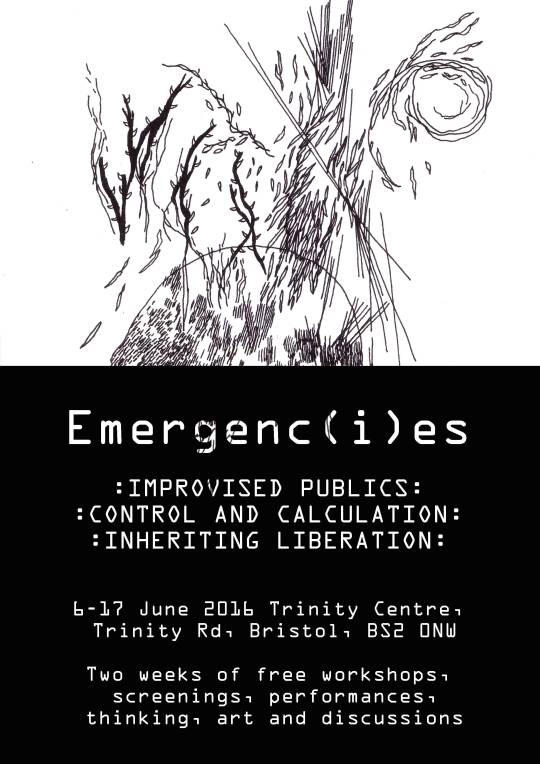
Reblog> Improvised Publics :: Control and Calculation :: Inheriting Liberation :: 6-17 June 2016

This event looks really interesting, check out the website for more information…

Emergenc(i)es – an event in Bristol between 6th and 17th June

Emergenc(i)es is an invitation to consider the emergency of the current historical moment.

The exhibition will dwell in the question of emergence within emergency.

Performance, education activities, visual art, screenings, installations, workshops and a library-cum-pharmacy will create time and space to diagnose, explore and understand the world we live in.

Enter – Relate – Improvise – Diagnose – Inherit – Public – Liberate – Gather

All activities are free to attend, thanks to generous funding from Awards for All.

Compositional thinking, or ‘deconstruction as composition’

I’ve been re-reading Dan Ross’ excellent chapter in the edited collection Stiegler and Technics entitled “Pharmacology and Critique after Deconstruction” and wanted to post an excerpt because it seems to me one of the clearest interpretations of one of the foundations of Bernard Stiegler’s thought: “composition”. This is a brief excerpt but I thoroughly recommend reading Dan’s chapter, and indeed the whole book – which is really good!


Stiegler inherits more from Derrida than from any other thinker: ‘deconstructive’ thinking is translated in Stieglerian terms into ‘compositional’ thinking:

Deconstruction is a thinking of composition in the sense that composition is ‘older’ than opposition (what Simondon would have called a ‘transductive relation’: that is, a relation that constitutes its terms, the terms not existing outside the relation). It is a relation that is the vehicle of a process (that of différance), one very close, I would argue, to what Simondon elaborates in terms of a ‘process of individuation’ (Stiegler 2001: 249-250).

Deconstruction, pursuing the complex genesis of oppositional pairs, amounts to the elaboration of s process of becoming. It is therefore more consistent than first appearances might indicate with the theories of Gilbert Simondon, for whom the key was not to begin with terms or individuals and then think their ‘relation’; rather, it is the process itself that ‘has the status of being’ (Simondon 1992: 306).

[…]

To this relation of differance to individuation should be added the influence of Nitetzsche, for whom existence must be understood as a play of forces, or, better, of tendencies. The formation of oppositions from prior compositions is an expression of this play of tendencies…

And it may turn out that where compositional thought is superior to deconstructive thought is in making it possible to think de-composition […] Deconstruction thus tends, perhaps, to perceive less clearly the pharmacological dangers of the deconstruction of ‘oppositions’, and the possibility that distinctions may on occasion be precisely what need to be preserved, that is, saved.

Ross, D 2015 “Pharmacology and Critiques after Deconstruction”, in  Howells, C and Moore, G eds. Stiegler and Technics, Edinburgh University Press, Edinburgh, pp. 245-246.

Other references:

Simondon, G. 1992 [1964] “The genesis of the individual”, in Crary, J. and Kwinter, S. Eds. Incorporations, Zone, New York.

Stiegler, B. 2001 “Deconstruction and technology: Fidelity at the limits of deconstruction and the prosthesis of faith”, trans. Beardsworth, R,, in Cohen, T. Ed. Jacques Derrida and the Humanities: A Critical Reader, Cambridge University Press, Cambridge.

Daniel Miller – The Internet: Provocation

There’s an entertaining and incisive piece on the Cultural Anthropology website by Prof. Daniel Miller (UCL) on (ethnographic) research concerning the internet/’online’…

I have felt that perhaps my primary qualification for engaging in the anthropology of this domain is simply that I have never, ever actually believed in “The Internet.” My provocation is that this disbelief is what distinguishes anthropologists from other scholars of online activity. My approach has always been ethnographic, what I call holistic contextualization. I study populations whose online activities are a growing element of who they are and what they do. Yet no one lives just online.

If you teach under the auspices of Internet studies or similar, it is pretty hard not to fetishize the Internet. But I cut my teeth on trying to develop something called material culture studies as a systematic defetishizing of objects (and of society). Instead, we examine the place of materiality within the anthropology of relationships. I see online as just one place in which we now live and conduct relationships with others. After overhearing a two-hour telephone conversation between your husband and his mother, for example, you would not remark, “Oh, that sounded bad, but what is your relationship like in the real world?”

Read the whole thing here.