The Museum of Contemporary Commodities in EXETER

The Museum of Contemporary Commodities

Just a quick note to let you know that the brilliant Paula Crutchlow has brought “The Museum of Contemporary Commodities” (MoCC) to Exeter for the majority of May.

There’s lots going on, much of it creative and interesting – so if you’re in Exeter or nearby: come and visit!

Two immediate things this week:

RIGHT NOW!: help re-create the internet in paper with Artist Louise Ashcroft from 11 -2 in the Exeter University Forum.

TOMORROW: sign up to do a data walkshop with Alison Powell from the LSE on Saturday from 10-1. Places have to be booked, and the Eventbrite page is here https://www.eventbrite.com/e/mocc-data-walkshop-tickets-24464719635

Please do visit the MoCC website for lots more events and activities taking place this month and visit the shop:

87 Fore St,
Exeter
EX46RT

Open 10:00-18:00pm Weds-Sat, 4th-21st May.

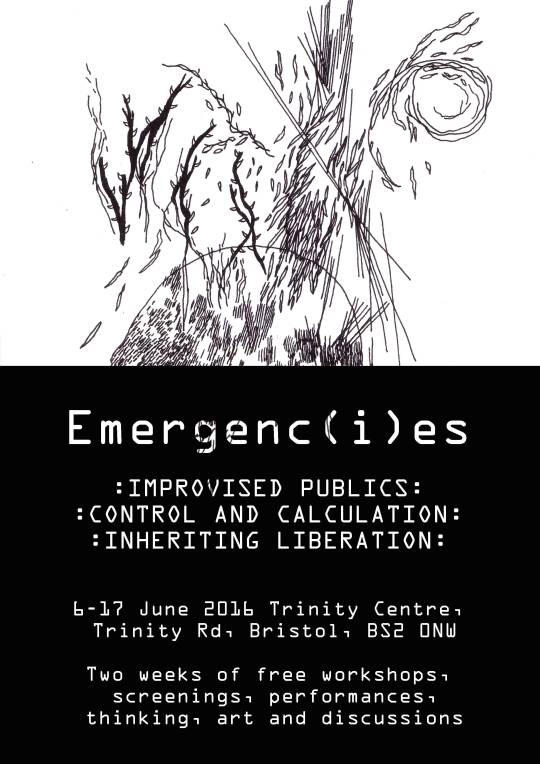
Reblog> Improvised Publics :: Control and Calculation :: Inheriting Liberation :: 6-17 June 2016

This event looks really interesting, check out the website for more information…

Emergenc(i)es – an event in Bristol between 6th and 17th June

Emergenc(i)es is an invitation to consider the emergency of the current historical moment.

The exhibition will dwell in the question of emergence within emergency.

Performance, education activities, visual art, screenings, installations, workshops and a library-cum-pharmacy will create time and space to diagnose, explore and understand the world we live in.

Enter – Relate – Improvise – Diagnose – Inherit – Public – Liberate – Gather

All activities are free to attend, thanks to generous funding from Awards for All.

Reblog> Screens – Waking a presence in Bristol’s concrete underbelly

An interesting blogpost by MSc Society & Space student Jethro Brice on the blog for the course concerning the installation art of Dani Landau, gentrification and nonrepresentational interventions in the city…

I couldn’t make it into Bristol in time to see this but wanted to, sadly teaching kept me in Exeter…

By Jethro Brice

Screens, by artist Dani Landau, is a pop-up installation which recently featured in a contested public space in Bristol. The work explores themes of urban renewal through the affective, material dimensions of processes of construction and deconstruction. The installation mobilises tensions between the virtual and the actual, and speaks to an interest in the more-than-human aspects of geographical processes of spatial distribution and bodily encounter. My particular interest in Screens arises with my own research (see profile) which explores the use of art methods to elicit affective registers in geographical research, and more specifically, in processes of change that operate in landscapes at different scales. I met with Landau for a post-exhibition ‘crit’; while this review reflects my own impressions, it is also informed by a lively discussion with the artist.

Jethro image one
Figure 1: Screens (detail), Dani Landau, 2015, mixed media installation (photo: J Brice)

Something is doing in the city. That much is hardly news – nor has it gone unremarked (Turner, 2015; Clement, 2012). Notwithstanding the UK’s experiences of economic and political stagnation in recent years, Bristol pulsates with the insistent, percussive buzz of demolition and construction, renovation and displacement. It is a transformation that has become so ordinary it hardly bears comment – hidden in stark visibility behind ephemeral screens of chipboard and scaffolding, the perpetual drone of activity recedes and is filtered out as white noise. On the daily commute (for those of us who have a job to go to), our transitory attention is confined to the felt effects of inconvenient bottlenecks and ambient road rage, and (for those of us who don’t drive) the prolonged ‘temporary’ disappearances of walkways and cycle tracks. Yet in all its ordinariness, this is a pulse that disrupts and displaces lives, alters flows and redistributes relations of power across the city. Back home, in rapidly changing residential neighbourhoods, the felt effects are more personal and sustained – heightening an awareness, that in among the busy-ness of the city centre, other intimately lived spaces and social relations persist or are obstructed and obliterated by the grind of the urban renewal machine.

One such space is the open cavity beneath a block of brick-and-concrete office blocks overlooking the juncture of Quay Street and Nelson Street, in central Bristol. Like more recent urban developments, such as Cabot Circus, the office block straddles and effectively encloses a public space. Imagined initially as a lively hub, with shops and adjacent pub, the blank module became (for a while) a social commons – a meeting point and sheltered “hang-out” for young people post work or school. Now, public right of passage through the space is curtailed by heavy steel gates that, while they do not lock, open only outwards. Office workers still use it as a place to smoke, but after hours this is a space where it is only possible to leave.

When I arrived there, however, on a dark evening towards the end of October, the space had been subtly transformed. Not a makeover – the walls were still laced with exhaust dust, and the hard, uninviting floor remained littered with a carpet of cigarette stubs – but something new inhabited the space. A tangle of gutted wires, broken bricks and disarticulated laptops lay strewn across the concrete terrace. On stripped-down, translucent screens perched precariously among the debris, something moved with the ponderous, deliberate grace of prehistoric reptiles. Light from recumbent spotlights caught in soft, drifting billows of dust. The shift of scale was at once immense and intimate. Drawn down on hands and knees to the gritty floor, I found myself perched knee-to-knee with strangers, straining to watch the delicate dance of high-reach excavators as they picked away at the towering carcass of an old tower block. Across the road, visible through the railings, bright slabs of new concrete rose tier on tier where a block of high-end student accommodation was under construction.

Jethro image two
Figure 2: Screens (detail), Dani Landau, 2025, mixed media installation (photo: J Brice)

There is something decidedly animal about Screens – a temporary pop-up installation by Bristol artist Dani Landau (danilandau.com) that recasts footage of recent demolition work as an ephemeral but momentous presence in the now-disused space. The sense of liveliness is not merely figurative. ‘Life’ here is in the tensions made tangible: between enormity and intimacy; between the heavy materiality of buildings and machines, and fragility of translucent screens; between the virtual (of digital media; of possibility and change) and the actual (of concrete; of felt effects); between fixity and movement; growth and decay. Overwhelmingly the tendency is to situate politics in the world of cerebral thought, in rational decision-making – here was an immense and immediate reminder that politics is also, and always, both spatial and tactile. Politics plays out at the level of visceral, shocking encounters between moving bodies in space.

Conclusion

The city writhes in an ecstasy of perpetual becoming, yet it is a transformation so ordinary that it effects nothing new. Gentrification, urban renewal, studentisation – the words are effectively sapped of their power by that very same process of enforced novelty which they attempt to call into question. Familiarity, it is said, breeds contempt. The something, however, is still doing. Bodies and lives are relocated and social assemblages unravel; flows are truncated, overextended or subsumed. People and other beings (that heterogeneous majority who in different ways are quietly displaced by urban renewal) struggle to reinvent familiar lives and orientations in unfamiliar situations.

Structures, and the structural critique bound to them, become fatigued; they erode and crumble. We are left to hone our attention to distributed processes, a fine tuning of affective relations that elide categorical thought. This is the stuff of our world as we are coming to understand it (Roberts, 2014, p.974). Yet, distributed relations and affective encounters are effects of power accumulating and unearthing expression in emergent differential structures (Massumi, 2015, p. 92–3). How, then, is it possible to reinvigorate worn channels, to reawaken us to the micropolitical affects and effects of urban processes that iterate and endure? Where words fail us, might other modes of enquiry open up a space within which changing material ecologies can be re-encountered (Brice, 2015, p. 61)? Art’s relationship to gentrification is of course neither simple nor unproblematic – artists have been key actors in processes of “detoxifying” neighbourhoods, even as they themselves are eventually displaced by rising property prices. Entangled as it is within relations of class and culture, art can equally work to challenge or normalise trajectories of change. Indeed, it is not always possible to distinguish these two functions – a tension provocatively mobilised in Bristol by the Facebook group Get the Easton Look (n.d.), and in the ambivalent role of the People’s Republic of Stokes Croft (n.d.)

Landau’s Screens woke a presence in the concrete underbelly of the Nelson Street towers. It made, for a brief episode, something newly alive in a space generally closed off: a space in which to confront the very material affects and elusive political ecologies of the relentlessly “regenerating” city. For me, this was a welcome disruption to the processes of sensory and political attrition that accompany and effectively obscure familiar trajectories of urban renewal – and a promising experiment with the possibilities of art methods to elicit new modes of attunement when researching society and space.

About the Artist:

Dani Landau is an artist doing practice based research through working with images in relation to public spaces. A graduate of Glasgow School of Art currently based at Spike Island Studios in Bristol, he is engaged in AHRC funded doctoral research at the University of the West of England.

For more information: http://www.danilandau.com

Video URL for documentation – https://vimeo.com/145854904

Imogen Heap on inventing new [blockchain] contracts for publishing/selling music digitally

This interview/article in Forbes with Imogen Heap offers an interesting insight into what some artists are beginning to think about in relation to how on earth one creates a ‘fair’ mechanism of reward/recognition of work as an artist in a world where one’s work is subject to near infinite digital reproducibility.

This, to me (in my naivety), seems to represent one of the more compelling and believable implementations of what the blockchain can enable. It’s worth checking out Heap’s articulation of Mycelia (the blockchain powered music publishing system she hopes to help create).

For years I’ve been so frustrated with the deep opacity of the music industry stopping me from really making the most out of my career and connecting the dots. The ‘black boxes,’ the NDAs, the endless contracts and statements. In the last few years, auditing labels and publishers seems to have become the norm, as it’s apparent how consistently the books don’t match up. You can pretty much guarantee you’ll find something, but it’s not always intentional; it’s just the deals, trigger points, and percentages are so complex – even more when mergers and acquisitions occur – that it’s hard to get it right every time, if you’re human!

[Mycelia…]

Its success will come from the adoption of millions of music lovers. A grand scale ongoing, collective project like no-other. To document, protect and share that which we love and build a place for it to grow, enabling future generations of artists to blossom as well as honouring those of the past.

Open source, a living, breathing, smart, decentralised, transparent, adaptable, useful, shining home for our love of music. A home which allows creativity to flow, connect and facilitate collaboration on so many levels, many of which just haven’t been possible. With this grand library of all music forming the basis upon which all music businesses from digital radio to tour bookings can then grow and thrive from. Empowering the artists, turning and landing the industry finally on its feet.

Inspired by the largest living organisms on earth, ancient, unseen, core to life itself, Mycelium (plural Mycelia) can stretch for miles, beneath the surface.

Each artist acting like its own Mycelium, in full animated dialogue with others on the global network.

Mycelia is huge, as it holds all music related information ever recorded anywhere ever ever ever but this organism stretches across our planet between hundreds of thousands of personal computers. It is the world’s greatest and most treasured library and it belongs to the two collective parties who solely make music complete. The music makers and their audience.

Read the whole piece here.

Stiegler on Daesh and ‘the age of disruption”

I offer a here a quick translation of an interview for Le Monde published past week with Bernard Stiegler, following the attacks in Paris in which he addresses Daesh/ISIS within the context of his conceptualisation of ‘disruption’, which is the context of his forthcoming book [Dans la Dusruption ~ “In the Age of Disruption”].

Only by planning a genuine future can we fight Daesh

The philosopher Bernard Stiegler develops this thesis in his forthcoming book: “In the Age of Disruption”.

Interview by Margherita Nasi.

For the philosopher Bernard Stiegler “war is economic”. The collapose of employment egenders a dispair that in turn leads to violence. “There is no future without a fundamental reversal of economic value”, he explains.

Since the attacks of the 13th of November the President of the Republic insists” “We are at war”, do you recognise yourself in such a war?

No. What is this “we”? They are at war, not me. War is economic, it is theirs and it creates casualties, including me, who cannot sleep at night, not because of terrorists but because of a lack of future for my children. This is not a war against Daesh, as they suggest, but a global economic war, which takes us into civil war if we do not combat it.

Employment will collapse, especially amongst young people, and dispair breeds violence. We no longer produce reasons for hope today. The attacks of the 13th of November were suicide attacks, which is not insignificant – suicide is developing around the world, especially amongst those young people who know they will not work for a long time.

Both Sarkozy and Hollande failed to provide any kind of prospects for these young people. It is against this stupidity, this madness, that I am at war. A war within myself as well: we are all subject to this tendency to find scapegoats, not to think and not to care. This is barbarism, and that is exactly what Daesh wants: to create civil war. There will be more attacks if we do not change our politics. This is the context of my next book ” In the Age of Disruption”.

What do you mean by disruption?

Disruption is a phenomenon of accelerating inovation which is the foundation of a strategy developed in Silicon Valley: it is a drive to go faster than societies in order to impose upon them models for the destruction of social structures, rendering public powers powerless It is a strategy that tetanises the opponent. In my book, I analyse a text signed by Abu Bakr Al-Naji, as summarised by Ignance Leverrier [former diplomat and journalist], that defines a collective, including former officers of Saddam Hussein that became Islamists. It is a sort of Daesh manual, in the image of corporate bibles that detail the rules to set up a franchise. This book explains how Daesh actors should seize power. One must create chaos and thus exploit the need for some kind of authority.

I compare this strategy with that of the website “Les Barbares attaquent” [The barbarians are coming], founded by Nicolas Colin, a former tax inspector known for his report on the tax system and the digital economy, in which hie highlighted the inadequacy of the tax system for dealing with digital companies, which he describes as the ‘four horsemen of the apocalypse’, in this case GAFA [acronym for: Google, Amazon, Facebook and Apple]. He has since moved to the other side, from public service into the economy which he described as so damaging, to create an investment fund that raises money to practice disruption on the French. Yet, repeating the strategy of GAFA, he can only extend their ecosystem and intensify the colonisation of Europe, wrecking transport, housing, education–all sectors–through new models such as Uber. However, such disruptive practices destroy the social balance, what [German Philosopher] Theodor W. Adorno anticipated by speaking in 1944 of a “new form of barbarism” in relation to the cultural industries.

It is not by declaring war on Daesh that this takes place. This declaration is one way of absolving oneself of one’s own responsibilities by scapegoating people that have become extremely dangerous and who we have co-produced with Daesh.

This radicalisation is thus built on the ruins of ultraliberalism?

Yes. We turn radicalism into a question of religion, and this is outrageous, Most recruits of radical Islam have no religious culture. It is not religion in question but despair. Richard Dur, the murderer of eight members of the Nanterre Council in March 2002, prefigures his actions by speaking about his feelings not existing: he wanted to become somebody by these actions.

In 2012 you launched a call for a global economic peace treaty, is this still a possible contemporary solution for eradicating barbarism?

We need to open out a debate in Europe, take things head-on, since the birth of the web we have all been losing. Exploited by the kinds of disruption practised by GAFA, digital technologies have accentuated the environmental toxicity that has been growing since the beginning of the anthropocene – an era in which humans have become the major geological factor – in terms of the climate, the atmosphere and in mental terms.

There is no future without a fundamental reversal of economic value: only the transition to an economy producing sustainable forms of value will overcome the challenges that are the subject of the COP21 next week.

We must launch a new European policy rather than aligning ourselves with the American model that is disruptive and suicidal/ We must invent a new Web in the service of viable marcoeconomic model, rather than developing a completely ruinous economy of data. These are the themes of the “Conversations about a new industrial world”, orgainsed at the Pompidou Centre on the 14th and 15th of December. Only by planning [projetant] a genuine [véritable] future for the planet can we combat Daesh, in other words to combat despair.

Performing the Humanities at 24 fps, Gay Hall in conversation with Stelarc

This is worth a watch:

Performing the Humanities @ 24 fps: Part 1

This is the first part of an interview conducted and filmed by the artist Stelarc for the Alternate Anatomies Lab at Curtin University, Perth, Australia. The second part of the interview is avaiulable here. Other interviews in the series are available on the website of the Alternate Anatomies Lab here.

See also Hall’s piece in Culture Machine [open access] on “Pirate Philosophy“, discussed in the video…

McKenzie Wark’s Critical Media Theory syllabus on Public Seminar

On the Public Seminar website, McKenzie Wark has written about a new Autumn course he’s teaching at the New School in NYC. He matches up each week’s class with a recent blogpost addressing the book they’ll be reading. Looks like a great exploration of what media is and how we can critically interrogate its/their role in what it is to be human…

Critical Media Theory

This semester (fall 15) I’m teaching Critical Media Theory (GLIB 5600) in the Liberal Studies program at the New School for Social Research. Critical Media Theory looks at a series of key texts that define pathways for thinking about media.

They are critical in the sense of aiming to delineate limits to how existing media function, and in pointing towards an expanded potential for what media could be. We start with some acknowledged classics, although hopefully not all of them will be too familiar. The we look at some recent texts that map out a range of approaches in media studies today.

The notes for the lectures will all be available here on Public Seminar. The students in the class can read the lectures before class, so we can get through the lecture part fairly quickly and on to discussion. I will be modifying and adding to the lecture notes as we go.

For anyone else who wants to follow along, here are the topics and links to the lecture notes for each week.

Read the rest of McKenzie Wark’s syllabus on the Public Seminar website…

Reblog> Danse macabre

Derek Gregory points to this really lovely video from Opéra National de Paris and Julien Prévieux inspired by Gregoire Chamayou’s work on ‘schematic bodies and patterns of life’.

I love how the ideas have been translated into performance in such a provocative yet beautiful way – this really gets you thinking about, as Stiegler would put it, the grammatisation of gesture (see, in particular: For a New Critique of Political Economy, pp. 8-13): the sense in which the capture and retention of our movements feeds back into the ways in which institutions and apparatuses address us both as individuals (‘subjects’) and populations (and/or ‘markets’)…

Danse macabre

Grégoire Chamayou writes to say that after our conversations in Irvine last year he has worked with an artist friend, Julien Prévieux (who won the Prix Marcel Duchamp in 2014) and the Opéra national de Paris to turn his ideas about schematic bodies and patterns of life into a short film: Patterns of Life.

I’ve embedded it below, but if the link doesn’t work you can watch it here or on YouTube here. You will soon see why Anne Buttimer once described Torsten HÃ¥gerstrand‘s time-geography diagrams as a danse macabre.  The subtitles are in French but the commentary is in English.

I find the combination of intellectual imagination and performance work absolutely compelling – see my comments on ‘Bodies on the line’ here, for example.

Jean Lievens introduction to Michel Bauwens’ Sauver le Monde

Earlier this year I posted rough translations of both Bernard Stiegler’s Preface and Dirk Holeman’s Postface to Michel Bauwens and Jean Lievens’ book Sauver le Monde: Vers une société post-capitaliste avec le peer-to-peer [To Save the World: towards a post-capitalist society with peer-to-peer].

I’ve translated a bit more now and I make this translation available, for free, to the publishers to do as they wish with it. I hope it helps in some small way…

These are the first few pages of the book following the Preface, in two short sections: Introduction and About this book.

As usual, clarifications or original French are in square brackets and I welcome any comments or suggestions – although I’m not trying to offer an ‘authoritative’ translation…

Introduction

“We do not live in a changing age, but rather a change of age”
Professor Jan Rotmans
(Professor of the Theory and Management of Transition,
Erasmus University Rotterdam)

It would be pointless to try to convince the reader of a book entitled To Save the World that life on Earth, as we understand it today, is in peril. Following a recently published study in the journal Nature Climate Change, more that half of terrestrial plants and the habitats of around a third of animals will disappear because of climate change if greenhouse gas emissions continue to increase at the current rate. Scientists at the renowned Global Footprint Network (an international laboratory of ideas that measures ecological sustainability using ‘ecological footprints’) have calculated that, at present, we will need a planet and a half to maintain the current global economy. Furthermore, the growth rate required to maintain this system until 2053 would require the global economy to quadruple. In this case, we would need six planets. One does not need to be genius to understand that endless growth on a finite planet is a scientific nonsense and we are heading for a crash. Faced with this bleak perspective for the future, there are different ways to react: simple denial, to resign ourselves to it, or to attempt to do something about it.

To change the world, we can draw inspiration from the past, but we need a new way of addressing the challenges of the future. Michel Bauwens brings us such a vision. Not the visions, but a vision. The title of this book thus reflects a certain arrogance inconsistent with his character. Indeed, very intelligent people are often very modest, because they are very conscious of their own limitations. But who is Michel Bauwens? Beneath the title “The most stimulating Belgian thinker is an unknown philosopher” in the newspaper De Morgen (on the 23rd March 2012) presents him as follows:

“Do you know Michel Bauwens? Perhaps not. This 54-year-old cyberphilosopher is not well known. Bauwens is the first Belgian to figure in a list of the 100 most influential people in the world. He finds himself in the illustrious company of people such as Mahatma Ghandi (9), Martin Luther King (24), The Dalai Lama (28), Thomas Malthus (55) and John Kenneth Galbraith (70). Bauwens occupies 82nd place, a few rungs above Eleanor Roosevelt (87).”

The list referred to in De Morgen, “The (En)Rich List”, is a table of 100 people established by the Post Growth Institute, an international group of scientists that lobby for a sustainable society in which prosperity can be created without a need for economic doctrine [besoin de croissance économique]. The list of the “most enriching people” is a foil [clin d’Å“il – literally “a wink”, could be translated to ‘a nod’] to the 100 “richest people” in the world, published annually by the American financial magazine Forbes.

Cyberphilosopher, futurologist, economist, researcher, conference convener, entrepreneur”¦ These are some of the epithets given to Michel Bauwens by journalists. Wikipedia designates him as a “peer-to-peer theorist”, and he describes himself in this book as a commentator and thinker attempting to forge a coherent link between the theories, hypotheses and explications of peer-to-peer, and to do so in the most ethical way possible.

So what is ‘peer-to-peer’ (abbreviated to P2P)? This is a term not well known or understood outside of the world of IT enthusiasts and geeks, nevertheless the collaborative economy, forged through networks of peers, has rapidly gained in popularity throughout our countries. A year before the publication of that short article in De Morgen, the Dutch-language Belgian newspaper De Tijd (on the 23rd April 2013) published a detailed interview with Michel, across a double-page spread. Little by little, he has gained notoriety even in his country of birth. As is often the case, local recognition comes on the back of an international breakthrough, and not vice versa. It is well-known that: “No one is a prophet in their own country” [«Nul n’est prophète en son pays» – this is an idiom that some suggest traces back to the apostles Luke and Matthew].

About this book

This book is the outcome of twelve Skype interviews, of around an hour each, between January and February 2014. If I had arranged twelve more hours, if someone else had interviewed Michel, this would have been a different book. In any case, our aim is to share with you some ideas at the heart of peer-to-peer, production between peers, in the hope of inspiring you to further your understanding through other lectures, books and studies. As this book contains a number of important new and uncommon terms (for example, you may have already struggled with the term ‘peer-to-peer’ in the subtitle of this book), we have created a glossary that is situated at the end of the book.

Personally, I think that politicians, whether on the right or the left, have a tendency to see the future [l’avenir] through the rear-view mirror. Just as Marxism is an ideological construct of the 19th century, liberalism and nationalism find their origins in the 18th century. From a historical perspective these ideologies each have respective values but they no longer offer a response to the enormous difficulties that confront us today. This is also expressed in the way that politicians are unable to offer solutions. Not only because the political class tends to defend the status quo and their vested interests but also because many of the problems can only be solved at a global scale and thus local authorities are powerless. This certainly does not mean that nothing is possible at a local level, quite the contrary. On those occasions when everything is paralysed at national and international levels, only local level action allows real progress. This is reflected in particular by increased urbanisation (since the beginning of the 21st century more than a half of the global population has lived in towns and cities), or what Eric Corijn calls the emergence of “urbanity” as new form of post-national society, but also by the development of peer-to-peer mechanisms through which a number of people take their fate into their own hands by launching new projects from within the very institutional framework with which they have often clashed. In the face of the pessimism of the political world, there is optimism within the science of peer-to-peer. This is why solutions will come first from civil society.

We live in an era of enormous possibilities, but also of contradictions and gigantic obstacles to the full realisation of those possibilities. Machines have releaved us of a large part of manual labour (and increasingly of intellectual labour), but the automisation of production processes has not translated into the redistribution or the reduction of working time. Financial markets, often governed by mathematical algorithms upon which no one has a grip, have a greater impact than governments upon our lives. Our parliaments vote for laws that render collaboration and sharing illegal. Our economic model is founded upon the absurd idea of material abundance and immaterial rarity. We behave as if the world was limitless and exploit it to the utmost, to the point of jeopardizing the survival of the human species. Furthermore, we use copyright and patents to build artificial barriers around human knowledge to complicate sharing and collaboration as much as possible. Yet, from the society of the industrial revolution emerged new models and ways of working, heralding a new society. Thus, today, in the words of the Dutch Scientist Jan Rotmans: “We do not live in an era of change but in a change of era”.

The emerging model of peer-to-peer, inspired by the open source movement, seeks to circumvent the false logic of material scarcity and the artificial scarcity of the immaterial. In the apparent tangle of new phenomena such as the collaborative economy, peer-to-peer networks, open source, crowd-sourcing, FabLabs, micro-factories, the “maker” movement, urban agriculture and so on, Michel Bauwens sees a model that leads us to a post-capitalist society, in which the market finally submits to the logic of the commons (the common good). This book is a first attempt to articulate ideas concerning peer-to-peer formulated by Michel Bauwens. It is not simply the result of the reflections of a single person but rather the collective inteilligence of a growing minority of active pioneers who are developing and revealing thousands of projects and experiences amongst peers. Hopefully they will be an inspiration for all who are active in this area and work to build a new world, starting with what affects us directly.

Jean Lievens
9th July 2013

Margaret Hamilton, Nasa software engineer & her ‘code’ printed out

I’ve put this picture on my office door:

Margaret Hamilton is an inspirational figure and we really should know more about her and her work!

Hamilton is now 78 and runs Hamilton Technologies, the Cambridge, Massachusetts-based company she founded in 1986. She’s lived to see “software engineering” – a term she coined – grow from a relative backwater in computing into a prestigious profession.

In the early days, women were often assigned software tasks because software just wasn’t viewed as very important. “It’s not that managers of yore respected women more than they do now,” Rose Eveleth writes in a great piece on early women programmers for Smithsonian magazine. “They simply saw computer programming as an easy job. It was like typing or filing to them and the development of software was less important than the development of hardware. So women wrote software, programmed and even told their male colleagues how to make the hardware better.”

“I began to use the term ‘software engineering’ to distinguish it from hardware and other kinds of engineering,” Hamilton told Verne’s Jaime Rubio Hancock in an interview. “When I first started using this phrase, it was considered to be quite amusing. It was an ongoing joke for a long time. They liked to kid me about my radical ideas. Software eventually and necessarily gained the same respect as any other discipline.”

Right on, Margaret.

The above quote is from this piece on vox.com by Dylan Matthews is worth reading – it contains lots of interesting bits and pieces, not least the fact that Apollo code was literally ‘hard wired’: it was woven in wire… astonishing to anyone who simply fires up a text editor and then uploads via ftp etc. etc. now…

The process of actually coding in the programs was laborious, as well. The guidance computer used something known as “core rope memory”: wires were roped through metal cores in a particular way to store code in binary. “If the wire goes through the core, it represents a one,” Hamilton explained in the documentary Moon Machines. “And around the core it represents a zero.” The programs were woven together by hand in factories. And because the factory workers were mostly women, core rope memory became known by engineers as “LOL memory,” LOL standing for “little old lady.”