CFP> “Countercultures of Data” – Special Issue of Philosophy & Technology

Another interesting CFP and goodness knows this needs doing(!) I look forward to seeing what comes of this, should be great!

CFP: “COUNTERCULTURES OF DATA” – SPECIAL ISSUE OF PHILOSOPHY & TECHNOLOGY

Call for Papers for Philosophy and Technology’s special issue on Countercultures of Data

Guest Editor – Anna Lauren Hoffmann, School of Information – University of California, Berkeley

Journal cover featuring white text on blue backgroundAbout the Issue
25 years ago, Sandra Harding–in her influential book Whose Science? Whose Knowledge? Thinking from Women’s Lives–detailed and extended critical debates surrounding knowledge production and practices in science and technology. Collectively, these “countercultures of science” confronted the “problematics, agendas, ethics, and consequences” of scientific and technological production head on. Today, these same perspectives offer insight into the realm of data science, as philosophers, scholars, and practitioners alike grapple with ethical questions in a world where discourse, design, and governance increasingly revolve around “big” data and quantifiable knowledge.

This special issue will bring together rigorous conceptual and theoretical perspectives on what might best be called–following Harding–emerging “countercultures of data.” In particular, this issue will further critical and philosophical thinking about the theories, methods, institutions, and technological arrangements that underwrite or support data science in various industries and forms. Combined, contributions to the special issue will put forward a more realistic assessment of possible futures for a data driven world.

We invite submissions related (but not limited) to:

– Race and Data Science
– Theories of Property, Labor, and Data
– Political Economies of Data
– Data and Imperialism
– Feminist Perspectives on Data Science
– Data, Bodies, and Disability
– Data, Infrastructure, and the Environment
– Data, Philosophy, and the Law
– Communities and Data
– Data and Queer Subjects
– Data and/as Human Subjects in Research
– Data Science and Epistemic Justice

Timetable for Submissions
October 24, 2016: Deadline for paper submissions
December 21, 2016: Deadline reviews papers
February 6, 2017: Deadline revised papers
2017: Publication of the special issue

Submission Details
To submit a paper for this special issue, authors should go to the journal’s Editorial Manager http://www.editorialmanager.com/phte/
The author (or a corresponding author for each submission in case of co- authored papers) must register into EM.

The author must then select the special article type: “COUNTERCULTURES OF DATA” from the selection provided in the submission process. This is needed in order to assign the submissions to the Guest Editor.

Submissions will then be assessed according to the following procedure:
New Submission => Journal Editorial Office => Guest Editor(s) => Reviewers => Reviewers’ Recommendations => Guest Editor(s)’ Recommendation => Editor-in-Chief’s Final Decision => Author Notification of the Decision. (The process will be reiterated in case of requests for revisions.)

About the Journal
The journal addresses the expanding scope and unprecedented impact of technologies, in order to improve the critical understanding of the conceptual nature and practical consequences, and hence provide the conceptual foundations for their fruitful and sustainable developments. The journal welcomes high-quality submissions, regardless of the tradition, school of thought or disciplinary background from which they derive. The journal’s Editor-in-Chief is Luciano Floridi (Oxford).

Contact
For any further information please contact: Anna Lauren Hoffmann – annalauren [at] berkeley [dot] edu

CFP> Feminist Media Studies Special issue on Online Misogyny: Call for papers

I saw this on Twitter via Huw Davies last night. Looks like a really interesting call:

Feminist Media StudiesSpecial issue on Online Misogyny: Call for papers

Deadline: 1 October 2016

Edited by Debbie Ging and Eugenia Siapera

In recent years, online misogyny has become a major concern for women. As a new wave of feminist / female bloggers, journalists, activists and gamers have attempted to assert their presence on the internet, there has been a concerted backlash against both feminism and women generally. This special issue of Feminist Media Studies seeks to identify and theorise the complex relationships between online culture, technology and misogyny. How have the internet’s anti-woman spaces and discourses been transformed by the technological affordances of the internet and social media? How are they being articulated and reproduced in diverse cultural contexts and / or transnationally? Are they borne of the same types of discontents articulated in older forms of anti-feminism or to what extent do they articulate a different constellation of social, cultural and gender-political factors?

Despite growing social concern about online misogyny, discussion and debate of this issue has been primarily journalistic to date. Moreover, the focus has been strongly western-/anglo-centric, and has tended to revolve around certain ‘flashpoint’ events. There is a need, therefore, for greater representation of how this phenomenon operates globally across contexts from non-anglophone, technologically advanced cultures to countries in the Global South. It is important to ask, for example, how internet access and local gender landscapes complicate our understanding of this subject. In addition to the more high-profile, anonymous attacks covered by the western media, there are also reports of intimate partner and acquaintance abuse online, which often takes the form of ‘revenge porn’ or unauthorized distribution of sexts by men known to their victims. Moreover, misogyny can and does operate in the more formal contexts of the technology sector. All of these examples should alert us to the importance of progressing academic inquiry on this issue not from a point at which we assume online misogyny to be a stable, recognisable phenomenon but rather by inviting contributions that will expand current knowledge and understanding beyond western experiences, gender-political contexts and epistemological frameworks.

What is significant about all of these phenomena is their very real impact on the lives and safety of real women, as well as their success in deterring women from expressing their opinions or putting their work online. Despite this, online misogyny remains under-researched in academia (Jane, 2014). There have, however, been important activist interventions such as #everydaysexism and #freethenipple as well as a raft of feminist groups organizing online to highlight and challenge misogyny. Given that activists, journalists, gamers and filmmakers have effectively led this charge, we consider it important to ask whether these new, more popular expressions of digital feminism are reaching new audiences and shaping new publics, and what impact this might have on theoretical understandings of feminism. Moreover, while it is important to consider the new misogyny in relation to older theorisations of anti-feminism (Faludi, 1991; Kimmel, 1995; Messner, 1997), it is also crucial to build reflexive criticism into narratives that have hitherto excluded non-western cultures as well as other, related forms of online hate speech such as racism, homophobia and transphobia.

Online Misogyny aims to give this increasingly important area of enquiry the impetus, attention and theoretical cohesion it requires. The increasingly amorphous and anonymous nature of online misogyny and the fluid and dynamic nature of online communication pose considerable challenges for data capture and analysis, and we expect methodological innovation to be a key element of this special issue. We also hope to publish at least one contribution from an activist, artist or non-academic.

Possible topics in relation to this theme may include (but are not limited to):

  • Online misogyny and feminist media theorisations
  • Forms of online misogyny  (including threats, abuse, ‘revenge porn’, creepshots, sexting, slut-shaming, technology-enabled intimate partner and acquaintance violence, and others)
  • Sites and contexts of online misogyny
  • Discourses and visuality of online misogyny
  • Global contexts and online misogyny
  • Transnational travel / global pathways of misogyny
  • Online misogyny’s articulations with racism, homophobia and transphobia
  • Technological affordances: the role of algorithims, anonymity, governance, technical design, platform politics, etc.
  • Social, political and personal impact of online misogyny
  • Women’s / feminist responses to online misogyny
  • Performative responses to online misogyny
  • The role of social media corporations and community managers
  • Workplace and institutional misogyny: misogyny in the technology / gaming / journalism sectors
  • Legislation and corporate policy
  • Digitally networked publics: the impact of online misogyny on democracy and the public sphere
  • Online misogyny and the post-feminist context

Aims & Scope
Feminist Media Studies provides a transdisciplinary, transnational forum for researchers pursuing feminist approaches to the field of media and communication studies, with attention to the historical, philosophical, cultural, social, political, and economic dimensions and analysis of sites including print and electronic media, film and the arts, and new media technologies. The journal invites contributions from feminist researchers working across a range of disciplines and conceptual perspectives.

Peer Review Policy
All research articles in this journal undergo rigorous peer review, based on initial editor screening and anonymous refereeing by at least two scholars.
Submission Instructions

Please submit a 350-word abstract as well as a short (1-page) CV to Debbie Ging (debbie.ging(at)dcu.ie) and Eugenia Siapera (eugenia.siapera(at)dcu.ie) by 1st October 2016. Authors whose abstracts are selected will be notified by 15th January 2017 and asked to submit complete manuscripts by 15th June 2017. Acceptance of the abstract does not guarantee publication of the paper, which will be subject to peer review.

Reblog> New article in EPD on geography & matter – @AngelaLast

This article looks really interesting!

New article in EPD on geography & matter


Image: ‘Crowd, Isolated on White’ (Leontura/Getty Images)

This morning, my latest article on geography and matter was published by Environment & Planning D: Society and Space. There are two kinds of discomforts that I am processing in this article: the lack of dialogue on the role of matter between followers of historical and new materialism, and my conflicted relationship with the work of Hannah Arendt. I had the feeling that the two problems were related, so I went ahead to see where it took me, starting with channelling the many animated conversation that I have had with people at workshops and conferences. I ended up somewhere different than expected, but with one thing I was right: it had to do with the way we make cuts between the material and supposedly non-material world. The result is called ‘Re-reading Worldliness: Hannah Arendt and the Question of Matter‘. If you do not have access to the journal, please send me an email. It is also available for free on the journal website until 12 September.

Abstract

Both new and historical materialisms have attracted a reputation for leading to ‘bad politics’. Historical materialisms have been accused of reducing too much to material relations and their production, whereas new materialisms have been accused of avoiding politics completely. This article reads the critique directed at materialisms against Hannah Arendt’s exceptional distrust of matter. Focusing on her concept of ‘worldliness’, it grapples with the question ‘why do we need an attention to matter in the first place?’ The attempted re-reading takes place through a feminist and postcolonial lens that draws out the contributions and failures of Arendt’s (anti)materialist framework in its banishing of matter from politics. Arendt’s focus on the prevention of dehumanisation further serves as a means to discuss materialism’s risk in negotiating the tension between deindividuation and dehumanisation.

Critical and Creative Ethnography After Human Exceptionalism. Brilliant new publication from @annegalloway

Amidst the slog of marking a shining jewel-like piece of inspiration appeared in my inbox – one of my academic heroes Anne Galloway shared a draft of what is a fantastic chapter for a brilliant book, which is set to be published later this year (what a great editorial team too!). Anne has posted about this on her lab’s blog, so I am reposting some of that post… however, go and read it on the More-than-human Lab blog!

I’m pleased to announce that The Routledge Companion to Digital Ethnography, edited by Larissa Hjorth, Heather Horst, myself & Genevieve Bell, will be published later this year.

For the companion I also contributed a chapter called “More-Than-Human Lab: Critical and Creative Ethnography After Human Exceptionalism.”

Anne shares the introductory paragraph, which I think wonderfully performs precisely the ethos of praxis she explores in the chapter:

Haere mai. Welcome. This story starts with an introduction so that the reader can know who I am, and how I have come to know what I know. My name is Anne Galloway. My mother’s family is Canadian and my father’s family is British. Born and raised outside both places, for the past seven years I have been tauiwi, or non-Māori, a settler in Aotearoa-New Zealand. I have always lived between cultures and have had to forge my own sense of belonging. Today I am in my home, on a small rural block in the Akatarawa Valley of the Tararua ranges, at the headwaters of the Waikanae River, on the ancestral lands of MuaÅ«poko (Ngāi Tara) & Ngāti Toa, with my partner, a cat, seven ducks, five sheep–four of whom I hope are pregnant–and a multitude of extraordinary wildlife. The only way I know how to understand myself is in relation to others, and my academic career has been dedicated to understanding vital relationships between things in the world. Most recently, I founded and lead the More-Than-Human Lab, an experimental research initiative at Victoria University of Wellington. Everything I have done has led me to this point, but for the purposes of this chapter I want to pull on a single thread. This is a love story for an injured world, and it begins with broken bones”¦

Anne offers more excerpts and explanation in her blogpost and her full reference list (so please do read it!).

I did however want to share a brief snippet of one of the many bits I love from the chapter:

As more technological devices connect people to things in the world, and as more data are collected about people and things, digital ethnography stands to make an important contribution to our understanding of constantly shifting relations. When combined with speculative design that translates realist narratives into fantastic stories, I also believe we can inject hope into spaces, times and relations where it seems most unlikely.

For me,  Anne’s reading of a feminist ethics of care: for knowledge for our ‘selves’ and for our decentred place in the vital soup of our (transindividuated) becoming, as a part of contemporary ethnographic praxis is really valuable and we would all do well to involve ourselves in the conversation which Anne invites.

The image at the top comes from Anne’s twitter feed, it’s one of her own sheep:

The Museum of Contemporary Commodities in EXETER

The Museum of Contemporary Commodities

Just a quick note to let you know that the brilliant Paula Crutchlow has brought “The Museum of Contemporary Commodities” (MoCC) to Exeter for the majority of May.

There’s lots going on, much of it creative and interesting – so if you’re in Exeter or nearby: come and visit!

Two immediate things this week:

RIGHT NOW!: help re-create the internet in paper with Artist Louise Ashcroft from 11 -2 in the Exeter University Forum.

TOMORROW: sign up to do a data walkshop with Alison Powell from the LSE on Saturday from 10-1. Places have to be booked, and the Eventbrite page is here https://www.eventbrite.com/e/mocc-data-walkshop-tickets-24464719635

Please do visit the MoCC website for lots more events and activities taking place this month and visit the shop:

87 Fore St,
Exeter
EX46RT

Open 10:00-18:00pm Weds-Sat, 4th-21st May.

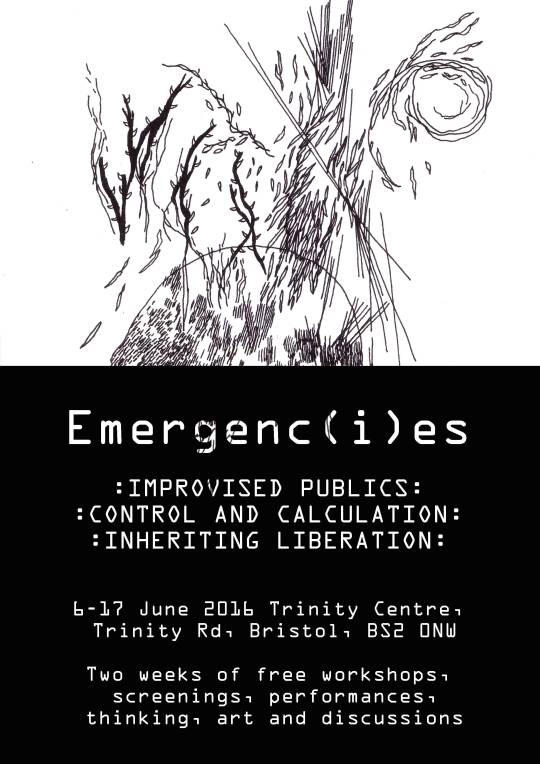
Reblog> Improvised Publics :: Control and Calculation :: Inheriting Liberation :: 6-17 June 2016

This event looks really interesting, check out the website for more information…

Emergenc(i)es – an event in Bristol between 6th and 17th June

Emergenc(i)es is an invitation to consider the emergency of the current historical moment.

The exhibition will dwell in the question of emergence within emergency.

Performance, education activities, visual art, screenings, installations, workshops and a library-cum-pharmacy will create time and space to diagnose, explore and understand the world we live in.

Enter – Relate – Improvise – Diagnose – Inherit – Public – Liberate – Gather

All activities are free to attend, thanks to generous funding from Awards for All.

Feminism, Digital Culture and the Politics of Transmission – Deborah Withers

I don’t really know why I haven’t seen this before today(?!) but just wanted to flag this really interesting book by Deborah Withers, which I will be ordering ASAP…

Feminism, Digital Culture and the Politics of Transmission argues that despite the prevalence of generational narratives within feminism, the technical processes through which knowledge is transmitted across generations remain unexplored. Taking Bernard Stiegler’s concept of the already-there as its starting point the book considers how the politics of transmission operates within digital culture. It argues that it is necessary to re-orient feminism’s political project within what is already-there so that it may respond to an emergent feminist tradition.Grounded in the author’s work collecting and interpreting the music-making heritage of the UK Women’s Liberation Movement, it explores how digital technologies have enabled empassioned amateurs to make ‘archives’ within the first decade of the 21st century. The book reflects on what is technically and politically at stake in the organization and transmission of digital artifacts, and explores what happens to feminist cultural heritage when circuits shut down, stall or become diverted.

And here’s some praise from Patrick Crogan, whose opinion I trust:

A substantial, judicious, and highly effective mobilisation of key tenets of Stiegler’s work pertaining to memory, technology, and cultural transmission. Withers develops a cogent political reformulation of questions of memory, heritage, and archival matters of preservation and access in the digital age in this book project. Her use of Stiegler is central to this, and indeed represents an important introduction to his philosophical critique of the digital mediated world to an area where his ideas have particular relevance but are under-represented.

Patrick Crogan, Associate Professor of Digital Cultures, University of the West of England