AI as organ -on|-ology

Kitt the 'intelligent' car from the TV show Knight Rider

Let’s begin with a postulate: there is either no “AI” – artificial intelligence – or every intelligence is, in fact, in some way artificial (following a recent talk by Bernard Stiegler). In doing so we commence from an observation that intelligence is not peculiar to one body, it is shared. A corollary is that there is no (‘human’) intelligence without artifice, insofar as we need to exteriorise thought (or what Stiegler refers to as ‘exosomatisation’) for that intelligence to function – as language, in writing and through tools – and that this is inherently collective. Further, we might argue that there is no AI. Taking that suggestion forward, we can say that there are, rather, forms of artificial (or functional) stupidity, following Alvesson & Spicer (2012: p. 1199), insofar as it inculcates forms of lack of capacity: “characterised by an unwillingness or inability to mobilize three aspects of cognitive capacity: reflexivity, justification, and substantive reasoning”. Following Alvesson & Spicer [& Stiegler] we might argue that such forms of stupidity are necessary passage points through our sense-making in/of the world, thus are not morally ‘wrong’ or ‘negative’. Instead, the forms of functional stupidity derive from technology/techniques are a form of pharmakon – both enabling and disabling in various registers of life.

Given such a postulate, we might categorise “AI” in particular ways. We might identify ‘AI’ not as ‘other’ to the ‘human’ but rather a part of our extended (exosomatic) capacities of reasoning and sense. This would be to think of AI ‘organologically’ (again following Stiegler) – as part of our widening, collective, ‘organs’ of action in the world. We might also identify ‘AI’ as an organising rationale in and of itself – a kind of ‘organon’ (following Aristotle). In this sense “AI” (the discipline, institutions and the outcome of their work [‘an AI’]) is/are an organisational framework for certain kinds of action, through particular forms of reasoning.

It would be tempting (in geographyland and across particular bits of the social sciences) to frame all of this stemming from, or in terms of, an individual figure: ‘the subject’. In such an account, technology (AI) is a supplement that ‘the human subject’ precedes. ‘The subject’, in such an account, is the entity to which things get done by AI, but also the entity ultimately capable of action. Likewise, such an account might figure ‘the subject’ and it’s ‘other’ (AI) in terms of moral agency/patiency. However, for this postulate such a framing would be unhelpful (I would also add that thinking in terms of ‘affect’, especially through neuro-talk would be just as unhelpful). If we think about AI organologically then we are prompted to think about the relation between what is figured as ‘the human’ and ‘AI’ (and the various other things that might be of concern in such a story) as ‘parasitic’ (in Derrida’s sense) – its a reciprocal (and, in Stiegler’s terms, ‘pharmacological’) relation with no a priori preceding entity. ‘Intelligence’ (and ‘stupidity’ too, of course) in such a formulation proceeds from various capacities for action/inaction.

If we don’t/shouldn’t think about Artificial Intelligence through the lens of the (‘sovereign’) individual ‘subject’ then we might look for other frames of reference. I think there are three recent articles/blogposts that may be instructive.

First, here’s David Runciman in the LRB:

Corporations are another form of artificial thinking machine, in that they are designed to be capable of taking decisions for themselves. Information goes in and decisions come out that cannot be reduced to the input of individual human beings. The corporation speaks and acts for itself. Many of the fears that people now have about the coming age of intelligent robots are the same ones they have had about corporations for hundreds of years.

Second, here’s Jonnie Penn riffing on Runciman in The Economist:

To reckon with this legacy of violence, the politics of corporate and computational agency must contend with profound questions arising from scholarship on race, gender, sexuality and colonialism, among other areas of identity.
A central promise of AI is that it enables large-scale automated categorisation. Machine learning, for instance, can be used to tell a cancerous mole from a benign one. This “promise” becomes a menace when directed at the complexities of everyday life. Careless labels can oppress and do harm when they assert false authority. 

Finally, here’s (the outstanding) Lucy Suchman discussing the ways in which figuring complex systems of ‘AI’-based categorisations as somehow exceeding our understanding does particular forms of political work that need questioning and resisting:

The invocation of Project Maven in this context is symptomatic of a wider problem, in other words. Raising alarm over the advent of machine superintelligence serves the self-serving purpose of reasserting AI’s promise, while redirecting the debate away from closer examination of more immediate and mundane problems in automation and algorithmic decision systems. The spectacle of the superintelligentsia at war with each other distracts us from the increasing entrenchment of digital infrastructures built out of unaccountable practices of classification, categorization, and profiling. The greatest danger (albeit one differentially distributed across populations) is that of injurious prejudice, intensified by ongoing processes of automation. Not worrying about superintelligence, in other words, doesn’t mean that there’s nothing about which we need to worry.
As critiques of the reliance on data analytics in military operations are joined by revelations of data bias in domestic systems, it is clear that present dangers call for immediate intervention in the governance of current technologies, rather than further debate over speculative futures. The admission by AI developers that so-called machine learning algorithms evade human understanding is taken to suggest the advent of forms of intelligence superior to the human. But an alternative explanation is that these are elaborations of pattern analysis based not on significance in the human sense, but on computationally-detectable correlations that, however meaningless, eventually produce results that are again legible to humans. From training data to the assessment of results, it is humans who inform the input and evaluate the output of the black box’s operations. And it is humans who must take the responsibility for the cultural assumptions, and political and economic interests, on which those operations are based and for the life-and-death consequences that already follow.

All of these quotes more-or-less exhibit my version of what an ‘organological’ take on AI might look like. Likewise, they illustrate the ways in which we might bring to bear a form of analysis that seeks to understand ‘intelligence’ as having ‘supidity’as a necessary component (it’s a pharmkon, see?), which in turn can be functional (following Alvesson & Spicer). In this sense, the framing of ‘the corporation’ from Runciman and Penn is instructive – AI qua corporation (as a thing, as a collective endeavour [a ‘discipline’]) has ‘parasitical’ organising principles through which play out the pharmacological tendencies of intelligence-stupidity.

I suspect this would also resonate strongly with Feminist Technology Studies approaches (following Judy Wajcman in particular) to thinking about contemporary technologies. An organological approach situates the knowledges that go towards and result from such an understanding of intelligence-stupidity. Likewise, to resist figuring ‘intelligence’ foremost in terms of the sovereign and universal ‘subject’ also resists the elision of difference. An organological approach as put forward here can (perhaps should[?]) also be intersectional.

That’s as far as I’ve got in my thinking-aloud, I welcome any responses/suggestions and may return to this again.

If you’d like to read more on how this sort of argument might play out in terms of ‘agency’ I blogged a little while ago.

ADD. If this sounds a little like the ‘extended mind‘ (of Clark & Chalmers) or various forms of ‘extended self’ theory then it sort of is. What’s different is the starting assumptions: here, we’re not assuming a given (a priori) ‘mind’ or ‘self’. In Stiegler’s formulation the ‘internal’ isn’t realised til the external is apprehended: mental interior is only recognised as such with the advent of the technical exterior. This is the aporia of origin of ‘the human’ that Stiegler and Derrida diagnose, and that gives rise to the theory of ‘originary technics’. The interior and exterior, and with them the contemporary understanding of the experience of being ‘human’ and what we understand to be technology, are mutually co-constituted – and continue to be so [more here]. I choose to render this in a more-or-less epistemological, rather than ontological manner – I am not so much interested in the categorisation of ‘what there is’, rather in ‘how we know’.

Popular automative imagination (some novels)

Twiki the robot from Buck Rogers

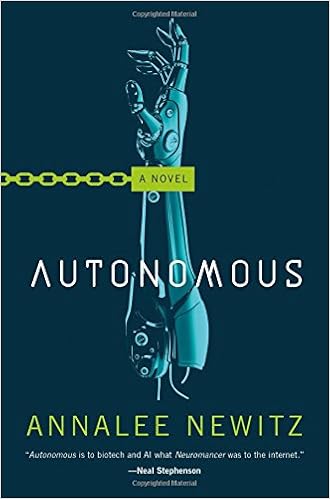
I’ve had about six months of reading various versions of speculative/science fiction after not having read in that genre for a little while… so here’s a selection of books I’ve read (almost exclusively on an ereader) that have more-or-less been selected following the ‘people who read [a] also read [b]’ lists.

I’m not sure these books necessarily offer any novel insights but they do respond to the current milieu of imagining automation (AI, big data, platform-ing, robots, surveillance capitalism etc etc) and in that sense are a sort of very partial (and weird) guide to that imagination and the sorts of visions being promulgated.

I’d like to write more but I don’t have the time or energy so this is more or less a place-holder for trying to say something more interesting at a later date… I do welcome other suggestions though! Especially less conventionally Western ones.

ADD. Jennie Day kindly shared a recent blogpost by David Murakami Wood in which he makes some recommendations for SF books. Some of these may be of interest if you’re looking for wider recommendations. In particular, I agree with his recommendations of Okorafor’s “Lagoon“, which is a great novel.

Talk – Plymouth, 17 Oct: ‘New geographies of automation?’

Rachael in the film Blade Runner

I am looking forward to visiting Plymouth (tomorrow) the 17th October to give a Geography department research seminar. It’s been nearly twenty years (argh!) since I began my first degree, in digital art, at Plymouth so I’m looking forward to returning. I’ll be talking about a couple of aspects of ‘The Automative Imagination’ under a slightly different title – ‘New geographies of automation?’ The talk will take in archival BBC and newspaper automation anxieties, management consultant magical thinking (and the ‘Fourth Industrial Revolution’), gendered imaginings of domesticity (with the Jetsons amongst others) and some slightly under-cooked (at the moment) thoughts about how ‘agency’ (what kinds of ‘beings’ or ‘things’ can do what kinds of action).

Do come along if you’re free and happen to be in the glorious gateway to the South West that is Plymouth.

(More) Gendered imaginings of automata

My Cayla Doll

A few more bits on how automation gets gendered in particular kinds of contexts and settings. In particular, the identification of ‘home’ or certain sorts of intimacy with certain kinds of domestic or caring work that then gets gendered is something that has been increasingly discussed.

Two PhD researchers I am lucky enough to be working with, Paula Crutchlow (Exeter) and Kate Byron (Bristol), have approached some of these issues from different directions. Paula has had to wrangle with this in a number of ways in relation to the Museum of Contemporary Commodities but it was most visible in the shape of Mikayla, the hacked ‘My Friend Cayla Doll’. Kate is doing some deep dives on the sorts of assumptions that are embedded into the doing of AI/machine learning through the practices of designing, programming and so on. They are not, of course, alone. Excellent work by folks like Kate Crawford, Kate Devlin and Gina Neff (below) inform all of our conversations and work.

Here’s a collection of things that may provoke thought… I welcome any further suggestions or comments 🙂

Alexa, does AI have gender?


Alexa is female. Why? As children and adults enthusiastically shout instructions, questions and demands at Alexa, what messages are being reinforced? Professor Neff wonders if this is how we would secretly like to treat women: ‘We are inadvertently reproducing stereotypical behaviour that we wouldn’t want to see,’ she says.

Prof Gina Neff in conversation with Ruth Abrahams, OII.

Predatory Data: Gender Bias in Artificial Intelligence

it has been reported that female-sounding assistive chatbots regularly receive sexually charged messages. It was recently cited that five percent of all interactions with Robin Labs, whose bot platform helps commercial drivers with routes and logistics, is sexually explicit. The fact that the earliest female chatbots were designed to respond to these suggestions
deferentially or with sass was problematic as it normalised sexual harassment.

Vidisha Mishra and Madhulika Srikumar – Predatory Data: Gender Bias in Artificial Intelligence

The Gender of Artificial Intelligence

Chart showing that the gender of artificial intelligence (AI) is not neutral
The gendering, or not, of chatbots, digital assistants and AI movie characters – Tyler Schnoebelen

“Consistently representing digital assistants as female…hard-codes a connection between a woman’s voice and subservience.”

Stop Giving Digital Assistants Female Voices – Jessica Nordell, The New Republic

“The good robot”

Anki Vector personal robot

A fascinating and very evocative example of the ‘automative imagination’ in action in the form of an advertisement for the “Vector” robot from a company called Anki.

How to narrate or analyse such a robot? Well, there are lots of the almost-archetypical figures of ‘robot’ or automation. The cutesy and non-threatening pseudo-pet that the Vector invites us to assume it is, marks the first. This owes a lot to Wall-E (also, the robots in Batteries Not Included and countless other examples) and the doe-eyed characterisation of the faithful assistant/companion/servant. The second is the all-seeing surveillant machine uploading all your data to “the cloud”. The third is the two examples of quasi-military monsters with shades of “The Terminator”, with a little bit of helpless baby jeopardy for good measure. Finally, the brief nod to HAL 9000, and the flip of the master/slave that it represents, completes a whistle-stop tour of pop culture understandings of ‘robots’, stitched together in order to sell you something.

I assume that the Vector actually still does the kinds of surveillance it is sending up in the advert, but I have no evidence – there is no publicly accessible copy of the terms & conditions for the operation of the robot in your home. However, in a advertorial on ‘Robotics Business Review‘, there is a quote that sort of pushes one to suspect that Vector is yet another device that on the face of it is an ‘assistant’ but is also likely to be hoovering up everything it can about you and your family’s habits in order to sell that data on:

“We don’t want a person to ever turn this robot off,” Palatucci said. “So if the lights go off and it’s on your nightstand and he starts snoring, it’s not going to work. He really needs to use his sensors, his vision system, and his microphone to understand the context of what’s going on, so he knows when you want to interact, and more importantly, when you don’t.”

If we were to be cynical we might ask – why else would it need to be able to do all of this? –>

Anki Vector “Alive and aware”

Regardless, the advert is a useful example of how the bleed from fictional representations of ‘robots’ into contemporary commercial products we can take home – and perhaps even what we might think of as camouflage for the increasingly prevalent ‘extractive‘ business model of in-home surveillance.

Reblog> session on feminist digital geographies at AAG conference April 2019

Women Who Code

Via Gillian Rose. If you’re going to the AAG – this session is sure to be a good one.

Session on feminist digital geographies at AAG conference April 2019

This is a call for papers for a session at the next conference of the American Association of Geographers annual meeting in Washington DC 3-7 April next year on feminist digital geographies, organised by Agnieszka Leszczynski (Western University) and me. It’s sponsored by both the Digital Geographies and the Geographic Perspectives on Women Speciality Groups of the AAG.

In the context of a flurry of activities coalescing around digital geographies, we invite papers that consider the “enduring contours and new directions” of feminist theory, politics, and praxis for geographies concerned with the digital (Elwood and Leszczynski, 2018). We broadly welcome interventions that proceed from, utilize, and advance feminist epistemologies, methodologies, theory, critical practice, and activism.

We are open to submissions offering empirical, theoretical, critical, and methodological contributions across a range of topics, including but not limited to:

  • big data
  • digitally-mediated cities
  • artificial intelligence and algorithms
  • social media
  • feminist/digital/spatial theory
  • progressive alternatives and activism
  • feminist histories and genealogies

Please submit abstracts of no more than 200 words by October 15thto aleszczy@uwo.ca and gillian.rose@ouce.ox.ac.uk. Please include a title, your name, affiliation and email address in the abstract. We will respond to authors with confirmation by November 1st.

Reference:

Elwood S and Leszczynski A (2018) Feminist digital geographies. Gender, Place & Culture25(5): 629-644.

Pitching the ‘automative imagination’

Still from the video for All is Love by Bjork

I’ve got a draft book proposal. I think I know where it’s going. I’ve also had a go at securing funding (yes, I’m not holding my breath) to support writing the book and hopefully produce an associated podcast – more on that another time.

It’s perhaps foolhardy or overly optimistic but I want to share the gist of the pitch here. I’d really welcome feedback or suggestions and can share a fuller version of the proposal if you happen to be interested – please get in touch via email.

The Automative Imagination

Automation is both a contemporary and enduring concern. The ‘automative imagination’ is a way to articulating different habits of considering and discussing automation.  I am not using the neologism ‘automative’ to assert any kind of authority but rather as a pragmatic tool. Other words do not fit – to speak of an ‘automated’ or ‘automatic’ imagination does not describe the characteristics of automation but suggests the imagining is itself automated, which is not the argument I am seeking to make. This book explores how automation is imagined as much as it is planned and enacted. 

The ways in which automation is bound up with how everyday life is understood is under-examined. Expectations are fostered, with examples drawing upon popular culture and mythology, without the bases for these expectations being sufficiently scrutinised. This book examines precisely the foundations of the visions of automation we are invited to believe. Through the original conceptual lens of the ‘automative imagination’ I interrogate and thematically categorise the forms of imagination that underpin contemporary discussion and envisioning of automation. The contribution of this book is the identification and analysis of the double-bind between the widespread envisioning of an automated future, always-to-come, and the power of such visions, and those who propose them, over the ongoing projects to automate various aspects of contemporary life.

The book is organised around the theoretical framework, emerging from initial research, consisting of five figures: ‘progress’, the ‘machine’, the ‘master’/‘slave’, the ‘idiot’ and the ‘monster’. Each of these figures forms the spine of the four substantive chapters of the monograph. ‘Progress’ is popularly figured as an economic and socio-cultural force of ‘ages’, ‘revolutions’ and ‘waves’ often tied to particular technologies and plays out in cities, at work and at home. The apparatus of the ‘machine’ is often figured as the driver of change – the near-autonomous mechanisms of factories, governments and institutions are seen as both the engines and regulators of change. Members of society are figured, therefore, as either ‘master’ of or ‘enslaved’ by autonomous technology – both at work and at home. The apparent autonomy of these technologies is said to divorce citizens from knowledge of how to work and live, rendering them ‘idiots’, whilst at the same time the errors of these autonomous systems repeatedly feature in the news as somehow ‘idiotic’. Finally, and perhaps most enduringly, the abstract figure of technology as a ‘monstrous’ other to ‘the human’ occupies a significant place in the collective imagination.

The Automative Imagination demonstrates that automation, and how it functions, is imagined to focus in five interlinked geographical contexts: the city (or region), the home, the factory (or workplace), the institution and ‘in transit’. These interlinked geographies are not chapters themselves but rather form the fundamental context of the five thematic chapters of the monograph and features as central threads that weave together the conceptual narrative of the book. The contemporary ‘automative imagination’ seen through theoretical lens of the five figures and their interlinked geographical contexts is a paradox of fantasy and uniformity. The book concludes by arguing for developing more pluralised and situated imaginings of automation and offering resources for doing so.

The central methodological framework for the completion of this project is a critical reading across genres of key contemporary and archival texts. The Automative Imagination develops novel theoretical perspectives for investigating the formation of the ‘automative imagination’. These novel perspectives, organised through the five figures outlined above, are developed in the intersections of deconstruction as a method of critical thinking, feminist technology studies’ examinations of the social shaping of technology and pragmatist interrogations of the ‘everyday’ and ‘ordinary’.

This synthesis attends to the normative and situated nature of the ‘automative imagination’, through analyses of particular texts. The texts that form the basis of the analysis span three categories: academic, archival and film. Through preparatory research, a range of discourses of automation have already been identified within economics and the social sciences that provide some of the rationale for contemporary visions of automation. These are critically read together with archival newspaper and trade journal articles, novels and fiction & non-fiction films. The ground work for this analysis is already completed – identifying key sources and gathering archival materials and an initial systematic literature review of consultancy, non-governmental organisation and think tank reports.

The Automative Imagination speaks to a range of contemporary academic and policy agendas, in the UK, the EU and globally, not least the UK government’s and World Economics Forum’s ‘Fourth Industrial Revolution’ agendas. The contribution of the book is novel in the formulation of theoretical resources for understanding how automation is imagined and what work those imaginings is doing in the world.